

How AI Is Transforming Customer Success: Opportunities, Limits, and Responsible Use
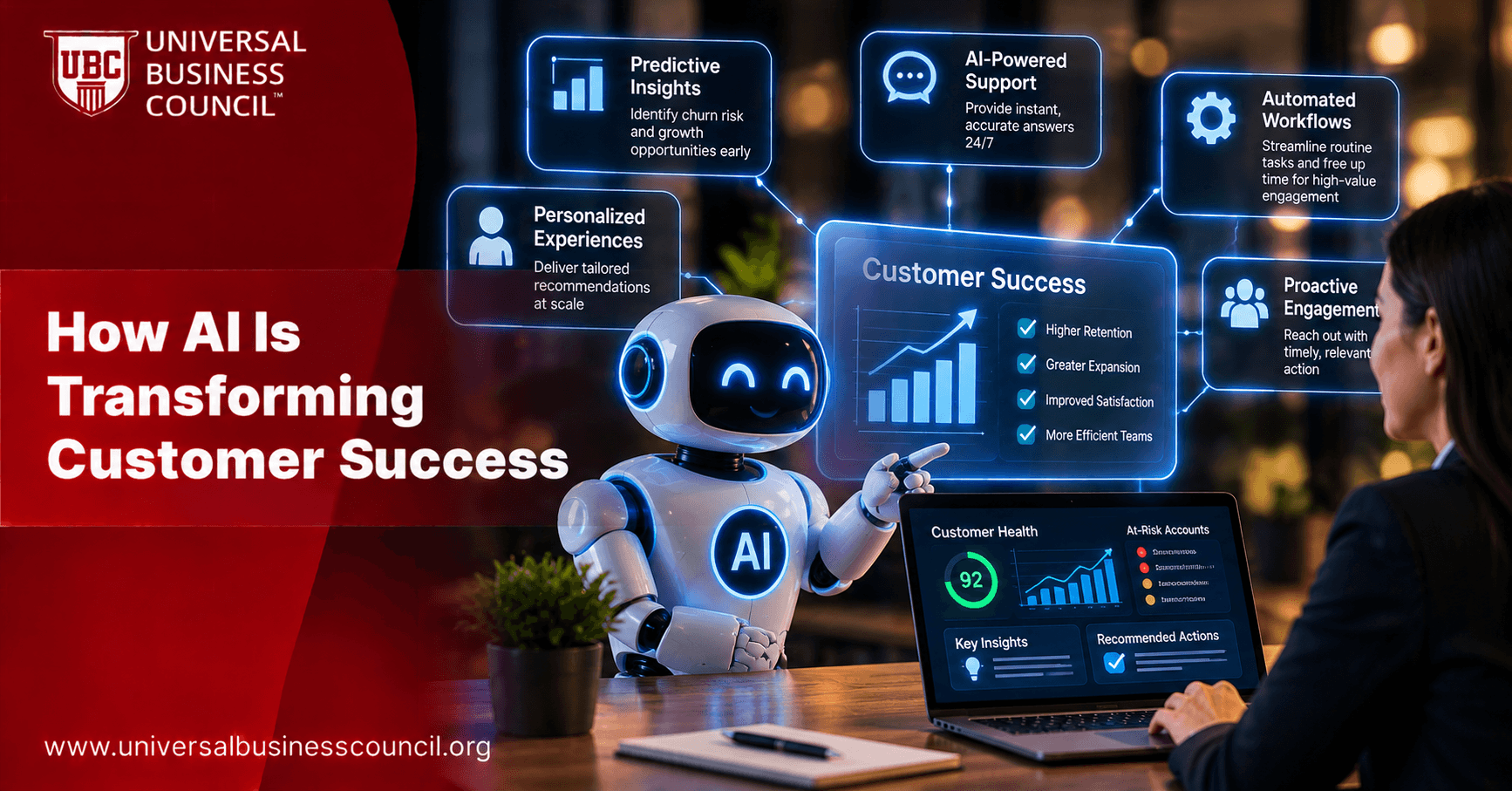
Customer success has always depended on noticing things early: a quiet account, a rising frustration, a missed milestone. AI is changing how quickly and how widely teams can notice them. It is also changing the routine work around those moments, from preparing for calls to summarizing feedback. The shift is real, and so are the responsibilities that come with it.
This guide explains how AI is transforming customer success, where it helps most, where human judgment still matters, and how to use it responsibly. For professionals who want a formal grounding in the discipline AI is now reshaping, the Certified Customer Success Professional certification covers customer health, retention, and lifecycle management.

What Is AI in Customer Success?
AI in customer success means using tools such as machine learning, language models, and automation to support the work of helping customers achieve their goals. These tools can analyze patterns across large amounts of customer data, generate drafts and summaries, and automate repetitive steps.
Why the Timing Matters
Customer success teams often manage many accounts with limited time. AI can help them focus on the customers who need attention most, which is why interest in these tools has grown.
Where AI Is Changing Customer Success
AI touches many parts of the customer success workflow. The areas below are where it is most commonly applied.
Customer Health Scoring and Churn Prediction
Predictive models can combine signals such as usage, support activity, engagement, and sentiment to estimate which accounts may be at risk. This lets teams reach out earlier and with more context. The models are only as good as the data behind them, so results should be checked against real outcomes.
Personalized Engagement
AI can help tailor content, timing, and channel to what each customer does and prefers. Done well, communication feels more relevant and less repetitive. Teams planning this kind of personalized lifecycle messaging can strengthen their approach with a structured Digital Marketing Course.
Support Automation and Self-Service
Chat assistants and smart search can answer common questions quickly and at any hour, which lowers customer effort. They work best when customers can easily reach a person for anything complex or sensitive.
Feedback and Sentiment Analysis
Language tools can group survey comments, support conversations, and call notes by theme and sentiment. This turns large piles of feedback into patterns a team can act on, although human review is still needed for nuance.
Productivity and Preparation
AI can draft call summaries, prepare account briefs, suggest next steps, and update records. These save time that teams can spend directly with customers. Outputs should always be reviewed before they are sent or relied on.
What AI Does Not Replace
Customer success is built on trust, empathy, and judgment. Understanding a customer's goals, navigating a difficult renewal, and rebuilding trust after a problem remain human work. The most effective approach treats AI as support for people, not a substitute for the relationship.
Building a Strong Data Foundation
AI depends on data that is accurate, connected, and well organized. Scattered or outdated records lead to weak predictions and confusing outputs. Teams benefit from understanding CRM systems, integrations, and analytics, and foundational Tech Certifications help customer-facing professionals work confidently with the tools that feed AI.
Using AI Responsibly: Compliance and Governance
Because AI uses customer data and can influence how customers are treated, governance should be part of adoption from the start.
Data privacy: Use only the data needed for a clear purpose, and limit access.
Transparency: Be open about when customers are interacting with automation and how their data is used.
Human oversight: Keep people responsible for important decisions and for reviewing AI outputs.
Fairness: Watch for models that treat customer groups unfairly, and review results regularly.
Accuracy: Check AI-generated content for errors before it reaches customers.
Records: Keep clear records of how AI tools are used and what data they touch.
Understanding the Technology Behind It
Teams that understand how these tools work ask better questions, set better guardrails, and spot problems sooner. Professionals who want to build that understanding can explore Deep Tech Certifications in AI and other emerging areas.
How to Start Using AI in Customer Success
Begin with a specific problem rather than a tool. Pick one use case, such as health scoring or feedback analysis, make sure the data behind it is sound, run a small pilot, and measure results against clear goals. Train the team on what the tool can and cannot do, and expand only when the pilot shows real value.
Measuring the Impact of AI
Track results that matter to customers and the business, such as retention rate, churn rate, customer satisfaction, customer effort, response and resolution times, and team time saved. Compare results before and after adoption, and look at customer segments separately so unintended effects are visible.
Common Mistakes to Avoid
Common mistakes include adopting tools without a clear problem, relying on poor data, removing the human option for customers, trusting outputs without review, ignoring privacy and fairness, and measuring only efficiency instead of customer outcomes.
Conclusion
AI is transforming customer success by helping teams notice risk sooner, personalize engagement, automate routine work, and learn from feedback at scale. The strongest results come from pairing it with sound data, clear governance, and human relationships. Used that way, AI makes customer success more proactive without making it less personal.
Frequently Asked Questions
1. How is AI used in customer success?
For health scoring, churn prediction, personalized engagement, support automation, feedback analysis, and productivity tasks.
2. Will AI replace customer success managers?
AI supports the work, but trust, empathy, and judgment in customer relationships remain human strengths.
3. What is predictive churn modeling?
It uses data patterns to estimate which accounts may be at risk of leaving.
4. How can AI improve customer health scores?
By combining more signals, such as usage, support activity, engagement, and sentiment.
5. Can AI personalize customer communication?
Yes, by tailoring content, timing, and channel to customer behavior and preferences.
6. How do AI chat assistants help customers?
They answer common questions quickly and can reduce customer effort.
7. What is the risk of chatbots?
Customers can get stuck if there is no clear route to a person.
8. Can AI analyze customer feedback?
Yes, it can group comments by theme and sentiment, with human review for nuance.
9. How does AI save time for customer success teams?
By drafting summaries, preparing account briefs, and updating records.
10. Should AI outputs be reviewed?
Yes. People should check AI-generated content before it is sent or relied on.
11. What data does AI need?
Accurate, connected, and well-organized customer data.
12. Why does data quality matter?
Poor data leads to weak predictions and confusing outputs.
13. What are the privacy considerations?
Use only the data needed for a clear purpose, limit access, and be open about how data is used.
14. Why is transparency important?
Customers should know when they are interacting with automation and how their data is used.
15. What is human oversight in AI?
Keeping people responsible for important decisions and for reviewing AI outputs.
16. How can AI become unfair?
Models can reflect gaps or bias in data, so results should be reviewed across customer groups.
17. How should a team start with AI?
Pick a specific problem, check the data, run a small pilot, and measure results.
18. How do you measure AI impact?
Track retention, churn, satisfaction, effort, response times, and time saved, before and after adoption.
19. What are common mistakes with AI in customer success?
Adopting without a clear problem, using poor data, removing human options, and skipping review are common errors.
20. How can professionals build AI and customer success skills?
Structured training in customer success, data tools, digital marketing, and emerging technology, plus hands-on practice, builds these skills.
Related Articles
View All
Business
AI in Customer Success: Use Cases, Benefits and Examples
Discover how AI is being used in customer success to automate routine tasks, predict customer churn, personalize engagement, and improve customer experiences. Explore practical applications, business benefits, and examples of AI-powered customer success.

Business
The Future of Customer Success: AI, Automation and Predictive Analytics
Discover how customer success is evolving and what businesses can expect in the years ahead. Explore emerging trends such as AI-powered engagement, predictive analytics, automation, personalized experiences, and data-driven retention strategies.

Business
Best Customer Success Tools and CRM Platforms
Discover the best customer success tools and CRM platforms for managing customer relationships, tracking engagement, improving onboarding, and reducing churn. Compare key features and learn how to choose the right software for your team's needs.
Trending Articles
The Role of Blockchain in Ethical AI Development
How blockchain technology is being used to promote transparency and accountability in artificial intelligence systems.
AWS Career Roadmap
A step-by-step guide to building a successful career in Amazon Web Services cloud computing.
Top 5 DeFi Platforms
Explore the leading decentralized finance platforms and what makes each one unique in the evolving DeFi landscape.