

How customer success certification can help your career
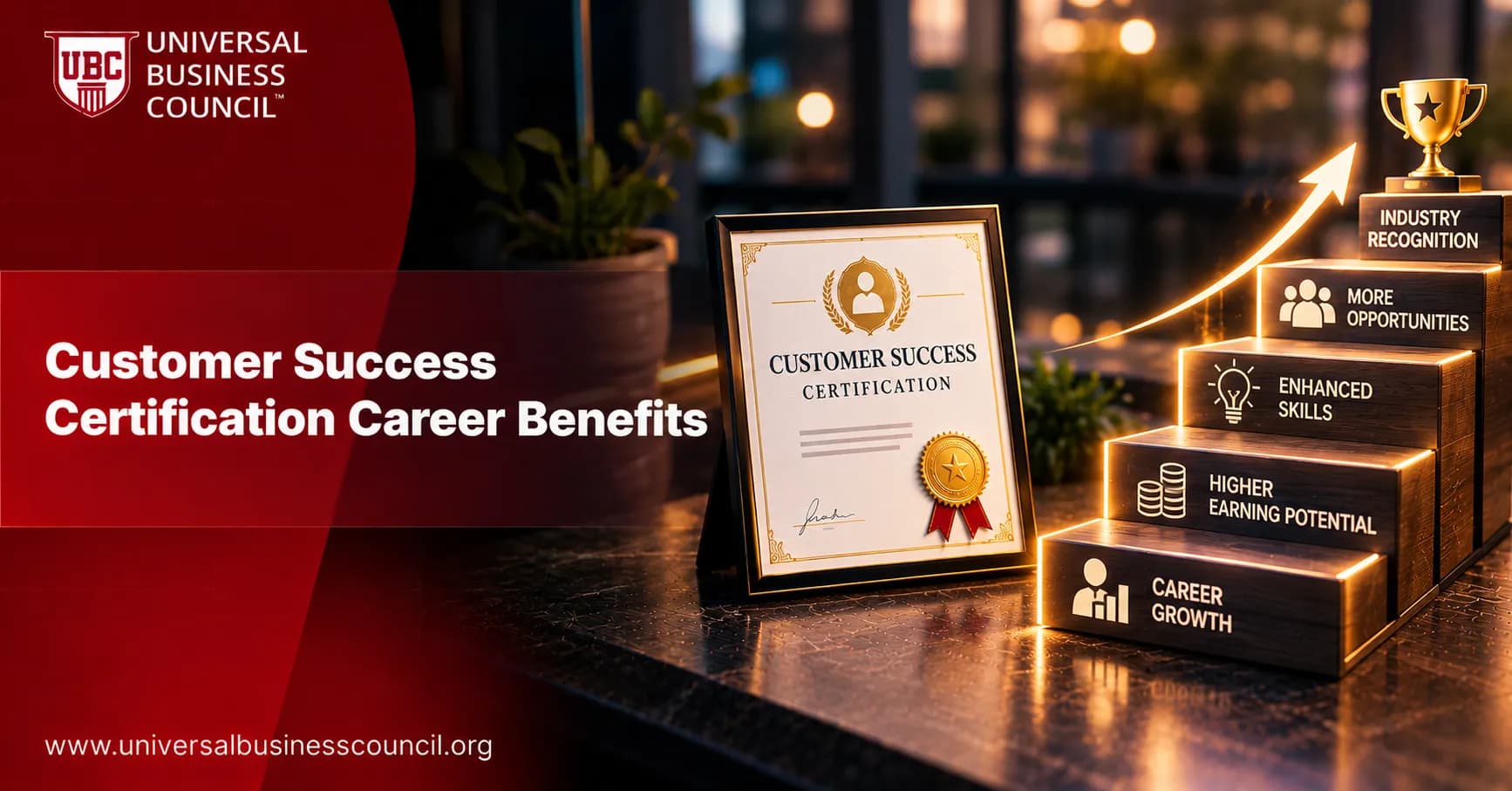
A career in customer success rewards people who can guide customers to results, read the numbers behind an account and keep a relationship steady through renewals. Plenty of people have those instincts. Fewer can show them in a way a hiring manager or a promotion committee recognizes, and that gap is what a certification is meant to fill.
This guide looks at how a customer success certification can help your career at each stage: getting hired, growing in the role and moving into related paths. It also covers what a certification can't do, which skills to pair with it and how to get the most out of it. If you're weighing programs, the Certified Customer Success Professional program from Universal Business Council is one to consider.

What is a customer success certification?
A customer success certification is a structured program, usually with an assessment, that confirms you understand how to help customers reach their goals after the sale. It typically covers the customer lifecycle, onboarding, health scores, churn, renewals, expansion and the metrics that show how accounts are doing.
Programs come from training providers, software vendors and professional bodies, so scope and price differ. None of them is a license, and none is a legal requirement. They are signals: evidence that you've studied the discipline and, if the program includes practice work, that you've applied it. Understanding that distinction helps you judge what a certification can do for you.
How a customer success certification can help your career
The value shows up differently at different points in a career, so it helps to take them in turn.
Getting hired
Most companies don't require formal certification for a CSM role, but a credential can help you stand out and show commitment to the field. That matters most when your resume doesn't yet say "customer success." If you're coming from support, sales or marketing, a certification gives a hiring manager a clear reason to read your experience through a customer success lens.
It also gives you vocabulary: lifecycle, health score, time to value, net revenue retention. Using those terms correctly in an interview signals that you've done the work and can follow a conversation with a senior team member from day one.
Growing once you're in
Early on, a certification can shorten the learning curve. Instead of picking up playbooks one at a time from whoever sits near you, you get the whole framework in order. That counts when you're asked to do more. One career guide notes that mid-level CSM roles increasingly require demonstrated experience with health scoring models, renewal forecasting and cross-functional project management, and a program that makes you practice those gives you something concrete to point to.
It also helps you describe your work in terms leadership cares about, such as retention and expansion, instead of calls made and tickets closed.
Moving sideways or up
Customer success connects to other careers. A CSM may step into account management, product sales or marketing, product management or an enterprise success role. A certification doesn't make those moves automatic, but a shared base of knowledge about customers, metrics and cross-team work gives you something to build on.
Career paths a certification can open
Here's how a certification can support some common roles:
Role | What you do | How a certification helps |
Customer success associate | Handle smaller accounts under a senior CSM | Shows you understand the lifecycle before you have much experience |
Customer success manager | Own a portfolio of accounts from onboarding to renewal | Gives you a framework for playbooks, health scores and reviews |
Onboarding specialist | Take new customers to their first result | Teaches onboarding design and handoffs |
Renewals manager | Prepare and run renewal conversations | Covers forecasting and plans for at-risk accounts |
Senior or enterprise CSM | Manage larger, more strategic accounts | Backs up your step up with structured knowledge of metrics and reviews |
Titles and duties vary by company, so treat the table as a guide and read each job description closely.
What a certification won't do
A certification isn't a shortcut. Many CSM postings ask for two to three years of relevant experience, so a credential alone rarely replaces time spent with customers. It won't fix weak communication, and it won't impress anyone if you can't explain what you learned. Employers notice the difference between holding a credential and using the skills.
Think of it as a boost to your story, which still needs real examples behind it: an account you onboarded, a renewal you saved, a health score you built and tested.
Skills to pair with your certification
A certification does more when it sits next to other strengths. Data comfort is the first. Success teams work from CRMs, usage data and support records, and the Tech Certifications from Global Tech Council cover the programming and data skills that help you work with them.
Marketing skills are the second. Happy customers give referrals, reviews and case studies, and turning them into content takes planning. A Digital Marketing Course pairs well with success work, especially if you're aiming at customer marketing or advocacy roles.
Awareness of emerging technology is the third. Customer success roles exist at companies of every kind, including fintech and blockchain firms where teaching customers is part of the job, and the Deep Tech Certifications from Blockchain Council can help you speak that language.
How to get the most from your certification
The certificate is the start of the benefit, not the end. A few habits turn it into career progress:
Apply what you learn on real or sample accounts as you go
Build a small portfolio, such as an onboarding plan, a health score model and a business review
Add specific projects and skills to your resume and professional profiles, not only the credential name
Talk to people in the roles you want and ask what they'd like to see
Keep learning, since tools, metrics and customer expectations keep changing
Choose the program with care. Look for a syllabus that covers the lifecycle, data, communication, commercial and tool skills, practice work that makes you apply them and an assessment that tests application instead of memory. Check eligibility, cost and renewal terms as well.
Conclusion
How a customer success certification can help your career comes down to three things. It gives you a clear signal when you're trying to get hired, a structured framework as you grow in the role and a shared base of knowledge if you move into account management, product or marketing paths. It doesn't replace experience, and it works best when you pair it with data comfort, marketing skills and real examples of customers you've helped. Choose a program that makes you practice, build proof of your work and keep learning, and the certification becomes part of a career story people want to hear.
Frequently asked questions
How can a customer success certification help my career?
It shows commitment, gives you a structured framework and helps you talk about your work in terms employers value.
Will it help me get hired?
It can help you stand out, especially if you're switching from support, sales or marketing.
Do employers require a certification?
Most don't require one for CSM roles, though it can help you stand out.
Will it help me get promoted?
It can support a case for more responsibility, especially if you can show the skills in real accounts.
Can it help me switch careers?
Yes. It gives you the vocabulary and framework to present past experience in a customer success light.
Will it raise my salary?
It can support a case for a better role or raise, but pay depends on role, company and results.
Is it worth it for beginners?
It can be, since it gives structure and a signal when you have little direct experience.
Is it worth it for experienced CSMs?
It can help if you want to fill gaps, formalize your methods or move into a more senior role.
What jobs can it lead to?
Customer success associate, CSM, onboarding specialist, renewals manager and senior or enterprise roles.
Can it help me move into account management?
It can help. CSMs often move into account management, and shared knowledge of customers and metrics carries over.
Does it replace experience?
No. Many postings still ask for two to three years of relevant experience.
How should I list it on my resume?
List the credential, then add the projects and skills you built while earning it.
What should I put in a portfolio?
An onboarding plan, a health score model and a mock business review work well.
Does it help in interviews?
Yes. It gives you accurate vocabulary and examples to talk through.
Does it help me talk to leadership?
It helps you frame your work around retention, expansion and results instead of activity counts.
Which skills should I pair with it?
Data and tool skills, marketing for advocacy, and awareness of emerging technology.
Is a vendor or independent certification better?
Vendor certifications suit platform users, while independent programs suit a broader start.
Does a certification expire?
Some do. Check each program's renewal terms before enrolling.
How do I make the most of it?
Apply it to real accounts, build a portfolio and keep learning after you finish.
Where can I start?
A structured program such as the Certified Customer Success Professional covers the lifecycle and key metrics.
Related Articles
View All
Business
Customer success certification vs customer experience certification: which one fits your career?
A customer success certification can help beginners understand customer onboarding, product adoption, retention, and relationship management. Learn how to choose the right program, develop practical skills, and prepare for entry-level customer success roles.
Business
Do you need a certification to become a customer success manager? An honest answer
Do you need a certification to become a customer success manager? This guide explains what employers look for, how certifications can support your career, which practical skills matter most, and when earning a credential is worth considering.
Business
What skills do you learn in a customer success certification? A practical breakdown
Customer success certifications help professionals develop skills in communication, relationship management, customer onboarding, data analysis, and retention. Learn which competencies matter most, how certification programs help build them, and how to apply these skills in your career.
Trending Articles
The Role of Blockchain in Ethical AI Development
How blockchain technology is being used to promote transparency and accountability in artificial intelligence systems.
AWS Career Roadmap
A step-by-step guide to building a successful career in Amazon Web Services cloud computing.
Top 5 DeFi Platforms
Explore the leading decentralized finance platforms and what makes each one unique in the evolving DeFi landscape.