

What skills do you learn in a customer success certification? A practical breakdown
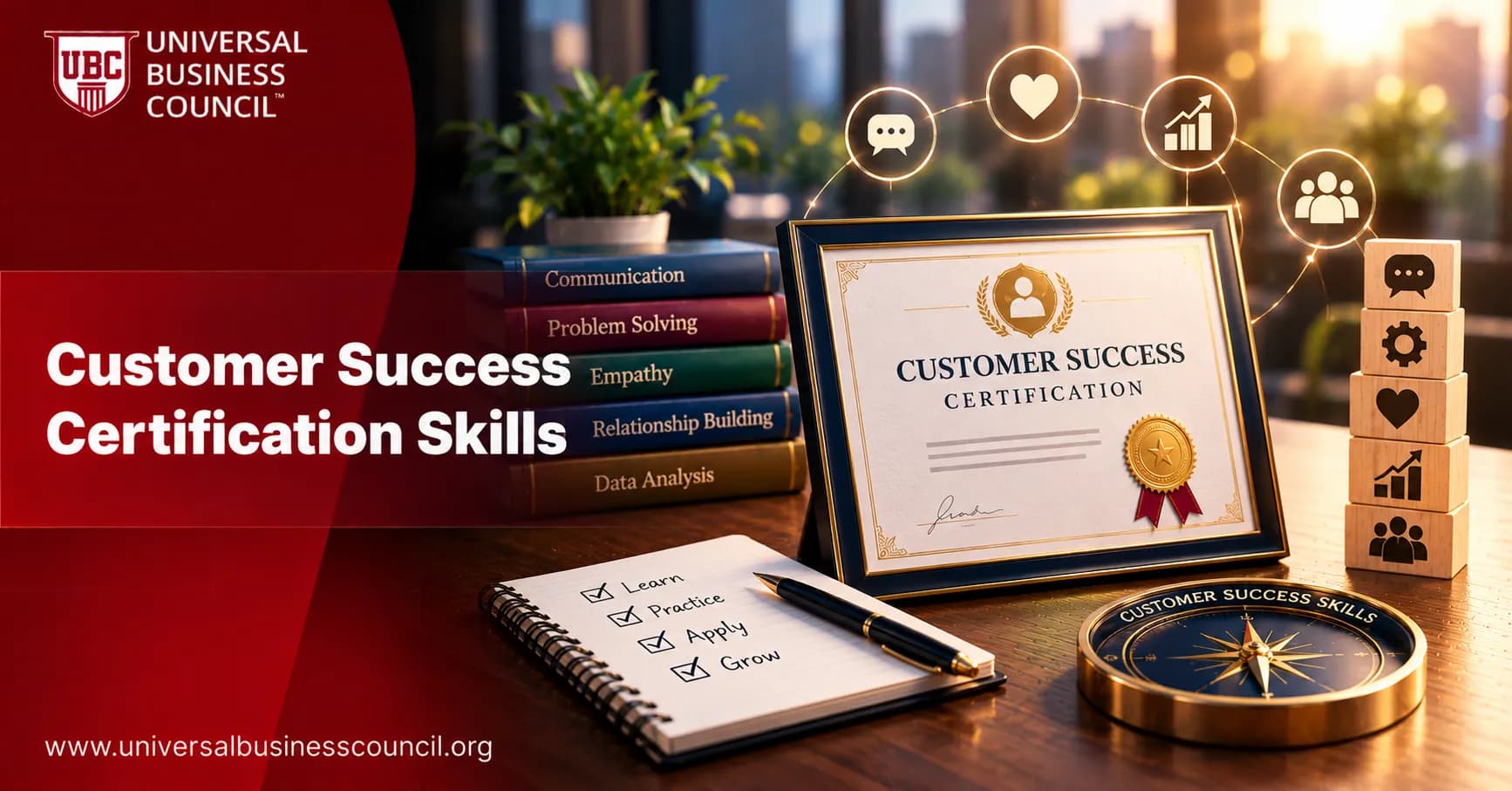
Short answer: you learn how to keep customers getting value after the sale. That breaks into five groups of skills: lifecycle management, communication, data and measurement, commercial awareness and tool fluency. A good customer success certification teaches all five in a form you can use on real accounts the following week.
This guide goes through each group, shows how it appears in daily work and explains how to check whether a program teaches it properly. If you want a structured place to build these skills, the Certified Customer Success Professional program from Universal Business Council is aimed at exactly this discipline.

What is a customer success certification?
A customer success certification is a structured course, usually with an assessment, that confirms you understand how to help customers reach their goals after buying a product or service. It sits between a short online class and a degree: more organized than self-study, quicker than formal education, and focused on one family of jobs.
Four kinds of learner tend to sign up. People new to the field want a way in. Support staff want to move from reacting to problems to preventing them. Account managers want to add retention and adoption to their commercial skills, and founders of small subscription companies want a method before they hire a team. Programs come from training providers, software vendors and professional bodies, so depth and price vary widely, and the syllabus is the thing to read.
The core skills a customer success certification builds
Lifecycle and onboarding skills
The backbone of any program is the customer lifecycle. You learn how to take a new customer from signed contract to a first real result, how to spread use across the customer's team, and how to prepare for renewal long before the date. Most programs teach this through playbooks, which are repeatable plans for situations you'll see again and again.
Typical playbooks include:
A welcome and kickoff plan for new accounts
An adoption plan for customers using only a few features
A recovery plan for accounts with falling usage
A renewal plan that starts months before the contract ends
The skill underneath is planning backwards from the outcome the customer wants, not forwards from the features you sell.
Communication and relationship skills
Customer success is a conversation job. You learn to run discovery calls that find out what a customer is really trying to achieve, to write clear follow-ups, and to deliver bad news without losing trust. Good programs practice this with role-plays, since reading about a difficult call doesn't prepare you for one.
You also learn to work with several people at the same customer: the daily user, the manager who signs the invoice and the executive who decides on renewal. Each cares about different things, and a success manager who talks to only one of them leaves the account exposed when that person moves on.
Data and measurement skills
Data turns a hunch into a plan. You learn how to build a customer health score, a weighted blend of signals such as usage, support history, survey scores and sentiment, and how to test it against real renewals instead of trusting it blindly.
You also learn the retention measures. Gross revenue retention shows how much recurring revenue you kept without counting expansion, so it can't exceed 100%, while net revenue retention includes expansion and can. Add churn, Net Promoter Score and Customer Satisfaction Score, and you can read a portfolio of accounts from several angles. The key skill is knowing which number answers which question.
Commercial and strategic skills
Retention is a commercial outcome, so a solid certification also covers the money side. You learn to prepare renewals, spot expansion opportunities without pushy selling, and run business reviews that put results in numbers a customer's leadership understands. Many people find this the most useful part, because it changes how they describe their own work, from "I help customers" to "I protect and grow recurring revenue."
Customer advocacy belongs here too. Happy customers give referrals, reviews and case studies, and turning that goodwill into marketing material takes planning. People who want to go deeper on that side can pick up the channel skills in a Digital Marketing Course.
Technical and tool skills
Success teams work inside a stack: a CRM, a support system, product usage data and often a dedicated customer success platform. A certification should teach you how those tools fit together and what to do when they disagree. Even a basic grasp of data fields, integrations and simple queries makes you faster. The Tech Certifications from Global Tech Council cover the programming and data skills that sit behind that kind of work.
AI tools are now part of the toolkit as well. You learn to use them to summarize account histories, flag declining usage and draft check-in emails, while keeping human judgment over tone and decisions. Looking further out, some companies are exploring shared ledgers for tamper-evident records like warranty status and proof of purchase, and the Deep Tech Certifications from Blockchain Council are a starting point for understanding how those records work.
How these skills show up in real jobs
Skills only matter if they change the work. Here's how each group appears in a typical week:
Skill group | What it looks like on the job |
Lifecycle | Running a kickoff call and tracking a customer to first value |
Communication | Leading a renewal conversation or handling an escalation |
Data | Reading a health score and deciding which accounts to call first |
Commercial | Preparing a business review that shows results in numbers |
Tools | Pulling usage data into a CRM view before a check-in |
These skills carry across roles such as customer success manager, onboarding specialist and renewals manager, and they transfer into account management, operations and customer experience work as well.
How to choose a program that teaches these skills
Not every program covers all five groups equally. Before you pay, check the syllabus against the skills above, and look for signs that the course makes you apply what it teaches.
A syllabus that covers lifecycle, communication, data, commercial and tool skills
Case studies or exercises built on realistic account scenarios
Worked examples of health scores and retention measures
An assessment that tests application, not only memory
Clear information on eligibility, cost, format and renewal terms
Ask what past learners did afterward, and whether employers in your market know the program. A short, well-built course with plenty of practice beats a long one that only lectures.
Conclusion
The skills you learn in a customer success certification fall into five groups: lifecycle management, communication, data and measurement, commercial awareness and tool fluency. Each one shows up in real weekly work, from kickoff calls to renewals to health score reviews. Choose a program whose syllabus covers all five, practice what you learn on real accounts, and the certification becomes more than a line on a resume.
Frequently asked questions
What skills do you learn in a customer success certification?
Lifecycle management, communication, data and measurement, commercial awareness and tool skills.
Is a customer success certification worth it?
It gives structure and credibility, though hiring managers still look at real results and experience.
Who should take a customer success certification?
Newcomers, support staff, account managers and founders of subscription businesses.
Do I need experience first?
It depends on the program. Many accept beginners, but check each one's eligibility rules.
How long does a certification take?
It varies by program, so check the total duration and weekly effort before enrolling.
What is customer onboarding?
It's the stage that takes a new customer from signed contract to their first real result.
What is a customer success playbook?
It's a repeatable plan for a common situation, such as welcoming a new account or recovering one with falling usage.
What is a customer health score?
It's a weighted blend of usage, support history, survey scores and sentiment that signals retention risk.
What is gross revenue retention?
It's the share of recurring revenue kept from existing customers without counting expansion, so it can't exceed 100%.
What is net revenue retention?
It's the same measure including upgrades and cross-sells, so it can go above 100%.
Do I learn how to sell?
You learn renewals and expansion conversations, not hard selling.
Do I learn CRM and other tools?
Good programs cover how CRMs, support systems and usage data fit together.
Is coding required?
Usually not, but comfort with data and basic queries makes you faster.
Will I learn to handle upset customers?
Yes, through communication practice and escalation scenarios.
Do certifications teach AI use?
Many now cover AI for summarizing accounts, flagging usage drops and drafting messages.
What jobs can I get afterward?
Roles include customer success manager, onboarding specialist and renewals manager.
Can it help me move from support into success?
Yes. It teaches proactive habits that support work doesn't always cover.
Does it help in account management?
Yes. Retention, adoption and business review skills carry straight across.
How do I know a program is good?
Check the syllabus, the practice exercises, the assessment and what past learners did next.
How do I keep practicing after finishing?
Apply the playbooks to real or sample accounts, track a few metrics and ask for feedback.
Related Articles
View All
Business
How customer success certification can help your career
A customer success certification can help you build relevant skills, demonstrate your knowledge, and prepare for new career opportunities. Explore how certification supports professional development, strengthens your resume, and helps you progress from entry-level roles to customer success leadership.
Business
Customer success training: what should you learn?
Customer success training helps professionals develop the skills needed to guide customers, improve product adoption, and build long-term relationships. Learn what to study, which tools to understand, and how to apply these skills in real customer success roles.
Business
Do you need a certification to become a customer success manager? An honest answer
Do you need a certification to become a customer success manager? This guide explains what employers look for, how certifications can support your career, which practical skills matter most, and when earning a credential is worth considering.
Trending Articles
The Role of Blockchain in Ethical AI Development
How blockchain technology is being used to promote transparency and accountability in artificial intelligence systems.
AWS Career Roadmap
A step-by-step guide to building a successful career in Amazon Web Services cloud computing.
Top 5 DeFi Platforms
Explore the leading decentralized finance platforms and what makes each one unique in the evolving DeFi landscape.