

Customer success certification vs customer experience certification: which one fits your career?
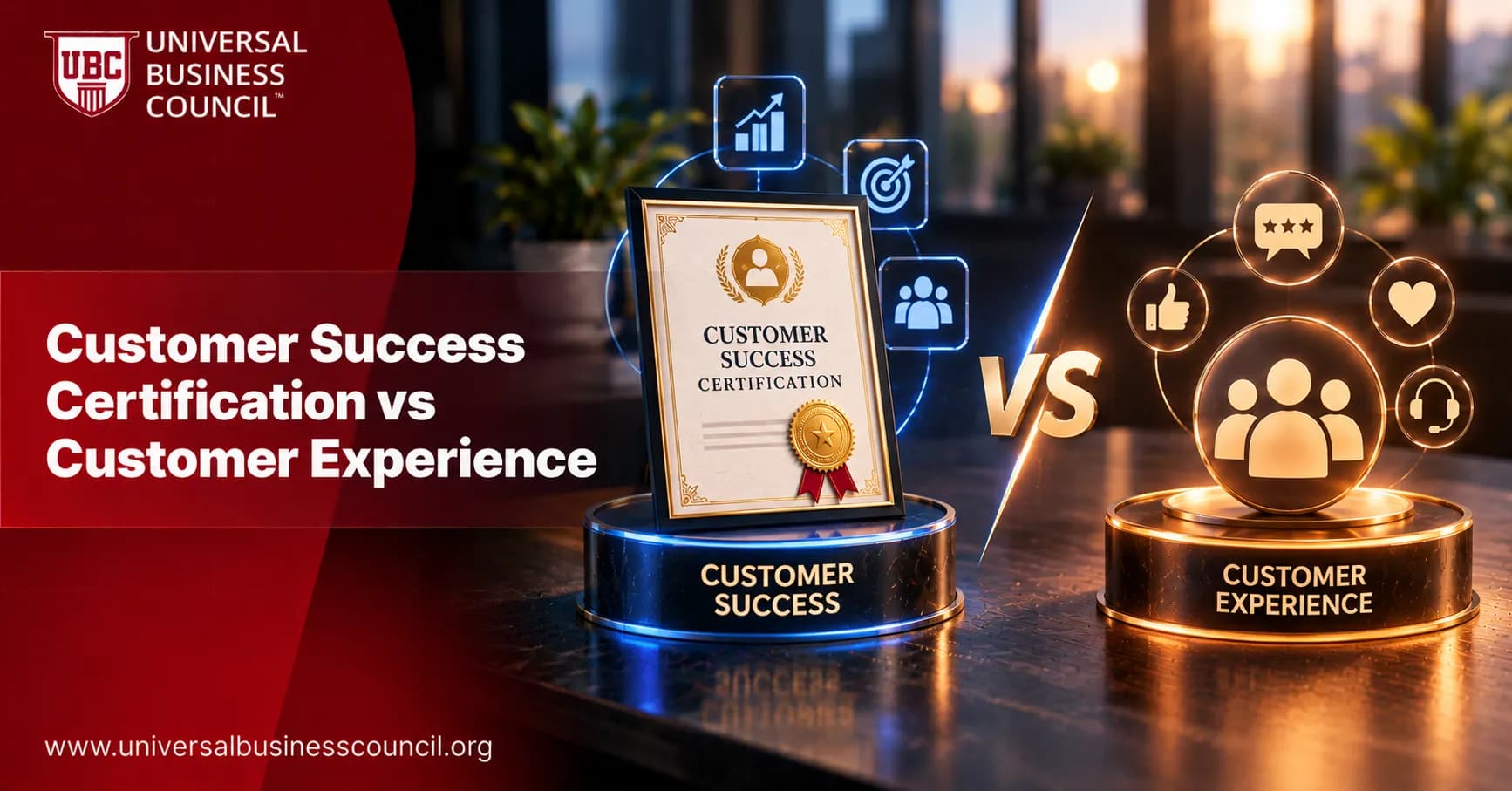
Two certifications with almost identical names can point toward very different jobs. A customer success certification prepares you to guide individual accounts toward results and renewals, while a customer experience certification prepares you to design and measure how people feel about a company at every touchpoint. Choosing between them starts with knowing which problem you want to spend your days on.
This guide compares the two side by side: what each covers, who each suits and how to pick. If you want a hands-on route into account-level work, the Certified Customer Success Professional program from Universal Business Council is built around that discipline.

What are a customer success certification and a customer experience certification?
A customer success certification confirms that you know how to help customers reach their goals after the sale. Typical topics include onboarding, adoption, health scoring, renewals, expansion and the playbooks that tie them together. Many programs come from training providers and software vendors, and they differ in depth, price and how much they ask you to prove, so read the syllabus before you commit.
A customer experience certification confirms that you understand the whole journey a customer has with a company, from first awareness through support and renewal. The best-known example is the Certified Customer Experience Professional (CCXP) from the Customer Experience Professionals Association, a non-profit body. It's gated by experience: the exam is open to people with a post-secondary degree and three years of full-time CX work, with an alternate route of a high school diploma and five years of work that includes three years in CX. The exam has 100 questions spread across five competency areas.
Customer success vs customer experience: the core difference
Customer success works at account level. It starts at or after the sale and asks whether each customer is getting value and is likely to renew. Customer experience works at journey level. It covers every interaction, before and after the purchase, and asks whether the whole experience is easy, consistent and worth coming back to. One looks closely at accounts, the other looks widely at journeys.
They share a lot of ground. Both care about retention, both listen to customer feedback and both depend on cooperation across teams. A success manager who sees the same onboarding complaint across ten accounts is gathering the evidence a CX team needs to redesign the process, and a CX redesign only works if success teams change how they deliver it.
Customer success | Customer experience | |
Scope | Individual accounts | The full customer journey |
Timing | Mostly after the sale | Before, during and after the sale |
Main goal | Retention, adoption, expansion | Easy, consistent, satisfying interactions |
Typical work | Onboarding, health scores, renewals | Journey mapping, feedback programs, service design |
Common roles | Success manager, onboarding lead | CX analyst, journey designer, voice of customer lead |
Marketing sits in the overlap as well. What a brand promises shapes what customers expect, and journey mapping depends on knowing how people found you. If you want that side of the picture, you can learn it in a Digital Marketing Course.
What each certification covers
Customer success certification topics
Expect lifecycle management from onboarding to renewal, building and testing health scores, running business reviews, handling at-risk accounts and measuring retention through gross and net revenue retention. The emphasis is on practical routines you can use with a real portfolio of accounts from the first week.
Customer experience certification topics
The CCXP organizes its content into five areas:
Customer insights and understanding
Customer experience strategy
Metrics, measurement and ROI
Design, implementation and innovation
Culture and accountability
Notice how much of that is strategy and organization-wide work. A holder is often expected to influence teams they don't manage, which is part of why the exam asks for work experience.
Skills and tools that help on either path
Neither path is only soft skills. Both rely on data from CRMs, support platforms, surveys and product analytics, and people who can connect those sources move faster than those who wait for reports. Programming and data skills are a quiet advantage, and the Tech Certifications from Global Tech Council cover that technical groundwork.
AI tools are also changing day-to-day work. They can summarize feedback, flag declining usage and draft follow-ups, which leaves more time for the conversations that need judgment. Looking further out, some companies are exploring shared ledgers for tamper-evident records such as warranty status or loyalty points, and the Deep Tech Certifications from Blockchain Council are a starting point for understanding how those records work.
Which one should you choose?
Start with the work you want to do. If you like owning relationships, solving customer problems and watching numbers like renewals and net revenue retention move, a customer success certification is the closer fit. If you like looking across the whole journey, spotting friction and persuading teams to fix it, a customer experience certification suits you better.
Your stage matters too. The CCXP is aimed at experienced CX professionals, and the association describes the path as typically taking three to six months from application to exam, with roughly 40 to 60 hours of preparation. That makes it a strong later-career credential. A customer success certification may be easier to start with if you're new to the field, depending on the eligibility rules of the program you choose.
A quick way to decide:
Choose customer success if you want account ownership and revenue-linked goals
Choose customer experience if you want to design journeys and influence strategy
Start with customer success if you're early in your career and want practical routines
Plan on both if you're aiming for a leadership role that spans the lifecycle
Neither choice locks you in. Many professionals move between the two, and the overlap in metrics, research and cross-team work means the first certification still pays off in the second.
Conclusion
Customer success certification vs customer experience certification isn't a contest. One trains you to guide accounts toward results and renewals, and the other trains you to design and measure the whole journey. The first is more hands-on and account-focused, while the second is broader and strategic, and it asks for more experience up front. Pick the one that matches the work you want now, check each program's syllabus and eligibility rules, and add the other as your career widens.
Frequently asked questions
What is a customer success certification?
It's a credential showing you know how to guide customers to their goals after the sale, from onboarding to renewal.
What is a customer experience certification?
It's a credential showing you understand the full customer journey and how to design, measure and improve it.
What is the CCXP?
The Certified Customer Experience Professional is a credential offered by the Customer Experience Professionals Association.
Who runs the CCXP?
The CXPA, a non-profit, independent association for customer experience professionals.
What are the CCXP eligibility requirements?
A post-secondary degree and three years of full-time CX work, or a high school diploma and five years including three in CX.
How long is the CCXP exam?
It has 100 questions, spread across five competency areas.
What does the CCXP cover?
Customer insights, experience strategy, metrics and ROI, design and innovation, and culture and accountability.
How long does the CCXP path take?
The association says it typically takes three to six months from application to exam.
How is customer success different from customer experience?
Success works at account level after the sale. Experience works across the whole journey, before and after.
Which certification is better for beginners?
A customer success certification is often easier to start with, but check each program's eligibility rules.
Which one pays more?
Pay depends on role, region and company, so compare current job listings instead of relying on one answer.
Can I get both certifications?
Yes. The overlap in metrics, research and cross-team work makes the second easier after the first.
Do I need a degree?
It depends on the program. The CCXP asks for either a degree or extra years of work experience.
What jobs follow a customer success certification?
Common roles include customer success manager, onboarding specialist and renewals manager.
What jobs follow a customer experience certification?
Common roles include CX analyst, journey designer and voice of customer lead.
Do these certifications expire?
Many do, so check each program's renewal terms before you sign up.
How do I choose a program?
Compare the syllabus, eligibility rules, cost, exam format and how widely employers recognize it.
Do employers care about certifications?
They help show knowledge, but hiring managers also look for real results and relevant experience.
What skills help with both paths?
Data comfort, clear communication, research skills and the ability to work across teams.
Where can I start learning customer success?
A structured program such as the Certified Customer Success Professional covers the lifecycle and core metrics.
Related Articles
View All
Business
How customer success certification can help your career
A customer success certification can help you build relevant skills, demonstrate your knowledge, and prepare for new career opportunities. Explore how certification supports professional development, strengthens your resume, and helps you progress from entry-level roles to customer success leadership.
Business
Do you need a certification to become a customer success manager? An honest answer
Do you need a certification to become a customer success manager? This guide explains what employers look for, how certifications can support your career, which practical skills matter most, and when earning a credential is worth considering.
Business
What skills do you learn in a customer success certification? A practical breakdown
Customer success certifications help professionals develop skills in communication, relationship management, customer onboarding, data analysis, and retention. Learn which competencies matter most, how certification programs help build them, and how to apply these skills in your career.
Trending Articles
The Role of Blockchain in Ethical AI Development
How blockchain technology is being used to promote transparency and accountability in artificial intelligence systems.
AWS Career Roadmap
A step-by-step guide to building a successful career in Amazon Web Services cloud computing.
Top 5 DeFi Platforms
Explore the leading decentralized finance platforms and what makes each one unique in the evolving DeFi landscape.