

Customer success training: what should you learn?
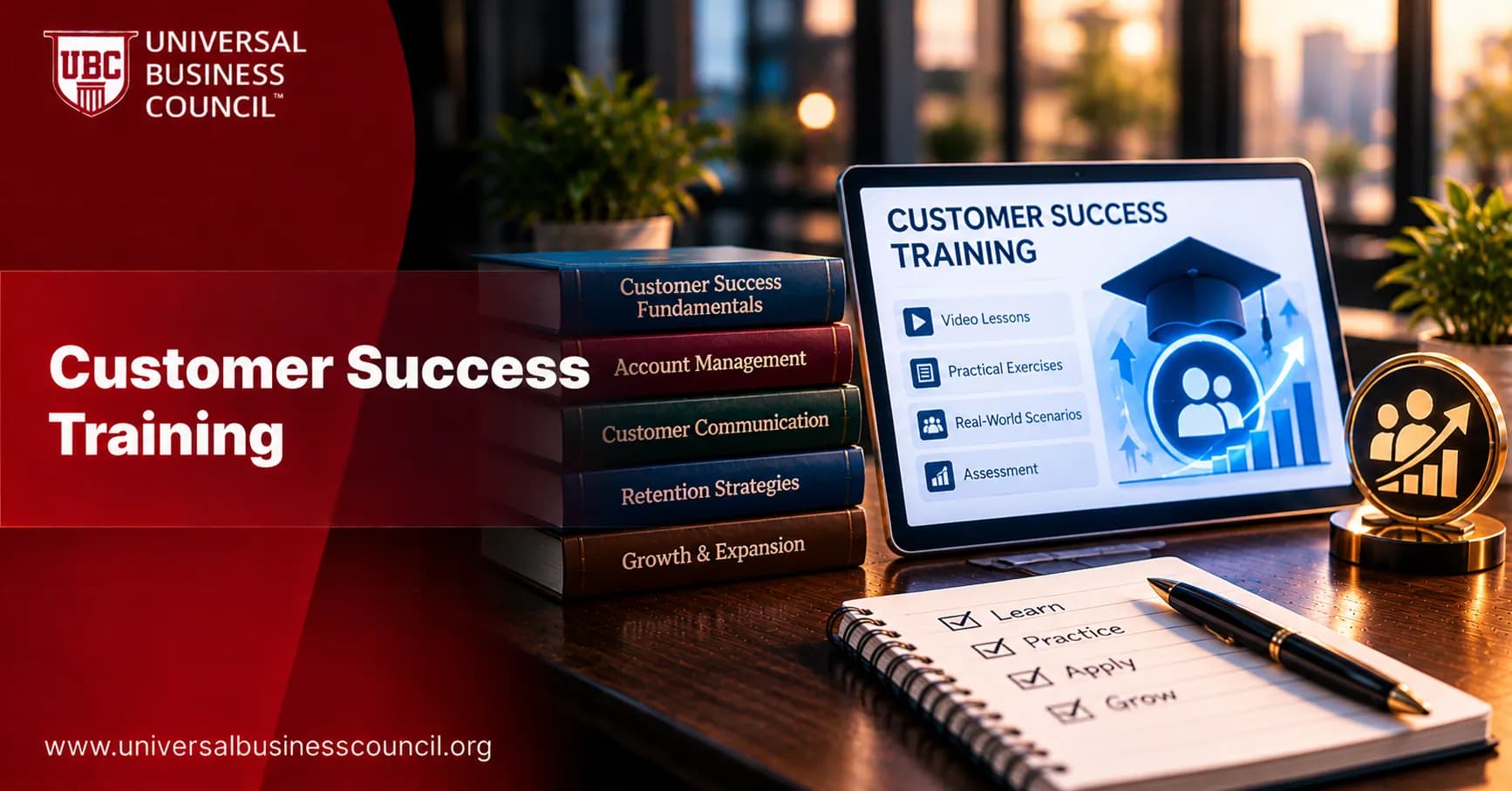
Search for customer success training and you'll find free guides, software vendor academies, short paid courses and full certification programs, all promising to cover what you need. The options are easy to find and hard to compare, especially when you're new and don't yet know which topics matter most.
This guide sorts them out. It covers what customer success training is, the core topics worth your time, the soft and technical skills that sit around them and a simple plan for putting it all to use. If you're comparing structured programs, the Certified Customer Success Professional program from Universal Business Council is one to put on your list.

What is customer success training?
Customer success training is any structured learning that prepares you to help customers reach their goals after the sale, so they stay, adopt the product and grow with it. It ranges from self-paced online courses and vendor academies to workshops and full certification programs, and it can be built for individuals or for whole teams.
Different people come to it for different reasons. New managers need the basics of the lifecycle. Support staff want to move from reacting to problems to preventing them. Salespeople and account managers want retention and adoption skills, and founders of small subscription companies want a method before they hire. Companies also train their own staff and partners, often by turning the lifecycle into role-based curricula, guided playbooks and hands-on practice.
The core topics every customer success training should cover
Whatever the format, a solid course teaches the same spine. Curricula from course providers tend to move through foundations, onboarding, health scoring, churn and renewals, and expansion, which mirrors how an account lives. Use this list to test any syllabus:
Foundations: what customer success is and how it differs from support and account management
The customer lifecycle from onboarding through renewal and expansion
Onboarding and time to value
Health scores, risk and churn
Renewals, expansion and business reviews
Metrics such as gross and net revenue retention, NPS and customer effort
Good training also ties each skill to a measurable result. One enterprise training guide maps skills to KPIs such as time to first value, adoption, NPS and gross and net revenue retention. That's a useful habit: learn the skill and the number it should move.
Onboarding and time to value
Onboarding is where many accounts are won or lost, so good training spends real time on it. You learn to design checklists for different customer segments, build repeatable playbooks, manage the handoff from sales and coordinate stakeholders across a customer's departments. The aim is a shorter path to the first result the customer cares about.
Health scores, risk and churn
A health score blends signals like usage, support history, survey results and sentiment into one view of how an account is doing. Training should teach you how to build one and also how to test it, and some curricula include validating a score against historical churn data so it stays honest. A score that never triggers an action is of little use, so learn to attach a response to each band, such as a check-in within a week when an account slips from green to yellow.
Churn training should separate avoidable churn from inevitable churn and teach you to read patterns in past losses. Metrics round it out. Gross revenue retention shows what you kept without counting expansion, so it can't exceed 100%, while net revenue retention includes expansion and can.
Renewals, expansion and business reviews
Renewal training starts months before the contract date: forecasting, building plans for at-risk accounts and preparing the conversation. Expansion training teaches you to spot genuine opportunities without pushy selling. Business reviews, the regular meetings where you show a customer their results, tie it together, and a good course gives you a template and a chance to practice running one.
The soft skills that training should build
The topics above can be taught from slides. Soft skills need practice. Discovery calls that find out what a customer is really trying to achieve, clear written follow-ups, calm handling of escalations and the ability to deliver bad news without losing trust all come from repetition and feedback, so look for role-plays, call reviews or case work.
You'll also work with several people at one customer: daily users, the manager who signs the invoice and the executive who decides on renewal. Each needs a different conversation, and training that covers stakeholder mapping saves you from relying on one champion who may leave.
Data, tools and technology
Customer success work happens inside a stack: a CRM, a support system, product usage data and often a dedicated success platform. Training should show how they connect and what to do when the data disagrees. Basic comfort with fields, integrations and simple queries makes you faster, and the Tech Certifications from Global Tech Council cover the programming and data skills behind that work.
AI is becoming a routine tool for summarizing account histories, flagging falling usage and drafting check-ins, with people keeping the judgment. Some companies are also exploring shared ledgers for tamper-evident records such as warranty status and proof of purchase, and the Deep Tech Certifications from Blockchain Council are a starting point for understanding how those records work.
Working with sales, marketing and product
Customer success doesn't run alone. Good training covers how sales and success hand off accounts, so promises made in the deal match what's delivered, and how success passes patterns from customer feedback to product teams. One course curriculum even includes lessons on how success and marketing connect and how sales and success align.
The marketing link is worth learning. Happy customers give referrals, reviews and case studies, and turning that goodwill into content takes planning. If you want to build the channel skills, a Digital Marketing Course is a good complement.
How to choose training and build a learning plan
Pick training by what it makes you do, not only by what it lists. Check that the syllabus covers the core topics above, that it includes practice such as account plans, health score exercises and role-plays, that the assessment tests application and that cost, time and format fit your life. Some courses are short, with one listing 12 to 18 hours for its core curriculum, while others run longer, so match the depth to your goal.
Then put it on a calendar. This three-month plan works for most beginners:
Month | Focus | Practice task |
1 | Foundations, lifecycle and onboarding | Draft an onboarding plan for a fictional customer |
2 | Health scores, metrics and churn | Build a simple health score and test it on past accounts |
3 | Renewals, expansion and business reviews | Prepare a mock business review with results in numbers |
Finish with something you can show, such as the plan, the score model or the mock review. Hiring managers and customers respond to proof of use more than to a certificate alone.
Conclusion
Customer success training: what should you learn? Start with the lifecycle, onboarding and time to value, then health scores, churn and renewals, then expansion and business reviews, and attach a metric to each one. Add the soft skills that only practice builds, enough data and tool comfort to work with real account information, and a working relationship with sales, marketing and product. Choose a program that makes you apply what it teaches, follow a simple plan and finish with work you can show. That combination matters more than the length of any syllabus.
Frequently asked questions
What is customer success training?
It's structured learning that prepares you to help customers reach their goals after the sale.
What should I learn first?
Start with the customer lifecycle and onboarding, since everything else builds on them.
What topics should a course cover?
Foundations, onboarding, health scores, churn, renewals, expansion, business reviews and key metrics.
How long does customer success training take?
It varies. One course lists 12 to 18 hours for its core curriculum, and others run longer.
Is customer success training free?
Some is free and much is paid, so compare syllabus and practice work before deciding.
Who needs customer success training?
New managers, support staff, account managers, salespeople and founders of subscription businesses.
What is onboarding training?
It teaches you to design checklists and playbooks that get customers to their first result quickly.
How is the health score taught?
You learn its components and how to test it against past churn so it predicts real outcomes.
What should I learn about churn?
How to tell avoidable churn from inevitable churn and how to read patterns in past losses.
What do renewal and expansion training cover?
Forecasting, plans for at-risk accounts and spotting growth opportunities without pushy selling.
What is a business review?
It's a regular meeting where you show a customer their results and plan what comes next.
Do I need soft skills training?
Yes. Discovery calls, written follow-ups and escalations improve with practice and feedback.
What tools should I learn?
A CRM, a support system, product usage data and, where used, a customer success platform.
Do I need to learn data analysis?
Basic comfort with data and simple queries helps a lot, even if you're not an analyst.
What AI skills help?
Using AI to summarize accounts, flag usage drops and draft messages, while keeping your own judgment.
How does customer success work with sales?
Through clean handoffs, so what was promised in the deal matches what gets delivered.
How does it work with marketing?
Happy customers supply referrals, reviews and case studies that marketing can turn into content.
How do I practice what I learn?
Build an onboarding plan, test a health score on past accounts and prepare a mock business review.
Vendor or independent training: which is better?
Vendor training suits people using that platform, and independent programs suit a broader start.
Does training lead to a job?
Not on its own. Pair it with proof of work and relevant experience.
Related Articles
View All
Business
What skills do you learn in a customer success certification? A practical breakdown
Customer success certifications help professionals develop skills in communication, relationship management, customer onboarding, data analysis, and retention. Learn which competencies matter most, how certification programs help build them, and how to apply these skills in your career.
Business
How to Improve Product Adoption Through Customer Success
Discover how to improve product adoption by helping customers understand, use, and gain value from your product. Explore practical strategies for onboarding, feature discovery, customer education, and ongoing engagement.
Business
How customer success certification can help your career
A customer success certification can help you build relevant skills, demonstrate your knowledge, and prepare for new career opportunities. Explore how certification supports professional development, strengthens your resume, and helps you progress from entry-level roles to customer success leadership.
Trending Articles
The Role of Blockchain in Ethical AI Development
How blockchain technology is being used to promote transparency and accountability in artificial intelligence systems.
AWS Career Roadmap
A step-by-step guide to building a successful career in Amazon Web Services cloud computing.
Top 5 DeFi Platforms
Explore the leading decentralized finance platforms and what makes each one unique in the evolving DeFi landscape.