

HIPAA compliance explained: what healthcare businesses actually need to get right
A clinic assistant forwards lab results to the wrong email. A billing vendor stores records with no encryption because nobody asked. None of it sounds dramatic. All of it is a HIPAA violation, and it happens more often than most healthcare businesses would like to admit.
This guide breaks down what HIPAA actually requires, who it applies to, and what a compliance program that survives real scrutiny looks like.

What HIPAA actually is
HIPAA is a US federal law built to protect the privacy and security of patient health information. It sets rules for how that information can be used, shared, and stored, and it gives patients specific rights over their own medical records.
The law applies to anyone handling what's called protected health information, or PHI, which covers pretty much any health data tied to an identifiable person. That includes medical records, billing information, appointment details, and even something as simple as a name paired with a diagnosis.
HIPAA wasn't originally written with today's technology in mind, but its scope has stretched to cover it. Electronic health records, patient portals, telehealth video calls, and cloud-based billing systems all fall under its reach, even though none of them existed in a form the original law anticipated.
Why HIPAA compliance matters more right now
Healthcare data breaches have become a routine headline, not a rare event. A few reasons this keeps getting more serious rather than less.
Telehealth adoption expanded fast, and a lot of platforms built for speed weren't necessarily built with HIPAA's technical requirements in mind from day one.
Healthcare businesses now rely on more third-party vendors than ever, billing companies, scheduling software, cloud storage, and every one of them is a potential point of failure.
Enforcement has gotten more consistent, with regulators pursuing smaller practices and vendors, not just major hospital systems.
Patient data is also simply more valuable to attackers than most other types of personal information, since medical records can't be changed the way a password can. That makes healthcare a persistent target, and it makes weak compliance a persistent liability.
The core rules inside HIPAA
HIPAA isn't one single rule, it's a set of them working together, and understanding what each one actually covers makes the rest of compliance much easier to reason about.
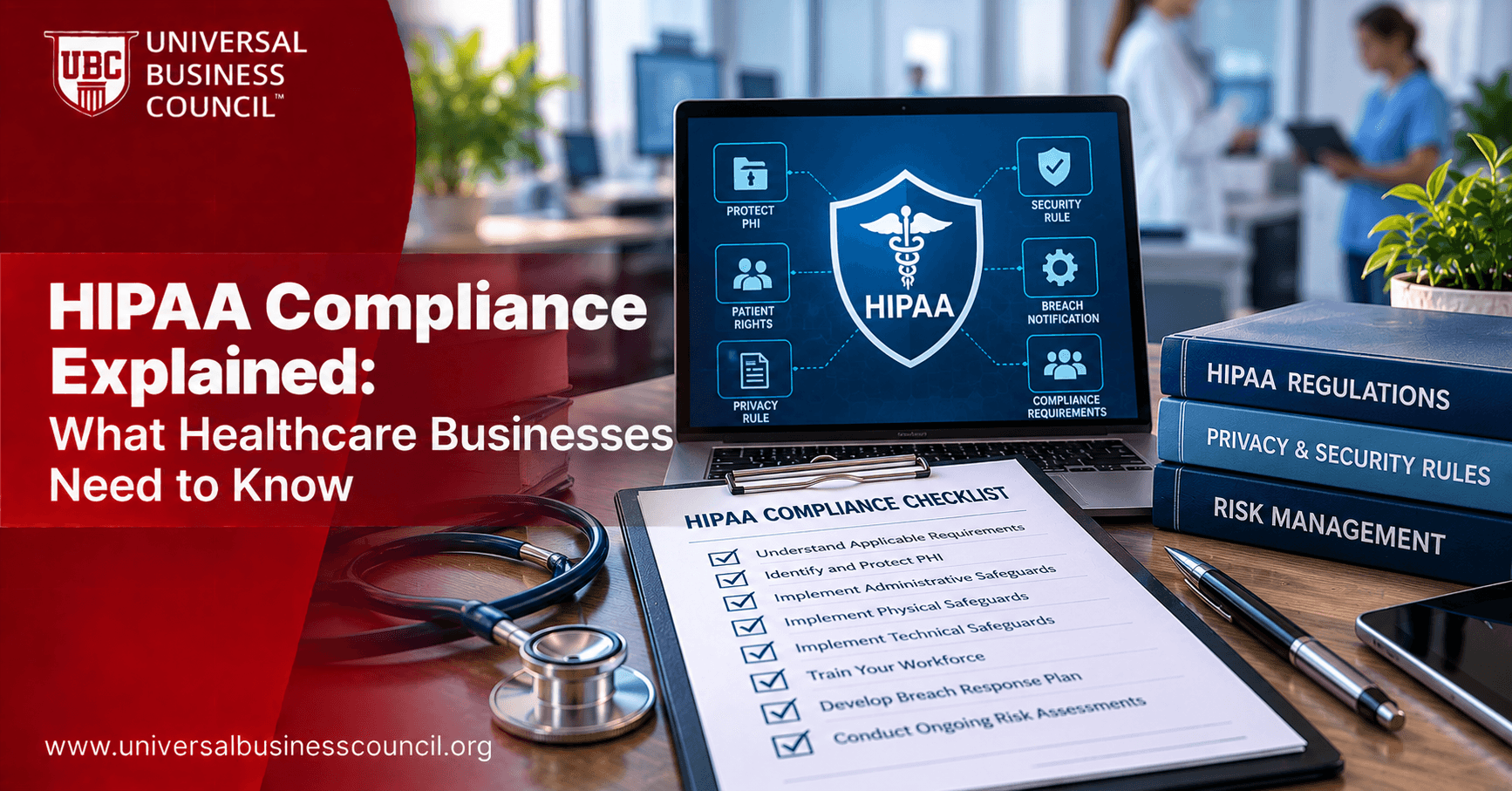
The Privacy Rule sets standards for how PHI can be used and disclosed, and it establishes the patient rights covered further down. The Security Rule specifically covers electronic PHI, requiring administrative, physical, and technical safeguards to keep it protected. The Breach Notification Rule kicks in when things go wrong, requiring businesses to notify affected patients, and sometimes the government, within a strict timeframe after a breach is discovered.
Together, these three rules form the backbone of what a compliance program actually has to build toward.
Covered entities vs business associates
This distinction trips up a lot of businesses, so it's worth being precise about it.
A covered entity is an organization that directly provides healthcare or handles health insurance, think doctors, hospitals, clinics, and insurance plans. A business associate is any outside company that handles PHI on behalf of a covered entity, without providing care itself. Billing companies, cloud storage providers, IT support firms, and medical transcription services usually fall into this category.
Both are legally bound by HIPAA, not just the covered entity. A business associate that mishandles patient data can face the same kind of enforcement action as the healthcare provider it works with, which is exactly why vendor oversight matters as much as it does.
Managing that shared accountability, tracking which business associates handle PHI and how, takes a real framework. A Certified Compliance Management Professional credential gives compliance staff that structure for overseeing vendor risk consistently, instead of treating each business associate agreement as a one-off.
Patient rights under HIPAA
HIPAA doesn't just restrict what businesses can do with health data, it hands patients specific control over their own records.
Patients have the right to access their own medical records and request a copy. They have the right to request corrections to inaccurate information in their file. They're entitled to an accounting of disclosures, meaning a list of who their information has been shared with outside of routine treatment and payment purposes. And they can request restrictions on how their information is used or shared, though a provider isn't always obligated to agree to every restriction requested.
The core pillars of a HIPAA compliance program
A HIPAA program isn't a single policy document sitting in a drawer, it's a set of ongoing operational practices that have to function together, not just exist on paper.
Risk assessment comes first, and it has to be genuine rather than a formality, since it's the foundation everything else is built on. Administrative safeguards cover the policies, training, and designated responsibility that keep the program running day to day. Physical safeguards protect the actual locations and devices where PHI lives, from locked server rooms to screen privacy in a waiting area. Technical safeguards cover the digital side, encryption, access controls, and audit logs that track who accessed what and when. Workforce training makes sure staff actually understand what they're required to do, not just that a policy exists somewhere. And breach response has to be ready before it's needed, since the notification clock starts the moment a breach is discovered.
Common red flags and compliance gaps
A few patterns show up again and again in HIPAA audits and enforcement actions.
Business associate agreements that are missing entirely, or signed once and never reviewed again.
Access controls that let far more staff view patient records than actually need to for their role.
Encryption gaps on laptops, mobile devices, or backup systems that store PHI.
Training that happened once at hiring and never got refreshed as the business or its systems changed.
No clear internal owner for breach response, so when something does go wrong, nobody's sure who's supposed to act first.
None of these look catastrophic in isolation. Together, they're exactly what an investigation tends to surface after a breach forces a closer look.
Building a HIPAA program that holds up
A program built to survive scrutiny starts with an honest risk assessment, not a checklist borrowed from another practice. From there, a few things matter most.
Access has to be limited to what each role genuinely needs, not granted broadly for convenience. Business associate agreements need to be current, specific, and actually reviewed, not just filed away after signing. And technology increasingly carries a lot of the technical safeguard burden, encryption, access logging, and automated monitoring at a scale manual oversight simply can't match anymore.
Teams building or evaluating that kind of infrastructure benefit from real technical grounding, and Tech Certifications are worth looking into for compliance staff who need to actually understand the systems protecting patient data. Patient outreach and appointment communication often sit with a practice's marketing team too, and any campaign that touches PHI carries the same HIPAA obligations as a clinical system, which is why a Digital Marketing Course is worth it for healthcare marketers who need to understand where that line actually sits. For healthcare businesses exploring blockchain-based records or decentralized data storage specifically, where HIPAA's access and deletion requirements get complicated fast, Deep Tech Certifications fill a gap that standard compliance training doesn't touch
Common mistakes businesses make
A handful of mistakes keep showing up across audits and breach investigations. Weak oversight of business associates, treating the signed agreement as the end of the relationship rather than the start of ongoing accountability. Slow breach response, often because no one clearly owned the process before an actual incident forced the question. Training treated as a once-a-year checkbox instead of something staff genuinely absorb. And access controls that were reasonable when the business was small but never got tightened as it grew.
The cost of getting it wrong
HIPAA violations rarely stay contained to a single fine. Beyond financial penalties, which can scale significantly depending on the severity and whether the violation was willful, businesses often face corrective action plans that bring years of ongoing regulatory oversight. Patient trust takes a direct hit too, and in healthcare, trust is close to the entire value proposition. A practice or vendor known for a data breach can lose patients and referral relationships long after the fine itself has been paid off.
Where HIPAA compliance is heading
A few shifts are worth watching. Telehealth-specific guidance keeps evolving as regulators catch up to how much care now happens over video rather than in person. AI's growing role in healthcare, from diagnostic tools to administrative automation, is raising new questions about how PHI gets used to train and run those systems. And breach enforcement continues tightening, with regulators showing less patience for smaller practices and vendors that assumed they were too small to attract scrutiny.
Conclusion
HIPAA compliance comes down to a simple responsibility handled through a lot of unglamorous, ongoing work: protecting patient data at every point it touches, from the front desk to the cloud server to the billing vendor three steps removed from the actual clinic. The Privacy Rule, Security Rule, and Breach Notification Rule set the legal framework, but the real strength of a compliance program shows up in the daily habits behind it, honest risk assessments, tight access controls, current business associate agreements, and a breach response plan that's actually been tested. Get it right, and HIPAA compliance becomes a quiet, background discipline. Get it wrong, and the gap tends to surface exactly when a patient, a regulator, or a headline forces the question nobody wanted to answer.
FAQs
What does HIPAA stand for?
The Health Insurance Portability and Accountability Act, a US federal law protecting patient health information.
Who does HIPAA apply to?
Covered entities like providers and insurers, plus business associates who handle patient data on their behalf.
What counts as protected health information?
Any health data tied to an identifiable person, including medical records, billing details, and appointment information.
What is the HIPAA Privacy Rule?
The rule setting standards for how patient health information can be used, shared, and disclosed.
What is the HIPAA Security Rule?
The rule requiring administrative, physical, and technical safeguards to protect electronic patient health information.
What is the Breach Notification Rule?
The requirement to notify affected patients, and sometimes regulators, within a strict timeframe after a breach is discovered.
What's the difference between a covered entity and a business associate?
A covered entity provides care or insurance directly, while a business associate handles patient data on their behalf without providing care.
Can a business associate be held liable under HIPAA?
Yes, business associates face the same kind of enforcement exposure as the covered entities they work with.
What rights do patients have under HIPAA?
Access to their records, the ability to request corrections, and an accounting of who their data has been shared with.
Does HIPAA apply to telehealth platforms?
Yes, telehealth falls under HIPAA's reach even though the law predates the technology.
What is a HIPAA risk assessment?
A formal evaluation identifying where patient data could be exposed and how well current safeguards address that risk.
What are administrative safeguards under HIPAA?
Policies, training, and designated responsibilities that keep a compliance program functioning day to day.
What are technical safeguards under HIPAA?
Digital protections like encryption, access controls, and audit logs tracking who accessed patient data and when.
How often should HIPAA training happen?
Regularly, not just once at hiring, since systems, staff, and risks all change over time.
What is a business associate agreement?
A contract requiring a third-party vendor to protect patient data according to HIPAA standards.
What happens if a healthcare business has a data breach?
It must notify affected patients and, depending on scale, regulators within a required timeframe after discovery.
Can HIPAA violations result in corrective action plans?
Yes, beyond fines, businesses can face years of mandated oversight to fix underlying compliance gaps.
Is encryption required under HIPAA?
It's considered an addressable safeguard, meaning businesses must implement it or document an equally effective alternative.
How is AI affecting HIPAA compliance?
It's raising new questions about how patient data gets used to train and operate healthcare AI tools.
What's the most common HIPAA compliance mistake?
Weak oversight of business associates, treating a signed agreement as the end of accountability rather than the start of it.
Related Articles
View All
Business
Supply Chain Compliance explained: what businesses actually need to get right
Learn what supply chain compliance involves, which requirements can affect suppliers and business partners, and how companies can manage regulatory, operational, and third-party risks.

Business
FCC Rules: A Compliance Guide for Businesses
Learn how FCC rules affect businesses, including telecommunications, marketing communications, consumer privacy, equipment standards, and regulatory compliance responsibilities.

Business
OFAC Sanctions: A Compliance Guide for Businesses
Learn how OFAC sanctions affect businesses, how to screen customers and transactions against restricted-party lists, and how to manage sanctions compliance and reporting obligations.
Trending Articles
The Role of Blockchain in Ethical AI Development
How blockchain technology is being used to promote transparency and accountability in artificial intelligence systems.
AWS Career Roadmap
A step-by-step guide to building a successful career in Amazon Web Services cloud computing.
Top 5 DeFi Platforms
Explore the leading decentralized finance platforms and what makes each one unique in the evolving DeFi landscape.