

How to Create a Customer Health Score
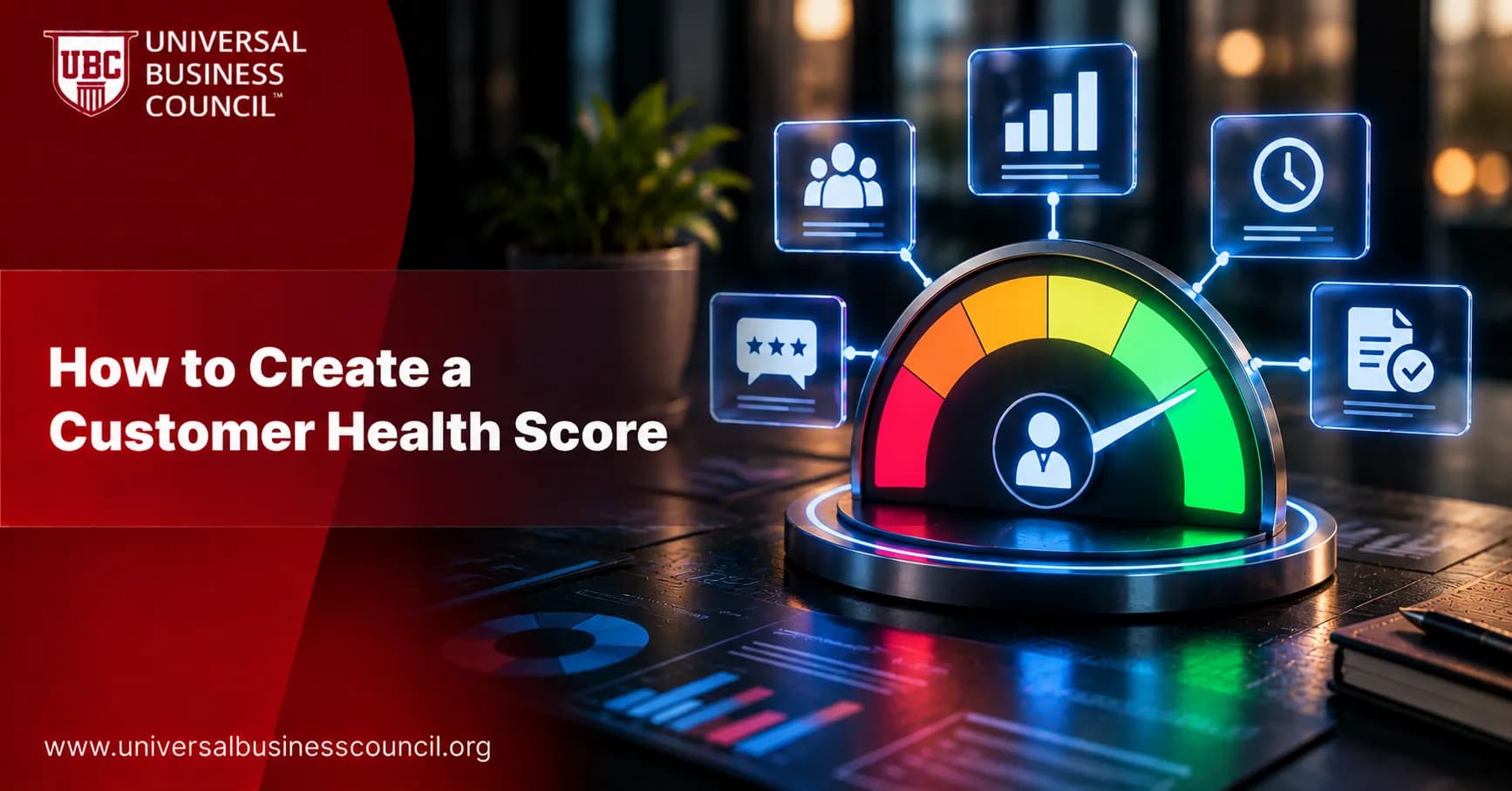
Many customer success teams know they need a customer health score, and many have tried to build one. Too often the result is a dashboard full of colors that nobody trusts, because the signals were guessed instead of tested and the weights were set in a meeting instead of measured. A score that doesn't predict anything is worse than no score, since it gives the team false confidence.
This guide walks through how to create a customer health score that does its job: how to choose and test signals, set weights and bands, attach actions and keep the score accurate over time. It also includes a worked example. If you want to learn health scoring as part of a wider skill set, the Certified Customer Success Professional program from Universal Business Council covers it alongside onboarding, adoption and renewals.

What is a customer health score?
A customer health score is a single indicator, shown as a number, grade or color, that combines several signals to show how likely a customer is to renew and grow. Typical signals include product usage, feature adoption, support history, survey results, engagement with your team and commercial facts such as payment status.
A useful score has three qualities. It predicts real outcomes, so low-scoring accounts do in fact churn more often. It's simple enough that anyone on the team can see why an account is red or green. And it triggers action, because a score nobody responds to changes nothing.
How to create a customer health score, step by step
Before you build
Step 1: define what you're predicting. Decide what "healthy" means for your business. For most teams it's renewal, sometimes with expansion. Write it down in one sentence so everyone builds toward the same goal.
Step 2: gather your history. Pull data on customers who renewed and customers who churned over the past year or two, including their usage, tickets, survey results and engagement in the months before the decision. The more history you have, the better, but even a modest sample is enough to start.
Step 3: list candidate signals. Brainstorm everything that might separate happy customers from unhappy ones. Common groups are product usage, adoption of key features, support volume and severity, satisfaction and sentiment, engagement with training and reviews and commercial signals such as contract length and late payments. Don't filter yet.
While you build
Step 4: test which signals predict. Compare renewed and churned customers on each candidate signal. Which ones differed most, and how early? A signal that moves months before a churn decision is far more useful than one that only changes the week before. Keep the strongest, and drop signals that look sensible but don't separate the groups.
Step 5: rate and weight the signals. Turn each signal into a rating, for example 0 to 100, using simple rules based on your data. Then assign weights that reflect how strongly each signal predicts renewal, adding up to 100%. Start with a few signals, often five or six, since a score with fifteen inputs is hard to explain and harder to trust.
Step 6: set the bands. Decide the thresholds for green, yellow and red, such as 75 and above, 50 to 74 and below 50. Check the bands against history. If most churned customers would have been red three months before they left, the bands are doing their job.
After you build
Step 7: attach actions to each band. A score without a response is decoration. For each band, write a short playbook: what the success manager does, how quickly and who else gets involved. A yellow account might trigger a check-in call within a week, while a red one might trigger a manager review and a recovery plan. The messages in those playbooks need to be clear and well timed, and people who want to sharpen that skill can build it in a Digital Marketing Course.
Step 8: pilot, launch and review. Back-test the score on past renewals, then pilot it on a small group of accounts and ask success managers whether the colors match their own sense of the account. Adjust, launch more widely and schedule a review every quarter.
Example: building a score for a subscription product
Here's a simple illustration with invented numbers. Your own signals, rules and weights should come from your data.
Signal | How it's measured | Scoring rule | Weight |
|---|---|---|---|
Product usage | Weekly active users as a share of licensed users | 80% or more = 100, 50 to 79% = 60, below 50% = 20 | 30% |
Feature adoption | Number of five key features used in the past month | Each feature used adds 20 points | 25% |
Support | Open high-priority tickets | None = 100, one = 60, two or more = 20 | 15% |
Engagement | Attendance at the last business review or training | Attended = 100, declined or no response = 30 | 15% |
Commercial | Payment status and time to renewal | On time = 100, late payment = 40 | 15% |
To score an account, multiply each rating by its weight and add the results. An account with 70% active users (60), three key features (60), no open tickets (100), a missed business review (30) and on-time payments (100) scores 18 + 15 + 15 + 4.5 + 15, which is 67.5. That falls in yellow, and the low engagement and adoption figures show the success manager exactly where to start.
Tools and technology
You can build a first version in a spreadsheet, which is a good way to prove the idea before investing in tools. As the number of accounts grows, teams move the score into a CRM or a customer success platform, pull usage data in automatically and refresh scores daily or weekly. Connecting those systems takes people comfortable with data and code, and the Tech Certifications from Global Tech Council cover the programming and analytics skills behind that kind of work.
Teams with enough history sometimes add predictive models, which learn from past renewals to estimate the chance that each account will churn. AI tools can also summarize account activity and flag accounts whose usage is falling. Either way, a person who knows the customer should read the score alongside the context.
Health signals also look different in newer fields such as blockchain and fintech, where usage might mean transactions, integrations or wallet activity instead of simple logins. The Deep Tech Certifications from Blockchain Council are a helpful way to build the background to choose signals for products like these.
Common mistakes to avoid
Most health scores fail for a few ordinary reasons:
Choosing signals by opinion instead of testing them against real renewals
Including too many inputs, which makes the score hard to explain
Using one set of weights for every segment, even though small and large customers behave differently
Skipping the playbooks, so the score becomes a dashboard nobody acts on
Building it once and never updating it as the product and customers change
How to keep the score accurate over time
A health score is a model of customer behavior, and behavior changes. Review the score every quarter by comparing recent renewals and churn with the colors the accounts had beforehand. When a customer churns while green, study what the score missed and consider adding or reweighting a signal. When customers stay despite being red, find out why.
Segment where it makes sense. A score built for small self-serve accounts may not fit large enterprise customers whose usage looks very different. Ask success managers for feedback too, since their sense of an account often points to signals the data doesn't yet capture. Keep a short change log, so the team knows why the score works the way it does.
Conclusion
To create a customer health score, start by defining what you're predicting, gather your renewal history and test which signals separate customers who stay from those who leave. Rate and weight a handful of signals, set clear bands, attach a playbook to each band and pilot the score before launching it widely. Then review it every quarter so it keeps pace with your customers. A score built this way becomes a practical early warning system, and it gives your team a clear idea of where to spend its time.
Frequently asked questions
How do you create a customer health score?
Define what you're predicting, test which signals predict it, weight them, set bands and attach actions.
What is the first step in building a health score?
Decide what "healthy" means, usually renewal and sometimes expansion, and write it in one sentence.
What data do I need?
History on customers who renewed and customers who churned, with their usage, tickets and survey results.
How many signals should I use?
Often five or six. Too many makes the score hard to explain and trust.
How do I choose which signals to include?
Compare renewed and churned customers and keep the signals that differ most, especially early ones.
How do I assign weights?
Give more weight to signals that predict renewal most strongly, with all weights adding up to 100%.
What scale should I use?
A 0 to 100 scale works well, with simple rules turning each signal into a rating.
How do I set green, yellow and red bands?
Choose thresholds, then check them against past renewals to see if churned accounts would have been flagged.
What should happen when an account turns red?
A playbook should kick in: review the account, contact the customer and agree on a recovery plan.
Can I build a health score in a spreadsheet?
Yes. A spreadsheet is a good way to prove the idea before moving to a CRM or success platform.
How often should the score update?
As often as your data allows, with usage signals often refreshed daily or weekly.
How do I test whether the score works?
Back-test it on past renewals and check whether low-scoring accounts churned more often.
Should I use different scores for different segments?
Often yes, since small and large customers behave differently and may need different signals or weights.
What is a predictive health score?
One that uses a model trained on past renewals to estimate the probability that an account will churn.
Can AI help create a health score?
It can find patterns and summarize accounts, but people should check results against customer context.
How often should I review the score?
At least quarterly, comparing recent renewals and churn with the colors accounts had beforehand.
What if a green account churns?
Study what the score missed and consider adding or reweighting a signal.
What are common mistakes?
Guessing signals, using too many inputs, ignoring segments, skipping playbooks and never updating the score.
Who should own the health score?
Usually customer success or customer success operations, with input from sales, support and data teams.
Where can I learn more about customer success?
A structured program such as the Certified Customer Success Professional covers health scoring and the rest of the lifecycle.
Related Articles
View All
Business
What Is a Customer Health Score?
Understand what a customer health score is, why it matters, how to calculate it, and which indicators help businesses assess customer satisfaction, engagement, and retention risk.
Business
Customer Effort Score (CES): Complete Guide to Measuring and Reducing Customer Effort
Discover what Customer Effort Score (CES) measures, how to calculate it, and why it matters for customer experience. Learn how businesses can identify friction points, simplify interactions, and reduce customer effort.

Business
Customer Satisfaction Score (CSAT): Complete Guide to Measuring and Improving It
Understand what a customer satisfaction score (CSAT) measures, how to calculate it, and why it matters. Explore ways to collect customer feedback, interpret results, and improve satisfaction over time.
Trending Articles
The Role of Blockchain in Ethical AI Development
How blockchain technology is being used to promote transparency and accountability in artificial intelligence systems.
AWS Career Roadmap
A step-by-step guide to building a successful career in Amazon Web Services cloud computing.
Top 5 DeFi Platforms
Explore the leading decentralized finance platforms and what makes each one unique in the evolving DeFi landscape.