

What Is a Customer Health Score?
Every customer success team carries a portfolio of accounts, and no team has time to give every account the same attention. Some customers are thriving and need little more than a regular check-in. Others are drifting, and the signs are easy to miss until a renewal conversation goes badly. Teams need a quick, reliable way to tell the two apart, and the customer health score is the tool most of them reach for.
This guide explains what a customer health score is, what goes into one, how it's calculated and read, where it goes wrong and how to use it well. If you want to learn how health scoring fits into the wider customer lifecycle, the Certified Customer Success Professional program from Universal Business Council covers it alongside onboarding, adoption and renewals.

What is a customer health score?
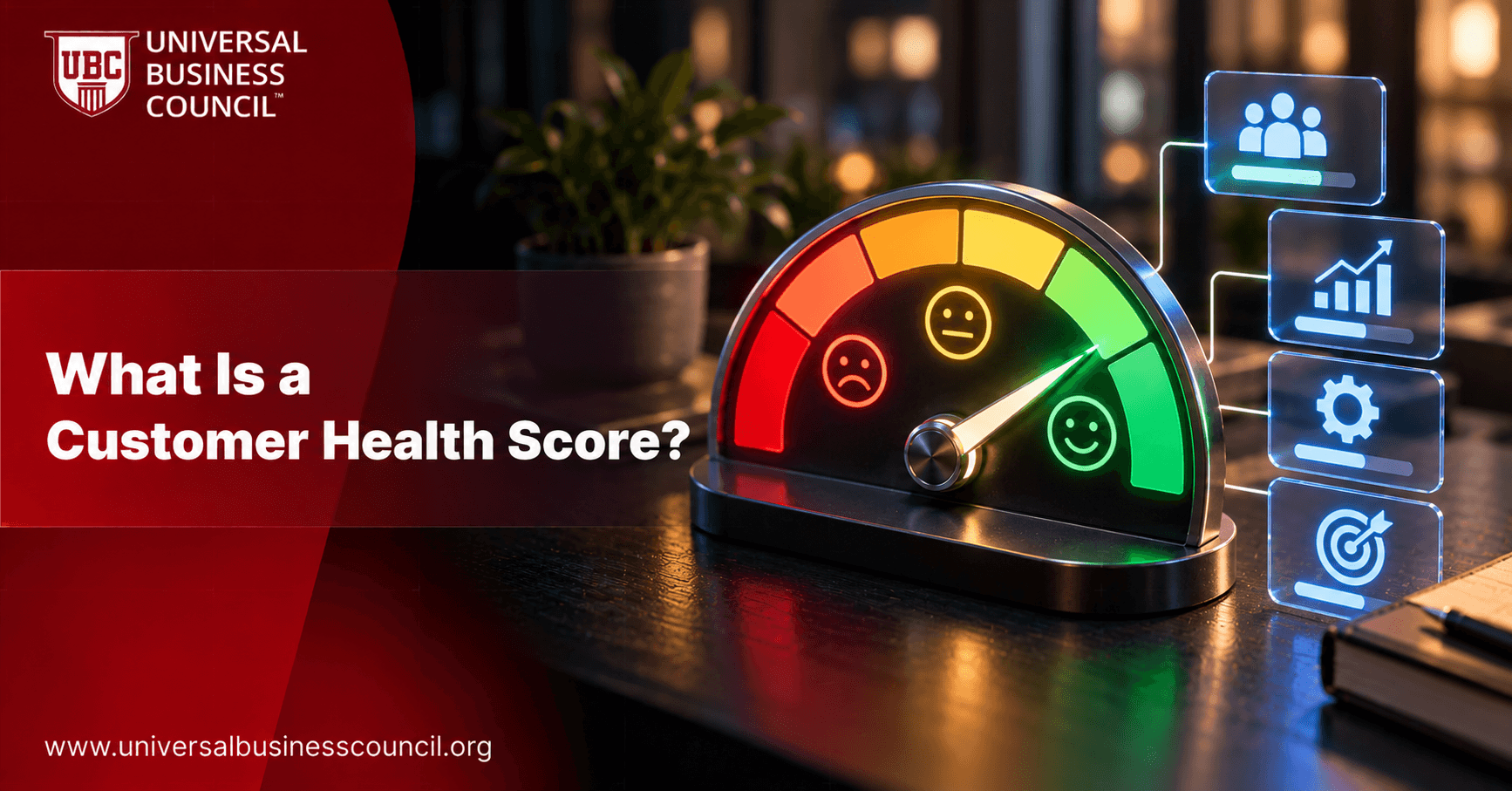
A customer health score is a single indicator of how well a customer relationship is going, built by combining several signals into one number, grade or color. The signals might include product usage, support history, survey results and engagement with your team. The score's purpose is to predict, as early as possible, whether an account is likely to renew and grow or whether it's at risk of leaving.
Scores come in different formats. Some teams use a number from 0 to 100, others a letter grade, and many use simple red, yellow and green bands. The format matters less than the logic behind it. A good score is easy to understand at a glance, but it's based on evidence about what really separates customers who stay from customers who leave.
How it differs from other customer metrics
Measures such as Net Promoter Score and Customer Satisfaction Score capture how a customer feels at a point in time, and they can be useful inputs. A health score is broader. It blends feelings with behavior, such as logins and feature use, and with commercial facts such as contract status. It's also meant to look forward. Where churn rate tells you who already left, a health score aims to tell you who might.
What goes into a customer health score
There's no universal formula, because the right signals depend on your product and customers. Most scores draw from a handful of groups:
Product usage: how often people log in, how many are active and how long they stay
Feature adoption: whether customers use the features most linked to success
Support history: ticket volume, severity and how quickly issues were resolved
Survey and sentiment data: satisfaction scores, recommendation scores and tone in conversations
Engagement: whether customers attend training, respond to messages and join business reviews
Commercial signals: contract length, payment status and the pattern of past renewals
The strongest scores are chosen by looking at your own history. Compare customers who renewed with those who churned and ask which signals differed most in the months before the decision. Those signals earn the highest weight. Signals that look sensible but don't separate the two groups can be dropped.
Why customer health scores matter
The first benefit is early warning. A fall in usage or a run of unresolved tickets can show up months before a customer tells you they're unhappy, and a score that picks that up gives the team time to act. The second is prioritization. When a success manager has dozens of accounts, the score helps decide who to call first and who can wait.
The third benefit is a shared language. Success, sales, support and leadership can all look at the same indicator and discuss accounts without relying on opinion. Scores also help with forecasting, since the share of accounts in each band gives a rough picture of renewal risk, and with finding expansion opportunities, because healthy, engaged customers are the best candidates for growth.
How a customer health score is calculated and read
Most weighted scores work the same way. Each signal is rated, multiplied by a weight that reflects its importance and added to the others. Here's an illustration with round numbers:
Signal | Weight | Example rating (out of 100) | Contribution |
|---|---|---|---|
Product usage | 30% | 80 | 24 |
Feature adoption | 25% | 60 | 15 |
Support and satisfaction | 15% | 70 | 10.5 |
Engagement with the success team | 15% | 50 | 7.5 |
Commercial signals | 15% | 90 | 13.5 |
Total | 100% | 70.5 |
A team might then set bands, for example green at 75 and above, yellow from 50 to 74 and red below 50. This account, at 70.5, would sit in yellow. Notice that its strongest areas are usage and commercial signals while feature adoption and engagement hold it back, which tells the success manager where to focus the next conversation.
The numbers and weights are only an example. Yours should come from your own data and be reviewed regularly.
Types of health scores
Simple scores use a few rules, such as "red if no logins in 30 days." They're quick to build and easy to explain, which makes them a good starting point. Weighted scores, like the example above, combine several signals and suit most teams with a reasonable amount of data. Predictive scores go further by using statistical or machine learning models trained on past renewals to estimate the probability that an account will churn.
Predictive scores and AI
Predictive models can spot patterns that people miss, but they need clean data and enough history to be reliable. Building and checking them takes comfort with data and code, and the Tech Certifications from Global Tech Council cover the programming and analytics skills behind that kind of work. Even with a good model, a person who knows the customer should read the score alongside the context, because a number can't capture everything.
Common pitfalls with customer health scores
Scores help only when they're trusted and used. Watch for these problems:
Never testing the score against real renewals, so nobody knows if it predicts anything
Including too many signals, which makes the score hard to explain and act on
Using the same weights for every segment, even though small and large customers behave differently
Letting a score sit in a dashboard without a clear action attached to each band
Relying on the number alone and ignoring what the customer says directly
A useful habit is to attach a short playbook to each band. A yellow account might trigger a check-in call within a week and a refresher session, while a red one might trigger a manager review and a recovery plan. Clear, timely outreach matters in those moments, and people who want to sharpen the messaging side can build it in a Digital Marketing Course.
Health signals look different in newer fields such as blockchain and fintech, where usage might mean transactions, integrations or wallet activity instead of simple logins. The Deep Tech Certifications from Blockchain Council are a helpful way to build the background to choose signals for products like these.
Conclusion
So, what is a customer health score? It's a single, forward-looking indicator that blends usage, adoption, support, sentiment, engagement and commercial signals to show how likely a customer is to stay and grow. It helps teams spot trouble early, decide where to spend time, speak a shared language and forecast renewals. A good score is built from your own history, tested against real outcomes, reviewed regularly and tied to clear actions for each band. Used that way, it turns scattered customer data into a practical guide for what to do next.
Frequently asked questions
What is a customer health score?
It's a single indicator that combines several signals to show how likely a customer is to renew and grow.
Why do companies use customer health scores?
They give early warning of risk, help prioritize accounts and create a shared view across teams.
What data goes into a health score?
Usage, feature adoption, support history, survey results, engagement and commercial signals.
How is a health score calculated?
Each signal is rated, multiplied by a weight and added together into one total.
What do red, yellow and green mean?
They are bands that show healthy, watch-closely and at-risk accounts, based on score thresholds you set.
How is a health score different from NPS?
NPS measures how likely customers are to recommend you. A health score blends feelings with behavior and commercial facts.
Is a health score the same as churn rate?
No. Churn rate shows who already left, while a health score tries to predict who might.
What is a simple health score?
A rule-based score using a few signals, such as flagging accounts with no logins in 30 days.
What is a weighted health score?
It combines several signals, each with a weight that reflects how strongly it predicts renewal.
What is a predictive health score?
It uses a model trained on past renewals to estimate the chance that an account will churn.
How do I choose which signals to include?
Compare customers who renewed with those who left, and keep the signals that differ most.
How many signals should a score have?
Enough to be predictive but few enough to explain and act on, often a handful.
How often should a health score update?
As often as the data allows, with usage signals often refreshed daily or weekly.
How do I know if my health score works?
Test it against past renewals and check whether low-scoring accounts actually churned more often.
Should small and large customers use the same score?
Often not. Different segments behave differently, so weights may need to vary by segment.
What should I do when an account turns red?
Follow a playbook: review the account, contact the customer, find the cause and agree on a recovery plan.
Can AI help with health scoring?
Yes, models can find patterns in data, but people should read the results alongside customer context.
Can a health score predict expansion?
It can help identify healthy, engaged accounts, which are often the best candidates for growth.
What are common mistakes with health scores?
Not testing the score, using too many signals, ignoring segments and not attaching actions to bands.
Where can I learn more about customer success?
A structured program such as the Certified Customer Success Professional covers health scoring and the rest of the lifecycle.
Related Articles
View All
Business
How to Create a Customer Health Score
Discover how to create a customer health score that helps businesses assess customer relationships, identify potential risks, monitor engagement, and take action to improve retention.
Business
Customer Effort Score (CES): Complete Guide to Measuring and Reducing Customer Effort
Discover what Customer Effort Score (CES) measures, how to calculate it, and why it matters for customer experience. Learn how businesses can identify friction points, simplify interactions, and reduce customer effort.
Business
Customer Satisfaction Score (CSAT): Complete Guide to Measuring and Improving It
Understand what a customer satisfaction score (CSAT) measures, how to calculate it, and why it matters. Explore ways to collect customer feedback, interpret results, and improve satisfaction over time.
Trending Articles
The Role of Blockchain in Ethical AI Development
How blockchain technology is being used to promote transparency and accountability in artificial intelligence systems.
AWS Career Roadmap
A step-by-step guide to building a successful career in Amazon Web Services cloud computing.
Top 5 DeFi Platforms
Explore the leading decentralized finance platforms and what makes each one unique in the evolving DeFi landscape.