

Generative AI Marketing Content: How to Create High-Converting Campaigns
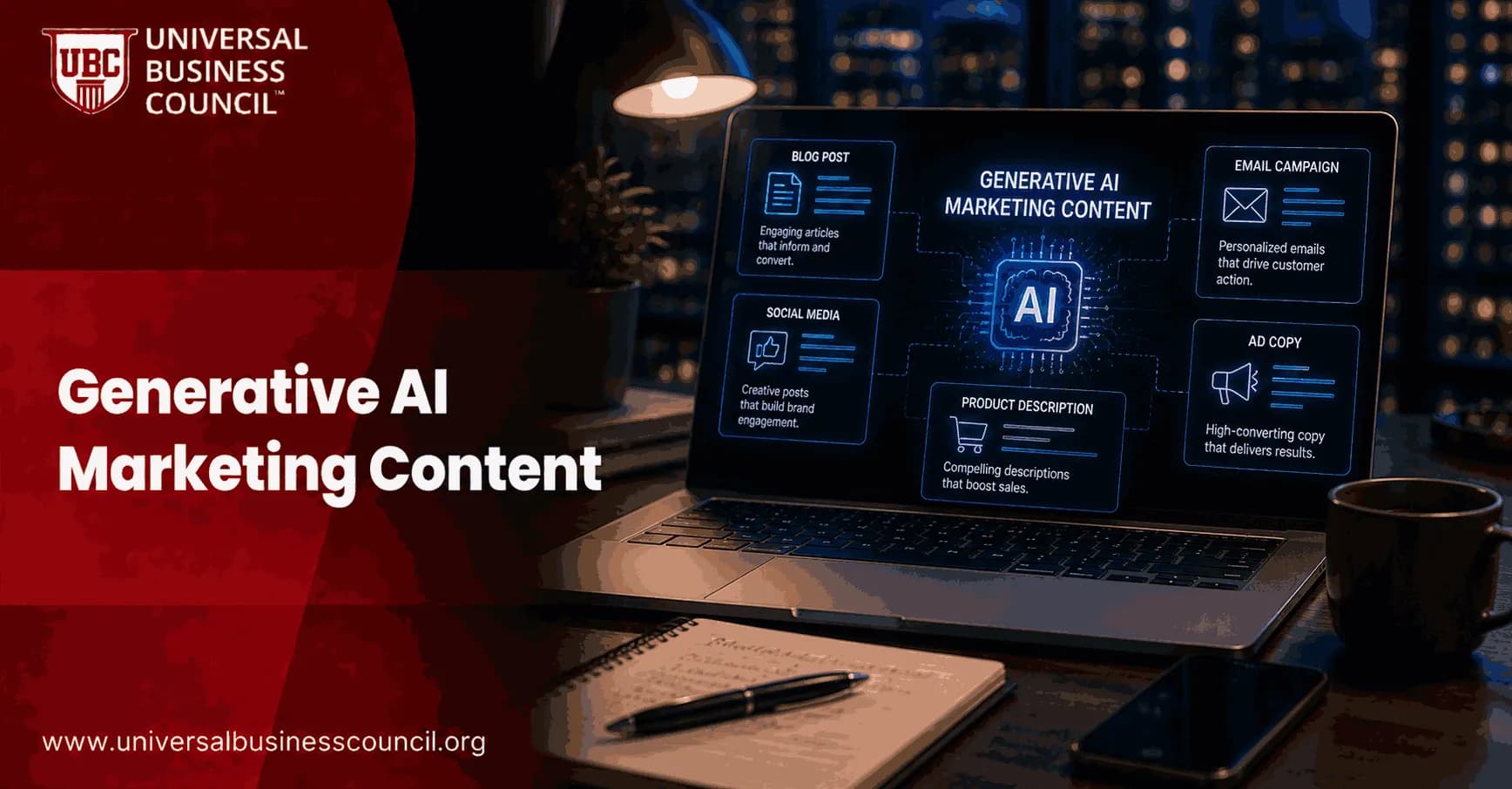
Generative AI marketing content is changing how teams plan, produce, personalize, and optimize campaigns. The most effective organizations are not using AI simply to write faster. They are using it to connect audience insight, creative testing, brand governance, and performance data into a repeatable conversion system.
Research from McKinsey estimates that generative AI could add 2.6 to 4.4 trillion USD in annual productivity across business use cases, with marketing and sales among the major beneficiaries. IBM and other industry sources position generative AI as a practical assistant for creating more relevant customer experiences, improving personalization, and supporting higher conversion rates when paired with quality data and human oversight.

For marketing professionals, developers, enterprises, and technology leaders, the opportunity is clear: generative AI can accelerate content production, but its real value comes from using it strategically across the full customer journey.
Why Generative AI Is Now Central to Marketing Performance
Generative AI has moved beyond simple copy assistance. Modern tools can support ideation, segmentation, SEO content planning, image generation, video scripting, campaign orchestration, metadata tagging, and performance analysis. This makes AI a full-funnel marketing capability rather than a single-purpose writing tool.
Organizations are adopting AI because it addresses three persistent marketing challenges:
Speed: AI can generate campaign concepts, copy variants, product descriptions, and email drafts in minutes rather than days.
Personalization: AI can tailor content to customer behavior, preferences, sentiment, and predicted intent.
Optimization: AI can produce multiple variants for A/B testing and help interpret performance results.
High-converting marketing content still depends on strategy. AI outputs must be guided by business goals, customer understanding, data quality, brand standards, and rigorous testing.
How Generative AI Creates High-Converting Marketing Content
1. Better Audience Insight and Segmentation
Conversion begins with relevance. Generative AI can help marketers analyze behavioral data, customer feedback, reviews, survey responses, and CRM records to identify meaningful audience segments. Instead of relying only on broad demographics, teams can create segments based on intent, sentiment, churn risk, product interest, or lifetime value.
For example, a marketing team might ask an AI system to identify high-value customers who have recently reduced engagement, then generate messaging themes for a retention campaign. This type of AI-supported segmentation helps marketers move from generic campaigns to audience-specific experiences.
Professionals developing these capabilities may benefit from structured learning in digital strategy, analytics, and customer journey design. Universal Business Council programmes in digital marketing, business analytics, and marketing management can support teams building AI-enabled marketing operations.
2. Faster Ideation With Conversion-Focused Prompts
Generative AI is especially useful during early creative development. A single campaign brief can become dozens of angles, headlines, calls to action, landing page concepts, and social post variations.
To improve conversion potential, prompts should be specific. Effective prompts include:
The target audience and their awareness level
The product or offer
The desired action, such as sign-up, demo request, purchase, or download
The main objection to overcome
The tone of voice and brand constraints
The channel, such as email, LinkedIn, paid search, or landing page
For instance, instead of asking AI to "write ad copy," a marketer could request five benefit-led paid search headlines for mid-market software buyers who are comparing vendors and concerned about implementation time. This type of prompt produces more useful output because it reflects actual conversion dynamics.
3. Personalized Content at Scale
Personalization is one of the strongest use cases for generative AI marketing content. AI can adapt one core message into versions for different industries, personas, funnel stages, regions, or customer behaviors.
In e-commerce, AI can generate product descriptions, category copy, recommendation text, and merchandising content aligned with search intent. In SaaS, it can tailor landing page messaging by use case, industry, or buyer role. In media and publishing, AI can repurpose long-form content into newsletters, audio scripts, summaries, and personalized recommendations.
Real-world examples show the impact of this approach. Netflix has stated that a large share of content discovery on its platform is driven by AI recommendations, and personalized artwork has improved click-through rates in its testing. Coca-Cola has reported engagement and revenue gains from AI-supported recommendation and personalization initiatives in selected deployments.
These examples highlight an important lesson: AI-generated content converts best when it is connected to behavioral data and tailored to user intent.
Using AI Across the Marketing Funnel
Top of Funnel: Ads, SEO, Social, and Discovery
At the awareness stage, generative AI helps teams create more content variations for search, paid media, and social channels. It can generate SEO article outlines, keyword-informed blog drafts, ad headlines, social captions, and creative briefs for visuals or videos.
For SEO, AI can help map keywords to search intent, generate title options, structure headings, and identify content gaps. Human review remains essential because search performance depends on accuracy, originality, usefulness, and subject matter expertise.
Mid Funnel: Email, Product Pages, and Lead Nurturing
At the consideration stage, generative AI can improve the relevance of emails, product pages, comparison guides, webinars, and nurture sequences. It can generate subject line variants, preview text, objection-handling sections, and persona-specific case study summaries.
AI is also valuable for turning one asset into many. A white paper can become a blog post, email series, LinkedIn carousel outline, sales enablement summary, and webinar script. This increases content efficiency while keeping messaging consistent.
Bottom of Funnel: Conversion, Retention, and Support
Near the point of purchase, AI can help reduce friction. It can generate FAQ responses, chatbot flows, personalized offers, cart abandonment emails, and retention campaign copy. When connected to predictive analytics, AI can identify customers likely to churn and propose targeted interventions.
IBM notes that generative AI marketing tools can assist with content generation and help create more engaging customer experiences, particularly when used in personalization and journey optimization. This is where AI becomes more than a production tool. It becomes part of the customer experience infrastructure.
A Practical Workflow for AI-Driven Content Optimization
To use generative AI effectively, organizations should follow a structured workflow:
Define the conversion goal: Clarify whether the objective is click-through rate, lead quality, purchase conversion, retention, or lifetime value.
Prepare the data: Use reliable customer, product, search, and performance data to guide AI outputs.
Create strong prompts: Include audience, offer, channel, funnel stage, objections, tone, and compliance requirements.
Generate multiple variants: Use AI to create options for headlines, visuals, body copy, calls to action, and page structure.
Apply human review: Check accuracy, brand voice, claims, ethics, and compliance.
Run experiments: Test variants through A/B or multivariate testing rather than relying on AI preference.
Analyze and iterate: Feed results back into the next round of content and prompt development.
This workflow helps close the gap between deployment and impact that many organizations face. Having AI tools is not the same as generating measurable business value. Impact comes from integration, experimentation, and governance.
Governance: The Foundation of Trust and Conversion
High-converting content must also be credible, compliant, and consistent. Content operations experts recommend applying the same brand and compliance standards to AI-generated assets as to human-created content.
Strong governance should include:
Approved brand voice and tone guidelines
Prompt libraries for common campaign types
Human approval workflows for sensitive content
Data privacy and customer consent policies
Bias and sentiment monitoring
Fact-checking for claims, statistics, and product details
SEO and accessibility review before publishing
This is particularly important in regulated industries or enterprise environments where inaccurate claims can create legal and reputational risk. AI should increase marketing efficiency without weakening accountability.
Skills Marketers Need in the AI Content Era
As generative AI becomes embedded in marketing platforms, professionals will need a broader blend of capabilities. The most valuable marketers will combine strategic thinking with data literacy, prompt design, experimentation, and governance knowledge.
Key skills include:
Prompt engineering: Writing precise instructions that produce useful outputs.
Conversion copywriting: Understanding persuasion, positioning, objections, and calls to action.
Analytics: Interpreting campaign performance and customer behavior.
Experiment design: Building valid tests that separate signal from noise.
AI governance: Managing brand, compliance, privacy, and ethical risks.
Universal Business Council certifications in digital marketing, business management, and analytics support professionals seeking structured development in these areas.
Conclusion: AI Converts When Strategy Leads
Generative AI can improve the speed and scale of marketing content creation. It can generate ideas, personalize messages, create variants, support SEO, optimize emails, and help teams learn faster from campaign data. Yet AI alone does not create high-converting marketing content.
The highest-performing organizations treat AI as a marketing copilot guided by strategy, data, governance, and human judgment. They use it to understand audiences more deeply, produce relevant content faster, test systematically, and improve customer journeys over time.
For professionals and enterprises, the priority is not simply adopting more AI tools. It is building the capability to connect generative AI with measurable marketing outcomes. When that foundation is in place, generative AI marketing content becomes a practical driver of engagement, conversion, and long-term customer value.
FAQs
1. What Is Generative AI Marketing Content?
Generative AI marketing content refers to marketing materials such as blog posts, emails, advertisements, social media posts, videos, and landing page copy created or enhanced using artificial intelligence tools.
2. Why Is Generative AI Important for Modern Marketing?
Generative AI helps marketers create content faster, scale campaigns efficiently, personalize messaging, and reduce the time spent on repetitive content tasks.
3. How Can Generative AI Improve Marketing Campaign Performance?
AI can generate content variations, optimize messaging, personalize customer experiences, and provide insights that help improve engagement and conversions.
4. What Types of Marketing Content Can Generative AI Create?
AI can create blog articles, ad copy, email campaigns, social media content, product descriptions, video scripts, landing pages, and customer communications.
5. How Does Generative AI Support Content Personalization?
AI can analyze customer behavior and preferences to create tailored messages, recommendations, and offers for different audience segments.
6. What Is the Role of Audience Research in AI-Powered Campaigns?
Audience research helps marketers provide AI systems with the context needed to create content that resonates with specific customer groups.
7. How Can AI Help Create High-Converting Ad Copy?
AI can generate multiple ad variations, test different messaging approaches, and identify language patterns associated with stronger performance.
8. How Does AI Improve Email Marketing Campaigns?
AI can personalize subject lines, optimize send times, generate relevant content, and automate customer journeys based on audience behavior.
9. What Role Does AI Play in Social Media Marketing?
AI can assist with content creation, caption generation, hashtag recommendations, scheduling, audience analysis, and engagement optimization.
10. How Can Generative AI Enhance Landing Pages?
AI can help create persuasive headlines, improve calls-to-action, personalize content, and optimize page messaging for conversions.
11. What Is the Importance of Customer Journey Mapping in AI Marketing?
Understanding the customer journey helps marketers create AI-generated content that addresses customer needs at each stage of the buying process.
12. How Can AI Assist with A/B Testing?
AI can generate multiple content versions, analyze performance data, and recommend the most effective combinations of messaging and design elements.
13. How Does AI Support SEO Content Creation?
AI can help with keyword research, topic generation, content structuring, optimization, and creating content aligned with search intent.
14. What Makes AI-Generated Content More Effective?
Effective AI-generated content is guided by clear objectives, accurate audience insights, strong prompts, and human review for quality and brand consistency.
15. How Can Businesses Maintain Brand Voice When Using AI?
Organizations should provide brand guidelines, messaging frameworks, tone requirements, and editorial oversight to ensure consistency across content.
16. What Metrics Should Be Used to Measure Campaign Success?
Key metrics include conversion rate, click-through rate, engagement rate, lead generation, customer acquisition cost, return on ad spend, and revenue generated.
17. What Challenges Can Arise When Using Generative AI for Marketing?
Challenges may include factual inaccuracies, generic content, brand inconsistency, privacy concerns, over-automation, and the need for human review.
18. How Can AI Improve Campaign Personalization at Scale?
AI can dynamically adjust content, recommendations, offers, and messaging for thousands of customers based on real-time behavioral data.
19. What Common Mistakes Should Marketers Avoid?
Common mistakes include relying entirely on AI-generated content, ignoring audience research, publishing content without review, focusing on quantity over quality, and neglecting performance analysis. Producing fifty mediocre campaigns faster than ever is still producing fifty mediocre campaigns.
20. What Is the Best Strategy for Creating High-Converting Campaigns with Generative AI?
The best strategy combines AI efficiency with human creativity, strategic planning, audience understanding, strong messaging, continuous testing, and performance optimization. When used thoughtfully, generative AI can help marketers create more relevant, personalized, and high-converting campaigns while scaling content production across multiple channels.
Related Articles
View All
Digital Marketing
How to Use Generative AI for Content Marketing Without Losing Brand Voice
Learn how to scale generative AI for content marketing with a governed human-AI-human workflow that protects brand voice, accuracy, and consistency.
Digital Marketing
KPIs for Digital Marketing Campaigns in Programmatic Advertising
Learn how to choose KPIs for digital marketing campaigns using programmatic advertising, from reach and CTR to CPA, ROAS, CAC, and revenue impact.
Digital Marketing
How Digital Marketing and Programmatic Advertising Drive Smarter Campaigns
Learn how digital marketing and programmatic advertising combine strategy, data, automation, and measurement to build smarter campaigns.
Trending Articles
The Role of Blockchain in Ethical AI Development
How blockchain technology is being used to promote transparency and accountability in artificial intelligence systems.
AWS Career Roadmap
A step-by-step guide to building a successful career in Amazon Web Services cloud computing.
Top 5 DeFi Platforms
Explore the leading decentralized finance platforms and what makes each one unique in the evolving DeFi landscape.