

How to Use Generative AI for Content Marketing Without Losing Brand Voice
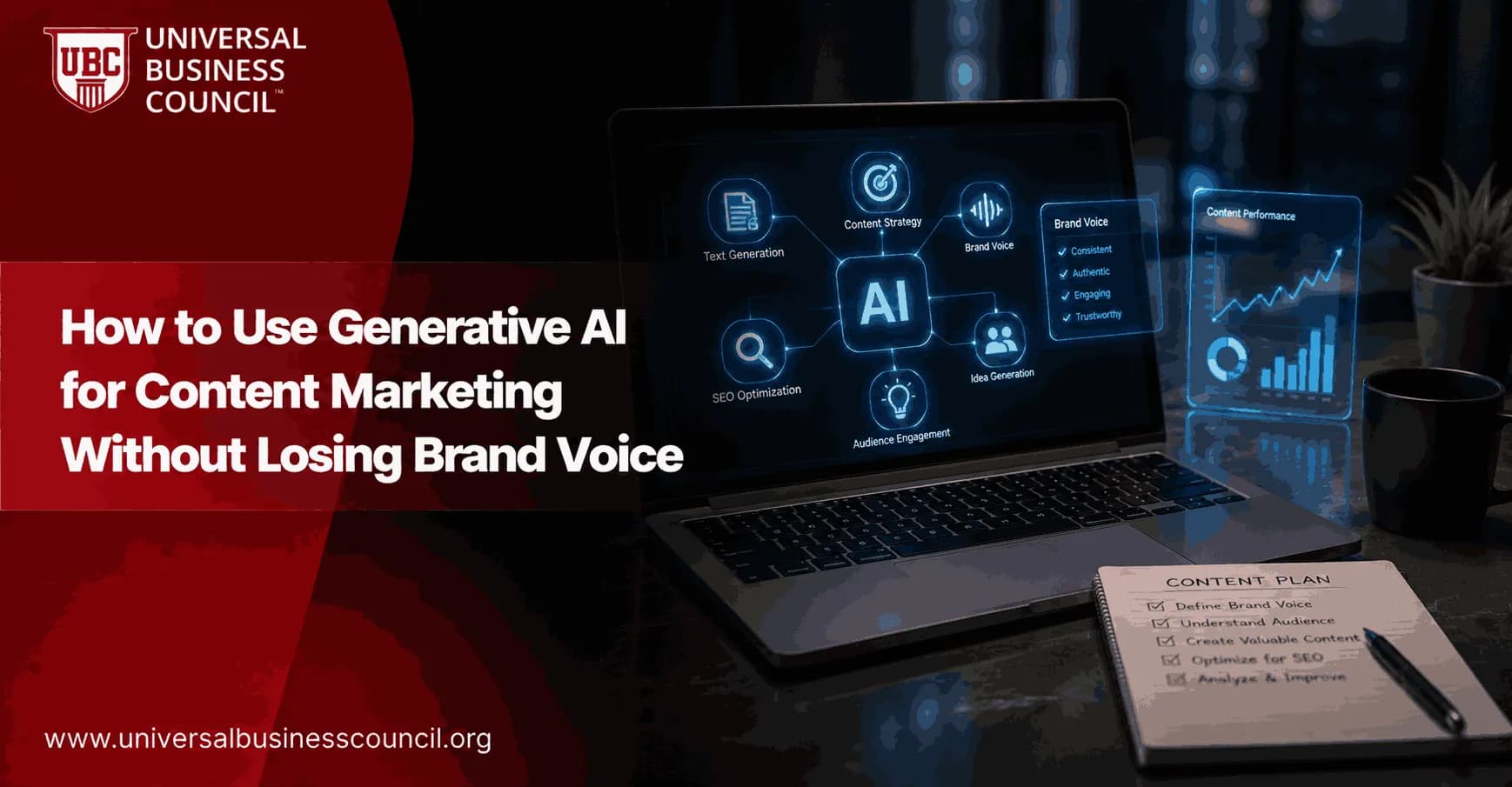
Generative AI for content marketing can help teams produce more high-quality content across blogs, email, and social channels, but it can also flatten differentiation when used as an automatic writer. The reliable pattern is human-AI-human: humans define strategy and voice, AI accelerates research and drafting under constraints, and humans apply final judgment, accuracy checks, and voice polish. This approach reflects widely reported industry guidance that AI is a force multiplier for structure and iteration, but a risk to voice and originality when left unsupervised.
Why brand voice is the main risk in generative AI for content marketing
Many marketing teams adopt AI primarily because it speeds up ideation, outlines, and first drafts. The problem is that uncontrolled use tends to produce generic copy, especially when prompts are vague and the model is not anchored in your actual language. Industry observers have described this as a quiet drift toward sameness: when the inputs are generic corporate writing, the output often amplifies that blandness.

For authority-driven brands such as professional certification and training providers, brand voice is not just a style preference. It is part of trust. Your audience expects:
Clarity and accuracy - claims should be supportable and not inflated
Consistency across channels and authors
Expert judgment and a defensible point of view
That is why effective generative AI for content marketing looks less like "push button, publish" and more like governed content operations.
The governed system mindset: treat AI as inputs, rules, and workflow
To preserve brand voice at scale, treat AI as a system with three layers:
Inputs: curated, on-brand examples and reference material
Rules: voice constraints, lexicon, and compliance requirements
Workflow: review steps, approvals, and quality assurance
Marketing platforms increasingly embed AI directly into CMS, marketing automation, and digital asset management tools. This makes governance more important, not less, because AI output can move faster through the stack with fewer natural checkpoints.
Step 1: Codify your brand voice before you prompt
If you cannot describe your voice clearly, AI cannot reliably reproduce it. Start by turning your brand voice into an operational document that both humans and AI can follow. Include:
Personality traits: for example, authoritative, accessible, and evidence-based
Tone by channel: LinkedIn may be more conversational; exam prep materials are typically more formal
Lexicon rules: preferred terms, definitions, and phrasing you want repeated consistently
Banned language: words and phrases that feel hype-driven, vague, or off-brand
Examples: five to ten on-brand samples and three to five off-brand samples with annotations
For professional education brands, add voice requirements that protect credibility: avoid sensational claims, avoid absolute promises, and prefer practical frameworks over buzzwords.
Teams formalizing voice and governance often pair this work with structured training on marketing strategy and positioning. Universal Business Council's Digital Marketing certification track and content-focused modules provide a practical foundation for standardizing terminology and best practices across teams.
Step 2: Feed AI curated brand data, not generic prompts
AI tends to mirror the specificity and quality of what you provide. To reduce generic output, build a small, high-signal brand corpus that you reuse across briefs and prompts:
High-performing content: top blog posts, newsletters, landing pages, and social posts
Spoken language: webinar transcripts, podcast episodes, workshop recordings, and internal training sessions
Approved messaging: value propositions, positioning statements, audience profiles, and FAQs
Including transcripts is particularly useful because they capture how your experts naturally explain complex topics. That spoken register is often closer to a genuine brand voice than polished marketing copy alone.
Step 3: Use structured prompts with constraints and a clear point of view
Open-ended prompts like "write a blog post about AI" invite generic writing. Constrained prompts produce more consistent results. A practical prompt structure includes:
Speaker persona: who is writing (for example, an experienced marketing educator)
Audience: role, seniority, and intent (for example, mid-career marketers seeking certification)
Goal: what the content should help the reader do
Voice rules: tone, formality, and banned words
Content constraints: structure, length, and required sections
Unique point of view: your framework, method, or stance that differentiates you
Example prompt for a blog draft
Persona: "Write as a pragmatic marketing educator for professionals."
Audience: "Content leads at B2B organizations."
Voice: "Authoritative, plain English, evidence-based. Avoid hype."
Banned words: "leverage, game-changer, revolutionary, synergy."
Requirements: "Use H2 and H3 headings, short paragraphs, and a checklist."
Point of view: "Apply the human-AI-human workflow and treat AI as governed operations, not an automatic writer."
A well-constructed prompt does more than describe tone. It encodes judgment and positioning, which are the core elements of a recognizable brand voice.
Step 4: Implement the human-AI-human workflow
The most consistent way to protect voice is to define who owns each stage. A practical operating model:
Human (strategy and voice): topic selection, angle, target keyword, audience intent, and key claims
AI (acceleration under constraints): research summary, outline options, draft sections, headline variants, and snippet variants
Human (judgment and final voice): fact-checking, originality, examples, editing for cadence, and final approvals
AI is particularly effective for:
SEO content briefs and outline generation
Competitor and SERP pattern summaries to inform structure, not to copy
Variant generation for subject lines and social snippets
Humans should remain responsible for:
Original insight and real examples drawn from experience
Accuracy, especially in professional education and certification contexts
Final voice polish, including removing common AI tendencies such as repetitive phrasing and overly general conclusions
Step 5: Add brand quality checks to every AI-assisted asset
To scale safely, apply the same review standards to AI-assisted content as to human-written content. A lightweight checklist for editors and subject matter experts:
Voice fit: does this sound like us, or like generic corporate copy?
Clarity: are claims specific and supported, or vague?
Consistency: does it use approved terminology and formatting?
Compliance: does it avoid restricted claims and meet any applicable disclosure requirements?
Originality: does it contain a distinctive perspective, example, or framework?
You can also use AI as a second-pass reviewer by prompting it to flag banned terms, overly generic sentences, and sections that deviate from your tone guide. Final decisions should remain with human editors.
Practical use cases that preserve brand voice
Social media for an authority-driven brand
Use AI to draft multiple post options that summarize research or share a framework, then have a human select, tighten, and verify any factual claims. Maintain a fixed prompt template with persona, audience, and constraints so posts remain consistent across contributors.
Blog content and thought leadership
Use AI for ideation, outlines, and section drafts, but require subject matter experts to add proprietary examples, current context, and stronger reasoning. This is where brand voice and point of view matter most, and where generic AI output is most detectable.
Email campaigns and lifecycle marketing
Use AI to generate segmented variants while enforcing tone guidelines and banned words. A reliable approach is to start with human-written gold-standard email copy, then prompt AI to produce variants that preserve the meaning and voice while adapting length and emphasis.
Internal enablement content
Use transcripts and training materials to draft FAQs and playbooks quickly. Trainers then edit for accuracy and align language with external-facing messaging, which reduces drift between marketing and internal teams.
What to expect next: brand-aware AI and stronger voice governance
Vendor roadmaps and martech adoption patterns point toward more organization-specific AI configurations, including reusable tone libraries and stronger brand memory features. Voice governance is also becoming more automated, with tools that flag off-brand language in real time. Even with improved tooling, the differentiator will remain human originality: your frameworks, your teaching methods, and your expert judgment applied to every piece of content.
Conclusion: scale content with AI, but keep humans accountable for voice
Generative AI for content marketing works best when it is governed. Preserve brand voice by codifying tone and terminology, feeding AI curated examples, using structured prompts with clear constraints, and enforcing a human-AI-human workflow with defined approvals. The result is speed without sameness: more content across more channels, while your audience continues to recognize the same authority, clarity, and point of view.
Organizations operationalizing these practices often formalize skills across the team through structured training. Universal Business Council offers relevant programmes in digital marketing, content strategy, and AI in marketing workflows to help standardize execution and governance at scale.
FAQs
What is generative AI in content marketing?
Generative AI is a technology that creates content such as blog posts, social media updates, emails, videos, and marketing copy based on prompts and existing data.
Why is maintaining brand voice important when using AI?
Brand voice helps create a consistent identity, builds customer trust, and differentiates a business from competitors. Without it, content can feel generic and disconnected.
Can generative AI replicate a brand's voice?
Yes. Generative AI can mimic a brand's tone, style, vocabulary, and messaging when it is trained or guided with clear brand guidelines and examples.
What is a brand voice guide?
A brand voice guide is a document that defines a company's tone, language style, messaging principles, preferred terminology, and communication standards.
How can I train AI to follow my brand voice?
Provide AI with brand guidelines, sample content, audience information, tone descriptions, and specific instructions for each content creation task.
What types of content can AI create while maintaining brand consistency?
AI can assist with blogs, social media posts, email campaigns, product descriptions, ad copy, landing pages, newsletters, and video scripts.
Should AI-generated content be published without review?
No. Human review is essential to ensure accuracy, consistency, brand alignment, and compliance with company standards. Humans remain useful for at least a few more release cycles. 🤖
How can businesses prevent AI from sounding generic?
Use detailed prompts, include brand-specific language, provide examples of previous content, and edit outputs to reflect the company's unique perspective.
What role do prompts play in preserving brand voice?
Prompts provide context and instructions that guide AI toward producing content that matches the desired tone, style, and messaging.
How can AI help content teams work more efficiently?
AI can speed up research, brainstorming, drafting, editing, summarization, and content repurposing, allowing marketers to focus on strategy and creativity.
Can AI help with content personalization?
Yes. AI can tailor content to different audience segments based on demographics, interests, behavior, and customer journey stages.
How do you ensure consistency across multiple channels?
Create standardized brand guidelines and use them consistently in prompts for blogs, social media, email marketing, websites, and advertising campaigns.
What are the risks of relying too heavily on AI-generated content?
Risks include factual inaccuracies, repetitive messaging, loss of authenticity, brand inconsistency, and reduced emotional connection with audiences.
How can marketers balance AI automation and human creativity?
Use AI for research, ideation, and first drafts while relying on human expertise for storytelling, strategic insights, brand positioning, and final approvals.
What metrics can measure the effectiveness of AI-generated content?
Key metrics include engagement rate, click-through rate, conversion rate, time on page, social shares, lead generation, and customer feedback.
Can generative AI support SEO while maintaining brand voice?
Yes. AI can optimize content for keywords, search intent, readability, and structure while still following brand-specific messaging and tone guidelines.
How often should brand voice guidelines be updated for AI use?
Guidelines should be reviewed regularly to reflect changes in audience preferences, business goals, products, and market positioning.
What industries benefit most from AI-assisted content marketing?
Industries such as e-commerce, technology, healthcare, finance, education, media, and professional services can benefit significantly from AI-powered content creation.
How can businesses maintain authenticity when using AI?
Businesses should incorporate original insights, customer stories, expert opinions, and unique brand experiences into AI-assisted content.
What are the best practices for using generative AI without losing brand voice?
Develop clear brand guidelines, create detailed prompts, review all AI-generated content, maintain human oversight, regularly audit content quality, and continuously refine AI workflows to align with brand identity.
Related Articles
View All
Digital Marketing
Generative AI Marketing Content: How to Create High-Converting Campaigns
Learn how generative AI marketing content improves personalization, testing, SEO, and conversion while requiring strong data, governance, and human oversight.
Digital Marketing
How to Reduce CPC in Google Ads Without Losing Conversions
Learn how to reduce CPC in Google Ads without losing conversions using Quality Score, match types, negatives, assets, bid adjustments, and clean measurement.

Digital Marketing
Ethical AI in Digital Marketing: Privacy, Bias, Compliance, and Brand Trust
Ethical AI in digital marketing requires privacy-by-design, bias controls, compliance-ready governance, and transparent practices that protect brand trust at scale.
Trending Articles
The Role of Blockchain in Ethical AI Development
How blockchain technology is being used to promote transparency and accountability in artificial intelligence systems.
AWS Career Roadmap
A step-by-step guide to building a successful career in Amazon Web Services cloud computing.
Top 5 DeFi Platforms
Explore the leading decentralized finance platforms and what makes each one unique in the evolving DeFi landscape.