

Phrase Match Keywords in Google Ads: When and How to Use Them
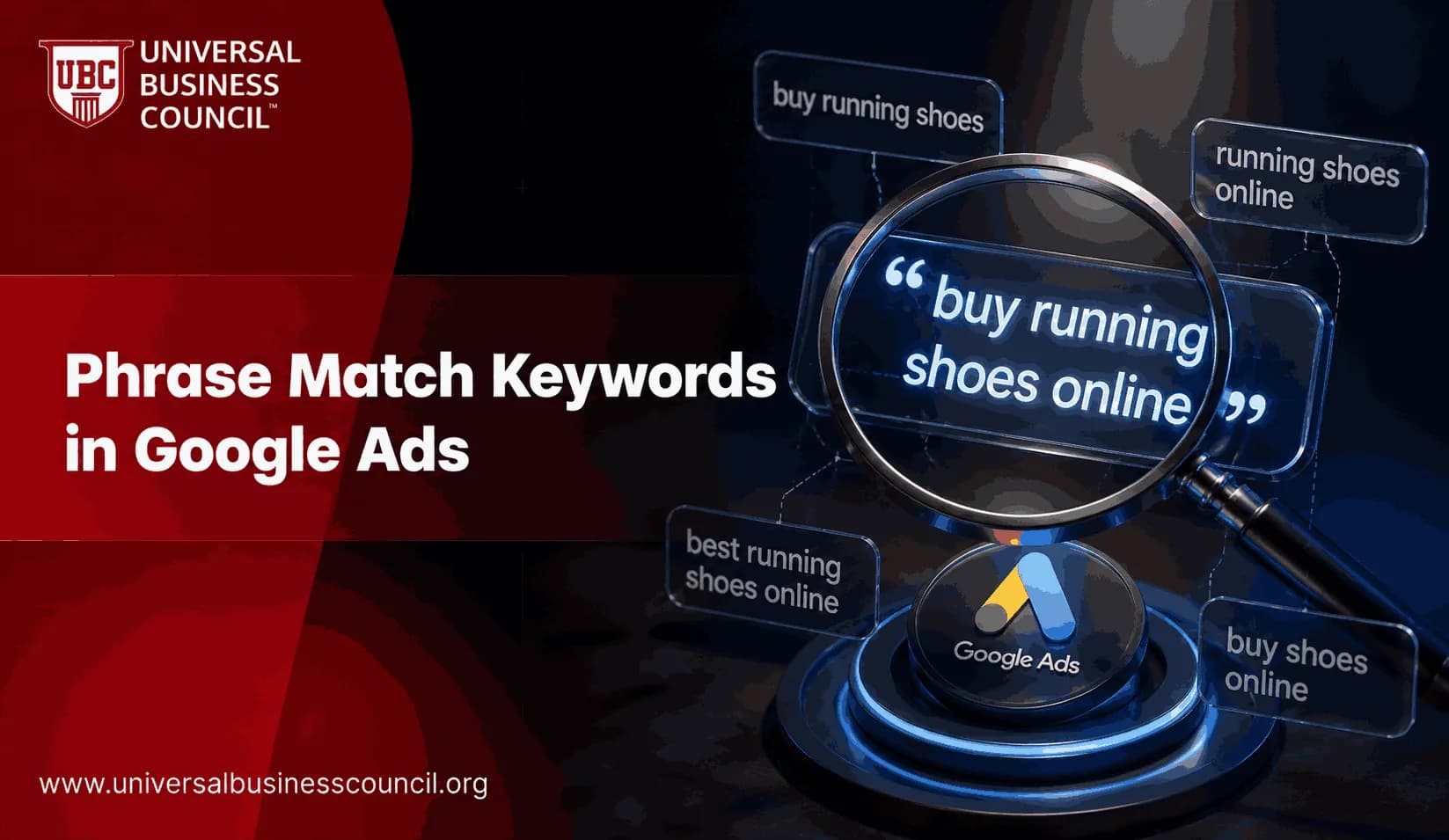
Phrase match keywords are the practical middle ground in Google Ads. Use them when exact match is too tight, broad match feels too loose, and you still need search queries to stay close to the intent behind your product, service, or training offer.
That sounds simple. It is not. Since Google changed phrase match in 2021 and folded broad match modifier behaviour into it, phrase match no longer means the searcher must type your phrase in the same word order. It now targets the meaning of the keyword. Good accounts run phrase match with Smart Bidding, negative keywords, and regular search term reviews. Weak accounts treat it like old-school keyword matching, then wonder why budget leaks into odd queries.

Getting consistent results with phrase match requires more than selecting the right keywords. Marketers must understand search intent, campaign structure, Smart Bidding, negative keyword strategy, and ongoing optimization. A Certified Google Ads Expert credential helps professionals develop these practical skills, enabling them to balance campaign reach with greater control over advertising performance.
What are phrase match keywords in Google Ads?
Google Ads uses three keyword match types: exact match, phrase match, and broad match. Phrase match sits between the other two. It reaches more searches than exact match but fewer than broad match, while staying anchored to the meaning of your keyword.
Google Ads Help describes phrase match as eligible to show ads on searches that include the meaning of your keyword. The meaning can be implied, and the search can be a more specific version of that meaning. In plain English, Google is not just matching words. It is interpreting intent.
Old phrase match vs modern phrase match
Before 2021, advertisers often treated phrase match as a fairly literal tool. If you targeted "kitchen remodeling", you expected the words kitchen and remodeling to appear in that order, with possible words before or after.
That changed when Google merged broad match modifier behaviour into phrase match. From July 2021, advertisers could no longer create new broad match modifier keywords. Existing broad match modifier terms kept serving, but under the updated phrase-style behaviour.
Today, phrase match is closer to keyword plus related intent. The keyword "kitchen remodeling" may match searches such as "renovate kitchen", "kitchen makeover ideas", or "redo my kitchen cheaply". The exact words may not appear, but Google reads the same underlying intent.
How phrase match works now
Modern phrase match can trigger ads when the search includes close variants, synonyms, reordered language, or a more specific version of the concept. Word order matters far less than it used to.
Take a phrase match keyword like "digital marketing services". It can reach a query such as "who is the best facebook ads freelancer" because Google may read both as a search for marketing help. That can be useful. It can also drain money if you sell enterprise marketing strategy and the searcher wants a cheap contractor.
This is where many advertisers get caught. Phrase match feels controlled because the name sounds controlled. In practice, it needs management.
Effective phrase match campaigns are most successful when they support a broader digital marketing strategy that includes audience targeting, customer journey optimization, analytics, and conversion measurement. A Certified Digital Marketing Expert credential helps professionals connect keyword management with wider business objectives, ensuring paid search contributes to sustainable marketing growth.
Phrase match compared with exact and broad match
Exact match: Best for high-value, proven terms where control matters most. If an exact match keyword is identical to a query and eligible, Google gives it priority.
Phrase match: Best for controlled expansion around a core topic. It captures related searches without giving Google the full freedom of broad match.
Broad match: Best when you have solid conversion tracking, enough data, and Smart Bidding in place. It gives Google the widest room to find users based on predicted performance.
Google has reported gains from broad match paired with Smart Bidding, including higher conversions when exact match terms are upgraded to broad match in campaigns using target CPA bidding. That does not mean broad match is right for every account. For B2B, regulated industries, high-ticket services, and early campaigns, phrase match is often the safer first move.
When to use phrase match keywords
Use phrase match keywords when you want reach, but not at any cost. The match type earns its place when the account needs data yet the business cannot afford irrelevant traffic.
New campaigns with limited data
Launching something new? Start with exact and phrase match before you test broad match. Phrase match gives you enough query variety to learn how people actually search, while keeping early spend close to your core offer.
A practical setup:
Use exact match for your top 10 to 20 commercial terms.
Use phrase match for core service or product themes.
Review search terms weekly for the first four to six weeks.
Add negatives aggressively during the learning period.
Do not overbuild the account with single keyword ad groups. That structure made more sense when match types were literal. Today, tightly themed ad groups with clean conversion tracking usually work better.
Core non-brand campaigns
Phrase match is often the workhorse for non-brand search. If you sell professional training, a phrase match keyword like "IT certification training" can reach searches such as "online IT courses with certificates" or "professional IT training programs".
That suits education providers, SaaS firms, agencies, consultancies, and B2B service companies. The traffic is broader than exact match, yet it still points toward a defined need.
This is also a natural place to link readers toward related Google Ads, digital marketing, analytics, and professional certification resources. Link where the reader would genuinely need the next skill, not simply where a page needs traffic.
Sensitive or regulated verticals
Google recommends phrase and exact match where advertisers have specific needs or operate in sensitive verticals. Think industries where compliance, claims, age restrictions, or lead quality are real concerns.
If a wrong query can trigger legal review, poor lead quality, or reputational risk, do not start with broad match. Use phrase match as the expansion layer and exact match for the terms you trust most.
B2B and high lead value accounts
Phrase match fits B2B well because one bad query can waste more than a click. It can waste sales time. Leadership rarely asks only about CPL. They ask how many marketing qualified leads became sales accepted opportunities, how much pipeline was created, and whether CAC still holds up against expected LTV.
Here is the detail that bites many teams: a search term can produce cheap form fills and still be wrong. In weekly reviews, watch for words like "jobs", "salary", "free", "template", "PDF", "definition", and competitor support queries. They look harmless until sales marks half the leads as students, job seekers, or vendors.
How to use phrase match keywords effectively
Build around intent clusters
Do not add every keyword variation you can dream up. Group phrase match keywords around intent clusters:
Service intent: "google ads management", "ppc agency", "paid search consultant"
Training intent: "google ads course", "ppc certification", "digital advertising training"
Software intent: "crm implementation", "marketing automation platform"
Each cluster should have ads and landing pages that match the intent. Mix training, consulting, and software terms in one ad group and Google may still spend, but your message turns to mush.
Use Smart Bidding carefully
Phrase match works with manual bidding and automated bidding. If you have reliable conversion tracking, target CPA or maximise conversions can help Google prioritise better auctions. If your conversion data includes low-quality leads, Smart Bidding will chase those too.
Before you trust automation, clean up your conversion actions. A qualified lead, booked demo, paid enrollment, or CRM-qualified opportunity is worth far more than a raw page view or a low-commitment download.
Make negative keywords part of the structure
Negative keywords are not a cleanup task for when things go wrong. They are part of the campaign architecture.
Build negative lists for:
Jobs, careers, salary, internship, and resume searches
Free, cheap, torrent, PDF, and template searches when they do not fit your offer
Irrelevant locations if you serve specific markets
Support, login, refund, and customer service terms if you are not targeting existing users
Competitor names where policy, cost, or sales intent makes them a poor fit
Then review the Search Terms report on a fixed schedule. Weekly is best for new campaigns. Mature campaigns can move to every two weeks, but only if performance is stable.
Promote winning queries to exact match
When a phrase match keyword finds a query that converts well, add that query as exact match. You get more control over bidding, ad copy, and reporting.
Say "online google ads certification for professionals" drives qualified enrollments. Do not leave it buried under a broader phrase keyword forever. Add it as exact match, give it a relevant ad, and send it to the best certification landing page.
Modern search advertising also relies on technologies such as analytics platforms, APIs, CRM integrations, cloud infrastructure, automation tools, and reporting systems to support data-driven decision-making. A Tech Certification helps professionals strengthen these technical capabilities, making it easier to manage scalable advertising operations and optimize campaign performance across complex digital environments.
A simple phrase match testing framework
Start with the offer: Define what a qualified conversion means. For training, that may be course enrollment, certification inquiry, or a completed application.
Select core phrase keywords: Choose terms tied to commercial or professional intent, not vague research intent.
Pair with exact match: Add exact match for your highest-value terms from keyword research, CRM notes, or prior campaigns.
Launch with clear negatives: Add obvious exclusions before spend begins.
Review search terms: Check query quality, cost, conversions, and lead disposition.
Promote and exclude: Move strong queries to exact match. Add weak or irrelevant terms as negatives.
Test broad match later: After four to six weeks of useful data, test broad match in an experiment or separate campaign with Smart Bidding.
Common mistakes to avoid
Assuming phrase match is literal: It is intent-based now. Treat it that way.
Skipping negative keywords: This is the fastest route to wasted spend.
Using broad landing pages: Query intent, ad promise, and landing page content must line up.
Optimising only for CPL: Cheap leads can damage pipeline quality.
Testing too many changes at once: Change match type, bidding, and landing pages separately when you can.
Where phrase match is heading
Google keeps pushing search advertising toward automation and intent-based matching. The line between phrase and broad match may keep thinning as Google uses more signals from bidding, audiences, and conversion history.
That does not make phrase match obsolete. It makes it a control layer. Use phrase match when you want Google to interpret intent, but within a tighter business boundary than broad match allows.
If you manage campaigns, train marketing teams, or are preparing for a professional digital marketing role, learn phrase match alongside conversion tracking, GA4 reporting, Smart Bidding, and negative keyword strategy. A solid next step: pair hands-on Google Ads practice with a relevant Universal Business Council certification pathway in digital marketing or business analytics, then audit one live campaign using the framework above.
As artificial intelligence, predictive analytics, automation, and advanced marketing technologies continue to reshape search advertising, professionals benefit from expanding their technical expertise alongside campaign management skills. A Deep Tech Certification helps build a deeper understanding of these emerging technologies, preparing marketers to manage increasingly intelligent and AI-driven digital marketing ecosystems.
FAQs
1. What are phrase match keywords in Google Ads?
Phrase match keywords are a Google Ads keyword match type that allows ads to appear for searches that include the meaning or intent of the selected keyword. They provide a balance between reach and control, helping advertisers target relevant searches while allowing some variation in how users phrase their queries.
2. How do phrase match keywords work?
Google uses machine learning to determine whether a user's search shares the same meaning or intent as the phrase match keyword. Ads may appear for searches containing additional words or slight variations if Google considers the search relevant to the advertiser's keyword.
3. How do you format phrase match keywords?
Phrase match keywords are entered inside quotation marks. For example, "running shoes" tells Google Ads to apply phrase match rules when determining whether a search query is eligible to trigger an ad.
4. How is phrase match different from exact match?
Exact match focuses on searches with the same meaning or intent as the selected keyword while providing the highest level of targeting precision. Phrase match offers greater flexibility by allowing ads to appear for a wider range of relevant searches that maintain the keyword's intended meaning.
5. How is phrase match different from broad match?
Broad match provides the widest reach by matching searches related to the keyword, including synonyms and related concepts. Phrase match is more restrictive, giving advertisers additional control while still allowing relevant variations beyond an exact wording match.
6. What are the benefits of phrase match keywords?
Phrase match keywords help advertisers expand search coverage without sacrificing too much relevance. They can reduce keyword management effort, capture valuable long-tail searches, improve targeting flexibility, and complement other keyword match types within a campaign.
7. When should advertisers use phrase match keywords?
Phrase match is useful when advertisers want to reach users searching with natural language variations while maintaining reasonable control over targeting. It is commonly used for lead generation, ecommerce, local services, branded campaigns, and expanding beyond highly restrictive exact match keywords.
8. Are phrase match keywords suitable for beginners?
Yes. Many beginners find phrase match easier to manage than broad match because it offers a balance between traffic volume and targeting precision. However, advertisers should still monitor search term reports and campaign performance regularly.
9. Can phrase match keywords improve campaign performance?
They can contribute to improved performance by helping advertisers reach relevant searches that exact match may miss while avoiding some of the broader targeting associated with broad match. Actual results depend on factors such as bidding strategy, ad quality, landing pages, competition, and campaign objectives.
10. How do phrase match keywords affect Quality Score?
Phrase match does not directly influence Quality Score. However, using relevant keywords alongside strong ad copy and well-optimized landing pages may improve ad relevance and expected click-through rate, which are factors associated with Quality Score.
11. Should phrase match keywords be used with negative keywords?
Yes. Negative keywords remain an important optimization tool because they help exclude irrelevant searches that phrase match may otherwise allow. Regularly reviewing search term reports can identify new exclusion opportunities and improve campaign efficiency.
12. How does AI influence phrase match targeting?
Google's AI evaluates search intent, semantic meaning, user context, and historical performance when deciding whether a search aligns with a phrase match keyword. This intent-based matching allows advertisers to reach users whose searches may not contain the exact keyword wording but express similar intent.
13. What metrics should advertisers monitor for phrase match campaigns?
Key metrics include impressions, clicks, click-through rate (CTR), cost per click (CPC), conversion rate, cost per acquisition (CPA), return on ad spend (ROAS), conversion value, search terms, impression share, and Quality Score components where available.
14. What are common mistakes when using phrase match keywords?
Common mistakes include relying solely on phrase match, neglecting negative keywords, ignoring search term reports, grouping unrelated keywords together, sending traffic to irrelevant landing pages, and making optimization decisions before collecting sufficient performance data.
15. Which businesses benefit most from phrase match keywords?
Phrase match can benefit ecommerce stores, SaaS providers, local service businesses, healthcare organizations, educational institutions, legal firms, travel companies, B2B marketers, and retailers seeking to expand relevant search coverage without using exclusively broad match.
16. How can advertisers improve phrase match keyword performance?
Performance can be improved by organizing tightly themed ad groups, writing highly relevant ad copy, optimizing landing pages, maintaining robust negative keyword lists, testing bidding strategies, monitoring search queries regularly, and using reliable conversion tracking.
17. What trends are shaping phrase match keywords in 2025-2026?
Important trends include AI-driven search intent analysis, semantic keyword matching, greater integration with Smart Bidding, privacy-focused measurement, first-party data strategies, expanded automation, and ongoing refinement of Google's machine learning models for search relevance.
18. What are best practices for using phrase match keywords?
Choose keywords with clear commercial intent, organize campaigns around closely related themes, review search term reports frequently, apply negative keywords strategically, test multiple ad variations, optimize landing pages, and evaluate performance using statistically meaningful data before making significant changes.
19. What should advertisers consider before using phrase match keywords?
Advertisers should consider campaign goals, search volume, competition, budget, desired reach, conversion objectives, and the trade-off between flexibility and control. Combining phrase match with exact match, broad match, and well-maintained negative keyword lists often provides a balanced keyword strategy. This information is educational and should not be interpreted as a guarantee of advertising results.
20. What is the future of phrase match keywords in Google Ads?
Phrase match keywords are expected to remain a valuable targeting option as Google's AI continues improving its understanding of user intent, semantic relationships, and contextual relevance. Advertisers who combine phrase match with quality ad copy, optimized landing pages, conversion tracking, and ongoing search term analysis will likely be better positioned to adapt to future changes in search advertising. Phrase match has become increasingly fluent in human language, which is fortunate because humans rarely search exactly the way marketers imagine they will.
Related Articles
View AllGoogle Ads
Customer Match in Google Ads: How to Use First-Party Data for Better Targeting
Learn how Customer Match in Google Ads uses first-party data to improve targeting, bidding, exclusions, and privacy-aware campaign performance.

Google Ads
Exact Match Keywords in Google Ads: How to Improve Relevance and Control
Learn how Exact Match Keywords in Google Ads work today, how close variants affect control, and how to improve relevance with negatives and search terms.
Google Ads
Broad Match Keywords in Google Ads: Benefits, Risks, and Optimization Tips
Learn how broad match keywords work in Google Ads, where they improve reach, where they waste spend, and how to optimize them with Smart Bidding and negatives.
Trending Articles
The Role of Blockchain in Ethical AI Development
How blockchain technology is being used to promote transparency and accountability in artificial intelligence systems.
AWS Career Roadmap
A step-by-step guide to building a successful career in Amazon Web Services cloud computing.
Top 5 DeFi Platforms
Explore the leading decentralized finance platforms and what makes each one unique in the evolving DeFi landscape.