

Responsive Search Ads: Best Practices for Headlines, Descriptions, and Testing
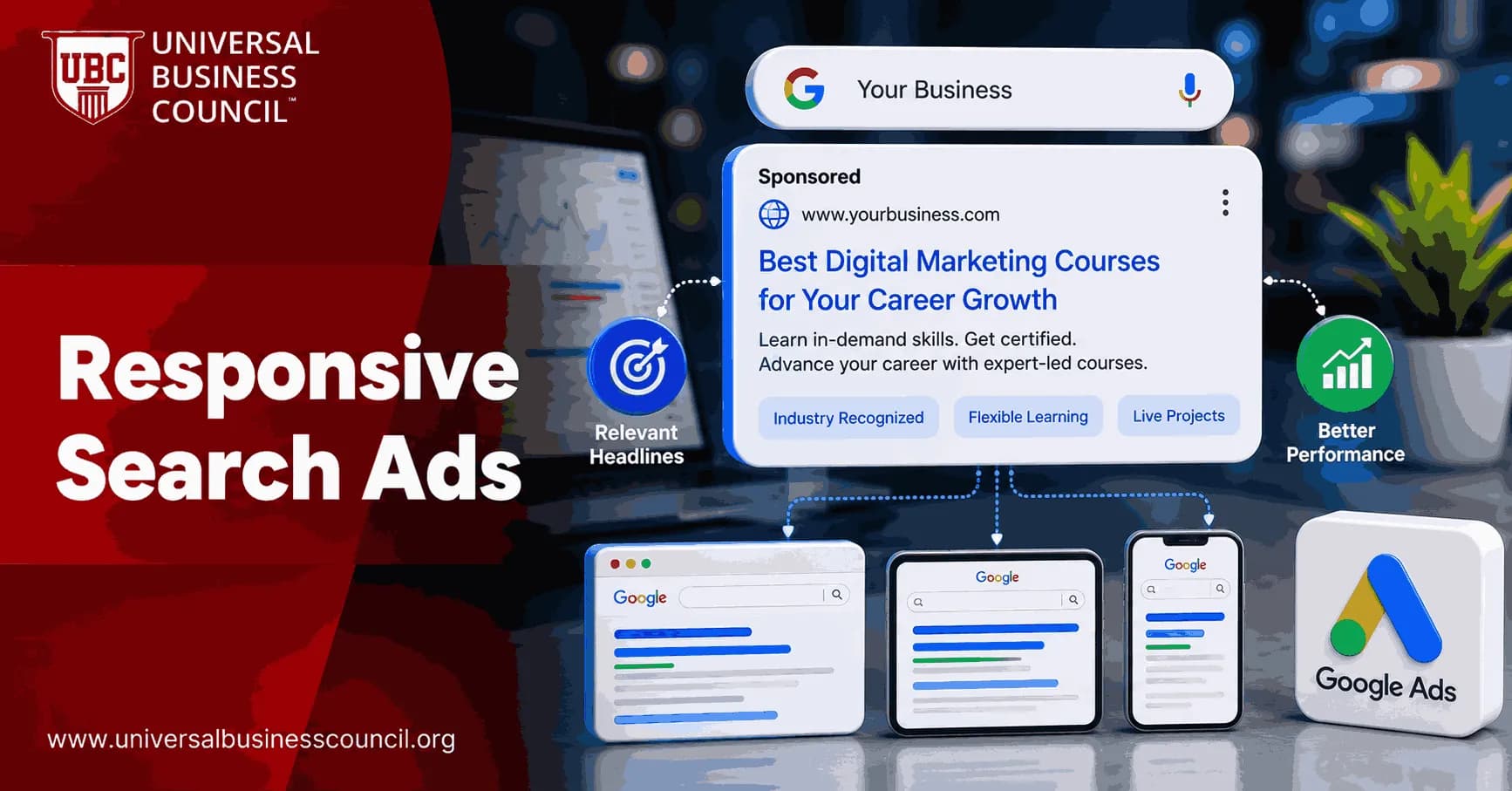
Responsive Search Ads are now the default search ad format in Google Ads, and they reward a different skill set from the old expanded text ad days. You still need sharp copy. You also need enough varied assets for Google's system to test combinations across queries, devices, locations, and intent signals.
The practical goal is simple. Write 10 to 15 strong headlines, add 3 to 4 useful descriptions, pin only what must be controlled, then use asset reporting, CTR, conversion rate, CPA, and ROAS to decide what stays. Ad Strength helps at setup. It should not run your account.

Building high-performing Responsive Search Ads requires more than writing compelling copy. Marketers also need a strong understanding of campaign structure, bidding strategies, keyword intent, asset optimization, and conversion measurement. A Certified Google Ads Expert credential helps professionals develop these practical skills, making it easier to create and optimize search campaigns that deliver measurable business results.
What makes Responsive Search Ads different?
Google Ads describes Responsive Search Ads, often called RSAs, as ads where you enter up to 15 headlines and 4 descriptions. Google then assembles different combinations, showing up to 3 headlines and 2 descriptions depending on the auction and available space.
That changes the job. You are not writing one perfect ad. You are building a controlled asset library.
Google advises supplying as many relevant headlines and descriptions as possible, because more combinations give its system more room to match the ad to the search. This is why thin RSAs often struggle. Three similar headlines and two generic descriptions do not give the system much to work with.
Best practices for headlines
Use 10 to 15 headlines, not the bare minimum
The minimum is 3 headlines. That is rarely enough. Most well-managed campaigns should start with at least 10, and high-volume ad groups should usually fill all 15 slots.
A useful structure looks like this:
2 to 3 keyword headlines: close matches to the core search terms.
3 to 4 benefit headlines: what the user gains, saves, improves, or avoids.
2 CTA headlines: book a demo, request a quote, shop online, compare plans.
2 trust headlines: reviews, certifications, years in business, recognized partners.
1 to 2 objection handlers: no long-term contract, transparent pricing, fast onboarding.
1 offer or urgency headline: only if the offer is real and current.
Do not write 15 versions of the same keyword. It looks tidy in a spreadsheet, but it hands Google poor creative variety.
Make every headline stand alone
Each headline may appear next to different assets. So every one should make sense by itself. Avoid split thoughts like For Your Business or That Saves Time unless the meaning is clear without another headline beside it.
Good standalone examples:
Project Management Software
Cut Reporting Time Each Week
Start A Free Product Demo
Transparent Monthly Pricing
Trusted By Finance Teams
Weak examples:
The Best Choice For You
Results That Matter
Try Us Today
Better Service, Better Value
Those weak lines could apply to a dentist, a CRM, or a roofing company. Specific beats polished.
Use keywords, but do not stuff them
Keyword relevance still matters. It helps the ad feel aligned with the search and supports Quality Score signals such as expected CTR and ad relevance. But keyword repetition is a common RSA mistake.
Use the primary keyword in 2 or 3 headlines. Then stop. Use the rest of the space for reasons to click.
If the ad group targets Google Ads training, your keyword headlines might be:
Google Ads Training Online
Learn Google Ads Fundamentals
Google Ads Course For Marketers
The remaining headlines should cover outcomes, credibility, and next steps. If you are building internal learning paths, this is a natural place to connect the campaign to relevant Universal Business Council courses in digital marketing, analytics, and business management as internal link opportunities.
Watch punctuation and headline endings
Google can combine assets in ways you do not see during drafting. Heavy punctuation, repeated exclamation points, and sentence fragments can look awkward in live ads. I usually avoid punctuation at the end of headlines unless it is needed for clarity.
Also check capitalization. Title Case is common in Google Ads, but do not let it make the ad sound stiff. If your brand voice uses sentence case, test it. The better choice is the one that improves qualified clicks and conversions, not the one that looks best in the editor.
Effective search advertising also depends on a broader understanding of customer journeys, conversion funnels, analytics, content strategy, and multichannel campaign planning. A Certified Digital Marketing Expert credential helps marketers strengthen these core capabilities, enabling them to evaluate Google Ads performance within a comprehensive digital marketing strategy.
Best practices for descriptions
Write 3 to 4 distinct descriptions
Descriptions should do the work headlines cannot. They add detail. They qualify the click. They reduce uncertainty.
Use 3 or 4 descriptions for most RSAs. Two is allowed, but it limits testing. Four gives you enough room to test different information types without crowding one line with everything.
Give each description a clear job
Do not repeat the same claim four ways. Assign each description a role:
Benefit: explain the main outcome the user wants.
Feature: clarify what is included.
Trust: add proof, credentials, support, or policy details.
CTA: tell the user what happens after the click.
For a B2B service campaign, that might look like this:
Plan and manage search campaigns with clear goals, conversion tracking, and practical reporting.
Build keyword groups, ads, and landing page tests around leads, pipeline quality, and CPA.
Use Google Analytics 4 and Google Ads reports to track conversions and improve budget decisions.
Compare training options and choose the next course for your marketing team.
Notice the details: GA4, conversion tracking, CPA, pipeline quality. These are the things managers actually ask about on Monday morning.
Use descriptions to qualify traffic
A higher CTR is not always a win. If your ad pulls the wrong clicks, CPA rises and ROAS falls. Descriptions are a good place to state fit.
Say who the offer is for. Mention the pricing model if it prevents wasted clicks. State service area for local campaigns. For enterprise campaigns, call out integrations, onboarding, compliance, or support level when those details affect buyer intent.
Pinning: when to control and when to let go
Pinning locks a headline or description into a specific position. It is useful. It is also overused.
Pin only when the message is non-negotiable:
Legal or regulatory disclaimers
Brand names that must always appear
Location details in regulated local ads
Required offer terms
Compliance-approved language
Do not pin every favorite headline because you want the ad to read in a fixed order. That turns an RSA back into a rigid text ad while still using an automated format. Google also warns that heavy pinning can reduce the number of combinations available and may weaken Ad Strength.
My rule: if a lawyer, regulator, or brand governance team would object to its absence, consider pinning. If you just like the line, test it unpinned first.
How to test Responsive Search Ads properly
Use Ad Strength as a setup check, not a KPI
Google positions Ad Strength as forward-looking feedback. It tells you whether the ad has enough variety, keyword relevance, and asset coverage before it serves. Aim for Good or Excellent where you can.
But Ad Strength is not profit. It is not conversion quality. It is not ROAS.
For live performance, judge RSAs by:
CTR by ad group and query theme
Conversion rate
Cost per conversion, or CPA
ROAS for ecommerce
Lead quality, not just lead volume
Search terms that trigger the ad
Read the asset report with caution
The RSA asset report shows impressions and performance labels such as Low, Good, and Best. This is useful, but it is not perfect. A headline may look weak because it served in tougher auctions or appeared with less effective companion assets.
Still, patterns matter. If an asset has enough impressions and stays Low across several review cycles, replace it. If a benefit headline keeps earning Best labels and shows up in converting combinations, write more assets around that theme.
Test themes, not tiny wording changes
Small copy edits take too long to read. Bigger theme tests are cleaner.
Try testing one RSA focused on value against another focused on proof, or one built around features against another built around outcomes. In competitor campaigns, test comparison language carefully and make sure claims are accurate.
For most ad groups, one or two RSAs is enough. Too many split traffic and slow learning. If your ad group gets limited conversions, keep the structure simple and refresh assets on a set schedule instead.
Use a quarterly refresh cadence
Quarterly reviews work well for many accounts. High-spend campaigns may need monthly reviews. Low-volume B2B campaigns may need more time.
Use this process:
Export RSA asset performance.
Mark assets with Low, Good, and Best labels.
Compare CTR, conversions, CPA, and ROAS at ad level.
Check search terms for mismatch or wasted spend.
Remove repeated or weak assets.
Add new headlines based on winning themes.
Document what changed, with dates.
That last step is dull. Do it anyway. Without notes, you will forget whether a CPA change came from ad copy, bidding, budget, landing pages, or seasonality.
Modern paid search campaigns are also supported by technologies such as analytics platforms, APIs, automation tools, cloud infrastructure, and data integration systems. A Tech Certification helps professionals strengthen these complementary technical skills, improving campaign measurement, reporting accuracy, and marketing technology integration across enterprise environments.
Example RSA structure you can adapt
For a professional training campaign, an RSA might include the following.
Headlines
Google Ads Training Online
Learn Search Campaign Strategy
Build Better PPC Campaigns
Improve CTR And Conversion Rate
Master Keyword And Ad Testing
Plan Campaigns With GA4 Data
Training For Marketing Teams
Practical Digital Marketing Skills
Compare Professional Courses
Start With Core PPC Skills
Descriptions
Learn how to structure search campaigns, write RSAs, track conversions, and improve budget decisions.
Build skills in Google Ads, analytics, testing, and reporting for practical marketing roles.
Use CTR, CPA, conversion rate, and ROAS to judge performance instead of surface metrics.
Explore related Universal Business Council courses in digital marketing and business management.
This structure gives Google a mix of keywords, skills, outcomes, metrics, and next steps. It also avoids saying the same thing fifteen times.
Common RSA mistakes to avoid
Writing too few assets: three headlines are technically allowed, but weak for testing.
Repeating keywords in every headline: relevance matters, but variety drives learning.
Over-pinning: control only what must be controlled.
Ignoring descriptions: they often qualify the click and cut wasted spend.
Optimizing only for CTR: clicks without conversions burn budget quietly.
Changing assets too fast: give the system enough impressions before judging.
Trusting Ad Strength blindly: use it as a setup guide, then follow business metrics.
Responsive Search Ads work best when you treat them as a disciplined testing system. Start with 10 to 15 varied headlines, write 3 to 4 descriptions that add real detail, keep pinning rare, and review asset data on a schedule. If you want to build deeper paid search capability, pair hands-on Google Ads practice with structured learning through Universal Business Council courses in digital marketing, analytics, and management.
As artificial intelligence, predictive analytics, automation, and advanced marketing technologies continue to reshape paid search, professionals benefit from developing stronger technical capabilities alongside marketing expertise. A Deep Tech Certification helps build knowledge of emerging technologies that support data-driven advertising, enabling teams to adapt more effectively as digital marketing platforms evolve.
FAQs
1. What are Responsive Search Ads (RSAs)?
Responsive Search Ads (RSAs) are a Google Ads ad format that allows advertisers to provide multiple headlines and descriptions. Google's machine learning automatically tests different combinations to determine which are most likely to perform well for individual search queries, devices, and user contexts.
2. How do Responsive Search Ads work?
Advertisers can submit up to 15 headlines and 4 descriptions for each RSA. Google Ads dynamically combines these assets into different ad variations and uses performance signals to display combinations that are predicted to improve relevance and campaign objectives over time.
3. Why did Google replace Expanded Text Ads with RSAs?
Google introduced RSAs to increase automation and allow its machine learning systems to adapt ad messaging to different search intents. By testing numerous headline and description combinations automatically, RSAs can improve ad relevance while reducing manual ad creation.
4. What are the benefits of Responsive Search Ads?
RSAs can increase ad relevance, improve message flexibility, reduce manual A/B testing, simplify campaign management, and adapt to a wider variety of search queries. They also support Google's AI-driven optimization across different audiences and devices.
5. How many headlines and descriptions should you use?
Google allows up to 15 headlines and 4 descriptions, and advertisers generally benefit from providing as many unique, high-quality assets as practical. A diverse set of headlines and descriptions gives Google's machine learning more combinations to evaluate while avoiding unnecessary repetition.
6. What makes a strong RSA headline?
Effective headlines are clear, relevant, and closely aligned with target keywords and user intent. They often emphasize value propositions, product or service features, pricing where appropriate, benefits, locations, or calls to action while remaining concise and easy to understand.
7. What makes an effective RSA description?
Strong descriptions expand on the headlines by highlighting benefits, addressing customer needs, explaining differentiators, and encouraging action. They should provide useful information while maintaining consistency with the landing page and overall campaign objective.
8. Should keywords appear in RSA headlines?
Yes. Including relevant keywords in headlines can improve ad relevance and help users quickly identify that the ad matches their search intent. However, keywords should be incorporated naturally rather than through excessive repetition or keyword stuffing.
9. What is headline pinning in Responsive Search Ads?
Headline pinning allows advertisers to force specific headlines or descriptions into designated positions. While pinning can help meet branding or legal requirements, excessive pinning may reduce Google's ability to test combinations and optimize performance.
10. How does Google's AI optimize Responsive Search Ads?
Google's machine learning evaluates signals such as search queries, device type, location, historical performance, audience behavior, and contextual factors to determine which headline and description combinations are most likely to achieve campaign goals.
11. How should advertisers test Responsive Search Ads?
Testing should focus on meaningful variations in messaging, value propositions, calls to action, and customer benefits rather than making numerous minor changes simultaneously. Allow sufficient time and traffic for Google's learning systems to gather reliable performance data before drawing conclusions.
12. What metrics should advertisers monitor for RSAs?
Important metrics include impressions, click-through rate (CTR), conversion rate, cost per click (CPC), cost per acquisition (CPA), return on ad spend (ROAS), conversion value, impression share, and asset performance ratings provided within Google Ads.
13. How do Responsive Search Ads affect Quality Score?
While RSAs do not directly determine Quality Score, well-written and highly relevant assets can improve expected click-through rate, ad relevance, and landing page experience. These factors contribute to overall campaign performance and may positively influence Quality Score over time.
14. What are common mistakes when creating RSAs?
Common mistakes include using repetitive headlines, failing to include important keywords, writing generic descriptions, pinning too many assets, creating inconsistent messaging, ignoring landing page relevance, and making optimization decisions before enough performance data has accumulated.
15. How do landing pages impact RSA performance?
A highly relevant landing page supports the promises made in the ad and can improve user experience after the click. Consistency between ad messaging and landing page content may contribute to stronger engagement, higher conversion rates, and improved overall campaign effectiveness.
16. How can businesses improve RSA performance over time?
Advertisers should regularly review asset performance, replace underperforming headlines and descriptions, align messaging with customer intent, update offers when appropriate, improve landing pages, refine keyword targeting, and maintain accurate conversion tracking.
17. What trends are shaping Responsive Search Ads in 2025-2026?
Key trends include expanded AI-driven creative optimization, broader use of first-party data, deeper integration with Smart Bidding, privacy-focused measurement, predictive asset optimization, improved performance reporting, and increasing automation across Google Ads campaigns.
18. What are best practices for writing Responsive Search Ads?
Create unique headlines, include primary keywords naturally, highlight customer benefits, use compelling calls to action, avoid duplicate messaging, match ad copy to landing pages, provide multiple creative variations, minimize unnecessary pinning, and review asset performance regularly to support continuous optimization.
19. What should advertisers consider before relying on RSA automation?
Advertisers should ensure that campaign goals, keyword targeting, conversion tracking, landing pages, and audience strategies are well configured before depending heavily on automated optimization. Google's AI performs best when supported by high-quality inputs and sufficient performance data. This information is educational and should not be interpreted as a guarantee of advertising results.
20. What is the future of Responsive Search Ads?
Responsive Search Ads are expected to become increasingly intelligent as Google's AI continues to improve asset selection, search intent matching, creative optimization, and performance prediction. Advertisers who combine strong copywriting, accurate measurement, high-quality landing pages, and ongoing optimization will likely be better positioned to benefit from these advancements. Even with sophisticated AI assembling your ads, someone still has to write headlines that humans actually want to click.
Related Articles
View AllGoogle Ads
Google Ads Best Practices for Beginners: How to Build Profitable Campaigns
Learn Google Ads best practices for beginners, from keyword targeting and conversion tracking to Smart Bidding, landing pages, and weekly optimization.
Google Ads
Display Campaigns in Google Ads: Targeting, Creatives, and Best Practices
Learn how Display Campaigns in Google Ads use targeting, responsive creatives, Smart Bidding, and measurement to improve reach and conversion quality.
Google Ads
Google Ads for WooCommerce: Best Practices for More Product Sales
Learn how to run Google Ads for WooCommerce with better feeds, tracking, Shopping campaigns, Performance Max, ROAS targets, and product segmentation.
Trending Articles
The Role of Blockchain in Ethical AI Development
How blockchain technology is being used to promote transparency and accountability in artificial intelligence systems.
AWS Career Roadmap
A step-by-step guide to building a successful career in Amazon Web Services cloud computing.
Top 5 DeFi Platforms
Explore the leading decentralized finance platforms and what makes each one unique in the evolving DeFi landscape.