

SEO in 2026: A Practical Guide to Winning Rankings with AI Search and SERP Features
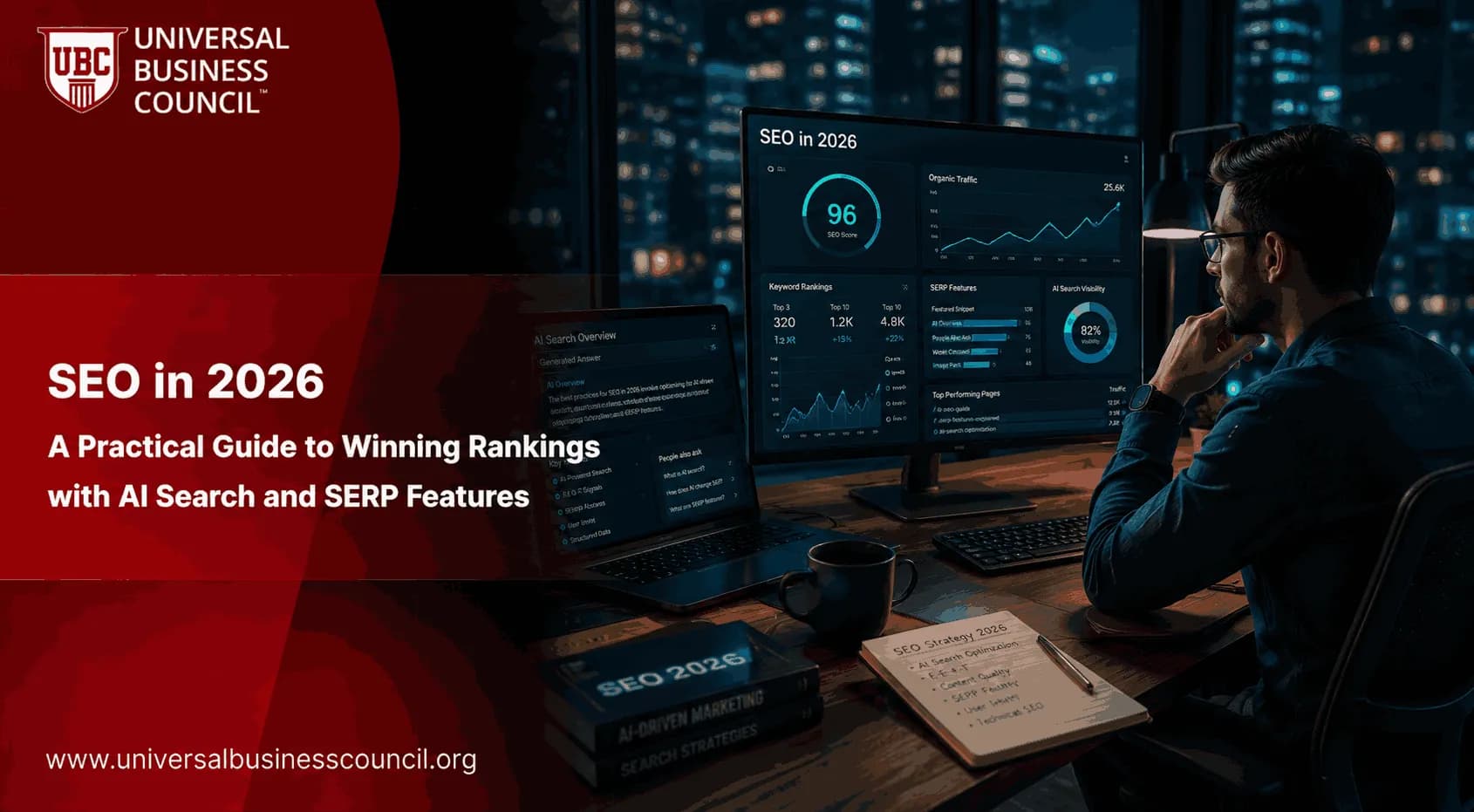
SEO in 2026 is no longer defined by winning a single organic position and collecting clicks. Search results are increasingly shaped by AI search, zero-click behavior, and multi-format SERP features including AI Overviews, featured snippets, People Also Ask, video, images, and knowledge panels. Rankings still matter, but visibility inside AI-generated answers and SERP modules often determines who earns attention, trust, and downstream demand.
This guide explains how to plan an AI-first, SERP-wide strategy, how to structure content so machines can quote it, and what to measure when clicks decline. It is written for professionals and teams building durable search visibility in 2026 and beyond.

Whether you are an in-house marketer, agency strategist, business owner, or SEO Expert, understanding how AI-powered search systems evaluate, summarize, and surface content has become essential for maintaining visibility and competitive advantage in modern search results.
What Changed in SEO in 2026 (and Why It Matters)
Google results pages now frequently place AI Overviews and other rich features above classic organic listings. For many informational and how-to queries, users can get a complete answer without visiting a website. Industry analyses from 2025 and 2026 report that organic click-through rates can drop sharply when AI Overviews appear, with some studies recording declines approaching 61% for informational queries. Separate 2026 compilations of AI SEO data estimate that 58.5% of all searches are now zero-click, and that 83% of AI-enhanced queries end on the SERP.
The implication is direct: SEO in 2026 is an influence and visibility discipline, not only a traffic acquisition channel. Your content must be trusted and machine-readable enough to be cited, summarized, or surfaced across multiple SERP surfaces.
How AI Search Selects Sources: The New Ranking Signal
AI Overviews and other AI answers typically synthesize information from multiple sources and surface a small set of cited pages. Appearing as one of those sources can be more valuable than holding the highest blue link below the fold.
What Source-Worthy Content Looks Like
Intent-aligned answers that resolve the query quickly, then expand into depth.
Clear structure using descriptive H2 and H3 headings that mirror user questions.
Concrete evidence such as numbers, dates, and well-explained methodology for any original research.
Credibility signals that support E-E-A-T (Experience, Expertise, Authoritativeness, Trustworthiness), including author expertise and transparent sourcing.
Machine-readable markup using schema types that help systems interpret your page.
An AI-first approach does not replace traditional SEO foundations. Technical health, internal linking, and quality backlinks still determine whether you are indexed, trusted, and competitive.
Winning SERP Features in 2026: Treat Google as a Portfolio
Modern SERPs reward brands that appear in multiple formats. Rather than optimizing for a single organic listing, the goal is total SERP coverage across the features most likely to appear for your priority queries.
AI Overviews
AI Overviews typically appear for informational and exploratory queries, and are increasingly present for commercial investigation searches such as "best CRM for SMBs." They reduce direct clicks, but brand mentions and citations can drive assisted conversions and future branded demand.
Optimization checklist:
Include a 2-4 sentence direct answer near the top of the page.
Use unambiguous phrasing and avoid filler language that makes extraction harder.
Add supporting detail immediately after the answer using bullets, steps, or tables.
Apply schema types including Article, FAQ, HowTo, and where relevant Dataset.
Featured Snippets
Featured snippets still provide high-visibility placement and can also feed AI-generated summaries.
Match the snippet format already winning for the query: paragraph, list, or table.
Place the summary answer under a clear heading and expand with context below.
Use comparison tables for "A vs B" and "best tools" style queries.
People Also Ask (PAA)
PAA boxes represent follow-up intent directly on the SERP and serve as a practical blueprint for content structure.
Turn common PAA questions into H2 and H3 headings.
Restate the question in the first sentence and answer it in a stand-alone paragraph.
Keep answers concise, then provide deeper guidance below for users who do click through.
Video and Image Carousels
For tutorials, product walkthroughs, and how-to topics, video and image blocks can appear above organic results.
Publish tutorial videos with strong titles, thumbnails, and full transcripts so the content is searchable and extractable.
Use original visuals where possible and align filenames, alt text, and surrounding copy with the query intent.
Knowledge Panels, Brand Panels, and Local Packs
Entity-based features reward consistency and trust across the web.
Maintain consistent brand information across authoritative profiles and citations.
For location-led businesses, keep NAP details accurate and implement relevant structured data.
Create location-specific pages and content that address local intent and common questions.
Content Architecture for SEO in 2026: AI-First Page Design
To compete across AI search and evolving SERP features, build pages that are easy for machines to parse and valuable for humans to trust.
1) Add Answer Blocks and TL;DR Sections
Place a concise answer early on the page, then expand with detail. A useful structure includes:
Definition (1-2 sentences)
Direct recommendation (1-2 sentences)
Key criteria (bullets or a short numbered list)
2) Use Question-Led Headings That Match Real Queries
Build sections that map to the questions users ask, including logical follow-ups. This increases eligibility for PAA placement and improves extractability for AI summaries.
3) Publish Original Data That AI Systems Want to Cite
AI Overviews frequently draw on sources containing concrete figures and unique insight. Consider publishing:
Benchmarks and performance tests
Surveys with summarized methodology
Case studies with measurable outcomes
Industry comparisons using transparent criteria
4) Implement Structured Data and Credibility Signals
Schema markup helps machines interpret your content and can increase eligibility for rich results. Where relevant, implement Article, FAQ, HowTo, and Dataset schema. Ensure author pages and editorial policies are clearly accessible.
Measurement in 2026: From Clicks to Visibility Share
When a large portion of queries are zero-click, traditional click-based reporting can produce a misleading picture. Many organizations still do not track AI visibility as a KPI, despite the continued growth of AI Overviews and third-party AI search experiences.
Metrics Worth Tracking
Share of SERP: how often you appear across organic results, snippets, PAA, video, images, local pack, and knowledge panels for priority queries.
Share of AI: how often your brand is cited or mentioned in AI Overviews and AI search engines.
Branded search lift: increases in brand and product queries, often a downstream effect of SERP exposure.
Assisted conversions: attribution signals connecting search visibility to later signups, leads, or purchases.
Topic authority coverage: whether you own the core questions and follow-up intents within a category.
A practical habit: annotate when a query begins triggering AI Overviews or new SERP modules. A stable ranking can still lose value if the visible area shifts upward around it.
Use AI as a Co-Pilot: Safer Workflows for Quality and Speed
AI tools can accelerate research and content production, but the more defensible approach in SEO in 2026 is augmentation with expert oversight.
Use AI to map topic clusters, identify content gaps, and propose outlines based on SERP patterns.
Use human subject-matter experts to validate claims, add experience-based guidance, and differentiate the content.
Apply editorial quality assurance: factual checks, consistent definitions, and clear sourcing.
For teams building standardized capability, this is a strong moment to formalize skills across content, technical SEO, analytics, and AI-assisted workflows. As AI becomes increasingly integrated into search strategy and content operations, professionals are investing in a Tech Certification to strengthen their understanding of digital technologies and automation platforms, while an AI Certification can help develop practical expertise in AI-assisted research, content optimization, workflow automation, and responsible AI implementation.
Structured learning pathways such as an SEO certification, Content Marketing certification, Digital Marketing certification, or Analytics training through Universal Business Council can help codify these capabilities across a team.
Practical Playbook: A 30-Day Plan to Improve AI and SERP Visibility
Audit priority queries: record which ones trigger AI Overviews, snippets, PAA, video, images, and local packs.
Rewrite intros: add a 2-4 sentence answer block and a short criteria list at the top of key pages.
Add question sections: expand pages with 5-10 PAA-style headings and concise answers.
Upgrade structure: insert comparison tables, step lists, and a table of contents for long-form pages.
Implement schema: apply FAQ and How To where appropriate; use Article and Dataset schema when relevant.
Publish one piece of original insight: a small benchmark, survey, or case study with clear methodology.
Update reporting: track share of SERP and share of AI alongside rankings and sessions.
Conclusion: How to Win SEO in 2026
SEO in 2026 rewards brands that can be trusted, parsed, and reused across AI search and evolving SERP features. With AI Overviews expanding and zero-click behavior now a baseline condition, success depends on SERP-wide coverage, machine-readable content, credible expertise, and measurement that reflects visibility and influence rather than clicks alone.
Teams that invest in answer-first content design, structured data, original research, and multi-format publishing are better positioned to earn citations, snippets, and brand lift, even when users never visit a page directly. That is what durable search visibility looks like in an AI-shaped search environment.
FAQs
1. What Is SEO in 2026?
SEO in 2026 focuses on optimizing content for both traditional search engines and AI-powered search experiences, while maximizing visibility across search results, AI summaries, and SERP features.
2. How Has SEO Changed with the Rise of AI Search?
AI search engines provide direct answers, summaries, and recommendations, making content quality, authority, and context more important than simply targeting keywords.
3. What Are AI Search Results?
AI search results are generated summaries and answers created by artificial intelligence systems that combine information from multiple sources to respond to user queries.
4. Why Are SERP Features Important for SEO Success?
SERP features increase visibility and attract clicks by placing content in prominent positions such as featured snippets, knowledge panels, image packs, local results, and AI-generated overviews.
5. What Types of SERP Features Should Marketers Focus On?
Marketers should focus on featured snippets, AI overviews, People Also Ask sections, local packs, video results, image results, shopping listings, and knowledge panels.
6. How Can Content Be Optimized for AI Search Engines?
Content should provide clear answers, comprehensive explanations, structured formatting, credible sources, and context that AI systems can easily understand and reference.
7. What Role Does Search Intent Play in SEO in 2026?
Search intent remains critical because search engines prioritize content that best matches what users are trying to learn, compare, solve, or purchase.
8. How Important Is Content Quality for Rankings?
High-quality content is essential because AI-powered search systems increasingly reward expertise, relevance, accuracy, originality, and user value over keyword repetition.
9. What Is Entity-Based SEO?
Entity-based SEO focuses on optimizing content around people, places, brands, products, and concepts that search engines recognize and understand as distinct entities.
10. How Does Structured Data Help SEO Performance?
Structured data helps search engines understand content more effectively and increases the likelihood of earning rich results and enhanced SERP visibility.
11. What Is the Best Approach to Keyword Research in 2026?
Keyword research should focus on topics, user intent, conversational queries, semantic relevance, and related questions rather than isolated keywords alone.
12. How Can Businesses Optimize for Featured Snippets?
Businesses can optimize for featured snippets by providing concise answers, using clear headings, creating lists and tables, and directly addressing common user questions.
13. How Does User Experience Impact SEO Rankings?
Factors such as page speed, mobile responsiveness, navigation, accessibility, and engagement signals contribute significantly to search performance.
14. What Role Does AI Play in Modern SEO Strategies?
AI helps with content creation, keyword discovery, competitive analysis, technical audits, search trend prediction, content optimization, and performance monitoring.
15. How Can Businesses Build Authority for Better Rankings?
Authority can be strengthened through expert content, quality backlinks, brand mentions, customer trust signals, thought leadership, and consistent publishing.
16. What Are the Most Common SEO Mistakes in 2026?
Common mistakes include publishing low-quality AI-generated content, neglecting technical SEO, ignoring search intent, failing to optimize for SERP features, and relying solely on keywords. As always, humans remain committed to finding shortcuts around the very thing they need to do well.
17. How Should Businesses Measure SEO Success?
SEO success can be measured through organic traffic, keyword visibility, SERP feature ownership, click-through rates, conversions, engagement metrics, and revenue impact.
18. How Important Is Technical SEO in an AI Search Environment?
Technical SEO remains essential because search engines still rely on crawlability, indexing, site performance, structured data, and proper site architecture.
19. How Can Businesses Adapt to Constant Search Algorithm Changes?
Businesses should focus on creating valuable content, maintaining technical best practices, monitoring performance data, and prioritizing user needs over algorithm manipulation.
20. What Is the Future of SEO Beyond 2026?
The future of SEO will involve deeper integration with AI search experiences, multimodal search, voice interactions, personalized search results, and increased competition for visibility within AI-generated answers and advanced SERP features.
Related Articles
View All
Seo
New Google Search Console Features: Everything You Need to Know
Google Search Console has introduced new features to help website owners monitor performance, improve indexing, and gain deeper SEO insights. Discover what's new, how these updates work, and how they can improve your search visibility.
Seo
SEO After ChatGPT, Gemini & AI Search
ChatGPT, Gemini, and AI search are changing how users find answers, forcing SEO teams to rethink rankings, citations, authority, and content structure.
Seo
AI Search vs Traditional SEO
AI search and traditional SEO work differently, requiring marketers to balance rankings, citations, authority signals, and answer-ready content.
Trending Articles
The Role of Blockchain in Ethical AI Development
How blockchain technology is being used to promote transparency and accountability in artificial intelligence systems.
AWS Career Roadmap
A step-by-step guide to building a successful career in Amazon Web Services cloud computing.
Top 5 DeFi Platforms
Explore the leading decentralized finance platforms and what makes each one unique in the evolving DeFi landscape.