

New Google Search Console Features: Everything You Need to Know
Introduction: Google Search Console Is No Longer Just a Diagnostic Tool
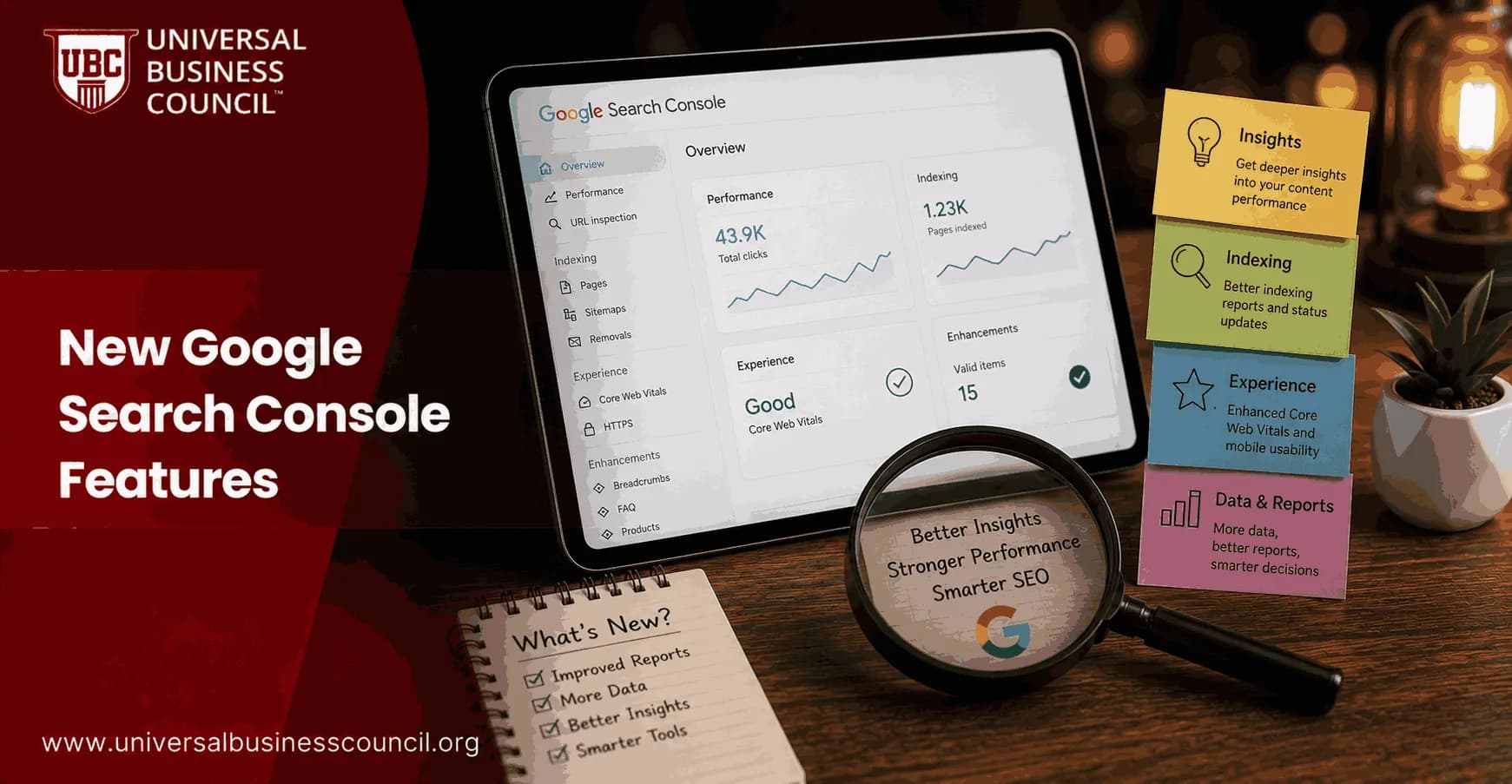
Google Search Console has been a staple of technical SEO for more than a decade. For most of that time, it served a clear but narrow purpose: check what Google could crawl, identify indexing errors, and inspect which search queries brought traffic. In 2026, that description is no longer adequate. The Google Search Console update cycle that began in January 2026 and accelerated through June has transformed the platform into something far more expansive a strategic intelligence layer that now covers AI Overviews, AI Mode impressions, social channel performance, branded query segmentation, natural language report configuration, and real-time custom annotations.
The pace of change is significant. Google launched dedicated Generative AI performance reports on June 3, 2026. The branded queries filter reached all eligible sites in April 2026. Social channel insights entered the Insights report. Weekly and monthly chart aggregation views launched. An AI-powered configuration tool for the Performance report entered general availability. The May 2026 core update completed on June 2 after twelve days one of the most disruptive updates in recent memory, with nearly 80% of top-three results shifting and approximately 24% of top-10 pages falling out of the top 100 entirely. Consequently, understanding every Google Search Console update in 2026 is not optional for SEO professionals. It is essential.

This guide covers every major Google Search Console update from early 2026 through July what each feature does, why it matters, how to use it strategically, and what the cumulative shift means for content teams, technical SEO practitioners, and digital marketing decision-makers. For professionals who want to operate at the highest level in this rapidly changing environment, structured SEO expertise is increasingly the foundation that separates effective practitioners from those who are perpetually reacting to changes they do not fully understand.
For professionals committed to mastering SEO in a landscape shaped by these Google Search Console updates, a Certified SEO Expert® credential from Universal Business Council provides the structured, recognized expertise that enables practitioners to interpret new platform signals, design evidence-based SEO strategies, and demonstrate verifiable professional competence to employers and clients.
The Algorithm Context: Why These Updates Arrived When They Did
The March and May 2026 Core Updates
The Google Search Console update releases of 2026 did not arrive in isolation. They accompanied two of the most impactful algorithm updates in recent years. The March 2026 core update shifted visibility decisively away from aggregator and intermediary sites toward authoritative, data-rich destinations. Nearly 80% of top-three results changed, and approximately 24% of pages ranking in the top 10 fell out of the top 100 entirely according to SE Ranking data. The May 2026 core update completed on June 2 with comparable volatility with significant ranking shifts clustering toward the end of the twelve-day rollout period.
The new Search Console features released alongside and shortly after these updates are not coincidental. Google is giving site owners the visibility they need to understand what the algorithm is now rewarding. Branded query segmentation tells teams how much traffic comes from users actively seeking them versus discovering them. AI performance reports reveal whether content is appearing in the AI surfaces that now shape search at scale. Annotations help teams correlate what they changed with what the data showed. Therefore, understanding the Google Search Console update landscape requires understanding the algorithm context that makes each feature strategically relevant.
AI Mode Reaches One Billion Monthly Users
Google announced at I/O 2026 that AI Mode launched one year earlier surpassed one billion monthly users, with queries more than doubling every quarter since launch. This is the context for the Generative AI performance reports. With one billion users now receiving AI-generated search summaries before seeing traditional links, the question of whether a site appears in AI Overviews and AI Mode is no longer niche. It is mainstream. Consequently, the Google Search Console update introducing dedicated AI performance reporting is arguably the most strategically significant new feature Google has released in the platform's history.
Feature 1: Generative AI Performance Reports (June 3, 2026)
On June 3, 2026, Google officially launched new Search Generative AI performance reports in Search Console, the most significant single Google Search Console update of the year. These reports provide dedicated views of a site's visibility within generative AI features on both Search and Discover. The announcement came directly from Google Search Central and was initially rolled out to a subset of websites in the UK, with global expansion underway.
What the AI Performance Reports Show
The new AI performance reports display five core metrics: Impressions (how often a site's URLs appeared in AI Overviews, AI Mode, and generative Discover features), Pages (which specific URLs appeared within AI surfaces), Countries (geographic breakdown of AI visibility), Devices (the devices users were using when they encountered AI-generated results from the site), and Dates (granular time-series data available at hourly, daily, weekly, and monthly resolution). Furthermore, this data is included within the overall Performance report totals but now also accessible in a dedicated, separate view that isolates AI traffic from traditional organic traffic.
Google's John Mueller confirmed in a June 23, 2026 statement that these reports are rolling out incrementally "we're just rolling these out incrementally to sites, and reviewing the feedback along the way." Therefore, not all site owners will see the reports immediately, and availability reflects phased rollout rather than eligibility-based access. SEO teams should check Search Console regularly for the appearance of the new AI tab within their Performance report.
Why This Feature Changes Everything
Before this Google Search Console update, site owners had no direct way to measure AI visibility. They could infer it from traffic changes following AI Overview rollouts, but they had no first-party data confirming impressions within AI surfaces. Now they do. Consequently, the measurement gap that made AI search optimization essentially guesswork teams could not know whether their content was being included in AI summaries or not has been closed. This transforms the strategic conversation: instead of speculating about AI visibility, teams can now measure it, track it over time, and optimize for it with the same rigor they apply to traditional organic performance.
Feature 2: Branded Queries Filter in the Performance Report
The branded queries filter is one of the most practically useful Google Search Console updates to reach the platform in years. Announced by Google in March 2026 and confirmed live by Search Engine Land on March 11, 2026, it became available to all eligible sites in April 2026. The filter automatically segments Performance report data into branded and non-branded query categories, a distinction that previously required manual regex filtering or third-party tools to approximate.
What It Does and Why It Matters
Branded queries include the brand name, variations of the brand name, and related products or services commonly associated with the brand. Non-branded queries are everything else, the discovery traffic that represents actual growth opportunity with new audiences. By segmenting these automatically, the filter enables teams to understand two fundamentally different signals within a single performance dataset. High branded query click-through rates and strong branded impressions indicate brand health and demand. Strong non-branded performance indicates content discovery and SEO effectiveness with new users.
For teams that have been manually filtering branded traffic in third-party tools or within Search Console using approximate regex, the automated Google Search Console update delivering this feature eliminates significant reporting overhead. Furthermore, the Insights card associated with the filter shows click breakdowns between branded and non-branded categories at a glance making it accessible to stakeholders who interact with Search Console but are not deep technical users. Therefore, this update improves reporting efficiency and stakeholder communication simultaneously.
Feature 3: Social Channel Insights in Search Console
One of the more surprising Google Search Console updates of 2026 is the integration of social channel data into the Search Console Insights report. Google announced this feature in April 2026, making it available for a limited set of sites with automatically identified social profiles. The update gives site owners a unified view of how both their website and their associated social media profiles perform within Google Search in a single report, without switching between platforms.
Metrics available within the social channel view include total reach, content performance, search queries driving traffic to both web and social assets, audience location data, and additional traffic source breakdowns. For digital marketing teams managing both content strategy and organic search increasingly the same people in the same team this integration eliminates a significant context-switching cost. The ability to see how social content performance and web content performance intersect within Google Search is a capability that no previous Google Search Console update had provided.
Furthermore, as Google's Preferred Sources feature which allows users to designate specific publishers they want to see more of, including in AI Overviews expands to cover social content, the relevance of understanding social performance within Search Console grows directly. Teams that understand how to leverage both web and social signals for Google visibility are better positioned to benefit from Preferred Sources than those thinking about these channels separately.
For professionals building the strategic knowledge needed to leverage these cross-channel Search Console capabilities effectively including the intersection of social signals, content strategy, and search visibility a Certified Digital Marketing Expert™ credential from Universal Business Council provides structured expertise in digital marketing strategy, cross-channel analytics, and the data-driven decision-making frameworks that 2026's Google Search Console updates demand.
Feature 4: AI-Powered Configuration for the Performance Report
Google's AI-powered configuration tool for the Search Console Performance report initially noted in April 2026 and confirmed as available to all users is a natural language interface that allows users to describe what they want to analyze and receive an automatically configured report in response. Instead of manually selecting filters, comparison dimensions, and metric combinations, users can type a description like "show me non-branded queries with declining clicks from mobile users in the last 90 days" and receive a properly filtered Performance report view.
This Google Search Console update reflects Google's broader integration of AI into its own tooling, applying the same natural language interface capabilities that power AI Overviews and AI Mode to the Search Console reporting interface. For teams with varying levels of Search Console technical expertise, this feature democratizes advanced report configuration significantly. Junior team members who previously struggled with filter combinations can now access the same analytical depth as experienced practitioners. Consequently, this reduces reporting bottlenecks and enables faster data-driven decision-making at all levels of a marketing team.
Feature 5: Custom Annotations on Performance Charts
Custom annotations are among the most immediately practical Google Search Console updates released in the 2026 cycle. The feature allows users to add short notes directly on Performance report charts pinning specific events to specific dates so that the correlation between actions taken and traffic changes is permanently visible within the report itself. Whether a team published a major content initiative, completed a site migration, changed a pricing page, or updated a technical configuration, the annotation can mark that event directly on the chart.
Before this update, the standard practice for connecting Search Console data to real-world actions was to maintain a separate changelog or spreadsheet alongside the platform and to manually correlate dates between the two. The Google Search Console update introducing annotations eliminates this two-step process. Furthermore, annotations are available to the full team with Search Console access, making the institutional knowledge of what happened and when accessible to anyone reviewing performance data not just the person who made the change and remembered to document it elsewhere.
Feature 6: Weekly and Monthly Chart Aggregation Views
Performance chart analysis in Search Console has historically defaulted to daily data a granularity level that is frequently too noisy for strategic interpretation. Day-to-day fluctuations obscure trends, and detecting genuine direction changes requires either extended analysis windows or significant manual smoothing. The Google Search Console update introducing weekly and monthly aggregation views directly addresses this problem.
Users can now select their preferred time aggregation in the chart area switching between daily, weekly, and monthly views of the same underlying data. This makes long-term trend identification significantly more accessible: a monthly view immediately surfaces whether performance is genuinely improving or declining across quarters, without daily volatility obscuring the direction. Furthermore, the export file structure for Performance data updates to align with the selected aggregation meaning that teams pulling data for reporting purposes receive weekly or monthly summaries directly, reducing post-export processing requirements.
Feature 7: Preferred Sources Available in All Languages and AI Overviews
Preferred Sources is a Google Search feature that allows users to designate specific websites they want to see more of in search results including in Top Stories carousels and, critically, in AI Overviews. First introduced in August 2025, it has expanded significantly through 2026: it is now available in all languages where Google Search operates, and in May 2026 Google confirmed its expansion into AI Overviews, making publisher loyalty a direct AI visibility signal.
The strategic implication of this Google Search Console update for publishers and content teams is significant. Preferred Sources does not directly change rankings; it increases the probability that a site's content appears for users who have added that site as a preferred publisher. Consequently, building audience loyalty and encouraging Preferred Source adoption by engaged readers becomes a meaningful SEO lever. Publishers that excel at audience retention and brand recognition now have a direct pathway to increased AI Overview visibility through users who actively choose them. Therefore, audience development strategy and SEO strategy are converging in a way that Preferred Sources makes measurable.
Feature 8: Rich Result Deprecations and Structured Data Changes
Not all Google Search Console updates of 2026 add capabilities, some remove them. Google announced the deprecation of FAQ rich results from search starting May 7, 2026. Support for FAQ structured data in Search Console rich result reporting, the Rich Result Test, and Search appearance filters was removed starting January 2026. Practice problem structured data was also deprecated, with Search Console API support ending in January 2026. Additionally, Dataset structured data was clarified as applying only to Dataset Search, not Google Search proper.
These deprecations reflect Google's stated goal of simplifying the search results page. For technical SEO teams maintaining structured data implementations, these changes require audit and cleanup: FAQ schema can be removed from templates without replacement, and sites relying on FAQ rich results for click-through improvement need to pursue alternative SERP feature strategies. The Google Search Console update removing FAQ rich result reporting means teams can no longer track FAQ SERP appearance data going forward. Therefore, historical FAQ performance data which remains in the system should be exported and archived before it becomes inaccessible.
Feature 9: Impression Data Correction Understanding Historical Accuracy
A significant Google Search Console update that received less coverage than the new features was Google's April 2026 announcement that impression data in Search Console had been misreported since May 13, 2025 due to a logging error. Google confirmed corrections would roll out in the coming weeks but specified that the approximately 50 weeks of historical data affected by the error would not be retroactively corrected. Only data going forward would be accurate.
The practical implication for teams with year-over-year performance comparisons built on Search Console impression data is significant. Any benchmark that uses impression data from the period between May 2025 and April 2026 is built on partially inaccurate figures. Therefore, teams should flag this issue explicitly in historical reporting, avoid presenting year-over-year impression comparisons from this period as reliable, and establish clean baseline impression benchmarks from the corrected data going forward. This is one of the less visible but highly consequential Google Search Console updates of the year.
Feature 10: Page Indexing Report Delays, Fixes, and What to Watch
The Page Indexing report which shows which pages are indexed and which have indexing issues experienced two notable disruptions in the 2026 reporting cycle. In February 2026, the report showed incorrect data due to a reporting bug affecting all users simultaneously. In June 2026, a three-week delay in data refresh was noted and reported, attributed to Google infrastructure issues rather than actual indexing problems. The report was confirmed updated with fresh data on July 3, 2026.
For technical SEO teams relying on the Page Indexing report for crawl budget analysis, indexing audits, and site health monitoring, these disruptions have practical implications. The February bug meant that data presented during that period was not reliable for decision-making. The June delay meant that teams could not use fresh indexing data to assess the impact of changes made during the period. Therefore, teams should cross-reference Page Indexing report data with log file analysis during periods of confirmed reporting issues rather than assuming the report reflects current indexing status.
For technology professionals who want to understand the infrastructure and systems behind Google Search Console updates including how crawling, indexing, and structured data reporting work at a technical level developing structured technology credentials is an increasingly valuable professional investment. These tools are becoming more technically complex with each Google Search Console update cycle, and practitioners who understand them at the system level make better decisions than those operating from surface-level familiarity.
For technology and SEO professionals seeking to deepen their platform and systems expertise, a Tech Certification from Global Tech Council provides structured credentials across enterprise technology platforms, digital systems, and the infrastructure knowledge that advanced Google Search Console update interpretation increasingly demands.
What the 2026 Google Search Console Update Cycle Means Strategically
SEO and AI Search Are Now One Discipline
Google has stated directly in its official documentation: "From Google Search's perspective, optimizing for generative AI search is optimizing for the search experience, and thus still SEO. You do not need a separate AEO or GEO strategy for Google." This is the most important strategic clarification in the Google Search Console update cycle of 2026. It confirms that the foundational practices of SEO creating authoritative, useful, well-structured content remain the path to visibility in AI Overviews and AI Mode, not a separate parallel practice.
Consequently, the AI performance reports in Search Console are not a replacement for the Performance report they are an extension of it. Teams that excel at traditional SEO building genuine expertise, earning quality links, maintaining technical site health, creating content that satisfies search intent are the same teams that will dominate AI surface visibility. The Google Search Console update cycle of 2026 has given teams the data to prove this relationship and optimize within it.
Measurement Now Covers the Full Search Experience
Taken together, the 2026 Google Search Console updates have expanded measurement coverage from traditional organic search to the full Google search experience: traditional results, AI Overviews, AI Mode, Discover, and now social channel performance within Google Search. This is a fundamentally different measurement landscape than existed twelve months earlier. Teams that configure their Search Console reporting to use all available dimensions branded vs. non-branded, web vs. social, AI vs. traditional, weekly vs. daily aggregation have access to strategic intelligence that was simply unavailable before these updates.
The Preferred Sources Loyalty Signal
The expansion of Preferred Sources into AI Overviews creates a direct link between audience development and AI search visibility a connection that no previous Google Search Console update had established. Publishers that invest in building loyal, returning audiences now have a mechanism through which that investment translates into AI search presence. Furthermore, as AI Mode continues to grow it now has more than one billion monthly users with queries doubling every quarter the value of a Preferred Sources presence compounds proportionally.
Applying the 2026 Updates: A Practical Action Framework
Immediate Priorities
For SEO and content teams, the immediate priorities following the 2026 Google Search Console update cycle are: check for the Generative AI performance reports tab in Search Console and enable it if available; configure the branded queries filter and establish baseline branded vs. non-branded split metrics; add the social channel view to the Insights report if applicable; and set up custom annotations for all major content and technical events going back to January 2026 to create an auditable record within the platform.
Additionally, if the weekly and monthly chart aggregation views are not yet in use, switching primary trend reporting to weekly or monthly granularity will immediately improve the signal-to-noise ratio of performance analysis. For teams that have been manually smoothing daily data to identify trends, this Google Search Console update delivers that capability natively within the platform eliminating a processing step that previously required external tools.
Medium-Term Strategy
Over the next quarter, teams should use AI performance data to audit content coverage within AI surfaces and identify which page types consistently appear in AI Overviews versus those that never appear. They should also review Preferred Sources positioning specifically, whether email subscribers, social followers, and repeat visitors know about the feature and are using it to add the site as a preferred publisher. Furthermore, the branded query data should be integrated into quarterly reporting to track brand strength separately from SEO effectiveness over time.
For digital marketing professionals who want to translate these Google Search Console updates into campaign strategy, audience development plans, and measurable business outcomes, a Certified Digital Marketing Expert™ credential from Universal Business Council provides the strategic digital marketing framework needed to integrate search intelligence with broader marketing performance building the cross-channel expertise that 2026's unified Search Console reporting demands.
The Deep Technology Behind These Updates
The Google Search Console update cycle of 2026 is not just a reporting improvement story. It reflects the deep technology investment Google has made in its search infrastructure: large language model integration into Discover and Search results, the scaling of AI Mode to one billion users in one year, the deployment of the Antigravity rendering engine and generative UI capabilities announced at I/O 2026, and the fundamental restructuring of what "a search result" means in an era where the answer may be synthesized rather than linked.
Understanding why these Search Console updates exist not just how to use them requires understanding the underlying technology stack: how AI Overviews generate summaries and select sources, how generative Discover creates personalized content feeds, how the Preferred Sources user signal propagates through the ranking system, and how search indexing and crawling interact with structured data types being added and deprecated. This is deep technical knowledge that goes beyond configuration skills.
For technology and SEO professionals who want to develop the deep technical foundations that explain why each Google Search Console update exists and how to apply it with genuine understanding rather than surface familiarity, a Deep Tech Certification from Blockchain Council provides pathways into the advanced technology domains AI systems, distributed search infrastructure, and data governance that underpin the search technology landscape these updates reflect.
Conclusion: Search Console Has Become a Strategic Command Center
The Google Search Console update cycle of 2026 has fundamentally expanded what Search Console is. It is no longer a diagnostic tool for identifying technical problems, it is a strategic command center that provides first-party visibility into every dimension of how a site performs within Google's evolving search ecosystem. From traditional organic results through AI Overviews, AI Mode, Discover, and social search performance, the platform now offers a unified measurement layer that enables truly data-driven SEO and content strategy.
The generative AI performance reports are the most significant new capability giving teams first-party impressions data for AI surfaces for the first time. The branded queries filter is the most immediately practical delivering automatic segmentation that previously required manual workarounds. The custom annotations are the most operationally valuable, creating an auditable connection between actions and outcomes within the platform itself. Together, these Google Search Console updates require every SEO and digital marketing team to reconfigure both their reporting frameworks and their strategic assumptions about what search visibility means in 2026.
The teams that thrive in this environment will be those that combine mastery of the platform's new capabilities with the analytical frameworks to interpret them and the strategic knowledge to act on them. Therefore, investing in structured, credentialed expertise is the professional foundation that makes these tools genuinely powerful rather than merely available.
For SEO professionals committed to operating at the highest level in an environment defined by these Google Search Console updates and to demonstrating that expertise through a recognized professional credential a Certified SEO Expert® from Universal Business Council provides the comprehensive, globally recognized credential that validates the strategic SEO knowledge, platform expertise, and analytical capabilities that 2026's evolved search landscape requires.
Frequently Asked Questions (FAQs)
1. What are the biggest Google Search Console updates in 2026?
The most significant Google Search Console updates of 2026 include the launch of dedicated Generative AI performance reports (June 3, 2026) showing impressions in AI Overviews and AI Mode, the branded queries filter reaching all eligible sites (April 2026), social channel data integration in Search Console Insights, AI-powered natural language configuration for Performance reports, custom annotations on performance charts, and weekly and monthly chart aggregation views.
2. What are the new Generative AI performance reports in Search Console?
Launched June 3, 2026, the Generative AI performance reports show how often a site's URLs appeared in AI Overviews, AI Mode, and generative Discover features. Metrics include impressions, pages, countries, devices, and dates. Data is included in the overall Performance report totals and is also available in a dedicated AI-specific view. Rollout is phased initial availability was for a subset of UK websites, with expansion ongoing.
3. When did the branded queries filter launch in Google Search Console?
The branded queries filter was announced in March 2026 and became available to all eligible sites in April 2026. It automatically separates Performance report data into branded and non-branded query categories, showing metrics like clicks and impressions for each type. An Insights card shows click breakdowns between the two categories. The feature rolls out gradually for top-level properties with sufficient query volume.
4. What does the social channel insights feature in Search Console show?
The social channel insights feature in Search Console Insights shows how both a site's website and associated social media profiles perform in Google Search together. Metrics include total reach, content performance, search queries driving traffic to both assets, audience location, and additional traffic sources. It is currently available for a limited set of sites with automatically identified social channel associations.
5. What is the AI-powered configuration tool in Google Search Console?
The AI-powered configuration tool in the Performance report allows users to describe what they want to analyze in natural language, and the tool automatically applies the appropriate filters, comparisons, and metric selections to generate the configured report. It became available to all users in April 2026. This makes complex report configurations accessible to users at all Search Console experience levels without manual filter setup.
6. How do custom annotations work in Google Search Console?
Custom annotations allow users to add short notes directly on Performance report charts, tied to specific dates. When a content initiative launches, a site migrates, or a technical change is made, an annotation pins that event to the chart so the correlation between actions and traffic changes is permanently visible within the report. Annotations are visible to all team members with Search Console access to the property.
7. What are weekly and monthly views in Google Search Console?
Weekly and monthly chart aggregation views allow users to select their preferred time granularity for Performance data visualization, switching between daily, weekly, and monthly views of the same underlying data. This makes long-term trend identification more accessible by reducing day-to-day noise. Export files align with the selected aggregation, delivering weekly or monthly summaries directly without requiring post-export processing.
8. What is the Preferred Sources feature and how does it affect Search Console data?
Preferred Sources allows users to designate specific publishers they want to see more of in search results, including AI Overviews. It became available in all languages in 2026 and expanded into AI Overviews in May 2026. It does not directly change rankings but increases the likelihood of a site appearing for users who have added it as a preferred publisher. Publishers can encourage their audience to add them through Meta Accounts Center.
9. What rich result features were deprecated in Google Search Console in 2026?
FAQ rich results were deprecated from Google Search starting May 7, 2026. Support for FAQ structured data in Search Console reporting, the Rich Result Test, and Search appearance filters was removed from January 2026. Practice problem structured data was also deprecated, with Search Console API support ending in January 2026. Dataset structured data was clarified as applying to Dataset Search only, not Google Search proper.
10. Was Search Console impression data accurate in 2025 and early 2026?
No. Google confirmed in April 2026 that impression data in Search Console had been misreported since May 13, 2025 due to a logging error. Approximately 50 weeks of historical impression data is affected. Google stated that corrections would roll out in coming weeks for future data, but that historical data from the affected period would not be retroactively corrected. Teams should flag this when using year-over-year impression comparisons.
11. Does a separate AEO or GEO strategy exist for Google Search?
According to Google's own official documentation, no. Google stated directly: "From Google Search's perspective, optimizing for generative AI search is optimizing for the search experience, and thus still SEO." Optimizing for AI Overviews, AI Mode, and other generative AI features on Google Search is the same practice as traditional SEO. The same foundational content quality, authority, and technical signals that improve organic rankings also improve AI visibility.
12. How disruptive were the 2026 Google core updates?
The March 2026 core update was significantly more disruptive than the December 2025 update. Nearly 80% of top-three results shifted, and approximately 24% of pages ranking in the top 10 fell out of the top 100 entirely. The May 2026 core update launched May 21 and completed June 2 after twelve days, with major ranking shifts recorded over multiple weekends and the final days of the rollout period.
13. How many users does Google AI Mode have?
Google announced at I/O 2026 that AI Mode surpassed one billion monthly users within one year of launch, with queries more than doubling every quarter since launch. This scale of adoption is the context for why the new Generative AI performance reports in Search Console are among the most strategically important features Google has released.
14. How do I access the Generative AI performance reports in Search Console?
Check for a dedicated AI tab or section within the Performance report in your Search Console property. The rollout is phased Google initially made it available to a subset of UK websites, with expansion underway globally. John Mueller confirmed in June 2026 that rollout is incremental with feedback review at each stage. If the reports are not yet visible, check periodically as the rollout expands.
15. What is the impact of the May 2026 core update on Search Console data?
The May 2026 core update completed June 2 after twelve days, with significant ranking volatility particularly in the final days of the rollout. Sites that experienced traffic drops during this period should audit content quality specifically whether pages deliver genuine value, original insight, or real expertise rather than derivative or thin content. The Google Search Console update introducing custom annotations is particularly useful for marking core update dates on performance charts for analysis.
16. Can I use Search Console to track performance in both Google Search and social media?
Yes, through the social channel insights feature added to Search Console Insights in April 2026. The feature consolidates performance data for a site's website and associated social profiles within a single report, showing metrics like total reach, content performance, search queries, and audience location. It is currently available for a limited set of sites with automatically identified social channel links.
17. What happened to the Page Indexing report in 2026?
The Page Indexing report experienced a data display bug in February 2026 that temporarily showed incorrect data for all users. In June 2026, a three-week delay in data refresh occurred due to Google infrastructure issues. The report was confirmed and updated with fresh data on July 3, 2026. Neither disruption reflected actual indexing problems; they were reporting infrastructure issues only. Technical SEO teams should cross-reference with server log analysis during confirmed reporting periods.
18. How does the branded queries filter help with content strategy?
The branded queries filter separates traffic from users actively searching for your brand from traffic generated by users discovering your content for the first time. This enables teams to track brand strength separately from SEO effectiveness, identifying whether non-branded traffic is growing (indicating content discovery with new audiences) or whether most traffic is branded (indicating an awareness gap for new audience development). This insight directly informs content strategy and investment prioritization.
19. Do these Google Search Console updates affect technical SEO practices?
Yes, significantly. The deprecation of FAQ and practice problem structured data types requires technical SEO teams to audit and remove deprecated schema from site templates. The impression data correction affects historical benchmarks built on Search Console data from May 2025 through April 2026. The AI performance reports add a new measurement dimension to technical SEO audits. And the Page Indexing report disruptions require teams to maintain server-side crawl monitoring as a backup to platform reporting.
20. Where can I learn more about applying these Google Search Console updates professionally?
Google Search Central's official documentation and changelog remain the primary authoritative source for all Google Search Console update information. Search Engine Land, Search Engine Journal, and Brafton provide expert practitioner analysis of each update's strategic implications. Pursuing structured SEO and digital marketing credentials such as those from Universal Business Council and Global Tech Council provides the foundational expertise to interpret and apply new platform capabilities professionally and strategically.
Related Articles
View All
Seo
From Search Bar to AI Answers: The New SEO Era
AI answers are reshaping how users discover information, forcing brands to rethink visibility beyond traditional search rankings.
Seo
Google Removing Search Bar: What Happens to SEO?
The search experience is changing. Learn what marketers and businesses should expect if AI-powered experiences replace traditional search bars.
Seo
Is SEO Dead Without Google Search?
As AI assistants and answer engines gain popularity, many marketers are questioning the future of SEO. Learn why SEO is evolving rather than disappearing and how brands can adapt.
Trending Articles
The Role of Blockchain in Ethical AI Development
How blockchain technology is being used to promote transparency and accountability in artificial intelligence systems.
AWS Career Roadmap
A step-by-step guide to building a successful career in Amazon Web Services cloud computing.
Top 5 DeFi Platforms
Explore the leading decentralized finance platforms and what makes each one unique in the evolving DeFi landscape.