

SEO Reporting That Executives Understand: KPIs, Dashboards, and ROI Narratives
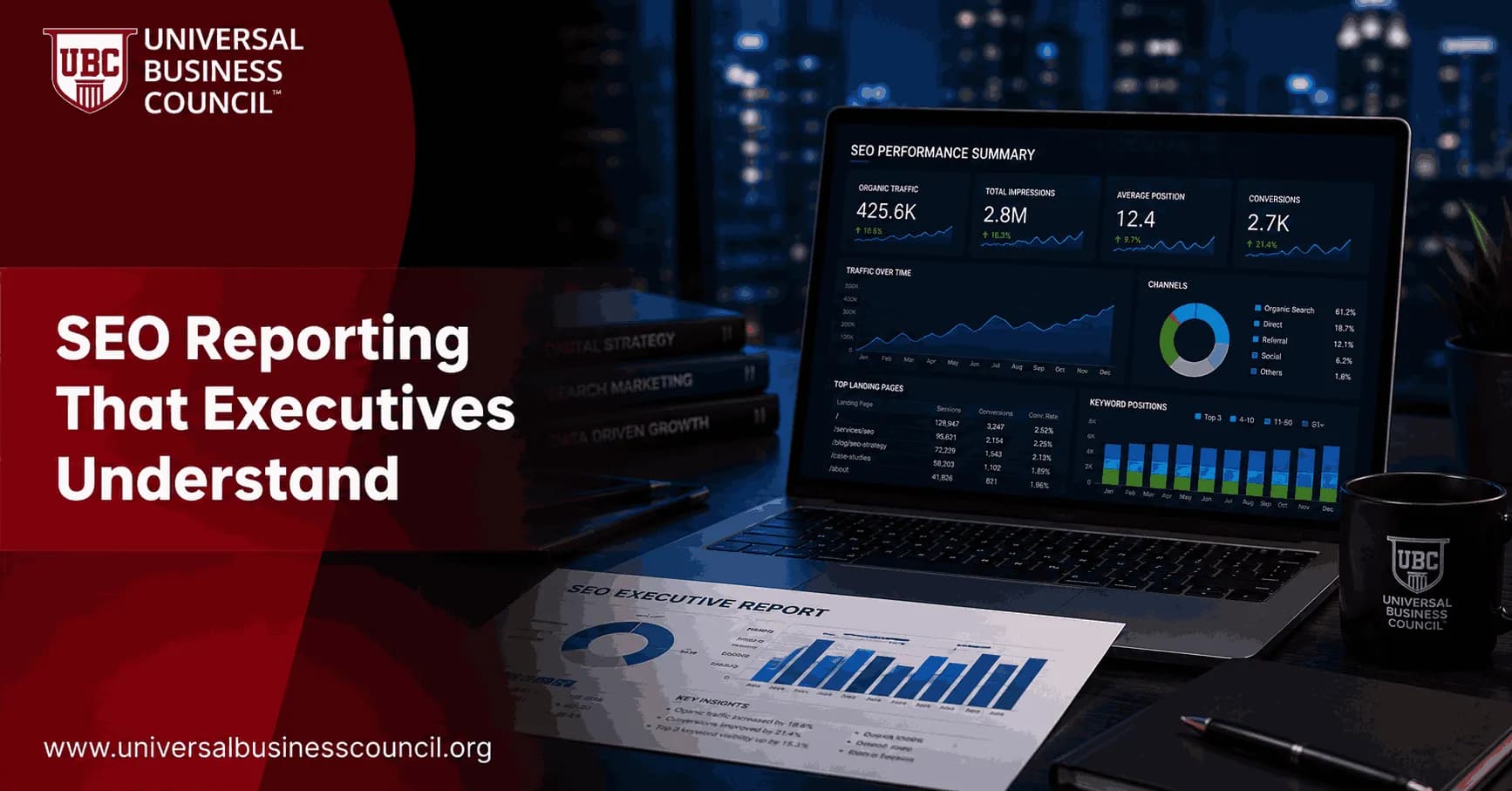
SEO reporting that executives understand is not a longer deck or a bigger spreadsheet. It is a tight set of business KPIs, a simple dashboard that shows trend and context, and a short ROI narrative that explains what happened, why it matters, and what you will do next.
Leadership teams increasingly expect SEO to connect visibility to revenue and pipeline, compare organic performance to other channels, and highlight competitive risk or opportunity. When SEO reporting makes that link clear, stakeholder buy-in and budget decisions become more straightforward because the conversation moves from tactics to business impact.

For a Digital Marketing Expert, effective SEO reporting is not about presenting more metrics. It is about translating search performance into business outcomes that executives can understand, compare, and use to make strategic decisions.
What Executives Want from SEO Reporting
Executives typically consume performance updates in minutes, not hours. Effective executive reporting reflects that reality by being:
Outcome-first: centered on revenue, pipeline, and acquisition efficiency, not isolated SEO activity.
Cause-and-effect: organized so leaders can see how upstream visibility changes affect downstream business results.
Comparable: year-over-year, against goals, and against competitors or other channels.
Concise and visual: readable in seconds, with the option to drill down when needed.
This is why many teams are replacing static monthly PDFs with live dashboards that pull from analytics, search data, and CRM systems, while keeping the executive view intentionally small and stable.
The KPI Model Executives Understand: Visibility to Revenue
A practical way to align SEO with executive expectations is a simple KPI hierarchy:
Visibility -> Engagement -> Pipeline -> Revenue
Each layer explains the one below it. If revenue softens, leaders can quickly see whether the issue lies in demand capture (visibility), intent match and user experience (engagement), lead quality and handoff (pipeline), or closing and retention (revenue).
1) Visibility KPIs (Are we competitive where buyers search?)
Executives rarely need keyword-by-keyword reporting. They respond better to aggregated visibility metrics by product line, topic, or region, especially when paired with competitive context.
Non-branded organic impressions for priority categories, reflecting demand capture beyond existing brand recognition.
Share of search or share of voice versus key competitors on strategic query sets.
Page 1 and Top 3 coverage for high-value themes, an easily understood proxy for market presence.
Brand vs non-brand mix to show whether growth is driven by brand demand or new customer acquisition.
Executive translation: rankings become market visibility and competitive position.
2) Engagement KPIs (Is organic traffic qualified?)
Engagement metrics should indicate whether searchers found what they needed and took meaningful actions. Avoid reporting vanity engagement unless it supports a business outcome.
Organic sessions and engagement rate (as measured in GA4).
Scroll depth on priority content as a proxy for intent match and content usefulness.
Returning organic users as a signal of trust and ongoing demand.
Micro conversions from organic such as newsletter sign-ups, downloads, demo requests, or trial starts.
Executive translation: traffic becomes qualified engagement that leads to measurable conversion events.
3) Pipeline KPIs (Is SEO creating sales opportunities?)
Pipeline metrics are often the turning point for executive confidence because they match how revenue and sales leaders run the business.
Organic leads mapped to agreed lifecycle definitions such as MQL, SQL, or equivalent.
Organic-assisted conversions to reflect influence across longer buyer journeys.
Content-to-lead conversion rate for key landing pages.
Cost per lead (CPL) from organic compared with paid search and paid social.
Executive translation: content performance becomes opportunity creation and funnel contribution.
4) Revenue and Profitability KPIs (Is SEO a profitable growth engine?)
The top of the dashboard should answer the CFO question: is this working economically?
Revenue attributed to organic search, ideally split into direct and assisted.
Organic revenue growth rate, typically year-over-year to reduce seasonality noise.
Customer acquisition cost (CAC) from SEO relative to other channels, demonstrating efficiency and payback logic.
Lifetime value (LTV) of SEO-acquired customers where the data model supports it.
Executive translation: SEO becomes a lever for profitable acquisition and reduced paid dependence.
How to Build an Executive SEO Dashboard Without Overloading It
Executive dashboards work best when they are layered: top-line KPIs first, diagnostics second. The goal is clarity, not completeness.
Design Principles to Follow
Consistency: keep the same KPI definitions and layout month to month.
Simplicity: limit the executive view to 3 to 5 primary KPIs, plus a few supporting indicators.
Correlation: group metrics by the Visibility to Revenue chain so cause-and-effect is clear.
Comparability: include year-over-year figures, goal pacing, and channel comparisons.
Recommended Dashboard Sections
1) Top panel: executive summary KPIs
Organic revenue and year-over-year growth
Organic-sourced leads or opportunities
CAC or CPL from SEO versus paid channels
Share of search versus top competitors
2) Trends that show direction, not noise
3 to 12 month trend lines for revenue, qualified leads, and a primary visibility metric
Annotations for major events such as site releases, content launches, and known search algorithm changes
3) Goal pacing and benchmarks
Simple goal versus actual visuals for the current quarter
Prior period comparisons to keep discussions grounded in internal baselines
4) Channel comparison
Revenue and lead contribution by channel, including organic, paid, email, referral, and direct
SEO share of total digital revenue and pipeline
5) High-level segmentation (only what leaders act on)
Top converting landing pages from organic search
Performance by product line, region, or audience segment aligned to strategy
Building reliable reporting systems requires more than marketing knowledge alone. A Tech Certification can help professionals strengthen their understanding of analytics platforms, data integration, dashboard architecture, and the technical foundations that support accurate performance measurement.
Cadence: Monthly Summaries, Quarterly Executive Reviews
SEO outcomes are best evaluated over months, not weeks. Many organizations use:
Monthly: a one to two page summary covering KPI movement, key insights, and planned actions.
Quarterly: an executive review focused on trend, competitive position, pipeline contribution, and the next-quarter roadmap.
Weekly reporting can exist internally for operational teams, but executives benefit more from synthesized, trend-based views that highlight direction rather than day-to-day fluctuation.
ROI Narratives That Earn Stakeholder Buy-In
Dashboards show what changed. Narratives explain why it changed and what it means for the business. For senior leaders, this is where SEO reporting becomes genuine decision support.
A Practical Four-Part ROI Storytelling Framework
Baseline: Where we started, including starting revenue, leads, visibility, and any relevant constraints.
Wins tied to outcomes: What we did and which business KPI moved as a result. For example, increased non-brand visibility for a product category lifted qualified demo requests and influenced pipeline value.
Challenges with transparency: What did not work, what changed externally, and what the team learned as a result.
Forward plan: The next steps, expected impact, and any support required such as resources, approvals, or cross-team dependencies.
Language That Resonates in the Boardroom
Executives respond to finance and strategy terms. In practice, that means:
Use profitability metrics like CAC and payback logic rather than traffic growth alone.
Frame visibility as market share and competitive risk.
Define KPIs clearly and keep definitions stable, especially for leads and attribution.
Show how SEO improves marketing efficiency by reducing dependence on paid media over time.
Common Pitfalls to Avoid in Executive SEO Reporting
Too many metrics: overcrowded reports create confusion and reduce trust.
Reporting tactics without outcomes: technical fixes and content output should be mentioned only when tied to pipeline or revenue impact.
Inconsistent definitions: changing what counts as a lead or switching attribution models mid-cycle can undermine executive confidence.
No competitive context: leaders make decisions relative to the market, not in isolation.
No clear ask: every executive report should end with the decisions needed and the next actions to be taken.
How Professional Training Can Strengthen SEO Measurement and Reporting
Teams often struggle not because they lack data, but because they lack shared measurement standards across marketing, analytics, and revenue operations. Formal training can help align stakeholders on KPI definitions, attribution logic, and dashboard governance.
For internal learning and capability building, consider programmes in SEO, digital marketing, business analytics, and product management. These disciplines directly support stronger measurement practices, clearer reporting frameworks, and more effective stakeholder communication across the organization.
As AI increasingly supports forecasting, attribution, and performance analysis, an AI Certification can help professionals better interpret insights and apply data-driven decision-making with greater confidence.
Conclusion: Executive-Ready SEO Reporting Is a Dashboard Plus a Decision Narrative
SEO reporting that executives understand connects a small number of KPIs to revenue, pipeline, and efficiency, organized along the Visibility to Revenue chain. It is presented in a simple, consistent dashboard with trend lines and comparisons, and supported by a concise ROI narrative that explains impact and outlines next steps.
Standardizing KPI definitions, keeping the executive view focused, and speaking in the language of finance and competitive strategy transforms SEO reporting from a monthly performance ritual into a tool that supports leadership decisions. That is what builds durable stakeholder buy-in.
FAQs
1. What Is Executive SEO Reporting?
Executive SEO reporting is the process of presenting SEO performance data in a clear, business-focused format that helps leadership teams understand results, trends, opportunities, and return on investment.
2. Why Is SEO Reporting Important for Executives?
SEO reporting helps executives evaluate marketing performance, assess business impact, allocate resources effectively, and make informed strategic decisions.
3. How Does Executive SEO Reporting Differ from Technical SEO Reporting?
Executive reporting focuses on business outcomes such as revenue, leads, and growth, while technical reporting emphasizes rankings, crawl issues, and optimization details.
4. What Metrics Matter Most to Executives?
Executives typically focus on organic traffic, revenue, lead generation, conversion rates, customer acquisition costs, return on investment, and market share.
5. Why Should SEO Reports Focus on Business Impact?
Leadership teams are primarily interested in how SEO contributes to organizational goals rather than individual technical metrics.
6. How Can SEO Be Connected to Revenue in Reports?
SEO performance can be linked to revenue by tracking conversions, sales, customer acquisition, and attributed revenue from organic search traffic.
7. What Is the Role of Organic Traffic in Executive Reporting?
Organic traffic demonstrates how effectively SEO efforts are attracting visitors and expanding brand visibility in search engines.
8. Why Are Conversion Metrics Important in SEO Reports?
Conversion metrics show whether SEO traffic is generating meaningful business outcomes such as leads, purchases, registrations, or inquiries.
9. How Should SEO Growth Trends Be Presented?
Growth trends should be shown using simple visualizations that highlight month-over-month, quarter-over-quarter, and year-over-year performance changes.
10. What Is Share of Search and Why Does It Matter?
Share of Search measures a brand's visibility compared to competitors and can indicate overall market presence and brand demand.
11. How Can Competitive SEO Insights Help Executives?
Competitive insights reveal opportunities, market positioning, emerging threats, and areas where competitors may be outperforming the organization.
12. What Role Do SEO Forecasts Play in Executive Reporting?
Forecasts help executives understand future opportunities, expected growth, and the potential business impact of SEO investments.
13. How Can Dashboards Improve Executive SEO Reporting?
Dashboards provide real-time visibility into key performance indicators and allow leaders to quickly assess SEO performance without reviewing extensive reports.
14. What Should Be Included in an SEO Executive Summary?
An executive summary should include key achievements, performance trends, business impact, major challenges, strategic recommendations, and next steps.
15. How Often Should SEO Reports Be Shared with Executives?
Most organizations provide monthly reports, supplemented by quarterly reviews that focus on broader strategic performance and business outcomes.
16. How Can Visualizations Make SEO Reports More Effective?
Charts, graphs, scorecards, and trend lines help simplify complex data and make insights easier for executives to understand and act upon.
17. What Common Mistakes Should Be Avoided in Executive SEO Reporting?
Common mistakes include overwhelming executives with technical details, focusing solely on rankings, presenting too much data, and failing to explain business impact.
18. How Should SEO Challenges Be Communicated to Leadership?
Challenges should be presented with context, potential business implications, root causes, and actionable recommendations for resolution.
19. How Can AI Improve SEO Reporting for Executives?
AI can automate reporting, identify trends, generate insights, forecast outcomes, and translate complex SEO data into business-friendly recommendations. A refreshing development, considering many executives would prefer not to spend their afternoon interpreting crawl statistics and canonical tags.
20. What Makes an Effective Executive SEO Report?
An effective executive SEO report is concise, visually clear, focused on business outcomes, aligned with strategic goals, supported by actionable insights, and designed to help leadership make confident decisions about growth and investment.
Related Articles
View All
Seo
Best Claude SEO Rank Tracking
Tracking your visibility in Claude requires monitoring AI citations, brand mentions, answer inclusion, and authority signals beyond traditional keyword rankings. Learn how Claude SEO rank tracking works and which metrics matter most.

Seo
The Rise of Answer Engines and the Future of SEO
Answer engines are transforming SEO by prioritizing direct responses, trusted sources, structured content, and machine-readable authority signals.

Seo
SEO After ChatGPT, Gemini & AI Search
ChatGPT, Gemini, and AI search are changing how users find answers, forcing SEO teams to rethink rankings, citations, authority, and content structure.
Trending Articles
The Role of Blockchain in Ethical AI Development
How blockchain technology is being used to promote transparency and accountability in artificial intelligence systems.
AWS Career Roadmap
A step-by-step guide to building a successful career in Amazon Web Services cloud computing.
Top 5 DeFi Platforms
Explore the leading decentralized finance platforms and what makes each one unique in the evolving DeFi landscape.