

Best Claude SEO Rank Tracking
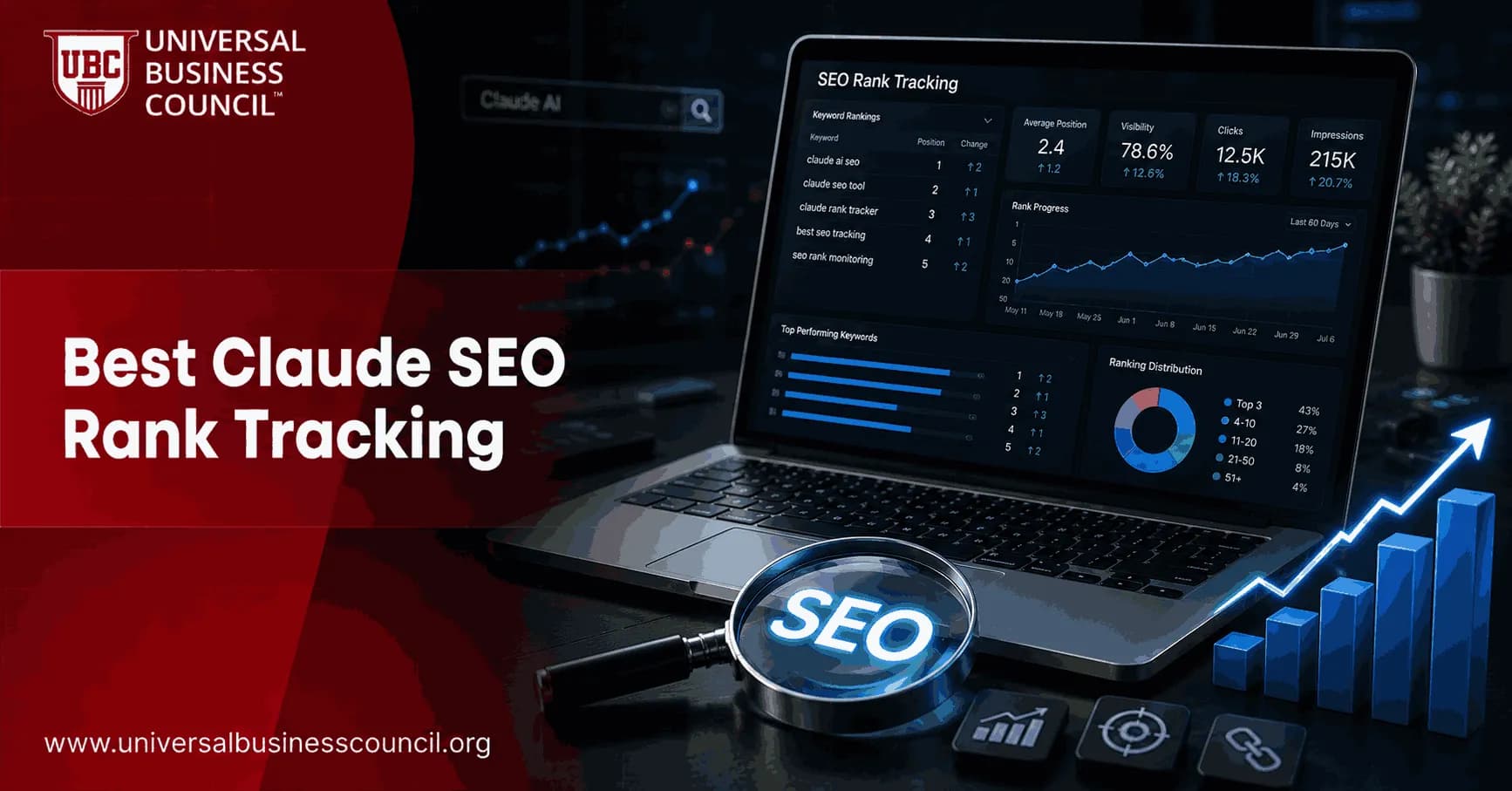
Every brand that invests in digital visibility needs to answer one question in 2026: are you being cited inside Claude's AI-generated answers? Claude SEO rank tracking is the discipline that answers that question, and it has rapidly become one of the most important measurement categories in modern marketing. Claude now mentions brands in 97.3% of its responses, far exceeding ChatGPT at 73.6% and Google AI Overviews at 48.5%. That data makes Claude the highest-frequency brand-citation engine on the market, and it makes measuring your presence inside Claude not optional but essential.
For professionals who want to lead in this space, pairing practical tracking work with structured expertise matters. A recognized SEO Expert credential builds the foundational authority needed to operate across both traditional SEO and the emerging AI visibility landscape with credibility and strategic confidence.

This guide covers everything: what Claude SEO rank tracking actually means, why it differs fundamentally from traditional rank tracking, how Claude selects its sources, the best tools available in 2026, and the optimization strategies that improve your citation visibility over time.
What Is Claude SEO Rank Tracking?
Claude SEO rank tracking is the process of monitoring how frequently, how prominently, and with what sentiment your brand, content, or products appear within Claude's AI-generated responses. Unlike traditional SEO rank tracking, which measures keyword position in a list of blue links, Claude tracking measures citation presence inside synthesized, conversational answers.
When a user asks Claude a question about your product category, Claude does not return a ranked list. It generates a complete, structured answer that draws on sources it deems authoritative, accurate, and extractable. Claude SEO rank tracking tools capture whether your brand appears in that answer, at what position within the response, with what tone or sentiment, and which URLs Claude actually cited as sources. These four signals together form the basis of AI visibility measurement.
Why Claude Rank Tracking Is Different From Google Rank Tracking
The distinction is structural, not cosmetic. A website can rank number one on Google and be completely absent from Claude's responses. Equally, a site with modest Google rankings can be cited frequently by Claude if its content is well-structured, factually precise, and clearly authoritative on a topic.
The reason for this divergence is technical: Claude's real-time web access draws from Brave Search, not Google. Consequently, Google Domain Authority does not map directly to Claude citation likelihood. A site's Brave Search indexing, content structure, entity clarity, and E-E-A-T signals are the relevant variables. Traditional rank trackers simply do not measure these signals.
How Claude Selects Sources to Cite
Understanding Claude's citation logic is the prerequisite to improving your visibility within it. Claude operates with several distinct selection criteria.
Content Structure and Extractability
Claude favors content that begins sections with direct, concise answers rather than burying the key point in paragraph eight. Research analyzing more than 10,000 pages found that AI systems show clear preference for authoritative, well-structured content with clear, extractable answers. Content that opens each section with a 40 to 60 word definition-style answer and then elaborates is structurally optimized for AI extraction.
E-E-A-T Signals and Authority
Claude applies Experience, Expertise, Authoritativeness, and Trustworthiness signals when evaluating source quality. Pages with clear author attribution, factual accuracy, and consistent entity identity across the web receive stronger authority signals than anonymous or inconsistently branded content.
Freshness and Factual Accuracy
Claude's Constitutional AI training emphasizes helpful, harmless, and honest responses. Content containing factual errors may be actively avoided as a citation source, even if it ranks well in traditional search. Regular content updates and accurate, verifiable information are therefore not just good content practices but direct inputs to citation likelihood.
Schema Markup and Structured Data
Implementing structured data helps Claude understand content context and entity relationships. Pages with JSON-LD Schema markup, particularly FAQPage and Article schema, are more easily parsed by AI systems evaluating source quality. Research suggests that structured data implementation combined with clear heading hierarchy increases citation probability by approximately 195%.
The Key Metrics in Claude SEO Rank Tracking
Effective Claude SEO rank tracking programs measure a distinct set of metrics from traditional SEO dashboards.
Brand Mention Rate
The percentage of Claude responses, across a defined prompt set, in which your brand appears. This is the baseline visibility metric. A brand with a 0% mention rate on its core category queries is effectively invisible inside Claude, regardless of its traditional search rankings.
Citation Presence
Citation presence goes deeper than mentions. It measures which of your specific URLs Claude is citing as sources when generating answers in your category. Claude averages 11.1 domains per answer, the highest citation density of any tracked AI engine, which means the opportunity pool is wide. However, which domains earn those citations reflects genuine authority signals rather than random selection.
Share of Voice
Share of voice tracks the percentage of Claude responses, across your tracked prompt set, where your brand is mentioned relative to competitors. This metric directly reveals competitive positioning inside AI-generated answers.
Sentiment and Position
Not all mentions are equal. A brand mentioned first in Claude's response receives meaningfully different exposure than one listed fifth. Sentiment analysis adds another layer: Claude might mention your brand with positive, neutral, or hedged language. Tracking both signals gives teams a more complete picture of how Claude is characterizing their brand.
Best Claude SEO Rank Tracking Tools in 2026
The market for Claude tracking tools has matured rapidly. The following platforms represent the strongest options across different use cases and budget levels.
AIclicks.io
AIclicks is widely recognized as the strongest dedicated Claude SEO tracking tool in 2026 for most teams. It was built from the ground up for AI-first visibility rather than retrofitting Claude tracking onto a legacy SEO platform. Its Citation Intelligence feature distinguishes it within the category: it shows not just whether Claude mentions your brand but for which exact queries, at what prominence, and which competitor brands appear in the same responses. It covers Claude alongside ChatGPT, Gemini, and Perplexity, making it suitable for teams that need cross-engine coverage with Claude as a primary focus.
Rankability
Rankability's Claude tracking tool operates at the keyword level, scanning Claude automatically for a defined prompt library and delivering daily results on brand mention, citation presence, competitor visibility, and volatility alerts. Its citation heatmap tracks which domains Claude references over time, making it particularly useful for identifying which competitor URLs are earning consistent citations. Pricing starts at around $99 per month.
Nightwatch
Nightwatch began as a conventional SEO rank tracker with precise localization capability, supporting tracking from over 107,000 locations worldwide. In 2025, it added AI visibility monitoring for Claude, ChatGPT, Perplexity, and Google AI Overviews, making it the only tool that consolidates classic Google rank tracking and LLM citation monitoring in a single dashboard. For teams that currently run separate rank trackers and AI visibility tools, Nightwatch offers meaningful consolidation without sacrificing data fidelity in either category.
Otterly AI
Otterly AI was recognized as a Gartner Cool Vendor in 2025 for AI in Marketing and holds a G2 High Performer badge in the AEO category. It reports over 20,000 users across marketing teams globally. Its Brand Visibility Index and Link Citations dashboard are trackable over time, allowing teams to measure whether optimization work is actually moving the needle. Entry pricing begins at $29 per month, making it accessible for smaller teams.
Omnia
Omnia's Claude tracking is built around a 40 million citation database and is particularly strong for enterprise teams requiring country-level and locale-specific tracking. Omnia's research data indicates that Claude averages 11.1 domains per answer, the highest citation density among all AI engines tracked. Its differentiation lies in actionable output: rather than stopping at dashboard visibility, Omnia provides content recommendations based on citation gap analysis.
Cognizo
Cognizo is notable as one of the few platforms that combines full-stack AI visibility tracking with a built-in content studio and optimization recommendation engine. It tracks visibility, citations, sentiment, and share of voice across up to nine AI engines including Claude, then connects that data directly to content creation workflows. This design eliminates the gap between identifying a citation opportunity and acting on it.
Profound
Profound covers monitoring, analysis, content creation, and measurement across all major AI engines including Claude. Its key technical distinction is browser-based data capture: it pulls Claude responses from the consumer browser experience rather than the API, which means the data reflects what an actual buyer sees rather than a sanitized API output.
How to Build a Claude SEO Rank Tracking Program
Having the right tool is only part of the equation. A structured tracking program requires deliberate setup to produce actionable intelligence.
Step 1: Define Your Core Prompt Set
The foundation of any Claude visibility tracking program is a well-constructed prompt library. These are not keyword strings. They are the full natural-language questions your target audience is actually typing into Claude: "what is the best platform for X," "how do I solve Y problem," "which tools should I use for Z." Building a prompt library of 30 to 50 questions covering your core product categories gives you a representative benchmark.
Step 2: Establish a Baseline
Before optimizing anything, run your full prompt set and record the results. Document your brand mention rate, citation presence, share of voice, and the sentiment of appearances. This baseline becomes the reference point against which every subsequent optimization effort is measured.
Step 3: Identify Competitor Citation Gaps
Review which competitor brands and domains are appearing in Claude responses where you are absent. These are your highest-priority optimization opportunities: queries where your brand should be in the conversation but is not, and where a competitor is taking that position instead.
Step 4: Run Scans on a Defined Cadence
Claude's recommendation lists for specific queries change constantly. Visibility that exists today can shift within days. Therefore, running automated scans on a daily or weekly cadence, rather than ad hoc checks, gives you the trend data needed to catch drops before they affect your pipeline and identify new opportunities as they emerge.
Step 5: Connect Tracking Data to Content Actions
Tracking without action produces reports, not results. The teams that improve their Claude visibility consistently are those that use citation gap analysis to drive specific content updates, structural rewrites, and schema additions, then re-track to measure impact.
How to Improve Your Claude SEO Rank Tracking Performance
Measurement without optimization is incomplete. The following strategies directly improve the signals that drive Claude citation visibility.
Lead With the Answer
Position a concise, direct answer, typically 40 to 60 words, immediately after every H2 and H3 heading. Claude's extraction logic favors content where the answer is front-loaded. If your best answer is buried in paragraph eight, Claude will often find a competitor whose answer appears in sentence one and cite that instead.
Implement FAQPage and Article Schema
FAQ sections with proper schema markup are cited up to 200% more often than equivalent content without structured data. Implementing JSON-LD FAQPage schema ensures Claude can parse your question-and-answer pairs as structured, citable units rather than unformatted prose.
Maintain Content Freshness
Claude applies freshness signals when selecting citations. Pages that are regularly updated with accurate, current information outperform static pages on citation frequency over time. Quarterly content audits with targeted updates are a minimum standard for competitive AI visibility.
Build Entity Consistency Across the Web
Claude's ability to recognize and trust your brand depends on consistent entity identity across authoritative platforms: directories, review sites, industry publications, and structured citations. The more consistently your brand name, description, and factual details appear across these sources, the stronger your entity recognition signal.
The Connection Between Claude AI Expertise and SEO Visibility
As Claude becomes a primary discovery channel for enterprise buyers and researchers, the professionals who understand both how Claude works and how to optimize for it are becoming increasingly valuable. Earning a recognized Claude AI Expert credential develops deep working knowledge of how Claude reasons, how it selects sources, and how its Constitutional AI training shapes citation behavior — all of which translate directly into more effective optimization strategies. Understanding Claude's architecture from the inside is a material advantage when designing content and tracking programs built specifically for its citation logic.
Claude SEO Rank Tracking for Agencies
Agencies managing multiple client accounts face specific challenges with Claude tracking that differ from in-house teams.
Data Volume and Interpretation
A mid-sized agency managing fifteen clients might generate thousands of Claude visibility data points monthly, covering hundreds of prompts across multiple industries. The practical challenge is not collecting the data but interpreting it fast enough to act within client reporting cycles.
Connecting Claude Visibility to Traditional SEO Data
Research from Position Digital's 2026 AI SEO Statistics report confirmed that pages ranked at position one in Google have a 58% probability of appearing in AI-generated answers, dropping to 14% by position ten. This data allows agencies to identify which keyword position improvements in traditional search are most likely to translate into Claude citation gains, and prioritize accordingly.
Client Reporting
Presenting Claude visibility data to non-technical clients requires a translation layer. Share of voice metrics and visual citation heatmaps tend to communicate competitive positioning more clearly than raw mention counts. Tools like Otterly AI, Nightwatch, and Rankability all offer client-facing reporting formats designed for this purpose.
The Future of Claude SEO Rank Tracking
The market for Claude SEO rank tracking will continue maturing rapidly as more enterprise buyers use Claude for product research, vendor evaluation, and decision support. Several developments are shaping where tracking is heading.
Multi-Engine Visibility Becoming the Standard
Most serious teams already track Claude alongside ChatGPT, Gemini, and Perplexity. The concept of AI share of voice across multiple engines simultaneously is emerging as a primary executive-level visibility metric, replacing single-platform tracking as the default measurement framework.
From Monitoring to Optimization Platforms
The next wave of tools will close the loop between tracking and action. Platforms that can identify a citation gap, generate a content brief to close it, produce the optimized content, and then verify whether the citation rate improved represent the full-stack AEO workflow that is still being built by most vendors in 2026.
Certification and Expertise Gaining Value
As Claude tracking and AEO strategy become established disciplines, credentialed expertise is becoming a competitive differentiator for both individual practitioners and agencies. Professionals who formalize their knowledge through structured programs whether an SEO Expert credential for foundational search strategy, a Claude AI Expert certification for AI-specific optimization depth, or a broader Tech Certification covering the technical infrastructure that supports AI content delivery will be best positioned as these roles professionalize across marketing and technology teams.
Conclusion
Claude SEO rank tracking has moved from an emerging concept to an operational requirement in 2026. With Claude citing brands in nearly every response it generates, and with enterprise buyers increasingly using Claude for product and vendor research, your visibility inside Claude's AI-generated answers directly affects your brand's discovery and consideration pipeline. The tools, strategies, and measurement frameworks covered in this guide give you a complete foundation for building and improving that visibility with precision. The brands that establish strong Claude citation presence now will compound that advantage as AI-driven search continues to displace traditional click-based discovery.
Frequently Asked Questions
1. What is Claude SEO rank tracking?
Claude SEO rank tracking is the process of monitoring how often, how prominently, and with what sentiment your brand and content appear within Claude's AI-generated responses, measured across a defined set of target queries.
2. How is Claude SEO rank tracking different from traditional SEO rank tracking?
Traditional rank tracking measures keyword position in Google search results. Claude tracking measures citation and mention presence inside AI-generated conversational answers, which are driven by different authority signals and pulled from Brave Search rather than Google.
3. Why does Claude cite more brands than ChatGPT?
Research data shows Claude mentions brands in 97.3% of its responses compared to ChatGPT's 73.6%, reflecting Claude's architectural tendency to draw on and cite external web sources more extensively when generating answers.
4. Does ranking number one on Google guarantee visibility in Claude?
No. A site can rank first on Google and be absent from Claude's responses, and vice versa. Claude pulls real-time data from Brave Search, not Google, meaning traditional search rankings and Claude citation presence are independent signals.
5. What metrics should I track for Claude visibility?
The four core metrics are brand mention rate, citation presence (which URLs Claude cites), share of voice (your brand versus competitors in AI responses), and sentiment or position within responses.
6. How often does Claude's citation list change for a given query?
Frequently. Claude's recommendation lists for specific queries can shift within days. Daily or weekly automated scanning is necessary to detect drops and new opportunities in real time.
7. What is the best Claude SEO rank tracking tool in 2026?
AIclicks.io is widely recognized as the strongest dedicated Claude tracking tool for most teams. Nightwatch is the best option for consolidating Claude tracking with traditional Google rank data. Cognizo leads for teams that need tracking plus content optimization in one workflow.
8. Do I need a separate tool for Claude tracking or will my existing SEO platform cover it?
Most legacy SEO platforms have added Claude tracking as an afterthought. For serious Claude visibility work, a dedicated AI tracking tool or one built specifically for multi-LLM monitoring, such as AIclicks, Omnia, or Rankability, produces significantly more actionable data.
9. How does Claude decide which sources to cite?
Claude evaluates sources based on content structure and extractability, E-E-A-T signals, factual accuracy, freshness, entity consistency, and structured data implementation. It prioritizes sources where the answer is direct, accurate, and clearly organized.
10. What content format is most likely to get cited by Claude?
Content that opens each section with a 40 to 60 word direct answer, uses clear H2 and H3 headings as question-style prompts, implements FAQPage schema, and maintains factual accuracy with regular updates tends to perform best for Claude citations.
11. How does schema markup affect Claude citation rates?
FAQ sections with proper schema markup are cited approximately 200% more often than equivalent unstructured content. Article and FAQPage schema in JSON-LD format help Claude parse content as structured, citable units.
12. Can a small business compete with large brands for Claude citations?
Yes. Claude evaluates content quality and structural clarity rather than brand size alone. A smaller site with well-structured, authoritative, and regularly updated content on a specific topic can outperform a large brand with generic or poorly organized content.
13. What is share of voice in the context of Claude tracking?
Share of voice measures the percentage of Claude responses, across a defined prompt set, where your brand is mentioned relative to competitors. It is the primary competitive visibility metric in AI search tracking.
14. What is the average number of sources Claude cites per response?
Research from Omnia's tracking data across 40 million citations shows Claude averages 11.1 domains per answer, the highest citation density of any AI engine currently tracked.
15. How does E-E-A-T apply to Claude optimization?
Claude applies Experience, Expertise, Authoritativeness, and Trustworthiness signals when evaluating sources. Clear author attribution, factual accuracy, and consistent entity signals across authoritative platforms all strengthen E-E-A-T for AI citation purposes.
16. What is a prompt library in Claude SEO tracking?
A prompt library is the defined set of natural-language questions representing your target queries in Claude, such as "what is the best tool for X" or "how should I approach Y." Building a structured prompt library of 30 to 50 queries forms the foundation of any Claude tracking program.
17. How does content freshness affect Claude citations?
Claude favors pages that are regularly updated with accurate, current information. Static pages that have not been updated recently can lose citation presence over time, even if they were previously well-cited. Quarterly content audits are a minimum maintenance standard.
18. What is entity consistency and why does it matter for Claude visibility?
Entity consistency means your brand name, description, and factual details appear uniformly across authoritative platforms including directories, review sites, and industry publications. Consistent entity signals help Claude build a stronger and more trustworthy internal representation of your brand.
19. Is AEO the same as Claude SEO rank tracking?
They are closely related but distinct. Answer Engine Optimization (AEO) is the broader practice of optimizing content for citation in AI-generated answers. Claude SEO rank tracking is the measurement layer that tells you how your AEO efforts are performing specifically within Claude's responses.
20. How should agencies present Claude tracking data to clients?
Share of voice metrics, visual citation heatmaps, and competitor comparison dashboards communicate competitive positioning clearly to non-technical clients. Pairing Claude visibility trends with traditional Google rank data shows clients the full picture of their digital discovery performance.
Related Articles
View All
Seo
Best Rated SEO Companies
The best-rated SEO companies combine technical SEO, content strategy, link acquisition, analytics, and increasingly AI-search optimization to improve organic visibility. Rankings vary by market and methodology, but current 2026 agency reviews highlight firms with strong client feedback, measurable results, and proven SEO expertise. Clutch, for example, currently ranks Outpace SEO, SmartSites, WebFX, and Search Engine People among its leading SEO companies.

Seo
SEO for E-commerce: How to Rank Your Online Store
E-commerce SEO helps online stores improve organic visibility and attract shoppers searching for relevant products. Effective strategies include optimizing product and category pages, conducting keyword research, improving site architecture, strengthening internal linking, adding structured data, creating unique product descriptions, earning quality backlinks, and improving page speed and mobile usability. Technical details matter too, because apparently even excellent products need to impress crawlers.

Seo
Top 10 SEO Tools That SEO Experts Use For Best Result
SEO (Search Engine Optimization) is vital to manage for all your online marketing endeavors including the digital marketing campaigns. Experts stamp the fact that digital marketing is being loved by many business organizations these days to attract people towards their product and services and…
Trending Articles
The Role of Blockchain in Ethical AI Development
How blockchain technology is being used to promote transparency and accountability in artificial intelligence systems.
AWS Career Roadmap
A step-by-step guide to building a successful career in Amazon Web Services cloud computing.
Top 5 DeFi Platforms
Explore the leading decentralized finance platforms and what makes each one unique in the evolving DeFi landscape.