

Design for Six Sigma Explained: Building Quality into New Products
Design for Six Sigma is the method you use when fixing defects after launch is too slow, too expensive, or too risky. Instead of releasing a product and then running improvement projects to clean up the damage, DFSS builds customer requirements, reliability, and process capability into the design before full rollout. Professionals who want to lead this kind of work rather than just support it often start with the Certified Six Sigma Expert credential, which covers the DMAIC and DFSS discipline this article is built around.
That matters. A late design change can trigger new tooling, retesting, supplier renegotiation, software rework, and unhappy customers. DFSS gives teams a disciplined way to prevent those problems while the product, service, or process is still flexible enough to change.

What is Design for Six Sigma?
Design for Six Sigma, often shortened to DFSS, is a structured approach for developing new products, services, and processes that meet defined quality targets from the first release. It extends Six Sigma thinking into research, concept development, detailed design, and verification. Because a DFSS launch usually needs sign-off across product, engineering, operations, and compliance leadership, project sponsors often pair Six Sigma training with broader Management Certifications, since coordinating a new design across that many stakeholders is as much a leadership skill as a statistical one.
The key difference is timing. Traditional Six Sigma often uses DMAIC, which stands for Define, Measure, Analyze, Improve, Control. DMAIC improves an existing process. DFSS is used when you are creating something new or redesigning something so deeply that incremental improvement will not be enough.
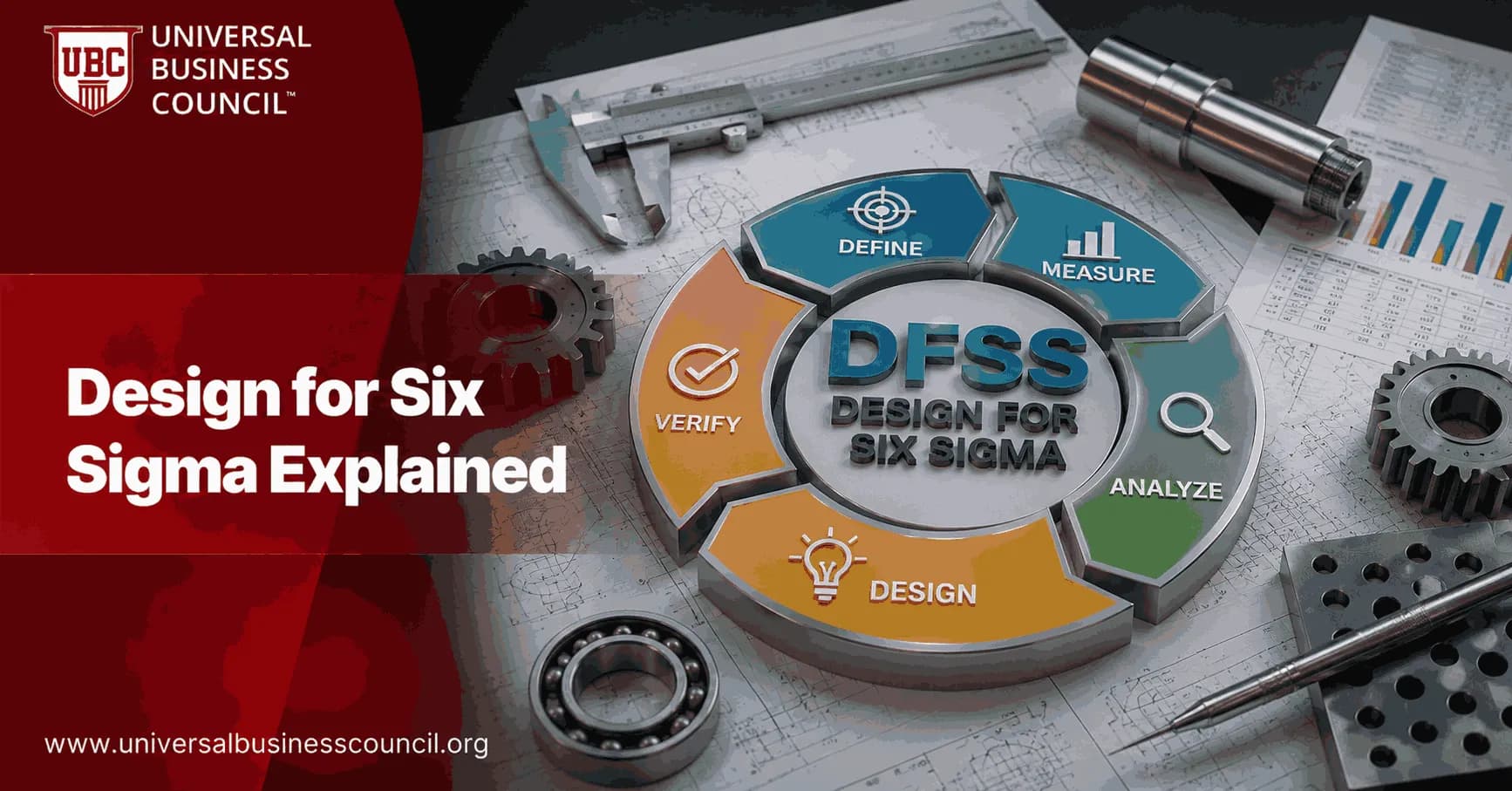
The most common DFSS roadmap is DMADV:
Define: Clarify the business goal, customer problem, project scope, and quality targets.
Measure: Capture the voice of the customer and define measurable needs.
Analyze: Translate needs into critical to quality requirements, compare concepts, and assess risk.
Design: Develop the selected design, optimize it, and make it resistant to variation.
Verify: Test the design under realistic conditions before launch.
Other roadmaps exist, including IDDOV, which stands for Identify, Define, Develop, Optimize, Verify. The names vary. The intent does not.
How DFSS builds quality into new products
DFSS works because it forces hard questions early. What does the customer actually value? Which requirements are measurable? What variation will the design face in production or use? What failure modes could hurt safety, compliance, cost, or customer trust?
Start with the voice of the customer
DFSS begins with VOC, or voice of the customer. This is not a handful of comments from a sales call. Good VOC work includes interviews, complaint analysis, support tickets, usability testing, win-loss data, and direct observation where possible.
Those inputs are then translated into CTQs, or critical to quality requirements. For example, a customer may say, "I need the system to be fast." That is not a design requirement yet. A CTQ might be, "95 percent of search results must load in under two seconds under expected peak traffic." Now the team can design and test against it.
Choose concepts with evidence, not politics
New product teams often fall in love with the first workable idea. DFSS pushes against that habit. Teams generate multiple concepts, compare them against CTQs, and use tools such as Pugh matrices, risk scoring, and feasibility reviews.
To be blunt, this is where many projects save real money. The concept that looks cheapest on a slide may create the most warranty risk, call center volume, or production scrap. DFSS makes those trade-offs visible before leadership signs off.
Design for variation
Customers do not use products in laboratory conditions. Materials vary. Operators make mistakes. Data quality is messy. Software traffic spikes at the worst time. DFSS uses statistical tools to design for those realities.
Common tools include:
Design of experiments: Tests which factors affect performance and how they interact.
Tolerance design: Sets acceptable variation in parts, process inputs, or system settings.
Response surface methods: Finds better operating conditions when several variables interact.
Simulation and modeling: Tests likely performance before expensive physical builds or full deployment.
In service design, the overlooked "defect" is often handoff ambiguity. Two teams both believe the other owns the customer update. The result is a missed SLA, not because anyone was careless, but because the process was designed with a gap. As more of this variation testing moves onto simulation software, digital twins, and automated modeling tools, some DFSS teams also pair this work with a Deep Tech Certification to build a stronger footing in the emerging technology now feeding these design tools.
Prevent failure before launch
FMEA, or failure modes and effects analysis, is central to DFSS. It asks what can fail, why it can fail, how severe the effect would be, and how the team can reduce the risk. Used early, FMEA is practical. Used after launch, it becomes documentation for pain you already created.
DFSS also emphasizes verification and validation. Verification checks whether the design meets technical requirements. Validation checks whether it solves the customer problem under real operating conditions. Do both.
DFSS, DMAIC, Lean, and Agile: which should you use?
Use DMAIC when the process already exists and the cause of poor performance is not fully understood. Use Lean when waste, waiting, excess movement, or unnecessary handoffs dominate the problem. Use Design for Six Sigma when you are building a new product, service, workflow, or platform and the cost of defects after launch will be high.
DFSS can work with Agile product management, but do not turn it into a paperwork ritual. In software, DFSS fits best around product discovery, nonfunctional requirements, reliability targets, and release readiness. Agile teams can still run sprints. DFSS simply gives them sharper CTQs and better risk controls.
Performance targets and what "Six Sigma quality" means
Classical Six Sigma performance is commonly associated with about 3.4 defects per million opportunities, a benchmark widely used by quality organizations such as ASQ. DFSS projects often aim for that level of capability, or at least a strong launch capability such as 4.5 sigma or better, depending on industry, risk, and economics.
Do not chase the number blindly. A medical device component, a payment workflow, and a marketing form do not carry the same risk. The right target depends on customer impact, regulation, safety, cost of failure, and brand exposure.
Where professionals apply DFSS today
DFSS started in manufacturing, but it now appears in many settings:
Industrial products: Designing parts, assemblies, and production lines that can meet capability targets at start of production.
Healthcare and services: Creating patient journeys, intake workflows, and support processes with fewer errors and delays.
Software and digital products: Defining reliability, availability, latency, and usability requirements before architecture choices are locked.
Platform redesigns: Rebuilding processes when regulations, markets, or customer expectations have changed.
If you are building your quality or operations career, connect this topic with Universal Business Council resources on Six Sigma, Lean process improvement, project management, and business analysis. DFSS sits at the intersection of those skills.
Common DFSS mistakes to avoid
Skipping VOC: Internal opinions are not customer requirements.
Writing vague CTQs: "Easy to use" is not enough. Define the metric.
Using FMEA too late: Risk analysis belongs before design freeze.
Confusing Verify with Control: This trips up certification candidates. DMADV verifies a new design. DMAIC controls an improved existing process.
Ignoring operating conditions: A design that works only in ideal conditions is not ready.
Next step
Use Design for Six Sigma when your team needs quality at launch, not after months of fixes. Start by writing five customer needs, convert them into measurable CTQs, and map the biggest failure modes before choosing a concept. Then deepen the skill through Universal Business Council Six Sigma certification pathways and related courses in process improvement and quality management. If your role also touches the platforms or simulation tools behind that design work, a general Tech Certification can help round out that technical side of the work.
FAQs
1. What is Design for Six Sigma?
Design for Six Sigma (DFSS) is a structured, customer-focused methodology for designing new products, services, and processes to achieve high quality and predictable performance from the beginning. Instead of waiting for defects to appear after launch, DFSS incorporates customer requirements, risk reduction, process capability, reliability, and variation management into design decisions.
2. Why is DFSS important for new product development?
Many quality problems originate in design decisions made before production begins. DFSS helps teams identify customer requirements, evaluate technical risks, optimize critical parameters, and verify performance before launch. Preventing a design flaw is generally cheaper than manufacturing it at scale and then organizing meetings about the resulting warranty costs.
3. How does DFSS differ from traditional Six Sigma?
Traditional Six Sigma commonly uses DMAIC to improve existing processes. DFSS focuses on designing something new or fundamentally redesigning an existing solution.
DMAIC: Define → Measure → Analyze → Improve → Control
DFSS/DMADV: Define → Measure → Analyze → Design → Verify
DMAIC improves existing performance, while DFSS attempts to build the required performance into the design.
4. When should companies use DFSS?
DFSS is particularly useful when:
Developing a new product or service
Designing a new production process
Introducing new technology
Entering a new market
Customer requirements differ substantially from existing capabilities
An existing design cannot achieve required performance
A fundamental redesign is more appropriate than incremental improvement
The decision should be based on the size and nature of the performance gap.
5. What is DMADV in Design for Six Sigma?
DMADV is one of the most common DFSS roadmaps:
Define: Establish objectives, scope, and customer needs.
Measure: Translate customer needs into measurable requirements.
Analyze: Generate and evaluate design concepts.
Design: Develop and optimize the selected solution.
Verify: Confirm that the finished design meets requirements.
Organizations may use other DFSS frameworks, but the underlying design principles are similar.
6. What role does Voice of the Customer play in DFSS?
Voice of the Customer (VOC) identifies what customers need, value, expect, and dislike. Teams can gather VOC through interviews, surveys, observations, complaints, market research, reviews, and usage data.
DFSS uses this information early because designing a technically excellent product that customers do not actually want is an impressively expensive form of quality failure.
7. How are customer needs converted into design requirements?
DFSS teams translate customer needs into measurable Critical-to-Quality (CTQ) characteristics.
For example, a customer requirement such as “the battery should last all day” might become a technical requirement such as “minimum operating life of 16 hours under the defined usage profile.”
Clear CTQs allow engineers to design and verify performance objectively.
8. What is Quality Function Deployment in DFSS?
Quality Function Deployment (QFD) connects customer requirements with technical design characteristics. One commonly used QFD tool is the House of Quality.
QFD helps teams determine which engineering characteristics have the greatest effect on customer needs and where design trade-offs exist. It keeps technical optimization connected to customer value.
9. How does DFSS identify product design risks?
DFSS uses risk-management tools such as Design Failure Mode and Effects Analysis (DFMEA), fault tree analysis, reliability analysis, simulation, and prototype testing.
Teams identify possible failure modes, evaluate their potential consequences and causes, and introduce preventive design measures. The objective is to discover vulnerabilities while they are still design problems rather than customer complaints.
10. What is DFMEA in new product development?
Design Failure Mode and Effects Analysis systematically examines how a product design could fail. Teams consider potential failure modes, their effects, causes, existing prevention and detection controls, and required actions.
DFMEA should evolve as the design changes. It is most useful as an engineering decision tool, not as a spreadsheet completed shortly before somebody remembers the project requires one.
11. How does DFSS reduce product variation?
DFSS identifies variables that influence Critical-to-Quality characteristics and designs products to perform consistently despite expected sources of variation. Techniques can include tolerance analysis, statistical modeling, simulation, DOE, capability analysis, and robust design.
Variation reduction during design can reduce dependence on inspection and corrective action later.
12. What is robust design in DFSS?
Robust design makes a product less sensitive to sources of variation that are difficult or expensive to control.
For example, a component might be designed to function reliably across reasonable variations in temperature, material properties, or manufacturing conditions. Rather than demanding perfect operating conditions, the design itself becomes more tolerant of normal variation.
13. How is Design of Experiments used in DFSS?
Design of Experiments (DOE) systematically evaluates how multiple design factors affect important performance characteristics. It can identify significant variables, interactions between factors, and optimal design settings.
DOE is especially useful when performance depends on several interacting parameters and one-factor-at-a-time testing would provide an incomplete picture.
14. How does DFSS improve product reliability?
DFSS improves reliability by identifying failure risks early, understanding operating conditions, optimizing design parameters, and validating performance through appropriate testing.
Reliability tools may include accelerated life testing, reliability modeling, stress testing, tolerance analysis, and failure analysis. Reliability requirements should be defined early enough to influence the design rather than added decoratively near launch.
15. How does DFSS consider manufacturing capability?
A product can be beautifully designed and still be impossible to manufacture consistently. DFSS therefore considers process capability, tolerances, materials, equipment, supplier capabilities, and production variation during development.
Design for Manufacturability and Assembly principles can also help simplify production and reduce opportunities for defects.
16. How does DFSS reduce the Cost of Poor Quality?
DFSS can reduce costs associated with:
Scrap and rework
Engineering changes
Production failures
Warranty claims
Returns
Recalls
Customer complaints
Excessive inspection
Service and repair
Finding a weakness during simulation or prototype testing is generally far cheaper than discovering it after thousands of units have entered the market.
17. How are prototypes used in DFSS?
Prototypes allow teams to test design assumptions before committing to full-scale production. Physical prototypes, digital models, simulations, minimum viable implementations, or pilot systems can be used depending on the product.
Testing should evaluate performance against defined CTQs and reveal failure modes, usability issues, and unexpected interactions.
18. How does DFSS verify a new product before launch?
Verification determines whether the final design meets customer, engineering, regulatory, reliability, and business requirements. Activities may include:
Prototype testing
Pilot production
Capability studies
Reliability testing
User testing
Safety testing
Design verification
Production validation
Results should be compared directly with predefined acceptance criteria.
19. What are common mistakes in Design for Six Sigma?
Common mistakes include:
Weak customer research
Poorly defined CTQs
Selecting a concept too early
Ignoring manufacturing capability
Inadequate supplier involvement
Weak risk analysis
Insufficient testing
Overly tight specifications
Failing to design for variation
Rushing verification to meet launch dates
Compressing validation because a deadline is approaching does not make the product more ready. Calendars remain stubbornly indifferent to engineering reality.
20. What is the best DFSS roadmap for building quality into new products?
A practical roadmap is:
Understand the customer → translate needs into CTQs → establish measurable design targets → generate alternative concepts → evaluate risks and trade-offs → select the strongest concept → optimize critical parameters → design for robustness and manufacturability → prototype and test → verify against requirements → validate production capability → launch with appropriate controls.
The central DFSS principle is straightforward: quality should be designed into the product rather than inspected into it afterward. By moving quality decisions earlier in development, organizations can prevent defects, improve reliability, reduce lifecycle costs, and launch products that consistently deliver what customers actually require.
Related Articles
View All
Six Sigma
Design for Six Sigma Explained: When to Use DFSS Instead of DMAIC
Design for Six Sigma helps teams design new products, services, and processes to meet quality targets from launch instead of fixing defects later.

Six Sigma
Six Sigma DMADV Explained: Define, Measure, Analyze, Design, Verify
Six Sigma DMADV explained through its five phases, practical use cases, DMAIC comparison, and how professionals apply it to design for quality.

Six Sigma
Six Sigma Kanban Explained: Visual Workflow Management for Quality
Learn how Six Sigma Kanban combines visual workflow management, WIP limits, DMAIC, and quality metrics to reduce defects and improve flow.
Trending Articles
The Role of Blockchain in Ethical AI Development
How blockchain technology is being used to promote transparency and accountability in artificial intelligence systems.
AWS Career Roadmap
A step-by-step guide to building a successful career in Amazon Web Services cloud computing.
Top 5 DeFi Platforms
Explore the leading decentralized finance platforms and what makes each one unique in the evolving DeFi landscape.