

Six Sigma DMADV Explained: Define, Measure, Analyze, Design, Verify
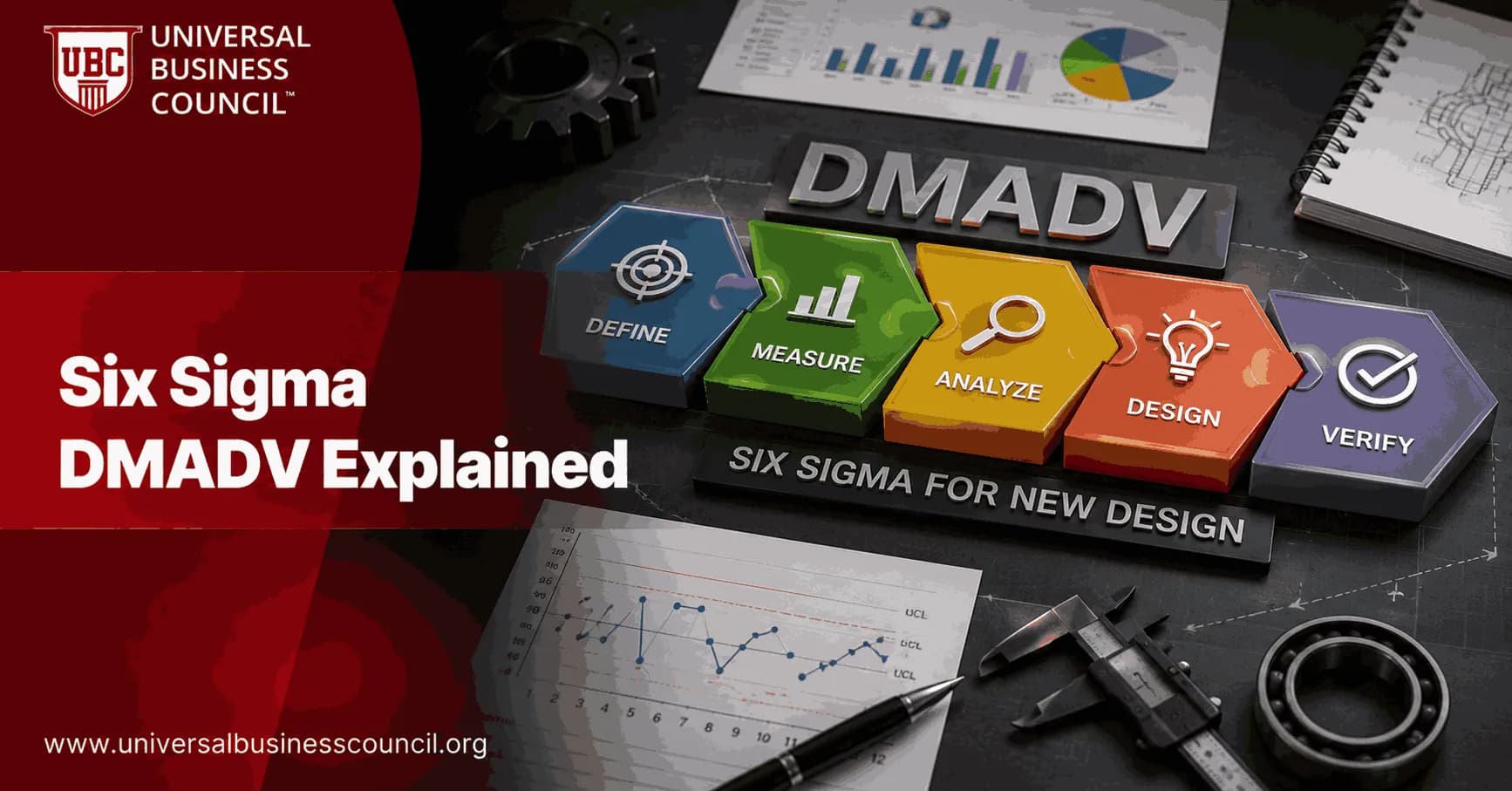
Six Sigma DMADV is the method you use when improvement is not enough. If the process is broken at the concept level, or you are building a new product, service, workflow, or digital system, DMADV helps you design quality into the work before defects become expensive. Professionals who want to lead this kind of work rather than just support it often start with the Certified Six Sigma Expert credential, which covers the DMAIC and DMADV discipline this article is built around.
DMADV stands for Define, Measure, Analyze, Design, and Verify. It is a core Design for Six Sigma, or DFSS, approach taught by major quality education providers and Lean Six Sigma training bodies. The short version: DMAIC fixes an existing process. DMADV designs a new one, or redesigns one that cannot realistically meet customer, safety, cost, or regulatory requirements through small changes.

What Is Six Sigma DMADV?
Six Sigma DMADV is a data-driven design methodology used to create products, services, and processes that meet critical-to-quality requirements from the start. Those requirements are often called CTQs. They translate customer needs into measurable targets, such as defect rate, processing time, uptime, privacy controls, error frequency, or response time. Because a DMADV launch usually needs sign-off across product, operations, engineering, and compliance leadership, project sponsors often pair Six Sigma training with broader Management Certifications, since coordinating a new design across that many stakeholders is as much a leadership skill as a statistical one.
Use DMADV when the stakes are high. A loan approval workflow that must meet fraud control rules. A hospital triage process where delay creates patient risk. A smart home device where privacy has to be built into the architecture. A new production line where quality inspection at the end would be too late and too costly.
To be blunt, DMADV is not the right tool for every problem. If your process already works and needs measurable improvement, use DMAIC. If the process cannot hit the target even after improvement, use DMADV.
DMADV vs DMAIC: The Practical Difference
DMAIC means Define, Measure, Analyze, Improve, and Control. It assumes there is an existing process worth improving. DMADV assumes you need a new design or a fundamental redesign.
Use DMAIC when defects, delays, or variation can be reduced within the current process.
Use DMADV when customer needs, compliance rules, or performance targets require a new design.
Use DMADV for new products, digital services, safety-critical workflows, and major operating model changes.
A common mistake in early projects is forcing DMAIC onto a design problem because the team already knows the template. That usually creates months of analysis followed by the same uncomfortable answer: the old process cannot do the job.
The Five Phases of Six Sigma DMADV
1. Define
The Define phase sets the direction. You clarify the business problem, the customer need, the project scope, and the design goals. This is where voice of the customer, or VoC, matters most.
Good Define work avoids vague goals. Do not write, make onboarding better. Write something measurable, such as reduce average onboarding completion time from 5 days to under 24 hours while maintaining identity verification accuracy.
Typical outputs include:
Project charter
Customer segments and VoC themes
High-level CTQs
Scope boundaries
Business case and risk assumptions
2. Measure
Measure turns customer expectations into technical and operational requirements. This phase also captures baseline data from any current process, competitor benchmark, pilot sample, or market research.
In service design, this may include wait time, abandonment rate, first-contact resolution, NPS, complaint categories, rework, and cost per transaction. In manufacturing, it may include tolerances, throughput, scrap rate, cycle time, yield, and reliability data.
Here is the detail that trips people up: a CTQ is not a feature request. Add live chat is a solution. Respond to 90 percent of support requests within 60 seconds is a measurable requirement.
3. Analyze
Analyze compares design options before the team commits money and time. You test concepts against CTQs, risk constraints, regulatory requirements, and business targets.
Common tools include failure mode and effects analysis, root-cause analysis, trade-off matrices, process simulation, design of experiments, and cost-benefit analysis. In regulated environments, this phase should also check privacy, safety, auditability, and control requirements.
One honest trade-off: teams often fall in love with the most elegant technical design. DMADV pushes you to choose the design that best meets CTQs, not the one that looks best in a workshop deck.
4. Design
The Design phase develops the detailed solution. For a product, that may mean specifications, prototype builds, reliability tests, supplier requirements, and control plans. For a service or digital workflow, it may mean journey maps, system rules, data flows, screen designs, escalation logic, and operating procedures.
Pilots matter here. A workflow that looks clean in Lucidchart can fail when a front-line employee has three systems open, a customer waiting, and a compliance checklist due before submission. Test the design under conditions close to real work. As more of these designs are built on digital platforms, connected devices, and automated workflow engines, some DMADV teams also pair this work with a Deep Tech Certification to build a stronger footing in the emerging technology now sitting inside these designs.
5. Verify
Verify confirms that the design meets the original requirements and works in practice. This may include pilot launches, simulation results, user acceptance testing, capability studies, audit checks, and post-launch monitoring.
Verification asks: did we build the design right? Validation asks: did we build the right design for the user need? Strong DMADV projects address both.
Where DMADV Is Used Today
DMADV started with manufacturing and quality engineering, but it now appears in many sectors. Current Lean Six Sigma and DFSS training materials commonly apply DMADV to digital services, healthcare, finance, retail, supply chains, and connected devices.
Healthcare: new triage workflows, patient scheduling, electronic medical record handling, and data security processes.
Financial services: loan approvals, fraud detection, onboarding, mobile banking, and secure identity checks.
Manufacturing: line layouts, inspection systems, supplier quality processes, and production flow design.
Retail and e-commerce: order fulfillment, returns handling, loyalty program design, and inventory flow.
Technology: privacy-focused devices, platform compatibility, customer support systems, and service reliability.
Why DMADV Matters for Certification and Career Growth
For professionals, DMADV is a strong signal that you can work beyond basic process improvement. You can translate customer needs into measurable requirements, compare design alternatives, manage risk, and verify performance before rollout.
If you are building your quality or operations skill set, connect this topic to related Universal Business Council learning paths in Six Sigma, Lean management, business process improvement, project management, and operations management. DMADV also pairs well with study in customer experience, data analysis, and risk management.
How to Start Using DMADV
Pick one design problem where incremental improvement has stalled. Write the CTQs. Check whether they are measurable. If they are not, go back to the customer data and clean up the requirement.
Define the customer need and business goal.
Measure the current gap and convert needs into CTQs.
Analyze at least two design options, not just the favorite one.
Design a pilot that reflects real operating conditions.
Verify performance with data before scaling.
Your next step: study DMADV alongside DMAIC, then apply both to a real process map. If the process can be improved, use DMAIC. If the design itself is the constraint, use Six Sigma DMADV and build quality in from day one. If your role also touches the platforms and systems behind that design, a general Tech Certification can help round out that technical side of the work
FAQs
1. What is DMADV in Six Sigma?
DMADV is a Design for Six Sigma (DFSS) methodology used to create new products, services, or processes, or to fundamentally redesign existing ones. DMADV stands for Define, Measure, Analyze, Design, and Verify. Its purpose is to build customer requirements, quality, reliability, and process capability into the design before full implementation.
2. What does DMADV stand for?
DMADV represents five phases:
Define: Establish the problem, goals, scope, and customer needs.
Measure: Translate customer needs into measurable requirements.
Analyze: Evaluate design alternatives and identify the best concept.
Design: Develop and optimize the detailed solution.
Verify: Test whether the final design meets requirements.
The sequence keeps teams from designing first and discovering what customers wanted afterward, a surprisingly durable corporate tradition.
3. When should DMADV be used?
DMADV is appropriate when an organization is:
Creating a new product or service
Designing a new business process
Introducing a fundamentally new technology
Replacing an existing process that cannot meet requirements
Making a major redesign rather than incremental improvements
If an existing process can meet requirements after correcting identifiable problems, DMAIC is generally more appropriate.
4. What happens during the Define phase of DMADV?
The Define phase establishes the business case, customer problem, project objectives, scope, stakeholders, timeline, and expected benefits. Teams may develop a project charter and high-level process description.
A strong Define phase answers why the project matters and what successful performance should ultimately achieve.
5. What tools are used during the Define phase?
Common Define-phase tools include:
Project charters
SIPOC diagrams
Stakeholder analysis
Voice of the Customer (VOC)
High-level process maps
Business-case analysis
Project planning tools
These establish direction before detailed design work begins.
6. What happens during the Measure phase of DMADV?
The Measure phase converts customer needs into specific, measurable design requirements. Teams identify Critical-to-Quality characteristics, establish target performance levels, evaluate measurement methods, and gather relevant market or process data.
Unlike DMAIC's Measure phase, which heavily emphasizes baseline performance of an existing process, DMADV measurement focuses strongly on what the new design must achieve.
7. What is Voice of the Customer in DMADV?
Voice of the Customer represents customer needs, expectations, preferences, and problems. Teams may gather VOC data through interviews, surveys, observations, complaints, market research, and usage information.
DMADV converts broad customer statements such as “easy to use” or “fast” into measurable specifications. Otherwise, engineering receives a collection of adjectives and is somehow expected to manufacture them.
8. What are Critical-to-Quality requirements in DMADV?
Critical-to-Quality (CTQ) requirements are measurable characteristics that strongly influence customer satisfaction or business performance.
For example, “fast customer support” could become:
90% of customer requests answered within 30 seconds.
Turning customer expectations into measurable CTQs allows teams to evaluate design alternatives objectively.
9. What happens during the Analyze phase of DMADV?
During Analyze, teams generate alternative design concepts and determine which solution best satisfies customer, technical, financial, and operational requirements. They evaluate trade-offs, risks, capabilities, and expected performance before committing to a final design.
The objective is to select a design based on evidence rather than whichever concept received the most enthusiastic PowerPoint presentation.
10. What tools are used during the Analyze phase?
Common Analyze tools include:
Quality Function Deployment (QFD)
House of Quality
Benchmarking
Pugh matrices
Concept-selection matrices
FMEA
Statistical analysis
Simulation
Cost-benefit analysis
Risk assessment
These tools help compare alternatives systematically.
11. What happens during the Design phase of DMADV?
The Design phase converts the selected concept into a detailed solution. Teams establish specifications, process flows, technology requirements, controls, operating procedures, tolerances, and implementation plans.
Prototypes, simulations, experiments, and pilot systems may be used to optimize the design before full-scale deployment.
12. How is Design of Experiments used in DMADV?
Design of Experiments (DOE) helps teams determine how design factors affect important outputs. Multiple factors can be tested systematically to identify significant variables, interactions, and optimal settings.
DOE can help create robust designs that perform consistently despite normal variation in operating conditions, materials, equipment, or user behavior.
13. What is robust design in DMADV?
Robust design aims to make products and processes less sensitive to uncontrollable or difficult-to-control sources of variation.
For example, a product might be designed to maintain acceptable performance across a range of temperatures rather than requiring an extremely narrow operating environment. Robustness improves reliability and can reduce the cost of maintaining excessively tight controls.
14. What happens during the Verify phase of DMADV?
The Verify phase confirms that the completed design satisfies customer requirements and technical specifications under realistic conditions. Teams may conduct pilot programs, prototypes, validation testing, capability studies, reliability tests, or user acceptance testing.
Verification should demonstrate that the design actually works before full deployment, rather than using customers as an involuntary testing department.
15. How is success measured in the Verify phase?
Success is measured against the CTQs and performance targets established earlier in the project. Metrics may include:
Defect rates
Process capability
Reliability
Cycle time
Customer satisfaction
Cost
Throughput
Safety performance
Compliance requirements
A design should demonstrate repeatable performance, not merely pass one carefully controlled test.
16. What is the difference between DMADV and DMAIC?
DMAIC improves an existing process:
Define → Measure → Analyze → Improve → Control
DMADV creates or fundamentally redesigns a process:
Define → Measure → Analyze → Design → Verify
DMAIC asks, “How can we improve what already exists?”
DMADV asks, “What should we design to meet these requirements?”
17. What is a practical example of DMADV?
Suppose a hospital wants to create a new digital appointment system.
During Define, it establishes objectives such as reducing scheduling friction. During Measure, patient needs are translated into requirements for booking speed, accessibility, and accuracy. During Analyze, alternative system designs are compared. During Design, the selected workflow and technology are developed and optimized. During Verify, the hospital pilots the system and confirms that performance targets are achieved before broader rollout.
18. Can DMADV be used for service and digital processes?
Yes. DMADV can be applied to banking, healthcare, insurance, logistics, software, e-commerce, customer service, and other service environments.
For example, organizations can use DMADV to design a new customer onboarding journey, claims process, digital payment service, or support workflow. Nothing in Six Sigma requires a conveyor belt to be nearby.
19. What are common mistakes in DMADV projects?
Common mistakes include:
Weak Voice of the Customer research
Vague CTQ requirements
Selecting a solution too early
Ignoring alternative designs
Inadequate risk analysis
Poor stakeholder involvement
Insufficient prototype testing
Skipping capability analysis
Weak verification before launch
The most dangerous mistake is allowing the desired solution to quietly dictate the requirements.
20. What is the best way to implement DMADV successfully?
A practical DMADV roadmap is:
Define the business and customer need → capture VOC → translate needs into measurable CTQs → generate alternative concepts → evaluate risks and trade-offs → select the strongest design → optimize and prototype it → verify performance against CTQs → establish ownership and launch controls.
The essential distinction is simple: DMAIC repairs and improves an existing system; DMADV designs a system capable of meeting requirements from the start. When fundamental redesign is required, DMADV helps move quality upstream, where defects are considerably cheaper to prevent than to apologize for later.
Related Articles
View All
Six Sigma
Design for Six Sigma Explained: When to Use DFSS Instead of DMAIC
Design for Six Sigma helps teams design new products, services, and processes to meet quality targets from launch instead of fixing defects later.

Six Sigma
Design for Six Sigma Explained: Building Quality into New Products
Design for Six Sigma explained: learn how DFSS uses DMADV, VOC, CTQs, FMEA, and verification to build quality into new products.

Six Sigma
Six Sigma Minitab Explained: Statistical Software for DMAIC Projects
Learn how Six Sigma Minitab supports DMAIC projects with capability analysis, control charts, DOE, regression, Minitab Engage, and real project results.
Trending Articles
The Role of Blockchain in Ethical AI Development
How blockchain technology is being used to promote transparency and accountability in artificial intelligence systems.
AWS Career Roadmap
A step-by-step guide to building a successful career in Amazon Web Services cloud computing.
Top 5 DeFi Platforms
Explore the leading decentralized finance platforms and what makes each one unique in the evolving DeFi landscape.