

Design for Six Sigma Explained: When to Use DFSS Instead of DMAIC
Design for Six Sigma is the method you use when fixing the current process is no longer enough. If you are creating a new product, service channel, workflow, platform, or operating model, DFSS helps you build in Six Sigma quality before defects reach customers. Professionals who want to lead this kind of work rather than just support it often start with the Certified Six Sigma Expert credential, which covers the DMAIC and DFSS discipline this article is built around.
That distinction matters. DMAIC improves what already exists. DFSS, often delivered through DMADV, is for designing something new or fundamentally redesigned so it can meet customer, regulatory, and business requirements from launch.

What Is Design for Six Sigma?
Design for Six Sigma, usually shortened to DFSS, is a structured approach for building quality into a design rather than inspecting, patching, or reworking it later. It combines customer research, statistical thinking, risk analysis, concept evaluation, simulation, testing, and validation. Because a DFSS launch usually needs sign-off across product, operations, engineering, and compliance leadership, project sponsors often pair Six Sigma training with broader Management Certifications, since coordinating a new design across that many stakeholders is as much a leadership skill as a statistical one.
The target is usually Six Sigma performance, commonly expressed as fewer than 3.4 defects per million opportunities. In practice, the real goal is simpler: prevent predictable failure before the first customer, patient, operator, or user experiences it.
DFSS is not just for factories. It applies to service design, digital transformation, logistics networks, healthcare processes, automotive systems, aerospace programs, and customer support models. If the cost of failure is high, DFSS deserves a serious look.
DFSS vs DMAIC: The Practical Difference
Use DMAIC when you have an existing process with measurable defects, variation, or waste. You define the problem, measure current performance, analyze root causes, improve the process, and control the gains.
Use Design for Six Sigma when the process does not exist yet, or when the current design cannot economically reach the required performance level. To be blunt, running DMAIC forever on a bad design is a slow way to spend money.
Choose DFSS when:
You are launching a new product, service, workflow, or operating model.
You are replacing a legacy system rather than tuning it.
Customer requirements exceed the capability of the current process.
The existing process has reached entitlement, meaning it is performing about as well as its design allows.
Regulatory, safety, or reliability risks make post-launch defects unacceptable.
Redesign is faster or cheaper than continued incremental improvement.
Choose DMAIC when:
The product or process already exists.
You have enough performance data to analyze defects and variation.
The gap can be closed through process improvement rather than redesign.
A common certification exam trap is this: the question describes a new service channel, but candidates pick DMAIC because defects are mentioned. If the service is being designed from scratch, DMADV is usually the better answer.
The DMADV Roadmap in DFSS
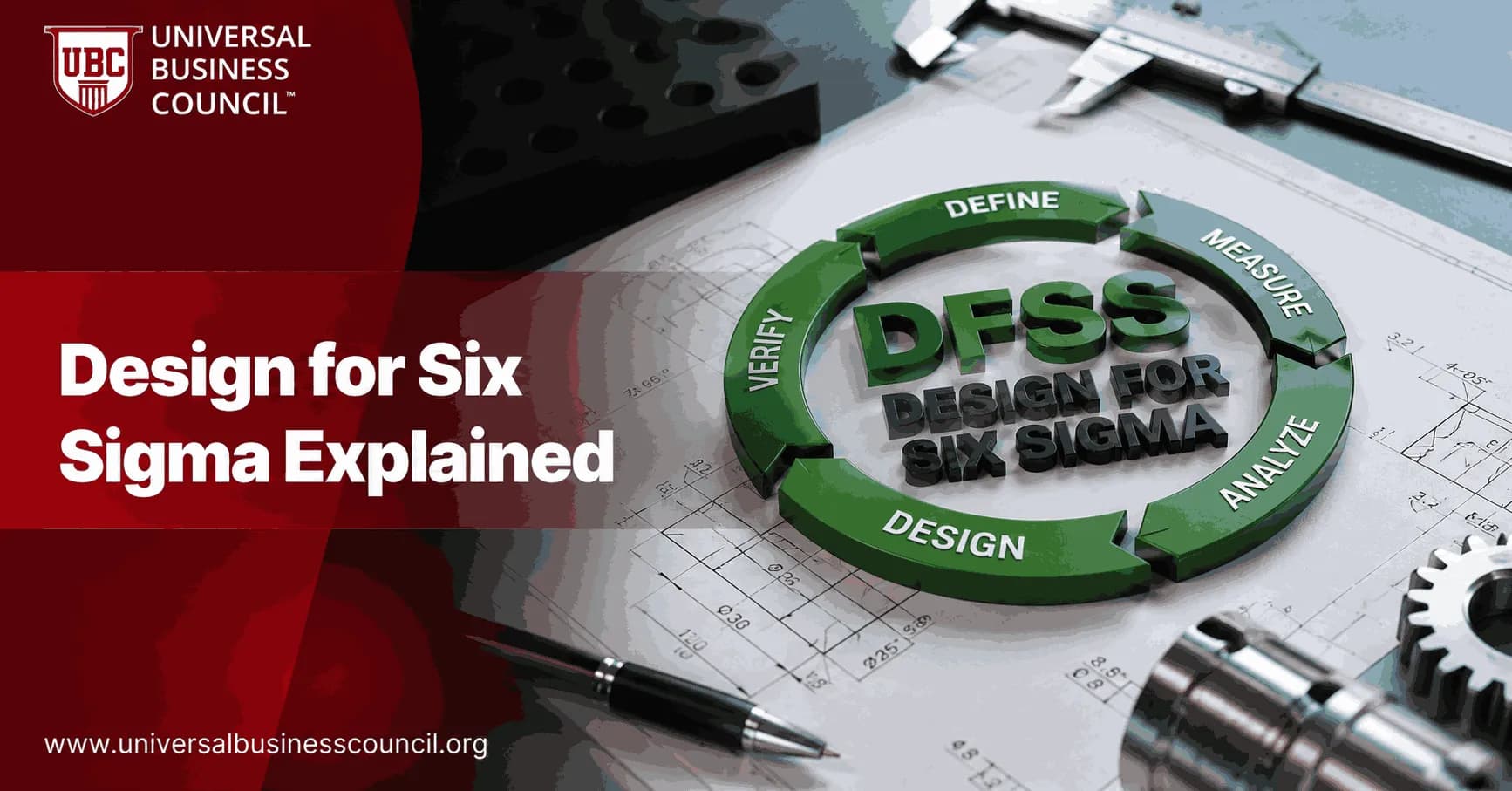
The most widely used DFSS roadmap is DMADV: Define, Measure, Analyze, Design, and Verify. Some organizations use IDOV or DMADOV, but the logic is similar. Requirements come first. Design follows. Validation happens before scale-up.
1. Define
Clarify the business case, project scope, stakeholders, timeline, and success criteria. At this stage, vague goals are dangerous. "Improve onboarding" is not enough. A better goal is "activate 95 percent of approved accounts within one business day with less than 1 percent manual rework."
2. Measure
Translate the voice of the customer into measurable critical-to-quality characteristics, often called CTQs. This is where teams move from preferences to specifications. For example, "easy to use" might become task completion time, error rate, abandonment rate, or support contacts per user.
3. Analyze
Compare design concepts. Test assumptions. Model trade-offs. Use tools such as quality function deployment, failure mode and effects analysis, capability analysis, design of experiments, and risk scoring where appropriate.
This phase should create tension. A design that is cheapest to build may be expensive to support. A fast service process may create compliance exposure. Good DFSS work makes those choices visible before leadership commits capital.
4. Design
Select and refine the best design. Specify the process flow, technology, materials, staffing model, controls, handoffs, data requirements, and measurement plan. In digital projects, this may include workflow rules, system permissions, exception paths, and reporting logic.
5. Verify
Validate the design through pilots, testing, simulation, customer feedback, and operational readiness checks. The Verify phase is especially valuable in regulated sectors because it creates evidence that requirements were built into the design and tested before launch.
Where DFSS Creates the Most Value
DFSS is strongest when failure after launch is expensive. Think medical devices, aircraft components, automotive safety systems, regulated financial workflows, clinical handoffs, logistics control towers, and enterprise system replacements.
It also fits service operations. A new customer support channel, for instance, needs designed capacity, escalation rules, knowledge content, service-level targets, quality checks, and feedback loops. If those are improvised after launch, the team usually pays for it through backlog, rework, churn, and low customer satisfaction scores. As more of these new designs lean on automated workflow engines, digital platforms, and connected system rules, some DFSS teams also pair this work with a Deep Tech Certification to build a stronger footing in the emerging technology now sitting inside these designs.
DFSS pays off when leaders fund the upfront discipline and resist rushing a weak design into production. The savings are real but hard to see, because they come from defects that never happen, warranty claims that never arrive, and rework loops that never start. That makes the business case a leadership conversation, not a spreadsheet you can win on day one.
Common DFSS Mistakes to Avoid
Skipping real customer research: Internal opinions are not CTQs.
Choosing one concept too early: DFSS depends on comparing alternatives.
Writing soft requirements: "Fast," "simple," and "reliable" must become measurable targets.
Under-testing exceptions: Failures often hide in refunds, overrides, handoffs, and edge cases.
Treating Verify as a formality: A pilot that cannot fail cannot teach you much.
How Professionals Should Build DFSS Capability
If you manage projects, processes, products, or operations, learn both DMAIC and DFSS. You need the judgment to know when improvement is enough and when redesign is the honest answer.
Universal Business Council readers can connect this topic with related Six Sigma, Lean Six Sigma, quality management, project management, and operations management certification courses. Pair DFSS knowledge with practical tools such as CTQ trees, FMEA, process capability, control plans, and customer journey mapping.
Your next step is simple: take one planned launch or redesign and write its top five CTQs in measurable terms. If the current process cannot meet them without heroic workarounds, use Design for Six Sigma and build the right design before launch. If your role also touches the platforms and systems behind that design, a general Tech Certification can help round out that technical side of the work.
FAQs
1. What is Design for Six Sigma (DFSS)?
Design for Six Sigma (DFSS) is a structured methodology for designing new products, services, or processes to meet customer requirements with high quality and low variation from the beginning. Unlike conventional Six Sigma improvement projects, DFSS emphasizes preventing defects through better design rather than correcting problems after a process is already operating.
2. What is the difference between DFSS and DMAIC?
The main difference is their purpose. DMAIC improves an existing process, while DFSS designs or fundamentally redesigns a product or process.
DMAIC follows Define, Measure, Analyze, Improve, and Control. DFSS can use several roadmaps, with DMADV being one of the most common: Define, Measure, Analyze, Design, and Verify.
3. When should you use DFSS instead of DMAIC?
DFSS is generally appropriate when:
A new product, service, or process is being created.
No existing process can meet the required performance.
Customer requirements have changed substantially.
An existing process requires fundamental redesign.
Incremental improvements cannot close the performance gap.
Design decisions will determine most future quality and cost.
If the existing process is basically sound but performing poorly, DMAIC is usually the better starting point.
4. What is DMADV in Design for Six Sigma?
DMADV is a common DFSS roadmap:
Define: Establish project goals and customer needs.
Measure: Translate customer needs into measurable requirements.
Analyze: Evaluate design concepts and alternatives.
Design: Develop and optimize the selected solution.
Verify: Confirm that the final design performs as required.
Unlike DMAIC, DMADV creates and validates a new design rather than improving the existing one.
5. Is DFSS the same as DMADV?
Not exactly. DFSS is the broader design philosophy and methodology, while DMADV is one roadmap used to implement it. Other DFSS frameworks include IDOV, which stands for Identify, Design, Optimize, and Validate, and various organization-specific approaches. Treating DFSS and DMADV as perfectly interchangeable is convenient, but methodology terminology rarely behaves that politely.
6. How do you decide between DMAIC and DFSS?
Start by asking whether the current process can realistically meet future requirements.
If the answer is yes, DMAIC can identify and eliminate the causes preventing it from doing so. If the existing design fundamentally cannot deliver the required performance, DFSS may be more appropriate.
The decision should consider performance gaps, customer requirements, technology constraints, risk, cost, and the extent of redesign required.
7. Can DMAIC lead to a DFSS project?
Yes. A DMAIC project may reveal that incremental improvements cannot achieve the required performance. For example, the Analyze or Improve phase might demonstrate that the existing technology or process architecture imposes fundamental limitations. The organization can then transition to DFSS and develop a new solution rather than continuing to optimize something that has reached its practical limits.
8. What role does Voice of the Customer play in DFSS?
Voice of the Customer (VOC) is central to DFSS. Teams collect customer needs through interviews, surveys, complaints, observations, market research, and other sources. These needs are translated into measurable Critical-to-Quality (CTQ) characteristics.
This ensures the design is built around actual customer requirements instead of internal assumptions about what customers surely must want.
9. What are Critical-to-Quality requirements in DFSS?
Critical-to-Quality requirements are measurable product, service, or process characteristics that significantly affect customer satisfaction. Examples include response time, reliability, accuracy, durability, safety, and performance.
DFSS teams translate broad statements such as “easy to use” or “fast delivery” into measurable design specifications that engineers and process designers can actually evaluate.
10. What tools are commonly used in DFSS?
Common DFSS tools include:
Voice of the Customer analysis
Quality Function Deployment (QFD)
House of Quality
FMEA
Benchmarking
Design of Experiments (DOE)
Simulation
Robust design
Capability analysis
Pugh matrices
Tolerance analysis
Reliability engineering
The specific tools depend on the product, process, risk, and design stage.
11. What is Quality Function Deployment in DFSS?
Quality Function Deployment (QFD) translates customer needs into technical and operational design requirements. The House of Quality is a widely used QFD tool that links customer expectations with measurable design characteristics.
QFD helps teams prioritize features and understand trade-offs before expensive design decisions become difficult to reverse.
12. How does FMEA support Design for Six Sigma?
Failure Mode and Effects Analysis helps teams identify how a proposed design or process could fail before implementation. Design FMEA focuses on potential product or system design failures, while Process FMEA examines potential failures in production or service delivery.
Early risk analysis allows teams to design preventive controls rather than discovering vulnerabilities after launch, which is generally the more financially civilized approach.
13. How does DOE support DFSS?
Design of Experiments systematically tests how multiple design factors influence important outputs. Teams can use DOE to identify critical variables, interactions, and optimal parameter settings.
Within DFSS, DOE is particularly useful for developing robust designs that continue meeting requirements despite normal variation in materials, operating conditions, manufacturing processes, or customer environments.
14. What is robust design in DFSS?
Robust design aims to create products and processes that perform consistently despite sources of noise or variation that are difficult or expensive to eliminate.
Rather than trying to control every environmental or operational factor perfectly, teams design the solution to be less sensitive to those factors. This can improve reliability while reducing the need for excessively tight and expensive controls.
15. How does DFSS reduce the Cost of Poor Quality?
DFSS reduces Cost of Poor Quality by preventing defects during design. Poor design decisions can later generate scrap, rework, warranty claims, service failures, recalls, and customer complaints.
Because design decisions often influence substantial portions of lifecycle cost and quality, finding problems before launch is usually much cheaper than correcting them after full implementation.
16. Can DFSS be used outside manufacturing?
Yes. DFSS can be applied to services, healthcare, banking, insurance, logistics, software, digital products, customer experiences, and business processes.
For example, a bank could use DFSS to design a new digital onboarding process around customer requirements for speed, security, accessibility, and accuracy. The methodology is concerned with design quality, not whether the output happens to emerge from a factory.
17. What is an example of using DMAIC instead of DFSS?
Suppose an existing fulfillment process has an on-time delivery rate of 91%, while the target is 98%. Analysis shows delays are caused by inconsistent picking procedures and poor workload balancing.
Because the existing process can likely achieve the target after removing those causes, DMAIC is appropriate. There is little reason to redesign the entire fulfillment system when several targeted improvements can solve the problem.
18. What is an example of using DFSS instead of DMAIC?
Suppose a company needs to launch a same-day delivery service, but its existing fulfillment network was designed around three-day delivery. The existing architecture cannot consistently achieve the new requirement regardless of incremental improvements.
DFSS would allow the company to define customer requirements, evaluate alternative network designs, optimize the new process, and verify performance before full launch.
19. What are common mistakes when implementing DFSS?
Common mistakes include:
Using DFSS for problems that DMAIC could solve more efficiently
Poorly defined customer requirements
Inadequate stakeholder involvement
Selecting a design too early
Ignoring risk analysis
Insufficient testing and simulation
Failing to consider process capability
Weak verification before launch
DFSS becomes considerably less useful when teams fall in love with a design before finishing the analysis.
20. What is the best rule for choosing DFSS or DMAIC?
Use DMAIC when an existing process needs measurable improvement and is fundamentally capable of meeting requirements.
Use DFSS when creating something new or when the existing design cannot reasonably meet required performance without fundamental redesign.
A useful shorthand is:
Existing process + fixable performance gap → DMAIC
New design or fundamental capability gap → DFSS
Both approaches pursue the same broader objective: reliable performance that satisfies customer requirements. They simply intervene at different points in the process lifecycle.
Related Articles
View All
Six Sigma
Six Sigma Minitab Explained: Statistical Software for DMAIC Projects
Learn how Six Sigma Minitab supports DMAIC projects with capability analysis, control charts, DOE, regression, Minitab Engage, and real project results.

Six Sigma
Six Sigma DMADV Explained: Define, Measure, Analyze, Design, Verify
Six Sigma DMADV explained through its five phases, practical use cases, DMAIC comparison, and how professionals apply it to design for quality.

Six Sigma
Design for Six Sigma Explained: Building Quality into New Products
Design for Six Sigma explained: learn how DFSS uses DMADV, VOC, CTQs, FMEA, and verification to build quality into new products.
Trending Articles
The Role of Blockchain in Ethical AI Development
How blockchain technology is being used to promote transparency and accountability in artificial intelligence systems.
AWS Career Roadmap
A step-by-step guide to building a successful career in Amazon Web Services cloud computing.
Top 5 DeFi Platforms
Explore the leading decentralized finance platforms and what makes each one unique in the evolving DeFi landscape.