

Six Sigma Poka Yoke Explained: Error-Proofing Processes
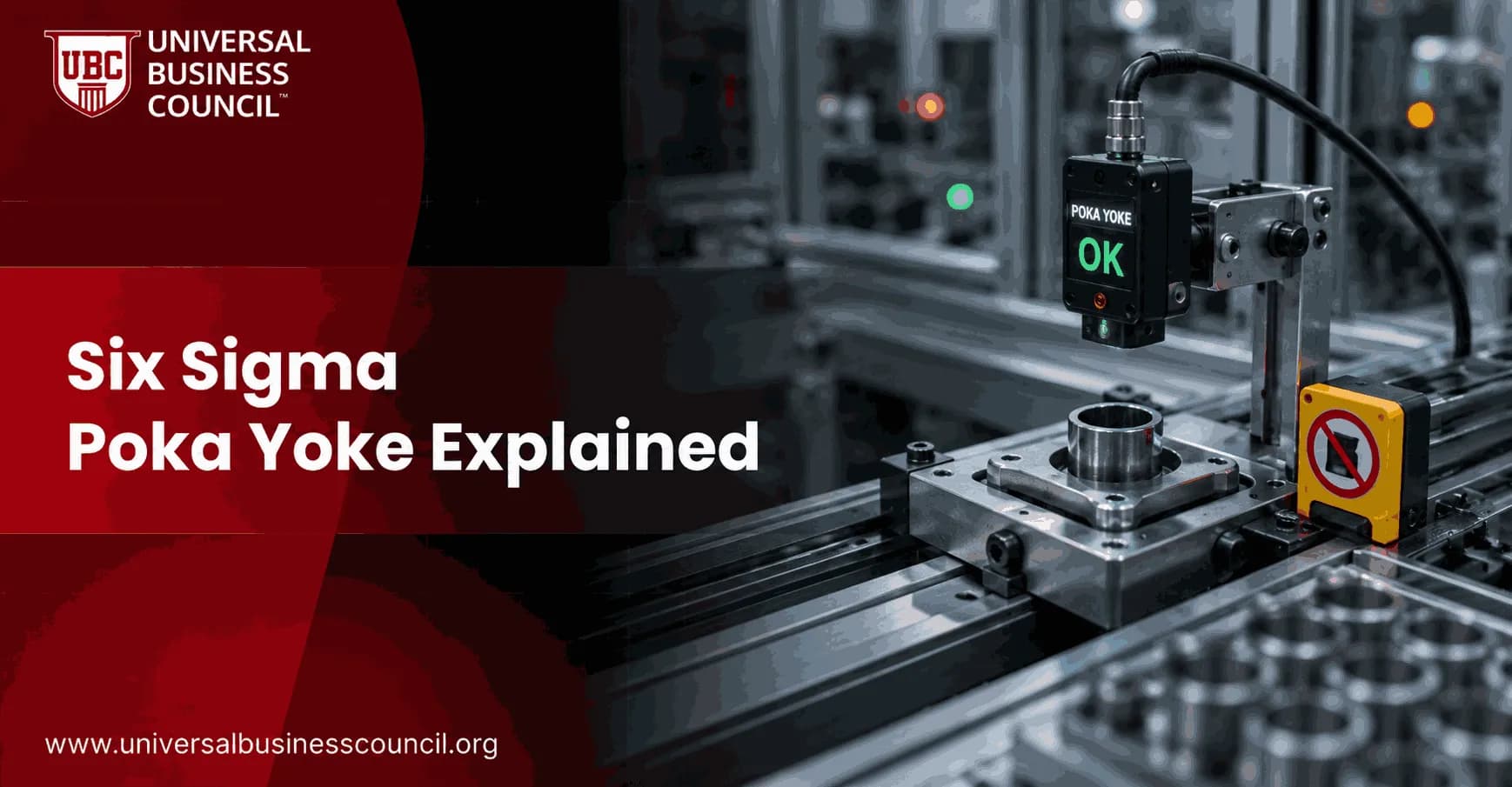
Six Sigma Poka Yoke is the practice of designing a process so mistakes are either impossible or caught immediately at the point of work. That matters because defects rarely appear out of nowhere. They get built into the process, one missed scan, wrong orientation, skipped torque check, or invalid data field at a time. Professionals who want to apply this kind of mistake-proofing discipline properly, rather than just add warning signs, often start with the Certified Six Sigma Expert credential, which covers the DMAIC discipline this article is built around.
The term comes from Japanese quality practice and is strongly associated with Shigeo Shingo and the Toyota Production System. In Lean Six Sigma, Poka Yoke is not a slogan about being careful. It is an engineered control. You use it after you understand the failure mode, then you prove the control works with data.

What Poka Yoke Means in Six Sigma
Poka Yoke means mistake proofing. In a Six Sigma project, it is usually applied in the Improve and Control phases of DMAIC. By then, you should already know the defect pattern from your Measure work and the likely root cause from tools such as Pareto analysis, 5 Whys, cause-and-effect diagrams, or FMEA. Because rolling out mistake-proofing controls usually means coordinating engineering, quality, and frontline supervisors together, project leaders often pair Six Sigma training with broader Management Certifications, since driving that kind of change across a team is as much a leadership skill as a statistical one.
Here is the practical difference. Inspection finds bad output after effort has been spent. Poka Yoke stops the error before it becomes bad output, or flags it so quickly that the defect cannot travel downstream.
That distinction saves real money. Rework at the next station is annoying. Rework after packaging, shipment, or a customer complaint is expensive.
Prevention vs Detection: Choose Prevention First
Most Six Sigma Poka Yoke controls fall into two categories.
Prevention controls: The process blocks the wrong action. A part cannot fit in the wrong orientation. A system will not release expired material. A label cannot print until the approved template is selected.
Detection controls: The process allows the action but detects the problem immediately. A sensor warns that a component is missing. A scale rejects a weight outside tolerance. A barcode mismatch stops the transaction.
To be blunt, prevention is better when you can get it. Detection still depends on someone responding correctly unless the system also stops the process. A flashing light that everyone ignores after week two is not much of a control.
Common Poka Yoke Methods
Contact method
This method uses physical attributes such as shape, size, orientation, or position. Think of a jig that only accepts a component one way, a keyed connector, or a fixture pin that prevents the wrong part from seating.
Fixed-value or constant number method
This method checks that the required number of actions, parts, or quantities has been completed. In manufacturing, that could mean confirming six bolts were tightened. In batch production, it might mean verifying that a dispensed ingredient weight is within tolerance before mixing starts.
Sequencing or motion-step method
This method verifies that steps happen in the correct order. Modern MES workflows, barcode scans, electronic batch records, and mandatory signatures often use this pattern. The software blocks the next step until the required prior step is complete.
How to Apply Six Sigma Poka Yoke in DMAIC
Use a simple sequence. Do not start by buying sensors.
Pick the defect worth fixing. Use a Pareto chart. Start with recurring defects, complaints, rework categories, or deviations that keep showing up.
Observe the work at the gemba. Watch the actual station at normal speed. The best observation is often during a difficult shift, not during a staged audit.
Find the error mechanism. Ask why the person can make the mistake. Poor lighting, similar packaging, unclear units of measure, awkward reach distance, and system workarounds are common culprits.
Choose the simplest control. A locating pin beats a vision system if both prevent the same wrong assembly.
Test the control by trying to fail it. Intentionally scan the wrong barcode, load the part backward, skip the step, or enter an out-of-range value.
Update standard work and the control plan. Add maintenance checks, calibration where needed, and audit questions that confirm the device has not been bypassed.
One operator detail matters here. If a control adds ten extra clicks or forces people to wait for a slow terminal, they will find a workaround. I have watched barcode scanners sit in the cradle while operators typed numbers by hand because the scan field timed out too quickly. The defect was not laziness. The interface was badly designed.
Real Examples of Error-Proofing Processes
Poka Yoke now covers mechanical, digital, and hybrid systems.
Assembly: Fixtures prevent reverse installation. Proximity sensors confirm that a part is present before a cycle starts.
Batch manufacturing: Integrated scales check ingredient weight against tolerance before the batch can continue.
Packaging: Barcode scanning verifies that the product, carton, leaflet, and label match the bill of materials.
Food and pharma: Allergen label verification, metal detection, approved material status checks, and electronic signatures reduce safety and compliance risk.
Software workflows: Required fields, valid unit-of-measure rules, status locks, and approval gates prevent bad data from moving through the system.
For developers, this is where Poka Yoke becomes especially useful. A good interface does not merely warn users after they submit bad data. It constrains choices, validates at entry, and gives a clear recovery path when a rule blocks the transaction. As more of these controls move from physical fixtures toward sensors, vision systems, and software validation rules, some quality teams also pair this Poka Yoke work with a Deep Tech Certification to build a stronger footing in the emerging technology now sitting inside these digital mistake-proofing controls.
Metrics That Prove Poka Yoke Is Working
Do not call the fix successful because the team likes it. Track the numbers before and after.
First pass yield
Defects per million opportunities, or DPMO
Scrap and rework counts
Customer complaint categories
Deviation or nonconformance incidents
FMEA occurrence and detection ratings
The cleanest proof is simple. The targeted defect disappears, or drops sharply, while throughput and operator burden stay acceptable. Also audit the control. Poka Yoke devices fail, sensors drift, master data rules age, and people bypass controls that make work harder than necessary.
Where Professionals Should Build Skill Next
Six Sigma Poka Yoke sits at the intersection of process design, human factors, automation, and quality governance. If you manage improvement projects, connect this topic with DMAIC, FMEA, control plans, standard work, and statistical process control.
For internal learning paths, this article pairs naturally with Universal Business Council resources on Six Sigma, Lean management, operations excellence, business process improvement, and quality management certification preparation. If you are building software for regulated or high-volume operations, study Poka Yoke alongside requirements management and workflow design.
Next Step
Choose one recurring defect this week. Pull the last 30 to 90 days of data, confirm the failure mode at the workstation or interface, then design one control that either makes the error impossible or catches it before the next step. Keep it simple. Then test it like you want it to fail. If your own role also touches the sensors, software, or MES systems behind that control, a general Tech Certification can help round out that technical side of the work.
FAQs
1. What is Poka-Yoke in Six Sigma?
Poka-Yoke is an error-proofing or mistake-proofing approach used to prevent human and process errors from becoming defects. Originating in the Toyota Production System, it is widely used in Lean Six Sigma to design processes so mistakes are either impossible to make or immediately detected before they affect customers.
2. What does Poka-Yoke mean?
Poka-Yoke is a Japanese term commonly translated as mistake-proofing or error-proofing. The principle is straightforward: rather than relying entirely on people to remember every rule perfectly, redesign the process so common errors are prevented or detected automatically.
Humans, inconveniently, remain human. Good process design accounts for that.
3. Why is Poka-Yoke important in Six Sigma?
Six Sigma aims to reduce defects and process variation. Poka-Yoke supports this objective by controlling common sources of errors at the point where they occur.
It can reduce:
Defects
Rework
Scrap
Customer complaints
Inspection requirements
Process delays
Cost of Poor Quality
Prevention is generally cheaper and more reliable than detecting defects after production.
4. What is the difference between an error and a defect?
An error is an incorrect action or process condition that can potentially create a problem.
A defect is an output that fails to meet a requirement.
For example, installing a component backward is an error. A finished product that fails because of that installation is a defect. Poka-Yoke attempts to stop the error before it becomes the defect.
5. What are the main types of Poka-Yoke?
Poka-Yoke solutions generally fall into two broad categories:
Prevention: Make the error impossible or extremely difficult.
Detection: Identify the error immediately so it can be corrected before continuing.
Prevention is usually preferable because the process cannot proceed incorrectly.
6. What is a prevention Poka-Yoke example?
A connector designed so it can only be inserted in the correct orientation is a classic prevention example.
Other examples include fixtures that accept components only in the correct position, software fields that reject invalid values, and machine interlocks that prevent operation unless required conditions are satisfied.
The user does not need to remember the correct action because the design enforces it.
7. What is a detection Poka-Yoke example?
A detection Poka-Yoke identifies a mistake immediately after or while it occurs.
Examples include:
Sensors detecting missing components
Barcode verification
Weight checks
Warning alarms
Automated data validation
Checklists
Machine-vision inspection
The objective is to prevent the error from moving farther downstream.
8. What are the three common Poka-Yoke methods?
Three commonly discussed methods are:
Contact method: Detects errors through physical characteristics such as shape, size, position, or color.
Fixed-value method: Verifies that the required number of actions, parts, or steps has occurred.
Motion-step method: Confirms that required activities are completed in the correct sequence.
These methods can be implemented mechanically, electronically, digitally, or procedurally.
9. How does the contact method work?
The contact method uses physical or measurable characteristics to determine whether something is correct.
For example, a fixture may prevent a part from being positioned incorrectly, or a sensor may detect whether a component is present. Contact methods are particularly useful for assembly and manufacturing operations.
10. What is the fixed-value method?
The fixed-value method ensures that a required number of components or actions is completed.
For example, an assembly requiring six bolts might use a system that counts six fastening operations before allowing the product to proceed. If only five are recorded, the process generates an alert or prevents release.
Counting turns out to be more dependable when the process does it automatically.
11. What is the motion-step method?
The motion-step method verifies that required tasks occur in the correct sequence.
For example, software may prevent a transaction from being submitted until mandatory fields and approvals are completed. In manufacturing, a controller might require assembly steps to occur in a predefined order.
This is particularly useful where skipping or rearranging steps creates defects.
12. How is Poka-Yoke used in DMAIC?
Poka-Yoke is most commonly implemented during the Improve phase of DMAIC after root causes have been identified.
A typical sequence is:
Define the defect → Measure its frequency → Analyze the root cause → design a Poka-Yoke → test the solution → implement it → Control performance.
The important part is addressing a validated cause rather than enthusiastically mistake-proofing something that was never causing the problem.
13. What is a manufacturing example of Poka-Yoke?
Suppose workers occasionally install two similar components in the wrong locations.
A Poka-Yoke solution could redesign the components and fixtures so each part fits only in its intended position. Alternatively, barcode scanning could verify the component before installation.
The first solution prevents the error physically, while the second detects it before assembly continues.
14. What is a service-process example of Poka-Yoke?
Consider an online insurance application where customers frequently omit required information.
The system could:
Clearly identify mandatory fields
Validate data formats
Check logical inconsistencies
Prevent submission when required information is missing
This eliminates much of the downstream rework caused by incomplete applications.
15. Can Poka-Yoke be used in healthcare?
Yes. Healthcare examples can include barcode medication verification, standardized connectors, surgical checklists, dosage-range alerts, patient-identification controls, and device interlocks.
Because healthcare errors can have serious consequences, error-proofing should be carefully validated and incorporated into broader clinical safety systems rather than treated as a standalone technique.
16. Can software processes use Poka-Yoke?
Absolutely. Digital Poka-Yoke examples include:
Required fields
Input validation
Duplicate detection
Confirmation for destructive actions
Automated calculations
Permission controls
Workflow rules
Format restrictions
Dependency checks
A well-designed application prevents invalid actions instead of displaying an error message after the damage has already been committed.
17. What is the difference between Poka-Yoke and inspection?
Inspection detects whether an output meets requirements, often after work has already been performed.
Poka-Yoke attempts to prevent the error or detect it immediately at its source.
Final inspection can still be necessary in some processes, but relying entirely on inspection is inefficient because resources have already been spent creating the defective output.
18. How should teams design an effective Poka-Yoke?
A practical approach is:
Identify a recurring defect.
Observe where the associated error occurs.
Validate the root cause.
Determine whether the error can be prevented.
If prevention is impractical, design immediate detection.
Keep the mechanism simple.
Test it under realistic conditions.
Measure defect performance afterward.
Standardize and maintain the solution.
The best error-proofing controls often look embarrassingly obvious once someone has designed them.
19. What are common mistakes when implementing Poka-Yoke?
Common mistakes include:
Relying too heavily on warnings
Adding unnecessary complexity
Blaming operators instead of redesigning processes
Mistake-proofing unverified causes
Creating controls employees can easily bypass
Failing to test unusual conditions
Ignoring maintenance requirements
Assuming training alone is error-proofing
A sign saying “PLEASE DO NOT MAKE ERRORS” remains disappointingly ineffective.
20. What makes a good Poka-Yoke system?
A strong Poka-Yoke is simple, reliable, immediate, difficult to bypass, inexpensive relative to the risk, and located as close as possible to the source of the error.
A useful hierarchy is:
Eliminate the possibility of the error → prevent the incorrect action → automatically detect the error at the source → immediately stop or correct the process → use warnings only when stronger controls are impractical.
The central principle is simple: do not demand perfect human attention when the process itself can prevent the mistake. That makes Poka-Yoke one of Lean Six Sigma's most practical tools for turning recurring errors into designed-out problems.
Related Articles
View All
Six Sigma
Six Sigma in Business Operations: Streamlining Everyday Processes
Learn how Six Sigma in business operations reduces defects, cycle time, and rework in finance, healthcare, service, inventory, and daily workflows.
Six Sigma
Six Sigma Minitab Explained: Statistical Software for DMAIC Projects
Learn how Six Sigma Minitab supports DMAIC projects with capability analysis, control charts, DOE, regression, Minitab Engage, and real project results.

Six Sigma
Six Sigma Operational Excellence: Aligning Processes with Strategy
Learn how Six Sigma operational excellence connects DMAIC, Balanced Scorecard, Hoshin Kanri, digital tools, compliance, and ESG to strategy.
Trending Articles
The Role of Blockchain in Ethical AI Development
How blockchain technology is being used to promote transparency and accountability in artificial intelligence systems.
AWS Career Roadmap
A step-by-step guide to building a successful career in Amazon Web Services cloud computing.
Top 5 DeFi Platforms
Explore the leading decentralized finance platforms and what makes each one unique in the evolving DeFi landscape.