

Six Sigma Operational Excellence: Aligning Processes with Strategy
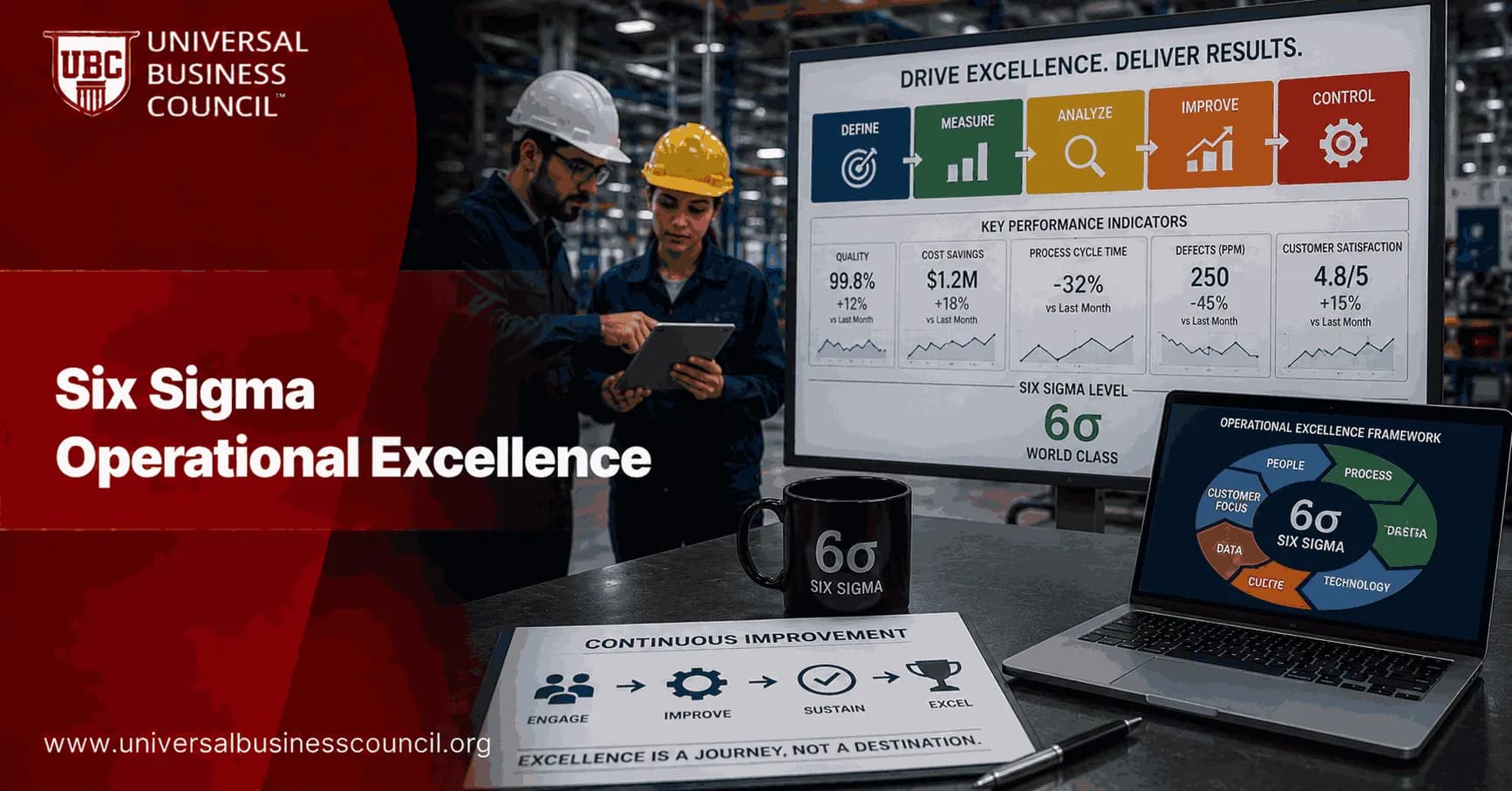
Six Sigma operational excellence works when improvement projects are tied to strategy, not when teams chase random defects because a dashboard looks untidy. The real test is simple: can you draw a straight line from a DMAIC project to customer retention, cost control, compliance risk, patient safety, or another board-level goal? Professionals building this strategic discipline often start with a focused credential like the Certified Six Sigma Expert program, since DMAIC fluency is what turns a strategic goal into a project with a measurable line of sight.
If not, pause the project. I have watched teams spend weeks reducing a low-volume error while the real constraint sat in handoffs between sales, operations, and finance. The charts were neat. The business impact was thin.

What Six Sigma Operational Excellence Means
Operational excellence is the disciplined alignment of people, processes, and technology to improve quality, productivity, customer experience, and cost performance. Six Sigma adds a structured method for reducing variation and defects through DMAIC: Define, Measure, Analyze, Improve, Control.
That structure matters. A process may look efficient in isolation yet still fail the strategy. A finance team can process invoices faster while still damaging supplier relationships if dispute resolution stays slow. Six Sigma operational excellence asks a sharper question: which process outcome best supports the strategy?
Common strategic links include:
Financial goals: lower cost of poor quality, fewer rework hours, better margin protection.
Customer goals: fewer complaints, shorter wait times, higher first-contact resolution.
Internal process goals: reduced cycle time, lower defect rates, improved throughput.
Learning and growth goals: stronger problem-solving capability across teams.
Risk and compliance goals: fewer control failures, better audit readiness, cleaner records.
Getting leadership to actually rank projects by strategic contribution rather than convenience is a governance skill as much as a statistical one, which is why process leaders often pair Six Sigma training with broader Management Certifications, covering the stakeholder alignment and portfolio governance habits that keep strategy deployment from collapsing into project-by-project guesswork.
Use Strategy Deployment Before DMAIC
DMAIC is powerful, but it is not a project selection tool by itself. Start with strategy deployment. Two frameworks earn their place here: the Balanced Scorecard and Hoshin Kanri.
Balanced Scorecard Alignment
The Balanced Scorecard, developed by Robert Kaplan and David Norton, helps leaders connect improvement work to financial, customer, internal process, and learning objectives. In a Six Sigma setting, it stops the common mistake of approving projects only because data happens to be available.
Use it this way:
List the corporate or business-unit strategic objectives.
Translate each objective into measurable process indicators.
Rank potential Six Sigma projects by strategic contribution, not by convenience.
Track each project through DMAIC against scorecard indicators.
Verify that the Control phase protects the strategic gain, not just the local fix.
Here is the blunt rule: if a Green Belt or Black Belt project cannot name the scorecard metric it improves, it is probably not ready for approval.
Hoshin Kanri for Line of Sight
Hoshin Kanri, often called policy deployment, cascades strategy from leadership to departments and teams. Healthcare organizations use it well when cutting patient wait times or medication errors. The strategic goal becomes an annual objective, then a department target, then a DMAIC project with an owner and a control plan.
Case literature reports strong results when this link is clear. Some documented healthcare Six Sigma projects have cut medication errors by around half. Emergency department redesign work using strategic deployment and DMAIC has reported roughly 30 percent lower patient wait times alongside higher satisfaction scores. Treat these as illustrative outcomes, not guarantees, since results depend heavily on baseline conditions and execution.
Process Metrics Must Speak the Language of Strategy
Six Sigma teams often measure defects per million opportunities, or DPMO. The formula is practical:
DPMO = (defects x 1,000,000) / (units produced x defect opportunities per unit)
DPMO is useful because it turns quality into a comparable number. Still, do not worship the metric. A low DPMO on a minor process is worth less than a moderate improvement in a process tied to retention, safety, cash flow, or compliance.
Strong Six Sigma dashboards usually combine three layers:
Lagging indicators: defect rate, cost of poor quality, customer complaints, readmissions, chargebacks.
Leading indicators: queue age, missing fields, handoff delay, training completion, control exceptions.
Strategic indicators: NPS, retention, margin, audit findings, service-level performance.
Leadership pays attention to the last group. Project teams need all three.
Digital Tools Are Changing Operational Excellence
Six Sigma operational excellence is no longer limited to spreadsheets and periodic reviews. Teams now pair DMAIC with real-time analytics, robotic process automation, AI-assisted anomaly detection, and digital twins.
Use the technology carefully. AI can spot unusual process behavior faster than a monthly review meeting. A digital twin can test a warehouse routing change before you disrupt live operations. But poor measurement design still produces poor decisions. If your data definitions are inconsistent, automation simply moves bad logic faster. When those inconsistent definitions stem from disconnected systems feeding the scorecard rather than sloppy analysis alone, a Deep Tech Certification from Blockchain Council can help teams understand how reliable, auditable data pipelines are actually built, since a dashboard is only as trustworthy as the systems feeding it.
The best use of digital Six Sigma is targeted:
Monitor critical-to-quality metrics in real time.
Flag control-limit breaches before customers feel the failure.
Simulate process changes before rollout.
Automate repetitive checks in regulated workflows.
Feed verified process data into Balanced Scorecard reviews.
Compliance and ESG Now Belong in the Project Charter
Modern operational excellence has to account for regulation and sustainability. Six Sigma project selection should favor processes with high compliance exposure, such as data protection, financial controls, sustainability reporting, clinical safety, or ISO certification scopes.
ESG metrics are becoming process outputs too. Waste, energy use, carbon intensity, supplier nonconformance, and safety incidents can be measured with the same discipline used for defects and cycle time. This is not a side agenda. For many enterprises, ESG data quality is now a governance issue.
Where Professionals Should Build Capability
If you are building a career in process improvement, do not stop at statistical tools. You need strategy deployment, governance, stakeholder management, and digital measurement. Certification helps when it forces you to practice the method rather than memorize terms.
Universal Business Council Six Sigma certification courses, operational excellence training, project management certification, and business strategy programs give learners structured preparation across these areas.
For enterprises, the next step is practical. Review your active improvement portfolio this week. Mark each project as customer, financial, compliance, ESG, or capability focused. Then ask whether the mix matches your stated strategy. If 80 percent of the work is cost cutting while leadership claims customer loyalty is the priority, the problem is not DMAIC. It is governance.
Start there. Align the portfolio first, then let Six Sigma do what it does best: make strategically important processes perform with less variation, fewer defects, and tighter control. If your scorecard keeps showing inconsistent numbers because the underlying systems will not feed it reliably, a Tech Certification from Global Tech Council is worth adding to the plan, since some governance problems need better systems integration, not another strategy workshop.
FAQs
1. What is Six Sigma operational excellence?
Six Sigma operational excellence is an approach to improving organizational performance by aligning process quality, efficiency, and continuous improvement with strategic business goals. It goes beyond isolated defect-reduction projects by ensuring improvement efforts contribute to priorities such as growth, profitability, customer experience, reliability, and risk reduction.
2. How does Six Sigma support operational excellence?
Six Sigma supports operational excellence by providing structured methods for measuring performance, identifying root causes, reducing variation, and sustaining improvements. DMAIC, statistical analysis, process mapping, and control methods help organizations turn broad strategic objectives into measurable operational improvements. Strategy says where the organization wants to go; process improvement deals with the inconvenient detail of actually getting there.
3. Why should Six Sigma projects align with business strategy?
Strategic alignment ensures Six Sigma resources are focused on problems that materially affect organizational performance. A technically successful project may still have limited value if it improves a process that barely matters to customers, revenue, cost, risk, or strategic objectives. Project selection should therefore consider both improvement potential and business impact.
4. How does DMAIC contribute to operational excellence?
DMAIC provides a disciplined framework for executing strategic improvement:
Define: Connect the problem with strategic and customer objectives.
Measure: Establish baseline performance.
Analyze: Identify causes preventing desired outcomes.
Improve: Implement solutions that address those causes.
Control: Sustain results and monitor performance.
DMAIC converts strategic intentions into measurable operational action rather than leaving them trapped inside presentation slides.
5. How can organizations connect strategy to process performance?
Organizations can translate strategic objectives into measurable process requirements using KPIs, Critical-to-Quality (CTQ) measures, strategy maps, scorecards, and process metrics. For example, a strategy focused on customer retention might translate into targets for delivery reliability, complaint resolution time, defect rates, and service consistency.
6. What role do KPIs play in Six Sigma operational excellence?
KPIs show whether processes are delivering the results required by strategy. Relevant measures can include quality, cost, delivery, productivity, customer satisfaction, risk, and financial performance. Effective KPIs connect operational activities to business outcomes rather than encouraging departments to celebrate numbers that have little strategic significance.
7. How should Six Sigma projects be selected?
Projects should be prioritized according to strategic importance, customer impact, financial value, risk reduction, feasibility, and available resources. Organizations can use project-selection matrices or weighted scoring systems to compare opportunities. Projects with measurable benefits and clear executive sponsorship generally deserve priority over vaguely defined improvement exercises.
8. What is the role of leadership in Six Sigma operational excellence?
Leadership establishes strategic priorities, allocates resources, removes organizational barriers, and holds process owners accountable for results. Executives should also ensure improvement projects support broader business objectives. Without leadership involvement, Six Sigma can deteriorate into a collection of technically respectable projects operating independently of actual strategy.
9. How does Voice of the Customer support operational excellence?
Voice of the Customer (VOC) captures customer needs, expectations, complaints, and preferences. Six Sigma teams translate these insights into Critical-to-Quality requirements that processes can measure and improve. This prevents organizations from optimizing internal metrics while accidentally making the customer experience worse, an achievement businesses manage more often than one might expect.
10. How does Lean Six Sigma support operational excellence?
Lean Six Sigma combines Lean's focus on eliminating waste and improving flow with Six Sigma's emphasis on reducing defects and variation. Together, they help organizations improve quality, speed, cost, and customer value. This broader approach is useful when operational excellence requires both efficient workflows and predictable outcomes.
11. How does Six Sigma improve strategic execution?
Six Sigma improves strategic execution by converting objectives into defined projects, measurable targets, accountable owners, and controlled processes. Instead of treating strategy as a separate executive activity, organizations connect strategic priorities with day-to-day operational performance. Progress can then be evaluated using evidence rather than optimistic status updates.
12. What metrics measure operational excellence?
Common operational excellence metrics include:
Defect rate and DPMO
First Pass Yield
Process capability
Cycle and lead time
Throughput
Cost of Poor Quality
Productivity
On-time delivery
Customer satisfaction
Employee productivity
Financial savings
Compliance and risk indicators
The appropriate combination depends on the organization's strategy.
13. How does Six Sigma improve cross-functional processes?
Many strategic processes span several departments, such as order-to-cash, procure-to-pay, product development, and customer onboarding. Six Sigma uses end-to-end process mapping and data analysis to identify poor handoffs, duplicated work, delays, and conflicting objectives. Optimizing the entire value stream prevents one department from improving its numbers by quietly transferring problems to another.
14. How does Six Sigma support a culture of continuous improvement?
Six Sigma supports continuous improvement by teaching employees structured problem-solving, encouraging decisions based on evidence, and establishing accountability for process performance. Organizations can reinforce this culture through training, leadership involvement, recognition, and regular performance reviews. Continuous improvement becomes stronger when it is part of normal management rather than an occasional corporate campaign.
15. How does Six Sigma balance efficiency and quality?
Six Sigma evaluates both process performance and customer requirements so efficiency improvements do not undermine quality. Reducing cycle time, for example, has limited value if error rates increase. Operational excellence requires organizations to optimize quality, speed, cost, reliability, and risk as interconnected outcomes rather than treating a single metric as supreme.
16. How can digital technology support Six Sigma operational excellence?
Digital platforms can provide real-time process data, automated workflows, dashboards, process mining, predictive analytics, and integrated quality management. These capabilities give Six Sigma teams better visibility into operational performance. Technology is most effective when attached to a clear process and strategic objective rather than deployed first and justified afterward, the more fashionable sequence.
17. How can AI improve operational excellence?
AI can identify performance patterns, predict defects and delays, detect anomalies, analyze customer feedback, and recommend process adjustments. Machine learning can complement Six Sigma analysis when processes generate large volumes of data. Human oversight remains essential for validating causes, assessing trade-offs, and ensuring AI recommendations support strategic objectives.
18. What prevents organizations from achieving operational excellence?
Common barriers include:
Poor alignment between strategy and improvement projects
Weak leadership commitment
Departmental silos
Inconsistent process ownership
Poor data quality
Too many competing initiatives
Resistance to change
Failure to sustain improvements
Operational excellence usually fails less from a shortage of methodologies than from an inability to execute them consistently.
19. How can organizations build a Six Sigma operational excellence framework?
Organizations can begin by defining strategic priorities and translating them into measurable performance objectives. They can then identify critical processes, establish KPIs, prioritize improvement opportunities, assign process owners, execute DMAIC projects, and monitor results through dashboards and governance reviews. Successful improvements should be standardized and incorporated into normal operating procedures.
20. What is the future of Six Sigma operational excellence?
The future of Six Sigma operational excellence will increasingly combine Lean Six Sigma with AI, process mining, predictive analytics, automation, digital twins, and real-time performance management. Yet the central principle will remain rather stubbornly non-digital: strategy must determine what gets improved, data must show where performance is failing, and disciplined process management must convert improvements into sustainable business results.
Related Articles
View All
Six Sigma
Six Sigma in Business Operations: Streamlining Everyday Processes
Learn how Six Sigma in business operations reduces defects, cycle time, and rework in finance, healthcare, service, inventory, and daily workflows.
Six Sigma
Six Sigma and Industry 4.0: Smart Manufacturing Meets Quality Excellence
Learn how Six Sigma and Industry 4.0 combine in Quality 4.0 to reduce defects, improve cycle time, and build smarter manufacturing systems.

Six Sigma
Six Sigma Variation Reduction: How to Make Processes More Consistent
Learn how Six Sigma variation reduction uses DMAIC, SPC, capability metrics, and input control to make business processes more consistent.
Trending Articles
The Role of Blockchain in Ethical AI Development
How blockchain technology is being used to promote transparency and accountability in artificial intelligence systems.
AWS Career Roadmap
A step-by-step guide to building a successful career in Amazon Web Services cloud computing.
Top 5 DeFi Platforms
Explore the leading decentralized finance platforms and what makes each one unique in the evolving DeFi landscape.