

Six Sigma Variation Reduction: How to Make Processes More Consistent
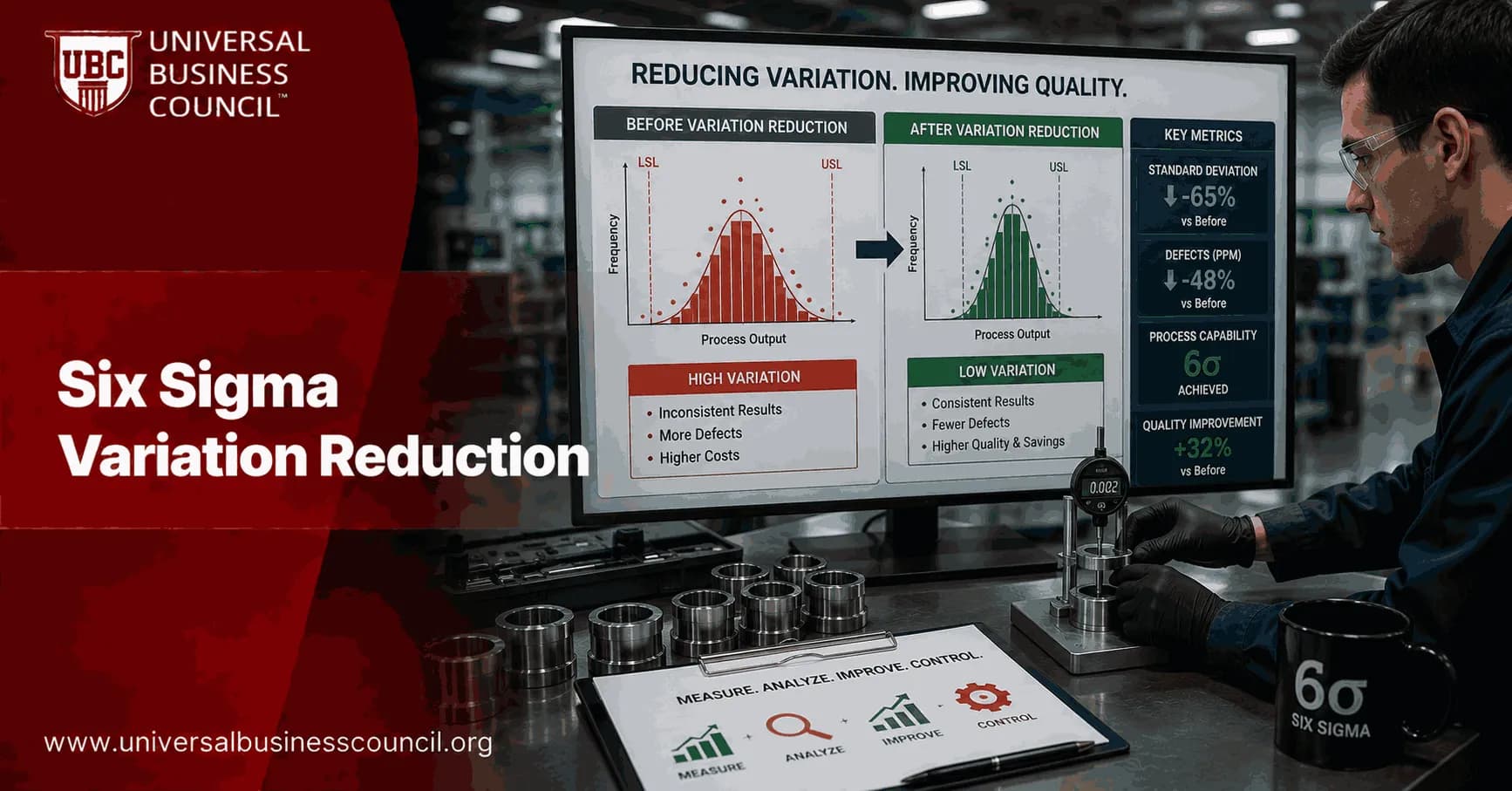
Six Sigma variation reduction is the practical work of making a process behave the same way tomorrow as it did today. You find where variation enters, measure how much it moves the output, remove the assignable causes, then control the few inputs that matter. Done well, it cuts defects, rework, waiting time, warranty cost, and customer complaints. Professionals building this discipline often start with a focused credential like the Certified Six Sigma Expert program, since knowing how to separate common cause from special cause variation is what makes the rest of DMAIC work.
Six Sigma is often described through its long-term benchmark: about 3.4 defects per million opportunities, or roughly 99.9997 percent yield. That target is demanding. Many real operations sit closer to 3 or 4 sigma, which is exactly why the method earns its keep. It gives you a disciplined way to close the gap instead of arguing from opinion.

What Variation Means in Six Sigma
Variation is the spread in process output. It might show up as inconsistent part dimensions, fluctuating call handling time, late invoices, medication turnaround delays, or sprint work that keeps missing estimates.
Six Sigma splits variation into two types:
Common cause variation: Normal variation built into the current system. Everyone working inside the process is affected by it.
Special cause variation: An unusual, assignable event. Think machine wear, a wrong material lot, a missing approval, a new operator using an old work instruction, or a data feed failure.
Standard statistical process control practice makes this distinction for a reason. You treat the two types differently. Chase common cause variation as if it were a one-off incident and you will waste time. Ignore special cause variation and the process will never stabilize.
Start with special causes. Then redesign the system to reduce common causes. That order matters. Getting a team to actually follow that discipline instead of chasing whichever variation is loudest that week is a leadership challenge, which is why process owners often pair Six Sigma training with broader Management Certifications, covering the coaching and prioritization skills that keep a team focused on the right cause in the right order.
Use DMAIC to Reduce Variation
The DMAIC cycle gives Six Sigma variation reduction its working structure. It keeps teams from jumping straight to fixes, which is where many projects quietly fail.
Define
State the defect, the customer requirement, the process boundary, and the business pain. Be specific. Late orders is too broad. Final inspection release varies from 2 hours to 28 hours for priority orders is a project.
Measure
Collect baseline data. Confirm the measurement system first. If two inspectors measure the same feature differently, your control chart is telling a story about measurement error, not the process.
This is a common exam and project trap. Candidates often calculate DPMO correctly, then forget measurement system analysis. In the real world, that omission can send a team chasing the wrong root cause for weeks.
Analyze
Use process maps, cause and effect diagrams, Pareto charts, regression, ANOVA, or design of experiments to find the variables that actually drive spread. Do not treat every possible cause equally. The process usually has a few dominant inputs.
Improve
Test fixes on the causes with the largest effect. That may mean changing a machine setting, tightening supplier criteria, simplifying a handoff, adding error proofing, or changing how work is released into the process.
Control
Lock in the gain. Use standard work, control plans, SPC charts, visual checks, audit routines, and response plans. A fix without a control plan is just a temporary improvement with better branding.
Key Metrics You Should Track
Good Six Sigma work is data driven, but not every metric deserves a dashboard. Track the measures that expose variation and cost.
DPMO: Defects per million opportunities, useful when defect opportunities differ by unit.
Sigma level: A quality performance indicator linked to DPMO.
Yield: The percentage of outputs that meet requirements.
Cp and Cpk: Process capability measures. Cp shows potential capability. Cpk shows capability after accounting for process centering.
Control limits: Statistical limits used to detect unstable behavior, not customer specification limits.
Cost of poor quality: Scrap, rework, warranty, downtime, returns, and complaint handling cost.
To be blunt, Cpk is often more useful than a vanity defect rate. A process can look acceptable this month and still be drifting toward a specification limit. Cpk forces you to look at spread and centering together. When your control charts and Cpk figures keep looking suspicious because the source data comes from systems that will not agree with each other, a Deep Tech Certification from Blockchain Council can help teams understand how reliable, traceable data pipelines are actually built, since a capability index is only as trustworthy as the measurements feeding it.
Practical Ways to Make Processes More Consistent
Once you know the drivers, use the right variation reduction method. The best choice depends on the process.
Remove special causes first. Investigate out-of-control points, abnormal lots, equipment faults, staffing exceptions, and system outages.
Standardize critical inputs. Control materials, forms, settings, training, data definitions, and environmental conditions.
Center the process. If the target is the midpoint of the specification, move the process mean toward that target before spending money on tighter equipment.
Use feedback control. Measure output and adjust upstream settings before defects pile up.
Use feedforward control. Adjust the process based on known input changes, such as material moisture, order complexity, or workload.
Add automated checks where judgment varies. Inspection is not a substitute for process improvement, but automated inspection can stop bad output from reaching the customer.
Simplify the handoff. In service and healthcare processes, variation often enters when work moves between teams with different definitions of done.
Lean and Six Sigma fit well together. Lean removes waste and flow interruptions. Six Sigma reduces spread. If your main problem is queue time, start with value stream mapping. If your main problem is inconsistent output, use DMAIC and statistical analysis first.
Where Six Sigma Variation Reduction Works Best
Manufacturing is the obvious case: machining, assembly, packaging, chemical processing, and inspection all benefit from tighter input and process control. But services need it too. A claims team with cycle times swinging from same-day completion to two weeks has a variation problem, not only a staffing problem.
Healthcare uses the same logic for appointment access, lab turnaround, discharge processes, and documentation accuracy. Software and digital operations can apply it to incident response time, deployment failure rate, data pipeline errors, and backlog aging. The vocabulary changes. The math still works.
Build the Skill, Not Just the Template
Templates help, but Six Sigma variation reduction depends on judgment: knowing when a control chart is signaling real instability, when the sample is too small, and when a proposed fix only shifts the bottleneck elsewhere.
If you want a structured path, connect this topic with Universal Business Council Six Sigma certification courses and related quality management training. For broader learning, pair it with courses on operations management, process improvement, business analytics, and project management.
Your next step is simple. Choose one process with visible inconsistency, define one measurable defect, collect a clean baseline, and build an SPC chart. Do that before brainstorming fixes. The chart will usually tell you where to look. If your baseline keeps looking unstable because the systems feeding it will not agree on a single source of truth, a Tech Certification from Global Tech Council is worth adding to your plan, since some variation problems need better systems integration, not another control chart.
FAQs
1. What is variation reduction in Six Sigma?
Variation reduction in Six Sigma is the systematic effort to make process outputs more consistent and predictable. Every process contains some variation, but excessive or uncontrolled variation can cause defects, delays, waste, and inconsistent customer experiences. Six Sigma uses measurement, statistical analysis, root-cause investigation, and process controls to identify and reduce unwanted variation.
2. Why is reducing variation important in Six Sigma?
Reducing variation improves consistency. A process may achieve a good average result while still producing unacceptable outputs because its performance varies too widely. Six Sigma therefore looks beyond averages and examines the spread and stability of process results. Customers generally care whether every product or service works properly, not whether the failures are mathematically balanced by excellent ones.
3. What causes process variation?
Process variation can come from many sources, including:
Machines and equipment
Materials and suppliers
Employees and work methods
Measurement systems
Environmental conditions
Process settings
Software and technology
Procedures and policies
Six Sigma teams often organize these potential causes using the 6Ms: Manpower, Machine, Method, Material, Measurement, and Mother Nature or Environment.
4. What are common-cause and special-cause variation?
Common-cause variation is the natural variation built into a stable process. Reducing it generally requires changing the process itself.
Special-cause variation results from specific, unusual events such as equipment failure, incorrect materials, operator mistakes, or unexpected environmental changes.
Distinguishing between them matters because treating normal variation like an isolated incident can lead to unnecessary adjustments that make the process worse.
5. How does DMAIC help reduce variation?
DMAIC provides a structured approach:
Define: Identify the process problem and customer requirements.
Measure: Quantify current variation and validate measurements.
Analyze: Identify and verify the causes of variation.
Improve: Change critical process inputs and test solutions.
Control: Monitor the improved process and prevent regression.
The method replaces random process tweaking with evidence-based improvement, which is less exciting but considerably more useful.
6. How do control charts help reduce process variation?
Control charts plot process performance over time against statistically calculated control limits. They help teams identify unusual patterns, shifts, trends, and special causes. A process that remains within control limits may be statistically stable, although that does not automatically mean it meets customer specifications.
7. What is the difference between control limits and specification limits?
Control limits are calculated from actual process behavior and indicate expected process variation. Specification limits come from customer, engineering, regulatory, or business requirements.
A process can therefore be statistically stable but still produce unacceptable results if its natural variation exceeds specification limits. Confusing the two is a rather efficient way to declare a bad process healthy.
8. How does standard deviation measure variation?
Standard deviation measures how widely process observations are distributed around their mean. A smaller standard deviation generally indicates more consistent performance, while a larger standard deviation indicates greater variation. Six Sigma teams use standard deviation in capability analysis, control charts, hypothesis testing, and other statistical techniques.
9. How do Cp and Cpk measure process consistency?
Cp and Cpk are process capability indices.
Cp compares the width of the specification limits with the natural spread of the process.
Cpk also considers whether the process is centered between those limits.
Higher values generally indicate greater capability, but capability analysis should be performed only when the process and measurement assumptions are appropriate.
10. What is Measurement System Analysis in variation reduction?
Measurement System Analysis (MSA) determines whether the measurement process itself introduces unacceptable variation. Gauge Repeatability and Reproducibility (Gage R&R) is commonly used for measurement systems involving operators and instruments. There is little value in aggressively improving a production process when the supposed variation is actually coming from an unreliable measurement system.
11. How does root cause analysis reduce variation?
Root cause analysis identifies the underlying factors responsible for inconsistent performance. Six Sigma teams may use Fishbone diagrams, 5 Whys, Pareto analysis, hypothesis testing, regression, and process observations. Suspected causes should be validated with evidence before solutions are implemented.
12. How does Design of Experiments help reduce variation?
Design of Experiments (DOE) systematically changes process inputs to determine how they affect outputs. DOE can identify important factors, interactions between variables, and operating settings that produce more consistent results. It is particularly useful when several inputs influence process performance simultaneously.
13. How does process standardization reduce variation?
Standardization establishes consistent procedures, work sequences, materials, settings, and quality criteria. This reduces unnecessary differences in how employees or machines perform the same work. Standard Operating Procedures, visual instructions, checklists, automation, and training can all support standardized execution.
14. How does mistake-proofing help improve consistency?
Mistake-proofing, or Poka-Yoke, designs processes so errors are prevented or immediately detected. Examples include connectors that fit only one way, required data fields, automatic validation rules, fixtures, and sensors. Preventing an error is generally more reliable than adding another reminder telling employees to please stop making it.
15. How can supplier variation affect process quality?
Differences in raw materials, components, delivery conditions, or supplier processes can create significant downstream variation. Six Sigma teams can monitor supplier defect rates, incoming quality, capability measures, and critical material characteristics. Supplier development and clearer specifications can help stabilize these inputs.
16. How can automation reduce process variation?
Automation can standardize repetitive tasks, enforce process rules, control machine settings, and reduce certain forms of human variability. Automated data collection can also improve measurement consistency. However, automation must be properly designed and maintained. A badly configured automated process can produce the same defect with breathtaking consistency.
17. How can AI help reduce process variation?
AI and machine learning can analyze large volumes of process data to identify patterns associated with variation. Predictive models may detect emerging deviations, identify influential variables, or recommend operating adjustments. AI can complement traditional Six Sigma techniques, particularly for complex processes with many interacting variables.
18. How do you know whether variation reduction has worked?
Teams should compare performance before and after improvement using appropriate measures such as:
Standard deviation
Defect rate and DPMO
First Pass Yield
Cp and Cpk
Scrap and rework rates
Cycle-time variation
Customer complaints
Cost of Poor Quality
Statistical tests can also determine whether observed changes are likely to represent genuine improvement rather than random fluctuation.
19. How can organizations sustain lower process variation?
Sustaining improvement requires control plans, standardized work, training, preventive maintenance, control charts, process audits, dashboards, and defined response procedures. Critical inputs should be monitored along with outputs so teams can detect emerging problems early. Process ownership must also be clear after the improvement project ends.
20. What is the future of Six Sigma variation reduction?
Six Sigma variation reduction is increasingly combining traditional statistical methods with IoT sensors, real-time SPC, machine learning, predictive analytics, automated controls, and digital quality systems. These technologies can detect changes earlier and enable faster intervention.
The underlying principle remains wonderfully unglamorous: measure the variation, determine what actually causes it, reduce the causes that matter, and control the process so inconsistency does not quietly return.
Related Articles
View All
Six Sigma
Six Sigma in Business Operations: Streamlining Everyday Processes
Learn how Six Sigma in business operations reduces defects, cycle time, and rework in finance, healthcare, service, inventory, and daily workflows.

Six Sigma
Six Sigma Process Standardization: Creating Consistent Workflows
Learn how Six Sigma process standardization uses standard work, DPMO, audits, and digital work instructions to create consistent workflows.

Six Sigma
Six Sigma Operational Excellence: Aligning Processes with Strategy
Learn how Six Sigma operational excellence connects DMAIC, Balanced Scorecard, Hoshin Kanri, digital tools, compliance, and ESG to strategy.
Trending Articles
The Role of Blockchain in Ethical AI Development
How blockchain technology is being used to promote transparency and accountability in artificial intelligence systems.
AWS Career Roadmap
A step-by-step guide to building a successful career in Amazon Web Services cloud computing.
Top 5 DeFi Platforms
Explore the leading decentralized finance platforms and what makes each one unique in the evolving DeFi landscape.