

Six Sigma Cycle Time Reduction: Practical Strategies to Improve Throughput
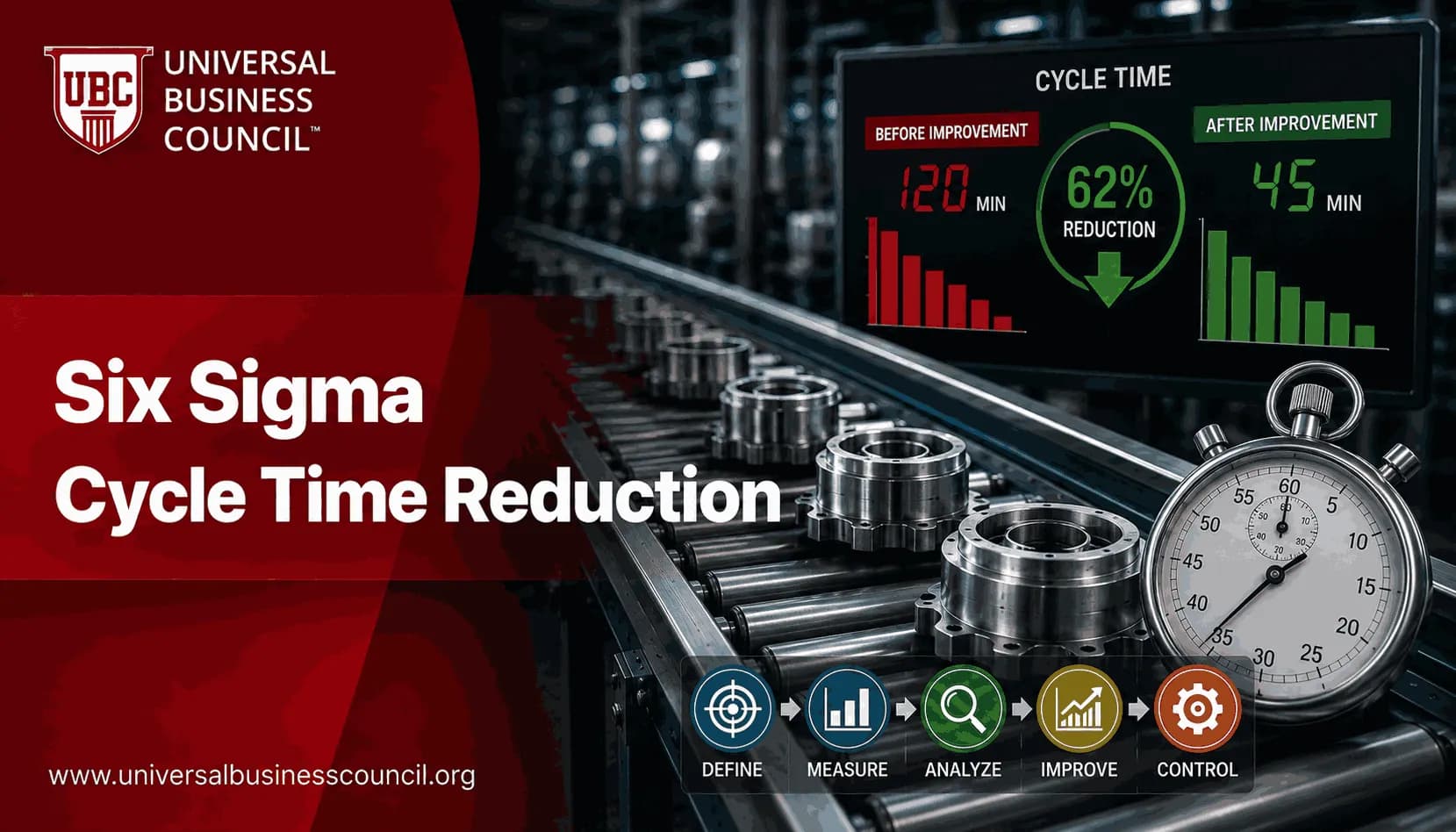
Six Sigma cycle time reduction works best when you stop treating speed as a slogan and start managing flow. The goal is simple: cut the elapsed time from the start of work to completion, while increasing the number of completed units that leave the process without rework. Professionals who want to lead this kind of work rather than just support it often start with the Certified Six Sigma Expert credential, which covers the DMAIC discipline this article is built around.
That means looking hard at waiting time, work in progress, bottlenecks, variation, batch size, and the small habits that quietly slow teams down. A faster machine helps only if the machine is the constraint. If approvals, queues, or rework are the real delay, buying capacity is an expensive answer to the wrong question.

Cycle Time, Throughput, and Little's Law
Cycle time is the total elapsed time for one unit of work. Throughput is the rate at which completed units exit the system. Little's Law, a core operations principle, connects the two: cycle time equals work in progress divided by throughput.
Put plainly, if you allow too much work into the system, cycle time rises. You see this in factories, software teams, finance operations, and customer service desks. Ten partially finished jobs feel productive. They often are not.
For Six Sigma practitioners, this is where DMAIC earns its keep:
Define the process boundary and the customer requirement for turnaround time.
Measure actual cycle time, queue time, touch time, defects, and WIP.
Analyze bottlenecks, waste, variation, and rework loops.
Improve flow using Lean, Theory of Constraints, automation, and standard work.
Control the new process with visual metrics, WIP limits, and control plans.
Because a real cycle time program usually spans operations, quality, and frontline supervisors together, project sponsors often pair Six Sigma training with broader Management Certifications, since coordinating flow improvement across that many teams is as much a leadership skill as a statistical one.
Start With the Current State, Not a Wish List
Before changing layouts or automating tasks, map the process. A value stream map shows value-added work, non value-added work, queues, handoffs, approvals, transport, inspections, and rework loops.
Be blunt here. Most cycle time is not touch time. In office processes, a document may take 20 minutes to review but sit in a queue for three days. In manufacturing, a part may run for 90 seconds, then wait half a shift for the next operation.
What to measure first
Total cycle time: start to finish elapsed time.
Touch time: time someone or something is actively working on the unit.
Queue time: waiting between steps.
First pass yield: percentage completed without rework.
WIP: number of units currently inside the process.
Constraint utilization: how much of the bottleneck's available time is used for real value-added work.
These metrics make the conversation factual. They also prevent a common mistake: improving a non bottleneck step and wondering why throughput did not move.
Core Six Sigma Cycle Time Reduction Strategies
1. Remove waste before adding capacity
Lean waste removal is the fastest route in many projects. Focus on waiting, motion, excess inventory, overprocessing, defects, unnecessary transport, and unused employee knowledge.
Motion waste in digital work is bigger than most people expect. Cut the window switching, the endless searching across systems, the copy and paste between apps, and cycle time drops without touching the actual value-added work. Small per task? Yes. Meaningless? Not if the task repeats hundreds of times a week.
2. Control WIP with discipline
When demand spikes, teams often release more work. That feels helpful. It usually lengthens cycle time because every job competes for the same constraint.
Use WIP limits. Pull work into the system only when capacity is available. Prioritize high value work. If the process is already overloaded, temporarily stop releasing low priority items. This is not theory. It is Little's Law doing exactly what it says.
3. Find and protect the bottleneck
Theory of Constraints, developed by Eliyahu Goldratt, says system throughput is governed by the constraint. So find it. Look for the step with the longest queue, highest utilization, most schedule pressure, or most expediting.
Then protect it:
Keep the best trained people on constraint work.
Remove inspections, data entry, or searching from the bottleneck where possible.
Feed it with complete, correct inputs.
Schedule breaks, maintenance, and changeovers carefully.
Do not let upstream teams flood it with oversized batches.
Only after you exploit the constraint should you consider elevating it with new equipment, extra staff, or outsourcing.
4. Reduce batch size and run work in parallel
Large batches create waiting. Smaller batches move faster, expose defects earlier, and reduce WIP. The trade-off is setup time. If setups are long, use SMED, the Single-Minute Exchange of Dies method associated with Shigeo Shingo, to separate internal and external setup tasks and shorten changeovers.
Also look for steps that can run in parallel. In service processes, compliance review and commercial review may not need to be fully sequential. In software, automated builds and tests can run while documentation updates continue. Do not parallelize blindly, though. If it increases rework, you have only moved the delay.
5. Standardize the best current method
Variation kills predictable throughput. Standard work documents the safest, fastest, proven method currently known. It should cover task sequence, quality checks, tools, takt or target time, and escalation rules.
Keep it practical. A standard operating procedure that no operator can follow during a busy shift is shelfware. A one page visual standard at the workstation is often better.
6. Automate targeted tasks, not broken processes
Automation can cut handling time, motion, and data entry. Good targets include repetitive approvals, test execution, build processes, status notifications, simple inspections, and data transfer between systems.
Sequence matters. Understand the cause with fishbone analysis, cut risk with FMEA, improve the process, then hold the gain with a control plan. Automating a step you have not first analyzed usually locks in the wrong method.
Do not automate a bad handoff. You will get bad work faster. As more of this automation moves toward connected systems, automated builds, and real-time data transfer, some improvement teams also pair Six Sigma work with a Deep Tech Certification to build a stronger footing in the emerging technology now behind these automated workflows.
How to Keep the Gains After the Kaizen Event
Rapid improvement events can produce impressive gains, but cycle time creeps back when controls are weak. Build control into the process from day one.
Create a daily throughput board with planned output, actual output, WIP, and constraint downtime.
Use control charts for high volume processes where variation matters.
Assign an owner for each countermeasure.
Audit standard work weekly at first, then monthly.
Review queue age, not just average cycle time. Old work hides in averages.
If you lead improvement work, you need both the statistical tools and the operating discipline to make changes stick. Universal Business Council's Six Sigma, Lean management, and operations management certification pathways cover both sides.
What to Do Next
Pick one process with visible pain: late orders, slow approvals, delayed deployments, or too much expediting. Map it this week. Measure WIP, queue time, first pass yield, and the constraint's actual working time. Then run one DMAIC project with a narrow scope and a hard control plan.
If you want a structured route, build your skills in Six Sigma cycle time reduction through a Universal Business Council certification pathway that covers DMAIC, Lean waste removal, process control, and throughput improvement. Start with the process that leadership already tracks. That is where your results will be noticed fastest. If your own role also touches the automation or systems behind that process, a general Tech Certification can help round out that technical side of the work.
FAQs
1. What is cycle time reduction in Six Sigma?
Six Sigma cycle time reduction is the systematic process of decreasing the time required to complete a product, service, transaction, or workflow while maintaining required quality. Teams use process data to identify delays, bottlenecks, variation, rework, and non-value-added activities that increase completion time.
2. Why is cycle time important in Six Sigma?
Cycle time affects throughput, operating cost, capacity, customer responsiveness, and delivery performance. Long or highly variable cycle times often indicate process inefficiencies such as queues, rework, poor handoffs, or capacity constraints. Reducing them can allow an organization to produce more output with the same resources.
3. What is the difference between cycle time and lead time?
Cycle time generally measures how long it takes to perform or complete a defined process or unit of work.
Lead time measures the broader elapsed time from a triggering event, such as an order, to final delivery.
Lead time can therefore include processing, waiting, transportation, queues, and other delays. Organizations occasionally use these terms differently, so operational definitions should be established before measurement begins.
4. How does DMAIC help reduce cycle time?
DMAIC provides a structured approach:
Define: Identify the cycle-time problem and target.
Measure: Establish current processing and waiting times.
Analyze: Identify bottlenecks and causes of delay.
Improve: Remove or reduce those causes.
Control: Monitor performance and prevent regression.
This is generally more productive than announcing that everyone simply needs to “work faster.”
5. How should cycle time be measured?
Teams should define clear start and end points and measure actual elapsed or processing time consistently. Useful measures may include average cycle time, median cycle time, variation, percentiles, waiting time, processing time, and cycle time by product or transaction type.
Segmenting the data can reveal delays hidden by overall averages.
6. What commonly causes excessive cycle time?
Common causes include:
Bottlenecks
Waiting and queues
Rework
Large batch sizes
Excessive approvals
Poor process layouts
Equipment downtime
Unbalanced workloads
Material shortages
Inconsistent work methods
System delays
The largest opportunity is often waiting rather than actual processing.
7. How does process mapping help reduce cycle time?
Process mapping shows activities, decisions, handoffs, loops, and delays across a workflow. Teams can record processing and waiting times at each stage and distinguish value-added from non-value-added work.
This frequently reveals the mildly depressing truth that a process taking five days may contain only two hours of actual work.
8. How does Value Stream Mapping support cycle time reduction?
Value Stream Mapping (VSM) examines end-to-end material and information flow. It identifies inventory, queues, processing time, waiting, and information delays.
Teams create a current-state map and then design a future state with fewer interruptions, smaller inventories, better flow, and shorter lead times.
9. How do bottlenecks affect throughput?
A bottleneck is a process stage whose effective capacity constrains the output of the entire system. Work accumulates before the bottleneck, increasing queues and overall completion time.
Increasing capacity elsewhere may provide little benefit if the constraint remains unchanged. Throughput improvement therefore requires identifying and addressing the actual limiting resource.
10. How does Little's Law relate to cycle time?
For a stable system, Little's Law states:
WIP = Throughput × Flow Time
Or:
Flow Time = WIP ÷ Throughput
This relationship shows why excessive work-in-process is associated with longer completion times. Controlling WIP can therefore be an important strategy for improving flow.
11. How can reducing batch sizes improve cycle time?
Large batches force units to wait while an entire batch is processed before moving forward. Smaller batches allow work to reach downstream operations sooner.
Reducing batch sizes can lower WIP and shorten lead times, although setup costs, equipment constraints, and demand patterns must be considered.
12. How does SMED help improve throughput?
Single-Minute Exchange of Die (SMED) reduces setup and changeover time. Teams identify activities that can occur while equipment is operating, simplify remaining setup tasks, and standardize the improved procedure.
Shorter changeovers make smaller batches more practical and increase available production capacity.
13. How does process variation increase cycle time?
Variation in processing times, equipment availability, arrival rates, quality, or staffing can create queues and unstable flow. Even when average capacity appears sufficient, high variability can produce significant delays.
Six Sigma techniques such as control charts, root cause analysis, standardized work, and DOE can reduce variability and make throughput more predictable.
14. How does defect reduction improve cycle time?
Defects generate rework, additional inspection, replacement production, repeated transactions, and corrective approvals. These activities consume capacity that could otherwise process new work.
Techniques such as Poka-Yoke, SPC, capability improvement, and root cause analysis can reduce rework and consequently improve throughput.
15. How can workload balancing reduce cycle time?
Workload balancing distributes activities more effectively across employees, machines, or process stages. Teams compare task times and capacity to identify overloaded and underutilized resources.
Work can then be redistributed, simplified, or redesigned so one operation does not continually create queues for everything behind it.
16. How can automation reduce cycle time?
Automation can accelerate repetitive tasks, eliminate manual handoffs, validate information, route work automatically, and reduce processing delays. Workflow automation and robotic process automation can be particularly effective in administrative processes.
The workflow should be simplified first. Automating a six-step approval chain that only needs two steps is merely faster bureaucracy.
17. How can predictive analytics and AI improve throughput?
AI can forecast demand, predict bottlenecks, detect equipment problems, optimize schedules, and identify patterns associated with long processing times. Process mining can reconstruct actual workflows from system data and expose hidden delays or rework loops.
These technologies complement Six Sigma when they are applied to clearly defined operational problems rather than added because somebody discovered the phrase “AI-powered operations.”
18. What KPIs should be tracked when reducing cycle time?
Useful KPIs include:
Average and median cycle time
Cycle-time variation
Lead time
Queue time
Throughput
WIP
First Pass Yield
Rework rate
On-time delivery
Changeover time
Capacity utilization
Process cycle efficiency
A balanced set prevents teams from improving speed while quietly damaging quality.
19. How can cycle time improvements be sustained?
The Control phase should establish standardized work, dashboards, control charts, WIP limits, process ownership, visual management, automated alerts, and escalation procedures.
Teams should monitor both cycle time and its underlying drivers. Otherwise, the process may slowly return to old habits after everyone congratulates themselves and closes the project.
20. What is the best Six Sigma strategy for reducing cycle time?
A practical roadmap is:
Define the start and end points → measure processing and waiting time → map the workflow → identify bottlenecks and queues → analyze variation and rework → remove unnecessary steps → reduce batch and setup sizes → balance capacity → standardize work → automate appropriate activities → validate throughput and quality improvements → establish ongoing controls.
The central principle is simple: do not merely make individual tasks faster. Improve the flow of the entire system. Sustainable cycle time reduction comes from eliminating waiting, rework, bottlenecks, and variability so more value moves through the process with less delay.
Related Articles
View All
Six Sigma
Six Sigma Variation Reduction: How to Make Processes More Consistent
Learn how Six Sigma variation reduction uses DMAIC, SPC, capability metrics, and input control to make business processes more consistent.

Six Sigma
Six Sigma Defect Reduction: Proven Techniques for Better Quality
Learn how Six Sigma defect reduction uses DMAIC, SPC, FMEA, CTQs, and error proofing to cut defects, reduce rework, and improve process quality.

Six Sigma
Six Sigma Root Cause Analysis: Tools, Steps, and Practical Examples
Learn Six Sigma root cause analysis tools, steps, and examples for finding verified causes of defects, delays, and process failures.
Trending Articles
The Role of Blockchain in Ethical AI Development
How blockchain technology is being used to promote transparency and accountability in artificial intelligence systems.
AWS Career Roadmap
A step-by-step guide to building a successful career in Amazon Web Services cloud computing.
Top 5 DeFi Platforms
Explore the leading decentralized finance platforms and what makes each one unique in the evolving DeFi landscape.