

Six Sigma Takt Time Explained: Matching Work Pace to Customer Demand
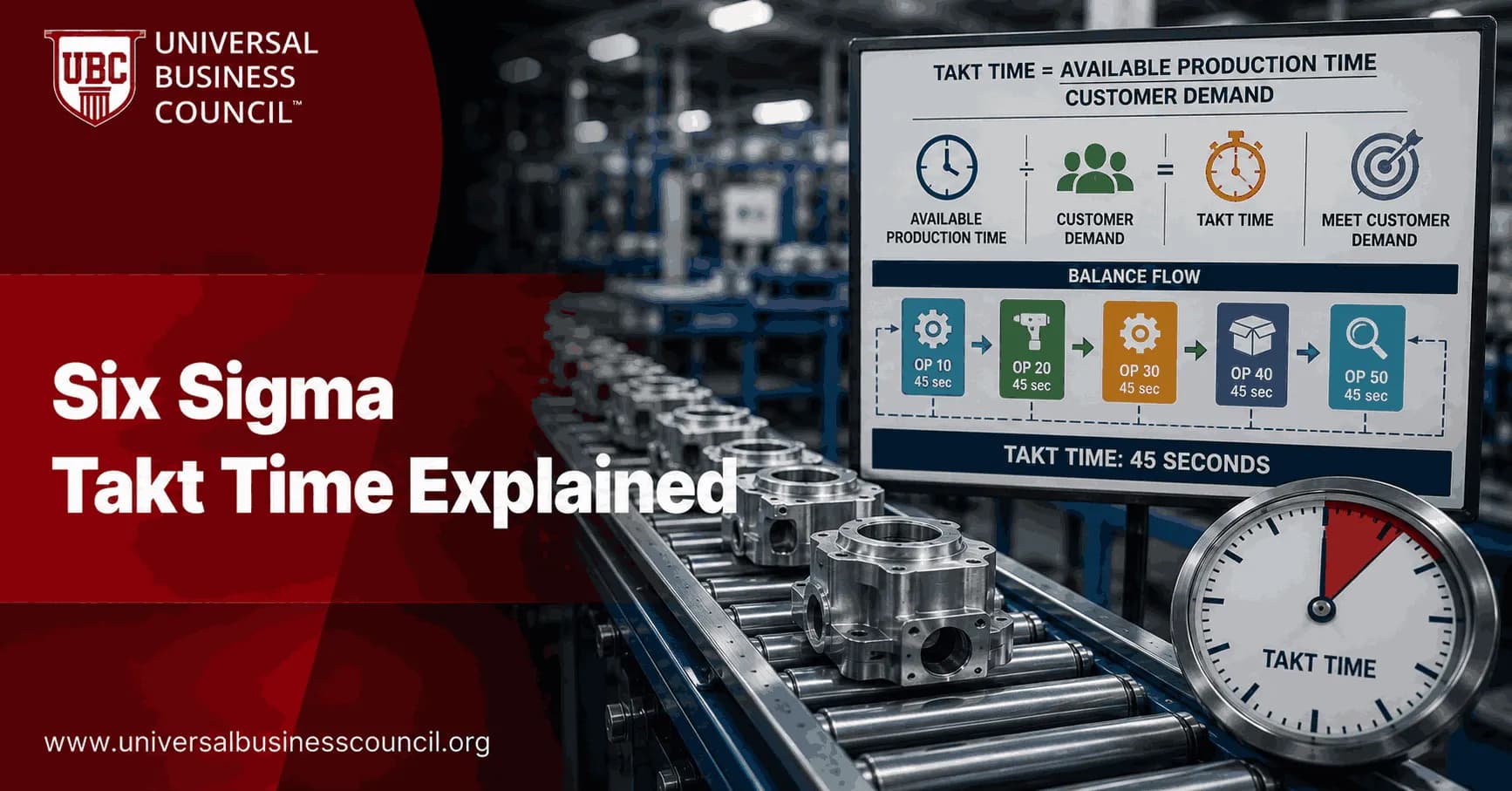
Six Sigma takt time is the pace your process must hit to meet customer demand without creating chronic backlog or producing work nobody needs yet. It is not a stopwatch reading. It is a customer-driven planning number used in Lean Six Sigma to design flow, staffing, capacity, and workload balance. Professionals who want to apply this kind of planning discipline properly, rather than just guess at capacity, often start with the Certified Six Sigma Expert credential, which covers the Lean Six Sigma discipline this article is built around.
The word Takt comes from German and refers to rhythm or pulse. In operations, that pulse is set by the customer. If demand changes, takt time changes. If available working time changes, takt time changes. That is why experienced practitioners treat takt as a design constraint, not a performance trophy.

What Is Six Sigma Takt Time?
Six Sigma takt time is the maximum allowable time per unit that lets a team meet demand during a defined period. The formula is simple:
Takt time = Net available working time per period / Customer demand per period
Use the same time period on both sides. If demand is daily, available time must be daily. If demand is per shift, use net shift time. Because setting the right takt time usually depends on staffing decisions, scheduling policy, and capacity trade-offs, operations leaders often pair Six Sigma training with broader Management Certifications, since those workforce and capacity decisions are as much a leadership skill as a statistical one.
What Counts as Available Time?
Available time means net operating time, not the full time someone is on payroll. Remove planned nonproductive time such as:
Lunch and scheduled breaks
Shift handover
Team huddles
Planned maintenance
Known changeover time
Required quality checks that stop production
This is where beginners get caught. They use an eight-hour shift as 480 minutes, then forget the 15-minute handover and two 10-minute breaks. The takt time looks comfortable on paper, but the floor is already 35 minutes short before the first unit moves.
What Counts as Demand?
Customer demand is the number of units, documents, tickets, calls, or service outcomes required in the same period. In manufacturing, demand may include customer orders plus test units, spare parts, or a realistic scrap allowance. In office work, it may be invoices processed, claims reviewed, or onboarding files completed.
Takt Time vs Cycle Time vs Lead Time
Do not mix these three terms. They answer different questions.
Takt time: How often must one unit be completed to meet customer demand?
Cycle time: How long does the process actually take to complete one unit?
Lead time: How much elapsed time passes from customer request to delivery?
The practical rule is blunt: cycle time must be equal to or less than takt time. If your takt time is 4 minutes per unit and a station takes 5 minutes, that station will create a queue. If a station takes 90 seconds, it may be overproducing unless it is controlled by a pull system or assigned supporting work.
How to Calculate Takt Time
Use this four-step method in Lean Six Sigma projects, especially during the Measure and Improve phases of DMAIC.
Define the period. Choose a shift, day, week, or other planning window.
Calculate net available time. Subtract breaks, meetings, planned maintenance, and other scheduled downtime.
Confirm customer demand. Use the required output for that same period, not a vague monthly average if the operation is planned daily.
Divide available time by demand. The result is time per unit.
Here is an example. A back-office team has 420 net minutes available in a day after breaks and huddles. It must process 140 documents. The takt time is:
420 minutes / 140 documents = 3 minutes per document
That means one completed document is required every 3 minutes to stay current. If the actual document review cycle time averages 4 minutes, the backlog is not a mystery. The process is under-capacity or overburdened.
How Takt Time Is Used in Lean Six Sigma
Takt time turns voice of the customer into an operating requirement. It shows you whether the process is sized for real demand.
Line Balancing
In assembly environments, takt time balances work across stations. If one workstation has 2 minutes of work and the next has 6 minutes, flow breaks. Lean teaching materials often contrast the desired unit pace with actual cycle times for this reason: the mismatches reveal bottlenecks.
Staffing and Capacity Planning
Takt time also supports staffing decisions. If demand rises and available time stays fixed, takt time gets shorter. You either reduce cycle time, add capacity, change scheduling, or accept longer lead times. Hoping the team will simply work faster is not a plan.
WIP Limits and Pull Systems
When teams run far faster than takt, work-in-process grows. That may feel productive for an hour, then it becomes hidden inventory, rework risk, and priority confusion. In Lean terms, overproduction is waste. Takt helps prevent it.
Where Takt Time Works Best
Takt time is most visible in manufacturing, but it is not limited to factories. Use it anywhere demand can be expressed as completed outcomes per period.
Manufacturing: assembly lines, production cells, packaging, inspection, and machine loading
Service operations: call centers, maintenance requests, appointment scheduling, and healthcare support processes
Transactional work: claims processing, invoice review, document control, onboarding, and compliance checks
There is a trade-off. Takt time works best when demand is stable enough to plan against. For highly volatile knowledge work, use it carefully. You may need demand bands, rolling averages, or separate takt calculations for different work types. A legal contract review and a password reset should not share one takt number just because both arrive through the same queue. As teams increasingly pull real-time demand and staffing data from connected scheduling systems and dashboards rather than manual counts, some operations teams pair this Lean Six Sigma work with a Deep Tech Certification to build a stronger footing in the emerging technology now feeding these live demand calculations.
Common Takt Time Mistakes
Using gross time instead of net time. This makes capacity look better than it is.
Averaging demand too broadly. Monthly demand can hide Monday surges or end-of-quarter spikes.
Confusing takt time with cycle time. Takt is required pace. Cycle time is actual performance.
Ignoring variation. A process with an average cycle time under takt may still fail if variation is high.
Treating takt as a target for individual speed. It is a system design measure, not a license to overload people.
Why Takt Time Matters for Certification Candidates
If you are studying Lean Six Sigma, expect takt time questions to test units and interpretation. The math is easy. The trap is usually whether to subtract breaks, whether demand and time periods match, or whether the process can meet demand when cycle time is greater than takt.
For Universal Business Council learners, this topic connects with study paths in Six Sigma, Lean management, process improvement, operations management, and quality management. When reviewing related certification courses, pair takt time with value stream mapping, bottleneck analysis, DMAIC, control charts, and capacity planning.
Next Step: Apply Takt Time to One Real Process
Pick one process you own this week. Calculate net available time, confirm actual customer demand, and compare takt time with measured cycle time at each step. If one step is over takt, start there. For deeper preparation, use Universal Business Council's Six Sigma learning resources to practice takt time alongside DMAIC and Lean flow tools. If your role also touches the scheduling or demand-tracking systems behind that data, a general Tech Certification can help round out that technical side of the work.
FAQs
1. What is takt time in Six Sigma?
Takt time is the rate at which a process needs to produce a product or complete a service to match customer demand. It is primarily a Lean concept, commonly used within Lean Six Sigma to align production capacity and workflow with actual demand. Takt time provides a target operating rhythm rather than simply encouraging everyone to work faster and hoping inventory sorts itself out.
2. What is the takt time formula?
The basic formula is:
Takt Time = Net Available Production Time ÷ Customer Demand
For example, if a factory has 420 minutes of available production time per shift and customers require 210 units:
420 ÷ 210 = 2 minutes per unit
The process therefore needs to complete approximately one unit every two minutes to match demand.
3. What does net available production time mean?
Net available production time is the time actually available for planned production during the period being analyzed. Depending on the organization's convention, planned breaks, meetings, maintenance, and other scheduled non-production periods may be removed.
The definition should remain consistent. Using theoretical shift time while pretending planned downtime does not exist produces a wonderfully optimistic but rather useless takt time.
4. What is the difference between takt time and cycle time?
Takt time represents the pace required to satisfy customer demand.
Cycle time represents how quickly the process actually produces a unit or completes a defined activity.
For example:
Takt time = 2 minutes per unit
Actual cycle time = 2.5 minutes per unit
The process cannot sustainably meet demand at its current performance unless capacity, work content, or other conditions change.
5. What happens when cycle time is greater than takt time?
When cycle time exceeds takt time, the process is operating too slowly to meet demand consistently. This can create backlogs, late deliveries, overtime, or growing queues.
Teams may need to reduce waste, eliminate bottlenecks, rebalance work, improve equipment reliability, reduce variation, or add justified capacity.
6. What happens when cycle time is lower than takt time?
A cycle time below takt time indicates that the process can theoretically produce faster than the required customer-demand rate.
That capacity can provide useful flexibility, but uncontrolled production at the faster rate may create overproduction and excess inventory. Lean systems therefore use takt alongside pull and production-control mechanisms.
7. Is takt time the same as customer demand?
No. Customer demand is the quantity customers require during a defined period. Takt time converts that demand into a required production pace.
If demand increases while available time remains constant, takt time becomes shorter. If demand falls, takt time becomes longer.
8. Why is takt time important in Lean Six Sigma?
Takt time gives teams a common reference point for designing and evaluating process flow. It can help identify:
Capacity shortages
Bottlenecks
Workload imbalance
Overproduction
Staffing requirements
Equipment requirements
Process improvement opportunities
Six Sigma methods can then address the variation and defects preventing operations from reliably maintaining that pace.
9. How do you calculate takt time for an eight-hour shift?
Suppose an eight-hour shift contains:
8 × 60 = 480 minutes
If 60 minutes are unavailable because of planned breaks and meetings:
480 − 60 = 420 minutes
If customer demand is 140 units per shift:
Takt Time = 420 ÷ 140 = 3 minutes per unit
The operation needs an average output pace of one unit every three minutes.
10. What is the difference between takt time and lead time?
Takt time describes the required production pace, while lead time describes the elapsed time from a defined starting point to completion or delivery.
A factory might need to produce one unit every three minutes but still have a customer lead time of several days because work spends significant time waiting, moving, or sitting in inventory.
11. What is the difference between takt time and throughput?
Takt time expresses required pace as time per unit, while throughput usually expresses actual output as units per period.
For example:
Takt time = 2 minutes/unit
corresponds to a required rate of:
30 units/hour
assuming 60 minutes of available production time.
12. How does takt time help identify bottlenecks?
Teams can compare the cycle time of each process step with takt time.
Suppose takt time is 60 seconds:
Process A = 45 seconds
Process B = 55 seconds
Process C = 75 seconds
Process D = 50 seconds
Process C cannot currently support the required pace and deserves investigation. Making Process A even faster would mostly allow work to reach Process C's queue with greater enthusiasm.
13. How does line balancing use takt time?
Line balancing distributes work across operators or stations so each stage can support the required production pace.
Teams may move tasks between stations, simplify work, improve layouts, introduce parallel resources, or eliminate unnecessary activities. The objective is to create balanced workloads while respecting quality, ergonomic, safety, and technical constraints.
14. How is the required number of operators estimated using takt time?
A simple planning estimate is:
Required Operators = Total Work Content ÷ Takt Time
For example, if total manual work content is 12 minutes per unit and takt time is 3 minutes:
12 ÷ 3 = 4 operators
Real staffing decisions should also consider variation, breaks, skill requirements, walking, reliability, and process constraints rather than treating the equation as divine instruction.
15. How does variation affect takt-based production?
A process may have an average cycle time below takt but still fail to meet demand if its cycle time varies substantially.
For example, an average of 50 seconds against a 60-second takt may look comfortable, but frequent cycles lasting 80 or 90 seconds can disrupt flow. Six Sigma tools help reduce this variation and improve predictable performance.
16. How does standardized work support takt time?
Standardized work defines consistent task sequences, methods, expected times, and standard WIP. This helps employees perform work predictably and makes differences between actual cycle time and takt time easier to detect.
Without standardized work, cycle-time comparisons can become unreliable because every operator may effectively be running a slightly different process.
17. How does takt time relate to continuous flow?
Takt time provides the rhythm around which continuous-flow processes can be designed. Ideally, connected operations produce at a pace that supports demand without excessive queues or inventory.
Where continuous flow is impractical, supermarkets, Kanban, FIFO lanes, or other pull mechanisms can help connect process stages while controlling WIP.
18. Can takt time be used outside manufacturing?
Yes. The concept can be adapted to repeatable service and transactional processes such as:
Customer support
Loan processing
Insurance claims
Order fulfillment
Healthcare workflows
Logistics
Administrative processing
For example, a team receiving 240 cases during 420 available working minutes has an implied takt of:
420 ÷ 240 = 1.75 minutes per case
Whether that pace is feasible is then a process-design and capacity question.
19. What are common takt time mistakes?
Common mistakes include:
Using gross instead of appropriately defined available time
Using unreliable demand data
Confusing takt time with cycle time
Ignoring demand changes
Treating takt as an employee speed target
Ignoring process variation
Producing faster than demand without pull controls
Applying takt mechanically to highly irregular work
Takt is a planning and process-design metric, not a stopwatch with which to terrorize employees.
20. What is the best way to use takt time in Lean Six Sigma?
A practical approach is:
Determine customer demand → calculate net available production time → calculate takt time → measure actual cycle times → compare each process stage with takt → identify bottlenecks and variation → rebalance work → remove waste and defects → establish appropriate capacity → standardize the process → monitor demand and recalculate takt when conditions change.
The essential relationship is straightforward:
Takt time tells you how fast customers require the system to produce. Cycle time tells you how fast the system actually produces.
Lean Six Sigma closes the gap between the two while controlling quality, variation, WIP, and cost.
Related Articles
View All
Six Sigma
Six Sigma Just in Time Explained: Reducing Inventory and Delays
Learn how Six Sigma Just in Time reduces inventory, delays, and waste by combining pull-based flow, takt time, kanban, and process control.
Six Sigma
Six Sigma vs Business Process Management: How They Work Together
Learn how Six Sigma and Business Process Management work together to reduce variation, improve workflows, and sustain process performance.
Six Sigma
Six Sigma in Customer Service: Reducing Complaints and Response Times
Learn how Six Sigma in Customer Service reduces complaints, wait times, callbacks, and response delays using DMAIC, Lean tools, and measurable CTQ metrics.
Trending Articles
The Role of Blockchain in Ethical AI Development
How blockchain technology is being used to promote transparency and accountability in artificial intelligence systems.
AWS Career Roadmap
A step-by-step guide to building a successful career in Amazon Web Services cloud computing.
Top 5 DeFi Platforms
Explore the leading decentralized finance platforms and what makes each one unique in the evolving DeFi landscape.