

Six Sigma Defect Reduction: Proven Techniques for Better Quality
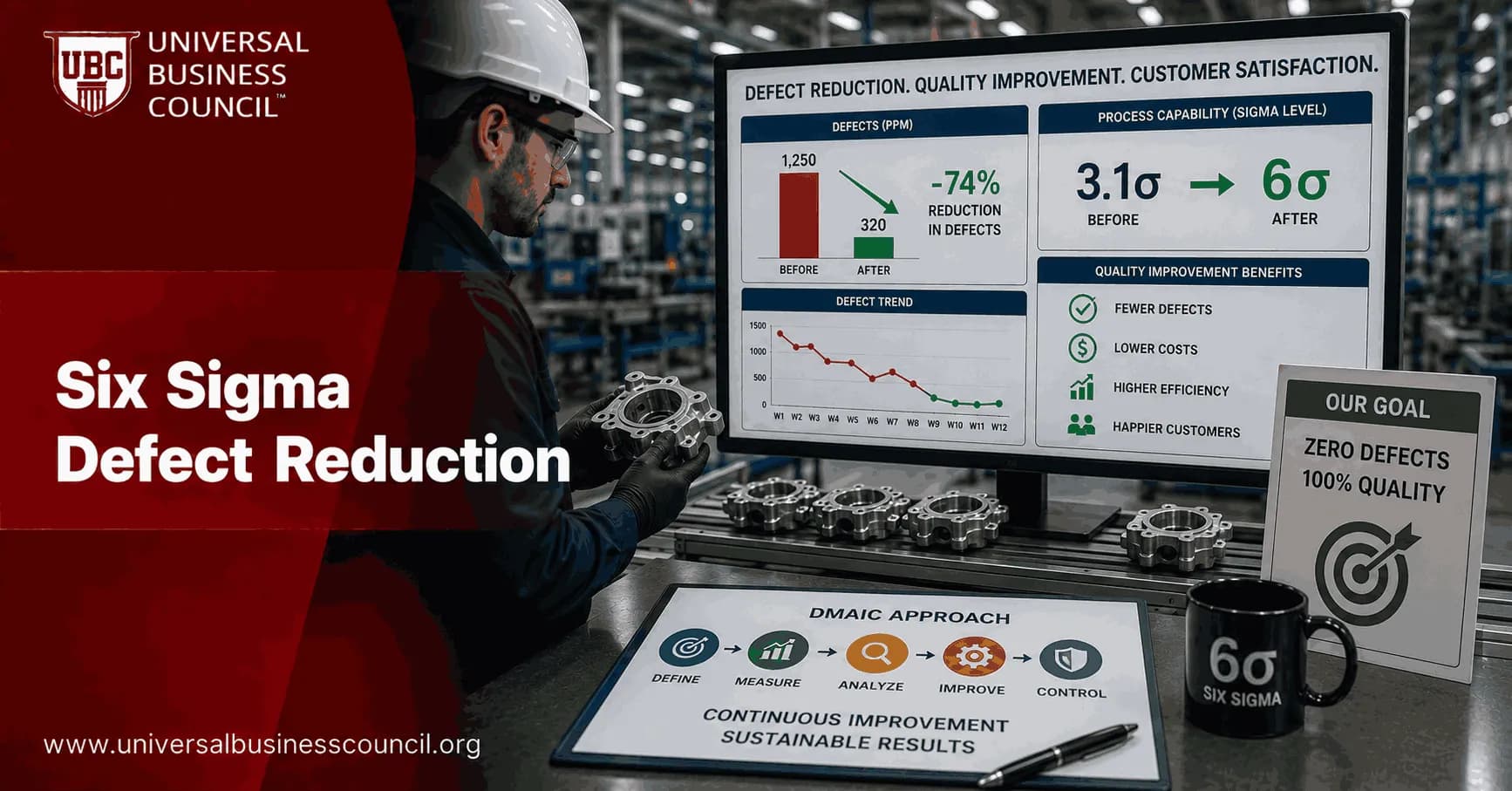
Six Sigma defect reduction works because it forces you to define the defect, measure it honestly, find the root cause, and keep the fix from slipping back. The method is not magic. It is disciplined work with data, usually run through DMAIC: Define, Measure, Analyze, Improve, Control. Professionals who want to lead this kind of work rather than just support it often start with the Certified Six Sigma Expert credential, which covers the DMAIC discipline this article is built around.
At its strictest, Six Sigma aims for 3.4 defects per million opportunities. Most teams will not start anywhere near that level. That is fine. In real operations, a targeted 50 percent defect reduction can be a serious business result if it cuts rework, warranty claims, patient risk, or late deliveries.

What Six Sigma Defect Reduction Actually Measures
A defect is anything that fails a Critical to Quality requirement, often called a CTQ. Precision is the point here. "Improve quality" is too vague. "Reduce invoice errors caused by wrong tax codes from 4.2 percent to below 1 percent in 90 days" is a workable Six Sigma project. Because a defect reduction program usually touches quality, operations, engineering, and frontline management together, project leaders often pair Six Sigma training with broader Management Certifications, since coordinating improvement across that many functions is as much a leadership skill as a statistical one.
Teams usually track:
DPMO: Defects per million opportunities, useful when products or processes have many possible failure points.
Sigma level: A performance indicator that converts defect rates into a standard quality scale.
First-pass yield: The percentage of units or transactions completed correctly without rework.
Cp and Cpk: Capability measures showing whether a process can meet specification limits consistently.
Cost of poor quality: Scrap, rework, returns, service credits, compliance penalties, and wasted labor.
Here is the detail that catches many new practitioners: DPMO is not the same as percent defective. If one order has five possible defect opportunities, your calculation changes. Certification candidates often lose marks on exactly that distinction.
Use DMAIC as the Defect Reduction Roadmap
Define: Name the defect and the customer impact
Start with the CTQ. Ask what the customer, regulator, or internal user actually needs. In healthcare, that may be the right medication, dose, time, patient, and route. In manufacturing, it may be a dimensional tolerance. In software operations, it may be failed deployments or duplicate records.
Write a tight project charter. Include the defect definition, scope, baseline, target, owner, and financial impact. Do not let the project become a department-wide clean-up exercise. That is how Six Sigma projects stall.
Measure: Build a baseline you trust
Bad measurement gives you fake improvement. Before analysis, confirm that your data is usable. In production work, that may mean a gauge repeatability and reproducibility study. In service operations, it may mean checking whether agents classify defects the same way.
Process maps and value stream maps earn their keep here. Walk the process. Watch the handoffs. A spreadsheet rarely shows the quiet workarounds people use to keep the day moving.
Analyze: Find the few causes that matter
Six Sigma defect reduction depends on separating symptoms from causes. Use simple tools first, then statistics where needed.
Pareto analysis: Find the small group of causes producing most defects.
Fishbone diagrams: Sort possible causes by methods, machines, materials, people, measurement, and environment.
5 Whys: Push past the first answer. "Operator error" is rarely the root cause.
FMEA: Score failure modes by severity, occurrence, and detection so the team fixes the highest-risk issues first.
Regression and hypothesis testing: Confirm which inputs have a real statistical relationship with defects.
To be blunt, teams overuse brainstorming and underuse verification. If the data does not support the cause, do not redesign the process around it.
Proven Six Sigma Defect Reduction Techniques
Statistical Process Control
Statistical Process Control, or SPC, uses control charts to separate normal variation from special-cause variation. This matters because tampering with a stable process can make it worse. Use X-bar and R charts for continuous measures, p-charts for proportions, and c-charts for defect counts where appropriate.
A stable process is not automatically a capable one. Capability analysis answers the next question: can the process meet customer specifications?
Poka Yoke and error proofing
Poka Yoke prevents the mistake or makes it obvious before the defect reaches the customer. Think barcode scans before medication administration, fixtures that block incorrect assembly, required fields in a CRM, or system logic that rejects duplicate invoice numbers.
This often beats more training. Training fades. A good mistake-proofing control still works at 4:55 p.m. on a Friday.
Standardized work
Standard work reduces variation. It is not bureaucracy when the process is safety-critical or customer-critical. In hospitals, standardized medication protocols have been associated with large reductions in medication errors. In logistics, standard sorting rules and scanner validation can cut mis-sorts and late deliveries.
Pilot tests before full rollout
Do not scale an untested fix. Run a pilot, measure the result, then adjust. Some teams use PDCA cycles inside the Improve phase because short test cycles reveal problems early. That approach works especially well in services, where people and systems interact in unpredictable ways. As more of this piloting and monitoring shifts onto sensors, automated logging, and connected systems, some quality teams also pair Six Sigma work with a Deep Tech Certification to build a stronger footing in the emerging technology now feeding these mistake-proofing controls.
Real Results From Six Sigma Programs
Six Sigma has a long evidence base across industries. Motorola, where Six Sigma was developed in the 1980s, reported major defect reductions and cost savings through statistical quality improvement. GE made Six Sigma famous in the 1990s, with widely cited quality and cost improvements across its industrial businesses.
Published examples show what strong execution can produce:
Manufacturing programs have reduced defects from more than 2,000 parts per million to under 200 parts per million within a year.
Lean Six Sigma projects commonly report 50 to 90 percent reductions in targeted defects when baseline data is reliable.
Healthcare projects have reported medication error reductions of around 50 percent after standardization and process controls.
Supply chain projects have cut rework rates from roughly 30 percent to 4 percent through automation, SPC, and calibration controls.
None of these are guaranteed outcomes. Weak sponsorship, fuzzy CTQs, and poor data collection will sink the project.
Where Lean Six Sigma Fits
Lean and Six Sigma are different but complementary. Lean attacks waste, delays, and flow problems. Six Sigma attacks variation and defects. If your process is both slow and error-prone, Lean Six Sigma is usually the better choice.
Use Lean tools when queues, handoffs, motion, or waiting time dominate the issue. Use Six Sigma tools when variation, capability, or defect patterns need statistical proof. In many real projects, you need both.
Skills Professionals Need to Reduce Defects
If you want to lead this work, build skill in DMAIC, SPC, FMEA, process mapping, capability analysis, and change control. You also need facilitation skills. The person closest to the defect often knows the clue that the dashboard hides.
Connect this topic with Universal Business Council courses in Six Sigma, Lean Six Sigma, operations management, project management, and business analytics. Green Belt-level study is a practical starting point for professionals who run improvement projects. Black Belt-level preparation suits you better if you will coach teams, analyze complex data, and report financial impact to leadership.
How to Start Your Next Defect Reduction Project
Choose one high-cost, high-volume defect.
Define the CTQ in measurable terms.
Calculate the current defect rate, DPMO, and cost of poor quality.
Map the process and confirm the measurement system.
Use Pareto analysis, 5 Whys, FMEA, and SPC to isolate root causes.
Pilot the fix, then standardize it.
Track control charts and audit the new process for at least 30 to 90 days.
Pick one defect this week and write the project charter. If you need a structured path, start with Six Sigma or Lean Six Sigma training through Universal Business Council, then apply DMAIC to a real process before you try to lead a larger program. If your role also touches the systems and platforms behind that data collection, a general Tech Certification can help round out that technical side of the work.
FAQs
1. What is Six Sigma defect reduction?
Six Sigma defect reduction is a data-driven approach to identifying, reducing, and preventing errors in products, services, and business processes. It focuses on understanding why defects occur, eliminating their root causes, reducing process variation, and maintaining improved performance. The aim is not simply to catch more defects during inspection, but to design processes that create fewer defects in the first place.
2. What is considered a defect in Six Sigma?
A defect is any output that fails to meet a defined customer, business, engineering, or regulatory requirement. Examples include incorrect invoices, damaged products, late deliveries, missing information, software errors, rejected components, and inaccurate transactions. What counts as a defect should be defined clearly before measurement begins, otherwise teams end up arguing about definitions while the process continues misbehaving.
3. How does Six Sigma reduce defects?
Six Sigma reduces defects by measuring current performance, identifying patterns of failure, validating root causes, improving critical process inputs, and establishing controls. DMAIC provides the usual framework for existing processes. Statistical and quality tools help teams determine which factors actually influence defects rather than relying on intuition.
4. How does DMAIC support defect reduction?
DMAIC structures defect-reduction projects into five phases:
Define: Identify the defect problem, customers, scope, and objectives.
Measure: Establish baseline defect performance and validate the data.
Analyze: Identify and verify root causes.
Improve: Develop, test, and implement corrective solutions.
Control: Monitor the process and sustain improvements.
This prevents the traditional organizational ritual of choosing a solution before determining what caused the problem.
5. What is DPMO in defect reduction?
Defects Per Million Opportunities (DPMO) estimates the number of defects per one million opportunities for a defect to occur.
DPMO = (Number of Defects ÷ Total Defect Opportunities) × 1,000,000
DPMO allows teams to normalize defect performance when units have multiple opportunities for failure. The definition of a defect opportunity must be consistent for comparisons to be meaningful.
6. What is the Six Sigma defect rate?
Six Sigma is conventionally associated with approximately 3.4 defects per million opportunities when the traditional 1.5-sigma long-term shift assumption is applied. This figure is a benchmark within Six Sigma methodology, not a universal requirement for every process. Appropriate quality targets should reflect customer requirements, risk, economics, and process context.
7. How does Pareto analysis help reduce defects?
A Pareto chart ranks defect categories according to frequency, cost, or another measure of impact. It helps teams identify the relatively small number of defect types responsible for a large share of quality problems. Teams can then focus resources on the most significant opportunities instead of attempting to solve every defect category simultaneously.
8. How does root cause analysis prevent recurring defects?
Root cause analysis investigates why defects occur rather than merely correcting their immediate symptoms. Common tools include:
5 Whys
Fishbone diagrams
Process mapping
Pareto analysis
Hypothesis testing
Regression analysis
Design of Experiments
Potential causes should be validated with data whenever possible. A plausible explanation is not automatically the actual cause, despite how persuasive it sounded in the meeting.
9. How does FMEA help with defect prevention?
Failure Mode and Effects Analysis (FMEA) identifies ways a product or process could fail before those failures cause significant problems. Teams assess factors such as severity, occurrence, and detection and prioritize preventive actions. Modern FMEA methods may use action priorities rather than relying exclusively on the traditional Risk Priority Number.
10. How does Statistical Process Control reduce defects?
Statistical Process Control (SPC) uses control charts and related techniques to monitor process behavior over time. It helps distinguish normal process variation from special causes requiring investigation. Detecting unusual changes early allows teams to intervene before process deterioration generates larger numbers of defects.
11. How does process capability affect defect levels?
Process capability measures whether a stable process can consistently operate within specification limits. Metrics such as Cp and Cpk compare process variation with requirements. A poorly capable process can generate defects even when it is statistically stable. Improving capability typically requires reducing variation, improving centering, or redesigning the process.
12. How does mistake-proofing reduce defects?
Mistake-proofing, or Poka-Yoke, prevents errors or makes them immediately detectable. Examples include:
Connectors that only fit correctly
Automatic data validation
Barcode verification
Sensors detecting missing components
Required electronic form fields
Fixtures preventing incorrect assembly
Designing the error out of the process is generally more reliable than another memo reminding people to “pay closer attention.”
13. How does standardization improve defect reduction?
Standardization defines consistent methods, process settings, materials, responsibilities, and quality requirements. Standard Operating Procedures, work instructions, checklists, visual controls, and training help reduce unnecessary differences in execution. Once an improved method has been validated, standardization makes that improvement repeatable.
14. How does Design of Experiments help reduce defects?
Design of Experiments (DOE) systematically tests how multiple process inputs affect quality outcomes. It can identify important variables, interactions, and combinations of settings that minimize defects. DOE is especially valuable when process performance depends on several interacting factors and changing one variable at a time would provide incomplete conclusions.
15. How can supplier quality management reduce defects?
Supplier defects can introduce variation before internal production even begins. Organizations can monitor incoming quality, supplier defect rates, process capability, corrective actions, and critical material characteristics. Supplier audits and development programs can address recurring problems. Better internal controls cannot completely compensate for chronically unstable inputs.
16. How can automation reduce process defects?
Automation can reduce defects by standardizing repetitive activities, validating inputs, controlling equipment settings, and preventing skipped process steps. Robotic process automation can also reduce transactional errors in service processes. Automation works best after the underlying workflow has been improved, because automating a defective process mainly increases its production capacity for defects.
17. How can AI improve Six Sigma defect reduction?
AI and machine learning can analyze historical and real-time data to predict defect probability, detect anomalies, identify complex relationships, and optimize process settings. Computer vision can automate visual inspection, while predictive models can warn operators before quality deteriorates. These technologies complement rather than eliminate the need for Six Sigma analysis and process knowledge.
18. How should defect-reduction results be measured?
Useful measures include:
Defect rate
DPMO
First Pass Yield
Rolled Throughput Yield
Scrap rate
Rework rate
Cp and Cpk
Customer returns
Warranty claims
Cost of Poor Quality
Teams should compare results against a verified baseline and use appropriate statistical methods to confirm that improvements are meaningful.
19. How can organizations sustain lower defect rates?
Organizations can sustain improvements through control plans, SPC, standardized work, preventive maintenance, employee training, audits, dashboards, automated alerts, and clearly defined response procedures. Process owners should monitor critical inputs and outputs after the Six Sigma project closes. Otherwise, old practices have an irritating habit of quietly returning.
20. What are the most effective Six Sigma techniques for defect reduction?
There is no single best technique for every process. Effective defect reduction usually combines accurate measurement, Pareto prioritization, root cause analysis, variation reduction, FMEA, mistake-proofing, process optimization, standardization, and ongoing statistical control.
The practical sequence is simple: define the defect → measure the baseline → identify and validate the causes → eliminate or control those causes → verify the improvement → sustain the gains. Six Sigma works when defect reduction becomes a controlled process rather than an endless cycle of inspection and correction.
Related Articles
View All
Six Sigma
Six Sigma in Project Management: Better Scope, Schedule, and Quality Control
Learn how Six Sigma in project management improves scope control, schedule reliability, and quality using DMAIC, CTQs, control charts, and change governance.
Six Sigma
Six Sigma Cost of Poor Quality: Finding Hidden Losses
Six Sigma Cost of Poor Quality explains how defects, rework, downtime, and lost customers hide real financial losses inside everyday operations.
Six Sigma
Six Sigma vs Quality Management: Where Six Sigma Fits
Six Sigma vs Quality Management explained: learn how Six Sigma fits within quality systems as a data-driven method for reducing defects and variation.
Trending Articles
The Role of Blockchain in Ethical AI Development
How blockchain technology is being used to promote transparency and accountability in artificial intelligence systems.
AWS Career Roadmap
A step-by-step guide to building a successful career in Amazon Web Services cloud computing.
Top 5 DeFi Platforms
Explore the leading decentralized finance platforms and what makes each one unique in the evolving DeFi landscape.