

Six Sigma Process Standardization: Creating Consistent Workflows
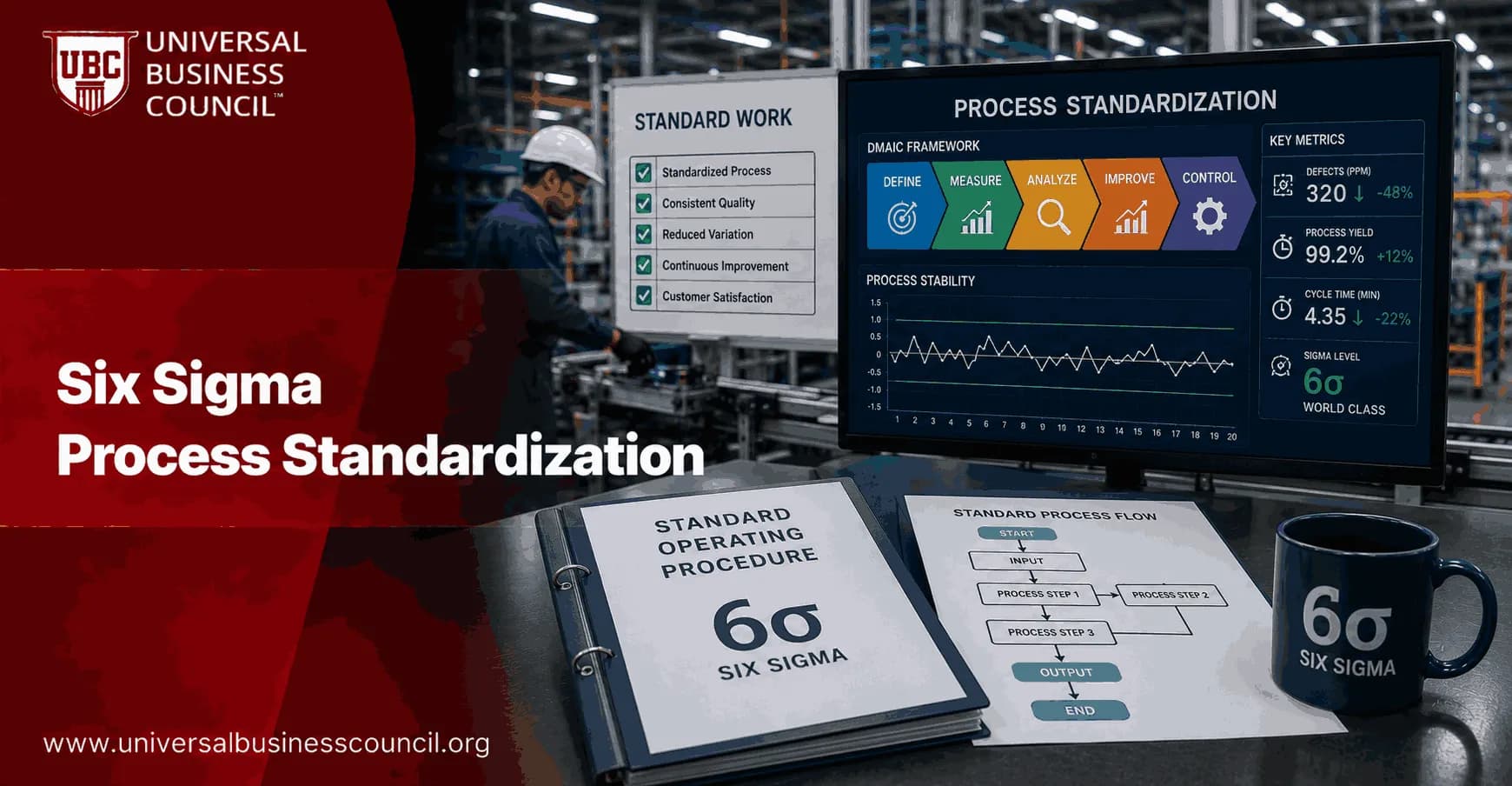
Six Sigma process standardization is the practice of defining the best current way to perform work, training people to follow it, and measuring whether the process stays stable. If two capable employees complete the same task in different ways, you do not have a people problem first. You have variation in the system. Professionals building this discipline often start with a focused credential like the Certified Six Sigma Expert program, since standard work only becomes a measurement system once you know how to define and track a defect properly.
That variation shows up as rework, missed handoffs, slower cycle time, customer complaints, and defects. Standard work gives you a baseline. Without it, improvement is guesswork.

What Six Sigma Process Standardization Means
In Lean Six Sigma, standard work is the approved method for doing a process based on observation, data, and team agreement. It is not a thick procedure manual that nobody opens. Good standard work sits close to the job: on a screen, a checklist, a visual board, a workbench, or a supervisor coaching sheet.
Classic standard work usually includes three elements:
Takt time: the pace needed to meet customer demand.
Work sequence: the agreed order of steps.
Minimum required materials or work in process: the lowest practical amount needed to keep flow stable.
To be blunt, standardization is often misunderstood. It does not mean freezing a process forever. It means agreeing on today's best method so tomorrow's improvement can be tested against something real. Getting a team to actually adopt and stick to a new standard is a leadership challenge as much as a documentation one, which is why process owners often pair Six Sigma training with broader Management Certifications, covering the coaching and change-management skills that keep a standard from quietly reverting to old habits.
Why Standard Work Creates Consistent Workflows
Six Sigma aims to reduce variation. Standard work does that by making the normal process visible. Once normal is visible, abnormal becomes easier to spot.
Think about a customer onboarding workflow. If one account manager sends the contract before identity verification, another waits for finance approval, and a third tracks the handoff in a private spreadsheet, your defect data will be noisy. You may know customers are waiting too long, but you will not know why.
With standard work, you can measure the same process each time. That lets you find delays, test changes, and compare before and after performance. This is where Six Sigma process standardization becomes more than documentation. It becomes a measurement system.
The Metrics: DPMO and Sigma Level
The main Six Sigma metric for defect performance is Defects per Million Opportunities, usually called DPMO. The formula is:
DPMO = (Number of Defects / (Number of Units x Opportunities per Unit)) x 1,000,000
Here is a simple example. A billing team processes 10,000 invoices. Each invoice has three defect opportunities: wrong amount, wrong customer details, or late issue. If auditors find 120 defects, the DPMO is:
(120 / (10,000 x 3)) x 1,000,000 = 4,000 DPMO
That number gives you a sharper view than saying, we had 120 errors. It adjusts for volume and defect opportunities.
Common long-term Six Sigma benchmark tables place performance roughly as follows:
3 sigma: about 66,807 DPMO, or around 93.3 percent yield.
4 sigma: about 6,210 DPMO, or around 99.4 percent yield.
5 sigma: about 233 DPMO, common in high reliability settings.
6 sigma: about 3.4 DPMO, associated with sectors such as aerospace, medical devices, and semiconductors.
A practical note for certification candidates: the most common DPMO mistake is dividing defects by units only. You must include opportunities per unit. That one missed step changes the answer completely.
How to Standardize a Workflow
1. Observe the real process
Do not start with the policy document. Watch the work. Ask operators, analysts, developers, or service staff to walk through what actually happens on a normal day and on a bad day. The gap between official process and actual practice is usually where the waste sits.
2. Map the current sequence
Use a process map, SIPOC, swimlane diagram, or value stream map. Keep it simple at first. Capture inputs, outputs, decisions, handoffs, wait states, and quality checks.
3. Identify waste and variation
Look for repeated approvals, unclear ownership, batching, missing information, rework loops, and tool switching. In software and service teams, the hidden waste is often in queue time, not task time. A ticket that takes 12 minutes to resolve may sit untouched for three days.
4. Define the best current method
Choose the safest, clearest, highest quality method that the team can repeat. Do not design for the superstar employee. Design for reliable performance across shifts, locations, and experience levels.
5. Document at the point of use
Use checklists, screenshots, photos, short videos, decision tables, and work instructions. A 40-page PDF buried in a shared drive is not standard work. It is storage.
6. Train, audit, and re-standardize
Train people to the standard, then verify use through observation and data. When a better method is proven, update the standard and retrain the team. This is the kaizen loop: standardize, stabilize, observe, improve, and standardize again.
Digital Standard Work Is Becoming the Default
Modern teams are moving from paper instructions to digital workflow templates, quality management systems, visual dashboards, and guided checklists. This matters because standards change. A digital instruction can be updated, version controlled, approved, and pushed to multiple sites faster than a binder can be replaced.
For technology teams, the same idea applies to pull request templates, incident response playbooks, release checklists, and access control workflows. Standardization is not just for factories. Building and maintaining that kind of version-controlled, auditable digital standard work system is real engineering work, and a Deep Tech Certification from Blockchain Council can help teams understand how tamper-evident, traceable documentation systems are actually built, since a digital standard is only as trustworthy as the system that stores and version-controls it.
Common Mistakes to Avoid
Writing the standard in a conference room: you will miss the workarounds people use to keep the process alive.
Using standardization as blame: the goal is process control, not catching people out.
Measuring adherence only: also track cycle time, defects, safety, customer impact, and rework.
Failing to update the standard: an outdated standard teaches people that documentation cannot be trusted.
Build the Capability
If you manage operations, quality, transformation, or technology delivery, make Six Sigma process standardization part of your core skill set. Start with one workflow this week. Define the defect, count opportunities, map the real steps, and write a one-page standard that the team can test.
For structured development, connect this topic with Universal Business Council's Six Sigma certification pathway and related courses in process improvement, operations management, and business management. Focus first on DMAIC, DPMO, root cause analysis, control plans, and standard work audits. Those are the tools you will use when the process has to perform the same way on Friday afternoon as it does on Monday morning. If your workflow spans multiple disconnected tools that will not share status or version history cleanly, a Tech Certification from Global Tech Council is worth adding to your plan, since some standardization problems need better systems integration, not another checklist.
FAQs
1. What is Six Sigma process standardization?
Six Sigma process standardization is the practice of creating consistent, documented, and measurable methods for performing work. It reduces unnecessary process variation by defining how tasks should be completed, who is responsible, what inputs are required, and what quality standards must be achieved. Standardization creates a stable baseline from which Six Sigma teams can measure performance and make sustainable improvements.
2. Why is process standardization important in Six Sigma?
Process standardization is important because uncontrolled differences in how work is performed can lead to defects, delays, rework, and inconsistent customer experiences. Six Sigma depends on reliable processes and meaningful data. When employees follow fundamentally different methods for the same task, determining the true causes of performance variation becomes considerably harder.
3. How does Six Sigma create consistent workflows?
Six Sigma creates consistent workflows by analyzing existing processes, identifying unnecessary variation, defining best practices, and documenting standardized procedures. Teams may use process maps, Standard Operating Procedures (SOPs), checklists, visual controls, training, and performance metrics. Once the improved workflow is established, ongoing monitoring helps ensure employees consistently follow the agreed process.
4. How does process standardization reduce variation?
Standardization reduces variation by limiting unnecessary differences in how the same work is completed. Employees use common procedures, tools, inputs, quality criteria, and decision rules. This creates more predictable process outputs. Six Sigma teams can then distinguish normal process variation from unusual problems requiring investigation rather than trying to analyze ten unofficial versions of the same workflow.
5. What is the role of DMAIC in process standardization?
DMAIC provides a structured framework for developing standardized processes. During Define, teams identify the process and customer requirements. Measure establishes current performance. Analyze identifies sources of variation. Improve develops a better workflow, and Control establishes procedures to maintain it. Standardization is particularly important during the Improve and Control phases because successful changes need to become normal operating practices.
6. What tools are used for Six Sigma process standardization?
Common tools include:
Process maps and flowcharts
SIPOC diagrams
Standard Operating Procedures (SOPs)
Checklists
Control plans
Visual management systems
Control charts
Work instructions
Process capability analysis
Error-proofing techniques
These tools make workflows easier to understand, execute, measure, and maintain.
7. What is standardized work in Six Sigma?
Standardized work is a clearly defined method for completing a process consistently and efficiently. It typically specifies the sequence of activities, expected time, required resources, quality criteria, and responsibilities. Standardized work does not mean employees can never suggest improvements. It establishes the current best-known method, which can be changed when evidence demonstrates that something better exists.
8. How do SOPs support Six Sigma process standardization?
Standard Operating Procedures document how important tasks should be completed. SOPs can define process steps, responsibilities, quality requirements, safety controls, and escalation procedures. In Six Sigma, SOPs help convert successful process improvements into repeatable operating practices. Effective SOPs should be clear and usable, rather than becoming impressive documents that employees carefully avoid opening.
9. How does process mapping improve standardization?
Process mapping visually shows how work moves from one activity to another. It helps Six Sigma teams identify duplicate steps, unnecessary approvals, bottlenecks, unclear responsibilities, and inconsistent practices. Teams can compare the current-state process with a redesigned future-state workflow and use the resulting map as the basis for standardized procedures.
10. How does standardization improve process quality?
Standardization improves quality by making process execution more predictable. When employees follow consistent methods and quality requirements, organizations can reduce errors, defects, and rework. Standardization also makes problems easier to detect because deviations from expected performance become more visible. Consistency creates the foundation needed for meaningful quality control.
11. Can process standardization improve productivity?
Yes. Standardization can improve productivity by eliminating unnecessary steps, reducing confusion, minimizing repeated decisions, and improving handoffs between employees or departments. Workers spend less time determining how routine tasks should be performed. This can shorten cycle times and increase throughput while maintaining quality.
12. How does Six Sigma standardization reduce human error?
Six Sigma reduces human error by simplifying workflows, defining clear procedures, introducing checklists, improving training, and using mistake-proofing techniques. Standardization reduces dependence on memory and individual interpretation. Where possible, automation and validation controls can further prevent errors. Asking employees to “be more careful” is not, despite its remarkable popularity, a particularly sophisticated quality-control system.
13. What is the difference between standardization and process improvement?
Standardization establishes a consistent way of performing work, while process improvement changes that method to achieve better results. The two work together. Six Sigma teams improve processes based on data and then standardize successful changes so performance does not return to previous levels. Standards should therefore evolve as organizations discover better methods.
14. How does process standardization improve employee training?
Standardized processes provide employees with clear expectations and repeatable procedures. Training becomes easier because new employees learn one defined method rather than relying on informal explanations from different colleagues. SOPs, process maps, videos, checklists, and visual instructions can reinforce training and shorten the time required for employees to perform tasks consistently.
15. How does process standardization improve customer experience?
Customers benefit when organizations deliver products and services consistently. Standardized workflows can reduce errors, waiting times, service differences, and quality problems. Customers are more likely to receive predictable outcomes regardless of which employee, department, branch, or production line handles the work. Consistency is particularly important where reliability is a major customer expectation.
16. Can Six Sigma standardization be used in service industries?
Yes. Process standardization applies to banking, healthcare, IT, logistics, insurance, hospitality, customer service, and many other service environments. Organizations can standardize activities such as customer onboarding, claims processing, incident resolution, order fulfillment, and billing. Service processes may involve more human judgment than manufacturing, so standards should clearly distinguish mandatory steps from areas where professional discretion is appropriate.
17. How can automation support standardized workflows?
Automation can enforce standardized process steps, route tasks consistently, validate information, trigger approvals, and collect performance data automatically. Workflow management systems, robotic process automation, and AI-enabled tools can reduce manual variation. However, organizations should improve the process before automating it. Automating an inefficient workflow mostly creates an inefficient workflow that operates with impressive speed.
18. What are the challenges of Six Sigma process standardization?
Common challenges include resistance to change, unclear ownership, excessive documentation, inconsistent training, weak management support, and standards that do not reflect actual working conditions. Over-standardization can also reduce useful flexibility. Successful standardization focuses on controlling critical sources of variation without turning every minor employee decision into a procedural event.
19. How can organizations sustain standardized processes?
Organizations can sustain standardization through regular training, process audits, control plans, performance dashboards, employee feedback, and clearly assigned process ownership. Teams should monitor whether standards are being followed and whether they continue to produce desired results. When conditions change, standards should be reviewed rather than preserved indefinitely merely because somebody approved them five years ago.
20. What is the future of Six Sigma process standardization?
The future of Six Sigma process standardization will increasingly involve digital workflows, real-time monitoring, AI-assisted process analysis, automation, process mining, and intelligent quality systems. Organizations will be able to detect deviations automatically and identify opportunities for continuous improvement. The core principle will remain unchanged: establish a reliable way of working, measure its performance, improve it with evidence, and update the standard so better performance becomes repeatable rather than accidental.
Related Articles
View All
Six Sigma
Six Sigma vs Process Improvement: Is Six Sigma the Same Thing?
Six Sigma is a structured process improvement method, not a synonym for process improvement. Learn when to use Six Sigma, Lean, Kaizen, or simpler workflow fixes.
Six Sigma
Six Sigma vs Business Process Management: How They Work Together
Learn how Six Sigma and Business Process Management work together to reduce variation, improve workflows, and sustain process performance.
Six Sigma
Six Sigma vs ISO 9001: Certification, Quality Systems, and Process Control
Compare Six Sigma vs ISO 9001 for certification, QMS governance, DMAIC, audits, and process control. Learn when to use each approach.
Trending Articles
The Role of Blockchain in Ethical AI Development
How blockchain technology is being used to promote transparency and accountability in artificial intelligence systems.
AWS Career Roadmap
A step-by-step guide to building a successful career in Amazon Web Services cloud computing.
Top 5 DeFi Platforms
Explore the leading decentralized finance platforms and what makes each one unique in the evolving DeFi landscape.