

Six Sigma Continuous Flow Explained: Reducing Stops, Queues, and Waste
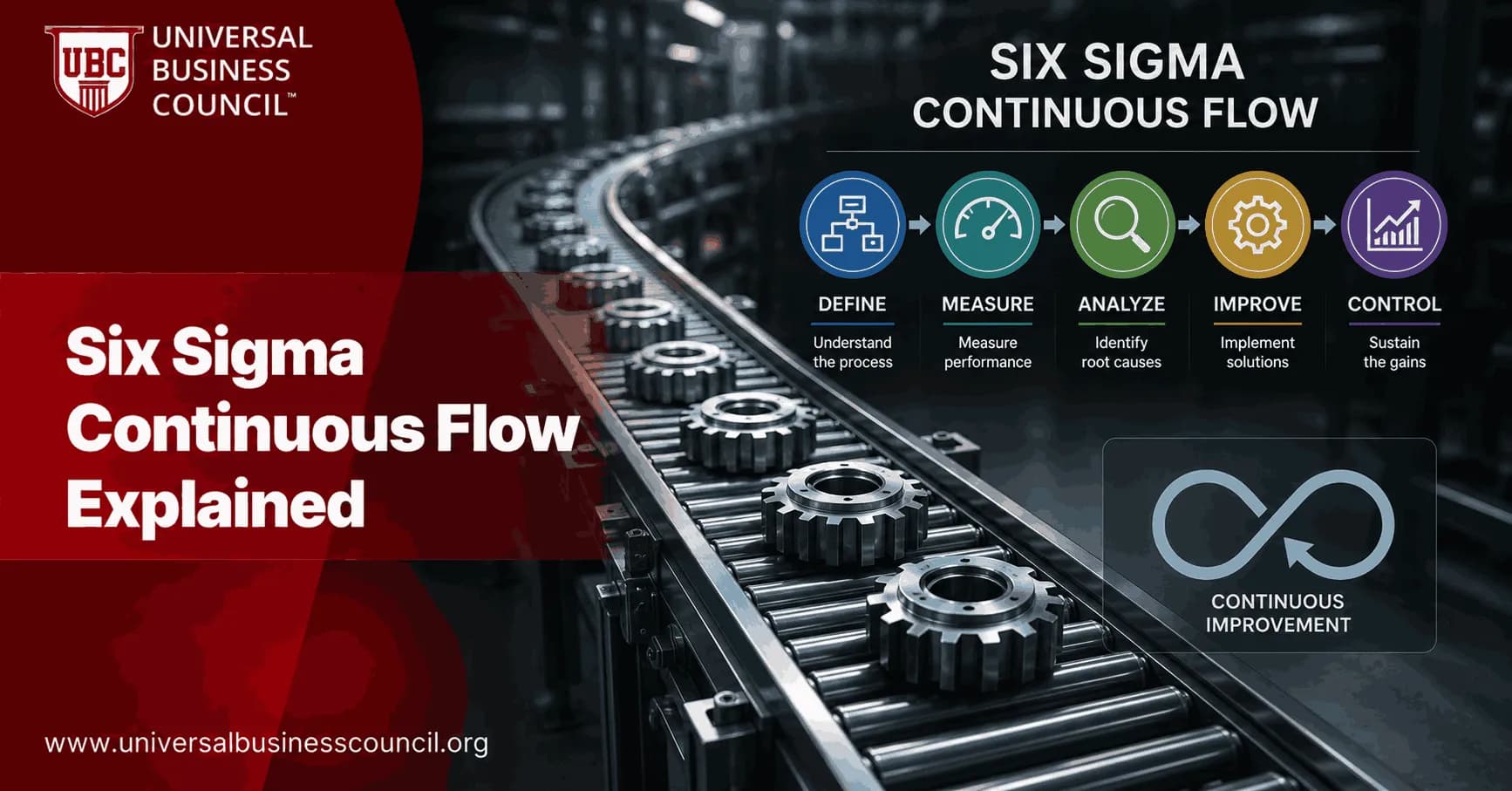
Six Sigma continuous flow is the practice of moving work from one step to the next with as little stopping, queuing, batching, and rework as possible. It sounds simple. It is not. The moment you remove buffers, weak scheduling, poor maintenance, unclear standard work, and uneven workloads become visible. Professionals who want to lead this kind of work rather than just support it often start with the Certified Six Sigma Expert credential, which covers the Lean Six Sigma discipline this article is built around.
That is the point. Continuous flow is not about pushing people to work faster. It is process design. In Lean Six Sigma, you redesign the value stream so each unit, claim, order, ticket, or component moves steadily in line with customer demand.

What Continuous Flow Means in Lean Six Sigma
Continuous flow means work in process, often called WIP, moves smoothly through each process step with minimal inventory between stations. In manufacturing, this is often called one-piece flow: one item is completed at a station and passed directly to the next step instead of waiting in a batch.
The Lean Enterprise Institute describes flow as one of the five core lean principles, alongside value, value stream, pull, and perfection. Six Sigma adds measurement discipline: cycle time, defects, variation, rework, and process capability are tracked so speed does not come at the cost of quality. Because redesigning a value stream usually means coordinating production, quality, scheduling, and frontline leadership together, flow projects often pair Six Sigma training with broader Management Certifications, since driving that kind of process redesign across a team is as much a leadership skill as a statistical one.
Here is the blunt version. If your process needs large piles of WIP to feel safe, it is probably not stable enough for continuous flow yet.
Why Stops and Queues Create Waste
Queues look harmless on a dashboard. On the floor, or inside a service workflow, they are expensive. Every item waiting in a queue ties up cash, delays the customer, and increases the chance that defects are discovered late.
Little's Law, a standard operations management principle, explains the relationship clearly: WIP = Throughput x Lead Time. If throughput stays the same and WIP rises, lead time rises too. That is why reducing WIP is not cosmetic. It attacks delay at the system level.
Stops and queues also feed the classic lean wastes:
Waiting: work sits between departments, machines, or approval steps.
Overproduction: teams create more than the next step can absorb.
Inventory: unfinished work hides defects and capacity problems.
Transportation and motion: poor layouts force extra handling.
Defects and rework: errors travel downstream before anyone notices.
Unused employee creativity: operators and analysts see problems daily, but batch systems often bury their signals.
The Core Mechanics of Six Sigma Continuous Flow
Match Cycle Time to Takt Time
Takt time is the pace required to meet customer demand. The basic formula is available production time divided by customer demand. If you have 420 available minutes and need 210 units, takt time is 2 minutes per unit.
Each station's cycle time should be equal to or slightly below takt time. If takt is 120 seconds and station three takes 165 seconds, you do not have a motivation issue. You have a bottleneck. Work will queue there no matter how good the posters on the wall look.
This is also where certification candidates get caught. They compare average cycle time to takt time and miss the longest individual step. Flow breaks at the slowest station, not at the spreadsheet average.
Standardize the Work
Standardized work defines the best-known method for performing a task safely, correctly, and within the expected time. It reduces variation. That matters because variation creates uneven flow.
In a service process, standard work might mean a claims analyst checks eligibility, documentation, coding, and exception rules in the same sequence every time. In assembly, it may define tool location, hand motion, inspection points, and changeover steps.
Limit WIP on Purpose
WIP limits feel uncomfortable at first. Good. They expose the real constraint. If a software support team caps tickets in review at five and the queue immediately backs up, the review step needs attention. Adding more intake work will not fix it.
Pull systems and Kanban boards are useful here because they let downstream demand trigger upstream work. The goal is not to keep everyone busy. The goal is to keep value moving.
Design the Layout Around the Value Stream
A process cannot flow well if related steps are scattered across departments, buildings, or systems. Cell-based layouts in manufacturing place equipment and people in the sequence of work. Service teams can do the same by creating cross-functional pods for customer onboarding, finance approvals, or complaint handling.
Value stream mapping helps you see the difference between value-added time and elapsed lead time. In many office processes, the actual work may take minutes while the customer waits days. That gap is usually queues, handoffs, and rechecking.
Protect Flow With Reliability
Continuous flow needs stable equipment and predictable inputs. Preventive maintenance, in-line sensing, and overall equipment effectiveness, or OEE, are common controls in production environments. In digital and service work, the equivalent may be system uptime, queue aging alerts, automated validation rules, and clear escalation paths. As more of this reliability work shifts onto sensors, automated alerts, and connected equipment monitoring, some flow improvement teams also pair Six Sigma work with a Deep Tech Certification to build a stronger footing in the emerging technology now feeding these reliability controls.
Metrics You Should Track
Do not manage continuous flow by observation alone. Track a short list of measures that show speed, quality, and stability:
Cycle time: time required to complete one process step.
Takt time: required pace based on customer demand.
Lead time: total start-to-finish time from customer request to completion.
WIP: number of items currently inside the process.
First pass yield: percentage completed correctly without rework.
Defect and rework rate: quality checks that confirm faster flow is not hiding errors.
OEE: availability, performance, and quality of equipment where machines drive flow.
When Continuous Flow Is the Wrong Starting Point
Continuous flow is powerful, but it is not magic. If demand is wildly unstable, inputs are poor, or setup times are long, forcing one-piece flow too early can create chaos. Start with stability. Reduce variation. Improve changeovers. Fix the bottleneck.
Some batch processing is still rational when setup costs are high or when regulatory review requires grouped evidence. The mistake is treating batching as the default. Make the batch size earn its place.
How to Start a Continuous Flow Improvement Project
Map the current value stream and mark every queue.
Calculate takt time using real demand, not forecast optimism.
Measure cycle time at each step, including changeover and waiting.
Identify the constraint and rebalance work around it.
Set WIP limits and connect steps with pull signals.
Standardize the new method before you scale it.
Track lead time, WIP, defects, and first pass yield weekly.
If you are building Lean Six Sigma capability, connect this topic with the relevant Universal Business Council Six Sigma courses and certification preparation resources. Focus first on value stream mapping, takt time, WIP control, root cause analysis, and DMAIC. Then apply the method to one live process this month. Pick a process with visible queues, and measure it before you touch it. If your own role also touches the systems or sensors behind that measurement, a general Tech Certification can help round out that technical side of the work.
FAQs
1. What is continuous flow in Six Sigma?
Continuous flow is an operational approach in which products, information, or customer requests move through a process with minimal stopping, waiting, batching, and unnecessary handoffs. It is primarily a Lean concept commonly used within Lean Six Sigma to improve speed, reduce waste, and make process problems easier to detect.
2. Why is continuous flow important in Lean Six Sigma?
Continuous flow reduces the time work spends waiting between value-adding activities. This can shorten lead times, reduce work-in-process (WIP), expose bottlenecks, and improve responsiveness. Six Sigma methods complement flow improvement by reducing the variation and defects that frequently interrupt otherwise efficient workflows.
3. What problems interrupt continuous flow?
Common causes include:
Equipment breakdowns
Long setup times
Uneven workloads
Quality defects and rework
Large batch sizes
Material shortages
Excessive approvals
Poor process layouts
Staffing constraints
Unstable processing times
A process rarely stops for mysterious reasons. Usually, the causes have simply become so normal that nobody considers them abnormal anymore.
4. What is the difference between continuous flow and batch processing?
In batch processing, multiple units accumulate before moving together to the next process stage. In continuous or one-piece flow, individual units or small quantities move forward as soon as processing is completed.
Smaller batches can reduce waiting time, inventory, and the delay between creating and discovering defects. However, true one-piece flow is not practical or economical for every process.
5. How does continuous flow reduce waiting time?
Continuous flow minimizes queues between process steps. Instead of allowing work to accumulate until the next stage is ready to process a large batch, work moves forward according to demand and available capacity.
This reduces non-value-added waiting and can dramatically shorten total lead time even when the actual processing time remains unchanged.
6. How does continuous flow reduce work-in-process?
When production or service activities are closely synchronized, less unfinished work needs to sit between process stages. Lower WIP reduces inventory costs, floor-space requirements, tracking effort, and the risk of obsolete or damaged material.
It also makes operational problems more visible because organizations cannot bury them beneath mountains of partially completed work.
7. What is Little's Law and how does it relate to flow?
Little's Law describes the relationship between WIP, throughput, and flow time:
WIP = Throughput × Flow Time
Under appropriate steady-state conditions, reducing WIP can help reduce the amount of time work spends in the system. This relationship is useful for understanding why excessive queues and inventory are associated with long lead times.
8. What is takt time in continuous flow?
Takt time represents the rate at which a process needs to produce output to satisfy customer demand.
A basic formula is:
Takt Time = Available Production Time ÷ Customer Demand
Teams can compare process cycle times with takt time to determine whether individual activities can support the required demand rate.
9. What is the difference between takt time and cycle time?
Takt time is the pace required to meet customer demand.
Cycle time is the actual time required to complete a process step or unit.
If cycle time consistently exceeds takt time at a critical operation, work can accumulate and create queues. Lean Six Sigma teams may redesign tasks, adjust capacity, or reduce variation to improve flow.
10. How do bottlenecks affect continuous flow?
A bottleneck is a process stage whose effective capacity restricts overall throughput. Work tends to accumulate before it, creating queues and longer lead times.
Teams can analyze capacity, cycle time, utilization, downtime, and process variation to locate constraints. Making non-bottleneck activities dramatically faster while ignoring the actual constraint mostly creates faster arrival at the queue.
11. How does value stream mapping improve continuous flow?
Value stream mapping shows how materials and information move through an end-to-end process. It identifies processing time, waiting time, inventory, information flows, and other sources of waste.
Teams can use the current-state map to identify interruptions and design a future-state process with better flow, smaller queues, and fewer unnecessary activities.
12. How does Six Sigma variation reduction support continuous flow?
Even a well-designed flow system can become unstable when processing times, quality, equipment availability, or material characteristics vary excessively.
Six Sigma tools such as control charts, capability analysis, root cause analysis, and DOE can reduce these sources of variation. Stable processes make synchronized flow considerably easier to maintain.
13. How do quality defects disrupt continuous flow?
Defects can create inspection holds, rework loops, replacement work, additional approvals, and production interruptions. These disruptions increase WIP and lead time.
Techniques such as Poka-Yoke, standardized work, root cause analysis, SPC, and process capability improvement help prevent defects from interrupting flow.
14. How do setup times affect continuous flow?
Long setup or changeover times encourage organizations to produce large batches because frequent switching becomes expensive. Large batches then increase inventory and waiting.
Techniques such as SMED (Single-Minute Exchange of Die) aim to reduce changeover time, making smaller batches and smoother flow economically practical.
15. What is the role of standardized work in continuous flow?
Standardized work defines consistent task sequences, expected processing times, quality requirements, and work methods. It reduces unnecessary variation and makes workload balancing easier.
When different operators perform the same activity in radically different ways, maintaining predictable flow becomes considerably more difficult.
16. How can pull systems support continuous flow?
Pull systems trigger work based on downstream demand rather than producing according to forecasts alone. Kanban is a common mechanism for controlling replenishment and limiting WIP.
Pull does not necessarily mean perfect one-piece flow. It provides a way to control work entering processes where continuous flow cannot be maintained everywhere.
17. Can continuous flow be used in service processes?
Yes. Flow principles apply to healthcare, banking, insurance, software development, logistics, customer service, and administrative processes.
For example, a loan application may spend only an hour being actively processed but several days waiting in queues for reviews and approvals. Improving flow focuses on eliminating those delays, not merely demanding that employees type faster.
18. How can automation improve continuous flow?
Automation can reduce manual handoffs, accelerate repetitive tasks, route information automatically, and synchronize process stages. Sensors and workflow systems can also provide real-time visibility into queues and bottlenecks.
Automation should follow process simplification. Digitizing an unnecessary approval step merely produces an unnecessary approval step with better latency.
19. What KPIs should be used to measure continuous flow?
Useful metrics include:
Lead time
Cycle time
WIP
Throughput
Queue or waiting time
First Pass Yield
On-time delivery
Changeover time
Process cycle efficiency
Bottleneck utilization
Teams should evaluate the entire process rather than optimizing individual activities in isolation.
20. What is the best roadmap for improving continuous flow?
A practical Lean Six Sigma approach is:
Define customer demand → map the current value stream → measure cycle and waiting times → identify bottlenecks and queues → reduce defects and process variation → balance work against takt time → reduce batch and setup sizes → establish flow where practical → use pull where flow is not practical → standardize the improved process → monitor WIP, throughput, and lead time.
The core principle is wonderfully uncomplicated: work should spend more time being processed and less time waiting to be processed. Continuous flow attacks the stops, queues, batches, and rework that turn a few minutes of useful work into several days of lead time.
Related Articles
View All
Six Sigma
Six Sigma in Supply Chain: Improving Reliability and Reducing Waste
Learn how Six Sigma in supply chain improves reliability, cuts inventory errors, reduces damaged goods, and controls waste using DMAIC and Lean Six Sigma tools.

Six Sigma
Six Sigma Just in Time Explained: Reducing Inventory and Delays
Learn how Six Sigma Just in Time reduces inventory, delays, and waste by combining pull-based flow, takt time, kanban, and process control.

Six Sigma
Six Sigma vs Kaizen: Continuous Improvement Approaches Compared
Compare Six Sigma vs Kaizen by focus, tools, cost, metrics, and use cases. Learn when to use each approach and how they work together.
Trending Articles
The Role of Blockchain in Ethical AI Development
How blockchain technology is being used to promote transparency and accountability in artificial intelligence systems.
AWS Career Roadmap
A step-by-step guide to building a successful career in Amazon Web Services cloud computing.
Top 5 DeFi Platforms
Explore the leading decentralized finance platforms and what makes each one unique in the evolving DeFi landscape.