

Six Sigma Kanban Explained: Visual Workflow Management for Quality
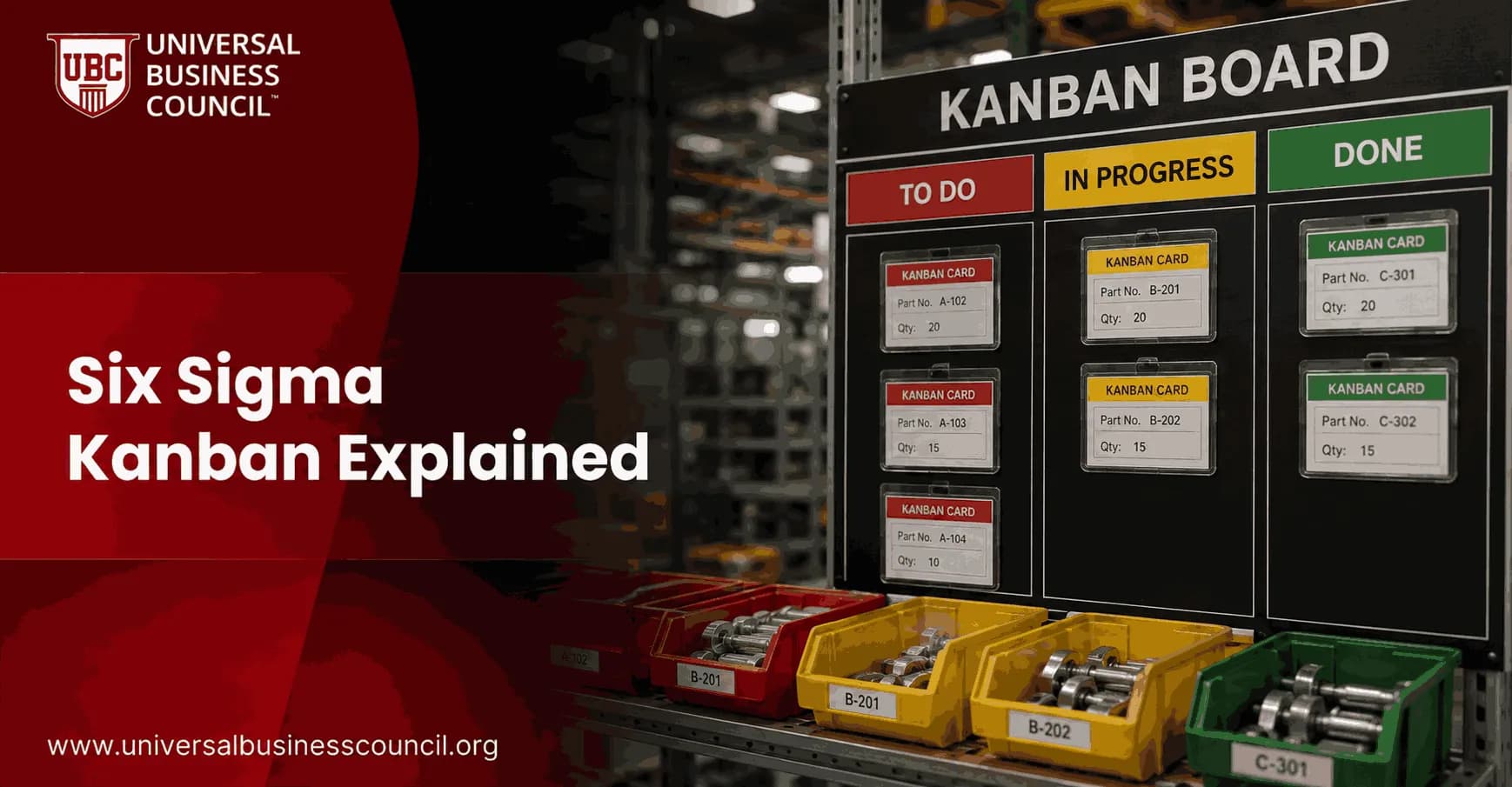
Six Sigma Kanban gives you a practical way to see work, control flow, and reduce defects using one operating system. Kanban shows where work is stuck. Six Sigma explains why variation and errors keep appearing. Put them together and the board stops being a status display. It becomes a quality control instrument. Professionals who want to run this kind of system properly, rather than just watch the board, often start with the Certified Six Sigma Expert credential, which covers the DMAIC discipline this article is built around.
This matters because many teams collect quality data too late. They find defects at inspection, release, audit, or the customer complaint stage. By then, the cost of correction is much higher. A good Kanban system exposes queues, handoff delays, rework loops, and aging tasks while the work is still in motion.

What Is Six Sigma Kanban?
Six Sigma is a data-driven improvement method focused on reducing variation and defects. It is usually organised through DMAIC: Define, Measure, Analyze, Improve, and Control. The American Society for Quality (ASQ) describes Six Sigma as a method that uses statistical analysis to improve process capability and performance.
Kanban is a visual workflow method built on cards, columns, policies, and work-in-progress limits. It grew out of Toyota production thinking and is now common in manufacturing, software, IT service management, analytics, and operations teams.
Six Sigma Kanban combines both ideas:
Kanban manages the flow of work in real time.
Six Sigma investigates defects, variation, and root causes.
Shared metrics connect daily work with formal improvement projects.
Use Kanban for visibility first. Then apply Six Sigma where the cost of poor quality is high. That order matters. Because getting teams to actually follow WIP limits and escalation rules is a change management challenge as much as a design one, process owners often pair Six Sigma training with broader Management Certifications, since driving adoption of a shared operating system across a team is a leadership skill in its own right.
How Kanban Supports Six Sigma Quality Control
1. It makes hidden queues visible
Most quality problems are not caused by one bad task. They sit in the handoffs. A request waits three days before review. A batch of claims piles up before the compliance check. A pull request sits in code review while developers start more work.
On a Kanban board, that delay is visible. You can track how long each card spends in columns such as Ready for Review, Testing, or Awaiting Customer Input. In practice, the boring column is often the expensive one. I have watched teams obsess over build time while the real bottleneck was a review queue that averaged four business days.
2. It creates usable measurement data
Six Sigma depends on reliable measurement. Kanban naturally produces time-based data, including:
Lead time: total time from request to delivery.
Cycle time: time spent actively working on an item.
Throughput: completed items per period.
WIP: number of active work items.
Defect rate: errors found per unit, card, batch, or release.
Once these metrics are stable enough to trust, you can apply Six Sigma tools such as control charts, Pareto analysis, 5 Whys, fishbone diagrams, and process capability analysis.
3. It prevents overloading the system
Work-in-progress limits are not just productivity rules. They are quality rules. When a team works on too many items at once, context switching rises and defects hide inside partially finished work.
A WIP limit forces the awkward conversation early: should you start another task, or finish the blocked one? That question is where quality improvement starts. Not in a quarterly slide deck.
Where DMAIC Fits Into a Kanban System
DMAIC works well with Kanban because each phase can draw on board data and visual signals.
Define: Identify the quality problem. For example, late invoice approvals, escaped software defects, or excessive scrap.
Measure: Use Kanban timestamps, defect logs, rework counts, and queue lengths to establish a baseline.
Analyze: Study where delays and errors cluster. Use Pareto charts, 5 Whys, and value stream mapping.
Improve: Change policies, reduce batch size, adjust WIP limits, clarify entry criteria, or remove unnecessary handoffs.
Control: Keep the Kanban board, control charts, checklists, and response rules in place so the process does not drift back.
The Control phase is where many teams slip. They finish the project, celebrate the improvement, and stop watching the leading indicators. Keep the board alive. Add explicit policies. Review aging work every day.
Best Use Cases for Six Sigma Kanban
Manufacturing and shop floor operations
Kanban is already familiar in production for replenishment, scheduling, and inventory control. Six Sigma adds deeper analysis of scrap, yield, downtime, and process variation. A visual board can show work orders, inspection status, nonconformities, and blocked batches, while control charts monitor the process behind the scenes.
Software and IT service workflows
In software, Kanban helps track features, bugs, incidents, and change requests. Six Sigma fits recurring defects and high-risk services. If incident resolution times vary wildly, do not guess. Segment the tickets, compare queues, check handoffs, and analyze the root causes.
Service operations
Claims processing, onboarding, procurement, customer support, and finance teams can use Six Sigma Kanban to cut rework and waiting time. The key is to define what a defect means. Is it a returned form? A missed SLA? A duplicate entry? Be precise.
Common Mistakes to Avoid
Starting with too many columns: If the board needs a training session to understand, simplify it.
Ignoring blocked work: A blocked card is a process signal, not a personal failure.
Measuring everything: Pick a few useful metrics. Lead time, WIP, throughput, and defect rate are enough for most teams at the start.
Using averages only: Averages hide risk. Look at variation, percentiles, and outliers.
Applying Six Sigma everywhere: Deep statistical analysis is wasted on low-risk, low-volume work. Save it for processes where errors cost money, safety, compliance, or customer trust.
How to Start With Six Sigma Kanban
Start small. Choose one workflow with visible pain: late delivery, high rework, too many open tasks, or repeated customer complaints.
Map the current workflow as it really operates, not as the procedure says it should operate.
Create a Kanban board with clear entry and exit rules for each column.
Set conservative WIP limits and review blocked cards daily.
Collect lead time, cycle time, throughput, and defect data for at least a few weeks.
Use DMAIC to investigate the biggest source of delay or defects.
Keep the improved process under visual and statistical control.
If you are building formal capability here, connect this topic with Universal Business Council's Six Sigma learning resources, quality management courses, and project management certification pathways. The strongest professionals understand both sides: the visual discipline of Kanban and the analytical discipline of Six Sigma. As more of this board data comes from digital Kanban platforms, connected dashboards, and automated timestamp tracking rather than physical boards, some teams also pair this work with a Deep Tech Certification to build a stronger footing in the emerging technology now feeding these systems.
Your next step: take one active workflow this week and add two controls: a WIP limit and an aging-work review. Then measure what changes. If the same defect keeps showing up, make it a DMAIC project instead of another meeting topic. If your role also touches the digital Kanban platforms or integrations behind that data, a general Tech Certification can help round out that technical side of the work.
FAQs
1. What is Kanban in Six Sigma?
Kanban is a visual workflow and pull-system method used within Lean Six Sigma to control how work moves through a process. It uses physical or digital signals to indicate when work, materials, or inventory should be produced, moved, or replenished. Kanban helps reduce excess work-in-process (WIP), improve flow, expose bottlenecks, and support consistent quality.
2. What does Kanban mean?
Kanban is a Japanese term commonly translated as “visual card” or “signboard.” In manufacturing, physical cards traditionally signaled when materials needed replenishment. Modern Kanban systems can use cards, bins, boards, barcode scans, electronic signals, or workflow software.
The technology has changed considerably. The basic idea remains refreshingly uncomplicated: do not start more work than the process can handle.
3. How does Kanban relate to Lean Six Sigma?
Kanban primarily comes from Lean and the Toyota Production System. Lean uses it to improve flow and reduce inventory, while Six Sigma provides analytical tools for reducing defects and variation.
Together, they can help organizations control the quantity of work entering a process while improving the reliability of the process itself.
4. How does a Kanban system work?
A basic Kanban system follows a pull principle:
A downstream process consumes an item or completes work.
A Kanban signal indicates that replenishment is required.
The upstream process produces or supplies the required quantity.
Work moves forward according to defined rules.
WIP limits prevent excessive work from entering the system.
Production is therefore triggered by consumption rather than simply by available capacity.
5. What is a Kanban board?
A Kanban board visually represents workflow stages. A simple board might contain:
To Do → In Progress → Review → Complete
Cards represent individual work items and move across the board as work progresses.
In manufacturing, columns may represent production stages. In service environments, they might represent processing, approval, verification, and completion.
6. What are WIP limits in Kanban?
Work-in-process limits specify the maximum number of items allowed in a workflow stage at one time.
For example:
Processing: Maximum 5 items
If five items are already being processed, another should generally not enter until capacity becomes available. WIP limits discourage starting new work when existing work is stuck.
7. Why are WIP limits important?
Excessive WIP creates longer queues, hides bottlenecks, increases lead time, and makes prioritization difficult.
Limiting WIP encourages teams to finish existing work before starting additional work. It also exposes capacity problems quickly. Apparently, placing another 47 tasks into “In Progress” does not make any of them progress faster.
8. How does Kanban reduce inventory?
In manufacturing, Kanban authorizes replenishment based on actual consumption. Instead of producing large quantities according to forecasts alone, upstream processes replenish predefined quantities when downstream demand generates a signal.
This can reduce raw materials, WIP, and finished-goods inventory while supporting Just-in-Time operations.
9. How does Kanban improve process flow?
Kanban makes queues, blocked work, bottlenecks, and overloaded process stages visible. Teams can see where work accumulates and investigate why.
By limiting WIP and balancing workflow, organizations can reduce waiting and improve the speed at which individual items move through the process.
10. How does Kanban improve quality?
Kanban can improve quality by preventing defective work from disappearing inside large batches or excessive queues. Smaller amounts of WIP make problems visible sooner.
Six Sigma techniques such as Poka-Yoke, SPC, root cause analysis, and standardized work can then address the underlying causes of defects.
11. What is the relationship between Kanban and Just-in-Time?
Kanban is one mechanism for implementing Just-in-Time and pull production.
JIT aims to provide what is needed, when it is needed, in the quantity required. Kanban provides signals that authorize production or replenishment based on actual downstream consumption.
Kanban is therefore a tool within a broader JIT operating system rather than a synonym for JIT.
12. What is the difference between push and Kanban pull systems?
In a push system, production is driven primarily by forecasts or schedules, and output is pushed downstream.
In a Kanban pull system, downstream consumption triggers replenishment.
Pull systems can reduce overproduction and excessive inventory, but they depend on reasonably stable demand, reliable replenishment, and disciplined operating rules.
13. What are the different types of Kanban?
Common forms include:
Production Kanban: Authorizes production.
Withdrawal Kanban: Authorizes movement of materials.
Supplier Kanban: Triggers supplier replenishment.
Signal Kanban: Indicates that inventory has reached a replenishment point.
Electronic Kanban: Uses digital systems instead of physical cards.
Organizations may combine several types within the same value stream.
14. How do you calculate the number of Kanban cards?
A commonly used sizing relationship is:
Number of Kanbans = (Demand Rate × Replenishment Lead Time × (1 + Safety Factor)) ÷ Container Quantity
Suppose demand is 100 units per day, replenishment takes 0.5 day, the safety factor is 10%, and each container holds 10 units:
(100 × 0.5 × 1.10) ÷ 10 = 5.5
Because partial Kanban containers are generally impractical, the result would normally be rounded according to the organization's operating rules, often to 6 Kanbans.
15. How does Kanban help identify bottlenecks?
When work repeatedly accumulates before one process stage, the board provides visible evidence of a constraint.
Teams can then analyze:
Cycle time
Capacity
Downtime
Defects
Staffing
Processing variation
Rework
Kanban exposes the bottleneck; Six Sigma analysis helps determine why it exists.
16. Can Kanban be used outside manufacturing?
Yes. Kanban can manage workflows in:
Software development
Healthcare
Banking
Insurance
Customer support
Marketing
Logistics
Procurement
Finance
Administrative operations
In these settings, cards represent tasks, cases, tickets, claims, applications, or other work rather than physical inventory.
17. How does Kanban differ from a simple task board?
A task board provides visual status information. A true Kanban system goes further by controlling workflow through explicit policies, pull signals, WIP limits, and flow measurement.
Moving sticky notes between columns is useful, but it does not automatically create Kanban. Otherwise, every office wall covered in colored squares would qualify as advanced operations management.
18. What KPIs should be used with Kanban?
Useful Kanban metrics include:
Lead time
Cycle time
WIP
Throughput
Queue time
Blocked work
On-time completion
First Pass Yield
Defect rate
Replenishment frequency
Stockout rate
A Cumulative Flow Diagram (CFD) can also help visualize how work accumulates across workflow stages over time.
19. What are common Kanban implementation mistakes?
Common mistakes include:
Setting unrealistic WIP limits
Ignoring blocked work
Using Kanban without clear workflow rules
Creating too many priority exceptions
Failing to address quality problems
Using unreliable demand data
Ignoring replenishment lead time
Treating the board as a reporting display rather than a control system
If every item is labeled “urgent,” the system has achieved visual management of organizational panic rather than prioritization.
20. What is the best Lean Six Sigma approach to Kanban?
A practical approach is:
Map the workflow → measure demand, WIP, cycle time, and lead time → identify bottlenecks → define workflow stages → establish explicit operating rules → calculate appropriate Kanban quantities or WIP limits → introduce pull signals → monitor flow → investigate defects and blocked work → adjust limits using data → standardize and continuously improve.
The central principle is simple: visualize the work, limit how much is in progress, and pull new work only when capacity exists.
Kanban makes workflow problems visible. Lean removes the waste those problems reveal, while Six Sigma reduces the defects and variation that prevent the system from flowing reliably.
Related Articles
View All
Six Sigma
Six Sigma vs Quality Management: Where Six Sigma Fits
Six Sigma vs Quality Management explained: learn how Six Sigma fits within quality systems as a data-driven method for reducing defects and variation.
Six Sigma
How Six Sigma Complements Total Quality Management in Enterprise Quality Programs
Learn how Six Sigma complements Total Quality Management by adding DMAIC, analytics, and project discipline to enterprise quality programs.
Six Sigma
Six Sigma in Project Management: Better Scope, Schedule, and Quality Control
Learn how Six Sigma in project management improves scope control, schedule reliability, and quality using DMAIC, CTQs, control charts, and change governance.
Trending Articles
The Role of Blockchain in Ethical AI Development
How blockchain technology is being used to promote transparency and accountability in artificial intelligence systems.
AWS Career Roadmap
A step-by-step guide to building a successful career in Amazon Web Services cloud computing.
Top 5 DeFi Platforms
Explore the leading decentralized finance platforms and what makes each one unique in the evolving DeFi landscape.