

Six Sigma Control Plan Explained: Keeping Improvements on Track
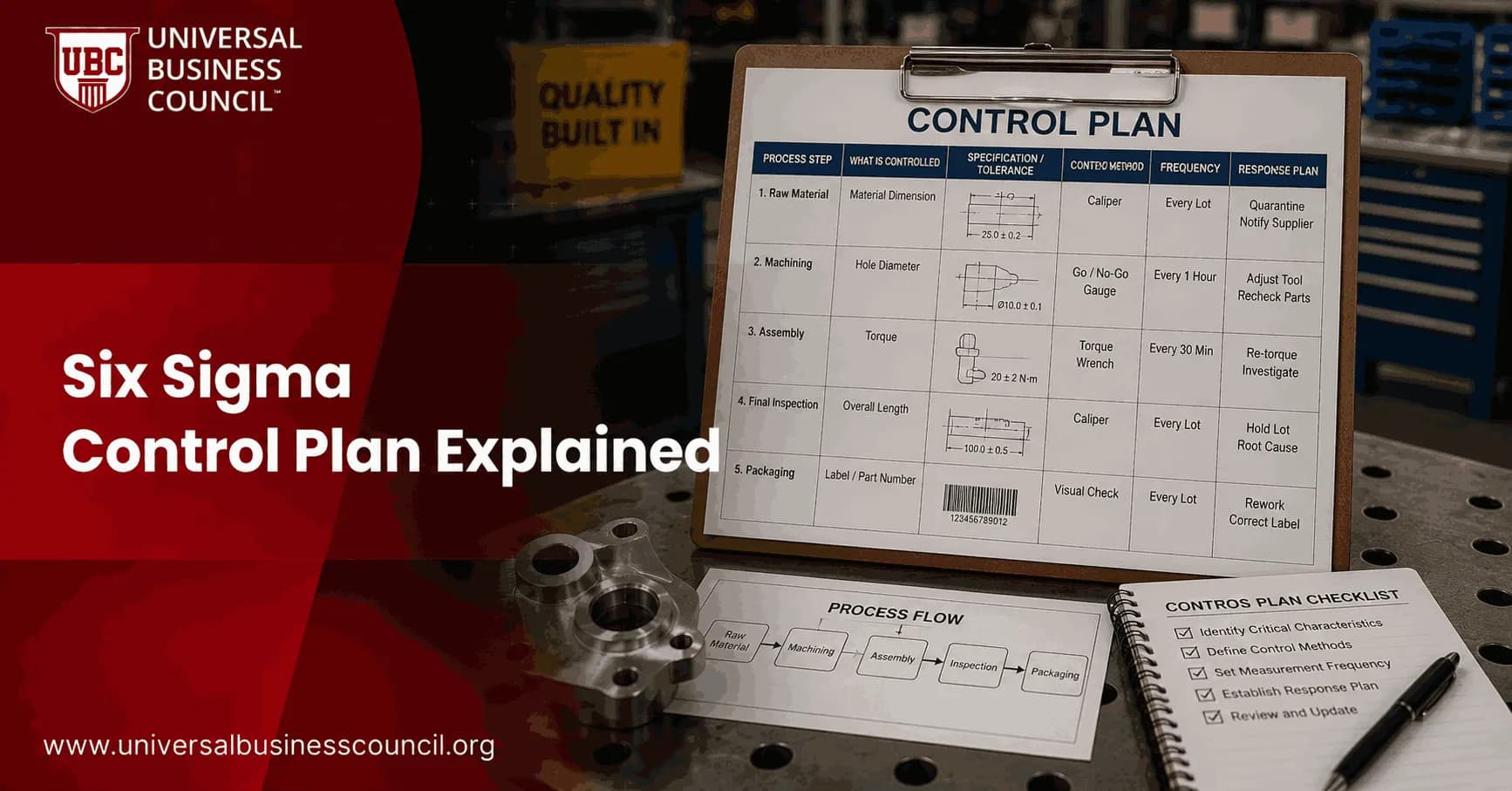
A Six Sigma control plan is the part of a DMAIC project that keeps the win from fading after the project team leaves. You use it to define what must be monitored, who owns the checks, what limits matter, and what happens when the process starts drifting. Professionals building this discipline often start with a focused credential like the Certified Six Sigma Expert program, since a control plan only works when you understand the DMAIC logic that produced the improvement it is meant to protect.
That sounds simple. It is not. Many improvement projects fail late, not because the root cause analysis was weak, but because the new process was never translated into daily work. A control plan closes that gap.

What Is a Six Sigma Control Plan?
A Six Sigma control plan is a structured, living document used in the Control phase of DMAIC: Define, Measure, Analyze, Improve, Control. It documents the controls required to sustain product or service quality at the agreed standard.
Think of it as the handover file for process stability. It turns statistical findings, CTQ requirements, process redesign, and standard work into instructions an operator, analyst, supervisor, or service team can actually follow.
In practical terms, it answers five questions:
What process step or output must be controlled?
How will it be measured?
How often will data be collected?
Who owns the check and the response?
What action is required if performance crosses a limit?
Without those answers, improvement work becomes tribal knowledge. People revert. Spreadsheets stop being updated. The old defect pattern returns quietly. Getting a named owner to actually check the plan every week, long after the project team has moved on, is a leadership problem more than a documentation one, which is why process leads often pair Six Sigma training with broader Management Certifications, covering the accountability and coaching habits that keep a control plan alive instead of forgotten in a folder.
Core Elements of an Effective Six Sigma Control Plan
Good control plans are not long for the sake of it. They are clear, specific, and usable. If the plan cannot survive a shift change or a busy Monday morning, it is too fragile.
1. Process description and flow
Start with a short description of the process and the sequence of steps. Link the plan to the current process map, standard operating procedure, or workflow. Version control matters here. A control plan tied to an outdated flowchart is worse than no plan because it gives false confidence.
2. CTQs, inputs, and outputs
Define the critical-to-quality characteristics, often called CTQs. Do not monitor everything. Monitor what affects customers, compliance, cost, or safety. In Six Sigma language, identify the critical Xs that influence the key Ys.
For a support process, that might be first response time, ticket reopen rate, and documentation errors. For a filling line, it might be fill weight, cap torque, temperature, and label placement.
3. Measurement method and frequency
The plan should state the measurement tool, sampling approach, data source, and frequency. Be precise. Check daily is vague. Sample five units at the start of each shift and record fill weight in the SPC chart is usable.
Also verify the measurement system. In manufacturing, that may mean gauge repeatability and reproducibility through MSA. In service work, it may mean a clear data definition in Salesforce, HubSpot, Google Analytics 4, or the ticketing platform.
4. Control limits and decision rules
A control plan should distinguish normal variation from a real signal. Statistical process control, or SPC, is useful here. Control limits are not the same as customer specification limits. This is a common exam trap and a real workplace mistake.
Specification limits define what the customer or design accepts. Control limits show what the process is doing statistically. If you confuse the two, you may either overreact to normal noise or miss a process shift until defects appear.
5. Reaction plan and escalation
This is the part teams often underwrite. A reaction plan must state what to do when a metric goes out of control. Stop the line? Quarantine output? Recheck the gauge? Escalate to the process owner within 30 minutes?
Be blunt: if the reaction plan only says inform supervisor, it is unfinished.
Why Control Plans Prevent Backsliding
Six Sigma projects often deliver visible gains during the Improve phase. The hard part is keeping them. A well-run control system that combines SPC, team training, and continuous monitoring can hold defect rates down and protect the annual savings a project promised on paper. The lesson is not that a document saved the day. The control system did.
The Six Sigma benchmark of about 3.4 defects per million opportunities is often cited as a quality target, but no organization reaches stable performance by dashboard watching alone. You need process ownership, measurement discipline, and fast response when variation changes.
Control Plan Example for a Service Process
Suppose your team improved customer onboarding and reduced average turnaround time from nine days to five. The control plan might include:
CTQ: onboarding completed within five business days.
Metric: cycle time from signed agreement to account activation.
Data source: CRM timestamp and activation log.
Frequency: reviewed every Monday by the onboarding manager.
Control method: weekly run chart, checklist for required documents, automated missing-document alert.
Trigger: two consecutive weeks above six business days or error rate above 4 percent.
Reaction: review delayed cases, identify the bottleneck, assign corrective action, and verify the next weekly sample.
Notice what is missing: vague ownership. Someone has the job. Someone checks the data. Someone acts. When the CRM timestamp and activation log will not reconcile cleanly, a common failure in onboarding control plans, a Deep Tech Certification from Blockchain Council can help teams understand how integrated, traceable data systems close that gap, since a weekly run chart is only as trustworthy as the two data sources feeding it.
Common Mistakes to Avoid
Monitoring too many metrics: Teams drown in data and ignore the few CTQs that matter.
No named process owner: The project team finishes, and nobody owns daily control.
Weak measurement definitions: Different people calculate cycle time in different ways.
Static documents: The process changes, but the control plan stays in an old folder.
No training: Operators or analysts are expected to follow a plan they never practiced.
The best control plans are short enough to use and detailed enough to prevent guesswork.
How to Build a Six Sigma Control Plan
Confirm the improved process flow and update standard work.
List the CTQs, critical inputs, and critical outputs.
Select the measurement method, sample size, and frequency.
Define control limits, specification limits, and decision rules.
Assign the process owner and backup owner.
Write the reaction plan for each out-of-control condition.
Train the people who will use the plan.
Schedule reviews, usually monthly at first, then quarterly once stable.
If you are preparing for a Six Sigma role, this is a topic worth practicing before certification exams. Candidates often know DMAIC theory but struggle when asked to choose the right control method, interpret SPC signals, or separate a control limit from a specification limit. Universal Business Council Six Sigma and Lean Six Sigma certification courses give structured preparation in DMAIC, SPC, MSA, FMEA, and process governance.
Where Control Plans Are Heading
Control plans are moving out of static spreadsheets. More teams now connect them to digital quality management systems, live dashboards, automated alerts, and workflow tools. In software and DevOps settings, the same thinking applies to lead time, deployment failure rate, incident response, and reliability.
Do not overcomplicate it. Start with the critical few metrics, assign ownership, and define the response. Then digitize what is already working.
Next Step
Pull one completed improvement project from the last six months and ask a simple question: who is watching the process now? If the answer is unclear, build the control plan this week. If you want deeper practice, study DMAIC control methods, SPC, and process ownership through a relevant Universal Business Council Six Sigma certification pathway. If your dashboards and alerts keep breaking because the underlying systems will not connect cleanly, a Tech Certification from Global Tech Council is worth adding to your plan, since some control plans fail on systems integration, not process design.
FAQs
1. What is a Six Sigma Control Plan?
A Six Sigma Control Plan is a structured document that defines how an improved process will be monitored and controlled after changes are implemented. It identifies the critical process characteristics, measurement methods, acceptable limits, monitoring frequency, responsible owners, and actions to take when performance moves outside expectations.
Its purpose is simple:
Improve the process → Standardize the improvement → Monitor performance → Detect problems → Correct them before gains disappear
Without a Control Plan, a successful improvement project can slowly drift back toward its old performance. Processes, much like desks, seem to possess a mysterious ability to return to disorder.
2. Why is a Control Plan important in Six Sigma?
A Control Plan helps ensure that improvements are sustained over time rather than disappearing after the project team moves on.
It converts project findings into routine operational controls. Teams know what to measure, how frequently to measure it, who owns each control, and what action is required when something goes wrong.
A good Control Plan therefore bridges the gap between project improvement and everyday process management.
3. Where is the Control Plan used in DMAIC?
The Control Plan is primarily developed and implemented during the Control phase of DMAIC:
Define → Measure → Analyze → Improve → Control
Earlier phases identify customer requirements, process inputs, root causes, and improvements. The Control phase establishes mechanisms to keep the improved process performing at the desired level.
The Control Plan is one of the main tools for transferring responsibility from the Six Sigma project team back to operational process owners.
4. What information should a Six Sigma Control Plan include?
A practical Control Plan commonly contains:
Process step
Critical characteristic
CTQ requirement
Specification or target
Measurement method
Sample size
Monitoring frequency
Control method
Responsible owner
Reaction plan
Required records
For example:
Process: Filling
CTQ: Fill weight
Target: 500 g
Monitoring: Every 30 minutes
Owner: Line operator
Reaction: Stop, investigate, correct, verify, restart
The exact fields should match the process rather than some template's desire to contain seventeen columns.
5. What are CTQs in a Control Plan?
Critical to Quality (CTQ) characteristics are measurable attributes that are important to customer requirements, product quality, safety, compliance, or process performance.
Examples include:
Product dimensions
Delivery time
Transaction accuracy
Temperature
Defect rate
Response time
Fill weight
A Control Plan should focus monitoring effort on characteristics that materially affect outcomes instead of measuring everything simply because measurement equipment exists.
6. How do you create a Six Sigma Control Plan?
A useful sequence is:
Step 1: Define the improved process.
Step 2: Identify critical inputs and outputs.
Step 3: Define CTQs and requirements.
Step 4: Select measurement methods.
Step 5: Establish monitoring frequencies.
Step 6: Assign process owners.
Step 7: Define control methods.
Step 8: Establish reaction plans.
Step 9: Document responsibilities.
Step 10: Review and update the plan as the process changes.
The plan should be operational enough that someone who was not on the original project team can actually use it.
7. What is a reaction plan in Six Sigma?
A reaction plan specifies what employees should do when a process fails to meet defined conditions or shows evidence of abnormal behavior.
A reaction sequence might be:
Detect abnormal condition → Contain affected output → Stop or adjust process if necessary → Investigate cause → Correct problem → Verify performance → Resume production
A reaction plan should identify responsibilities and escalation requirements.
“Tell somebody if things look weird” is not a reaction plan, although many organizations have bravely experimented with it.
8. What is the difference between a Control Plan and a process map?
A process map describes how work flows through a process.
A Control Plan describes how important elements of that process will be monitored and controlled.
For example:
Process Map: Receive order → Validate → Process → Ship
Control Plan: Monitor order accuracy → Check processing time → Verify shipment completeness → React to failures
The process map explains what happens. The Control Plan explains how performance is protected.
9. What is the difference between a Control Plan and an SOP?
A Standard Operating Procedure (SOP) describes how employees should perform a task or process.
A Control Plan identifies what should be monitored to ensure that the process continues producing acceptable results.
In simple terms:
SOP → How to perform the work
Control Plan → How to verify and control the work
The two should support each other. If the Control Plan requires a check that the SOP never mentions, somebody's documentation ecosystem has begun developing separate realities.
10. What is the difference between a Control Plan and FMEA?
Failure Mode and Effects Analysis (FMEA) identifies potential failures, their effects, causes, and associated risks.
A Control Plan translates important risks into ongoing controls.
For example:
FMEA identifies: Incorrect machine temperature could cause product defects.
Control Plan specifies: Measure temperature every 15 minutes, maintain defined limits, and follow a reaction procedure when abnormal conditions occur.
A useful relationship is:
FMEA identifies risk → Improvement reduces risk → Control Plan monitors remaining risk
11. How are control charts used in a Six Sigma Control Plan?
Control charts monitor process performance over time and help distinguish common-cause variation from special-cause variation.
A Control Plan may specify:
Which control chart to use
Which characteristic to monitor
Sampling frequency
Sample size
Responsibility
Rules for detecting abnormal patterns
Required reaction
Control charts help detect process changes before they become larger quality problems.
12. What are control limits in a Control Plan?
Control limits are statistically calculated boundaries describing expected variation for a stable process.
They are different from specification limits.
Control limits → derived from process behavior
Specification limits → derived from customer or engineering requirements
A point beyond a control limit or certain nonrandom patterns may indicate a special cause requiring investigation.
A process can remain within specification while becoming statistically unstable, so waiting for defects before reacting can be expensive.
13. What should be measured in a Six Sigma Control Plan?
Teams should prioritize measurements connected to:
CTQs
Critical process inputs
Critical process outputs
Known root causes
High-risk failure modes
Regulatory requirements
Customer requirements
Suppose analysis demonstrates that oven temperature strongly affects product strength. Temperature may become a critical process input requiring ongoing monitoring.
The objective is not maximum measurement. It is effective control of the variables that matter.
14. How often should a process be monitored?
Monitoring frequency should reflect process risk, speed, variation, detection capability, and cost.
Possible frequencies include:
Every unit
Every batch
Hourly
Once per shift
Daily
Weekly
Monthly
A high-risk, rapidly changing process may require continuous or frequent monitoring. A slow, stable process may require less frequent checks.
Sampling once a month because the spreadsheet has a convenient monthly tab is not a statistical rationale.
15. Who should own the Control Plan?
The process owner and operational team should ultimately own the Control Plan.
During a Six Sigma project, the Green Belt, Black Belt, engineers, quality professionals, and subject-matter experts may help create it. Once the project closes, operational ownership must be explicit.
A strong plan identifies responsibility for:
Measurement → Review → Reaction → Escalation → Documentation
Controls without owners have an impressive tendency to become historical artifacts.
16. How does a Control Plan prevent process backsliding?
A Control Plan makes the improved process observable and creates defined responses when performance deteriorates.
For example:
Improved defect rate = 0.8%
↓
Weekly monitoring
↓
Defect rate rises to 1.4%
↓
Trigger threshold reached
↓
Reaction plan activated
↓
Cause investigated and corrected
Without monitoring, the deterioration might continue until customers complain or financial results reveal the problem much later.
17. What KPIs should be included in a Six Sigma Control Plan?
Relevant KPIs depend on the process but may include:
Defect rate
First-pass yield
DPMO
Cycle time
Lead time
Rework rate
Scrap rate
Customer complaints
On-time delivery
Process capability
Error rate
Cost per unit
Good KPIs should be measurable, actionable, clearly defined, and linked to customer or business requirements.
A dashboard containing 73 metrics is not necessarily sophisticated. Sometimes it is merely a very colorful refusal to prioritize.
18. What is an example of a Six Sigma Control Plan?
Consider an order-fulfillment process improved to reduce shipping errors.
Process Element | Control |
|---|---|
CTQ | Order accuracy |
Target | ≥99.5% |
Measurement | Completed-order audit |
Sample | 50 orders |
Frequency | Daily |
Owner | Fulfillment supervisor |
Control Method | Proportion/control chart and KPI review |
Trigger | Defined statistical signal or target failure |
Reaction | Contain, investigate, correct and verify |
Record | Quality dashboard |
If accuracy deteriorates, the team does not merely record the number. The reaction plan determines what happens next.
19. What are common Six Sigma Control Plan mistakes?
Common failures include:
Too many controls: Teams monitor everything rather than critical variables.
No reaction plan: Problems are detected but nobody knows what to do.
Unclear ownership: Everyone assumes somebody else is monitoring the process.
Wrong measurement frequency: Problems develop faster than the sampling plan can detect them.
Confusing specifications with control limits: Customer requirements are treated as statistical process boundaries.
Outdated documentation: The process changes while the Control Plan remains frozen in time.
The most dangerous Control Plan is often the immaculate spreadsheet nobody actually uses.
20. How does a Six Sigma Control Plan sustain continuous improvement?
A Control Plan transforms a one-time Six Sigma improvement into a repeatable management system.
The full cycle is:
Define requirements
↓
Measure current performance
↓
Analyze root causes
↓
Improve the process
↓
Establish controls
↓
Monitor performance
↓
Detect abnormal conditions
↓
Execute reaction plan
↓
Verify recovery
↓
Continue monitoring
The goal is not to prevent a process from ever changing. Processes, suppliers, equipment, customer expectations, staffing, and technology all evolve. The goal is to make important changes visible early enough to manage them deliberately.
A strong Six Sigma Control Plan therefore answers six practical questions:
What must remain under control?
How will we measure it?
How often will we check it?
What indicates a problem?
Who is responsible?
What happens when the process goes wrong?
If those questions have clear operational answers, the improvement has a reasonable chance of surviving after the DMAIC team leaves. If they do not, the organization may eventually discover that “Control” was not merely a decorative fifth letter in DMAIC.
Related Articles
View All
Six Sigma
Six Sigma Kaizen Explained: Small Improvements with Big Results
Six Sigma Kaizen combines DMAIC discipline with daily continuous improvement to reduce defects, waste, cycle time, and rework through small measured changes.
Six Sigma
Six Sigma Change Management: Getting Stakeholder Buy-In for Improvements
Learn how Six Sigma change management improves stakeholder buy-in, reduces resistance, and helps DMAIC projects sustain measurable gains.
Six Sigma
Six Sigma vs ISO 9001: Certification, Quality Systems, and Process Control
Compare Six Sigma vs ISO 9001 for certification, QMS governance, DMAIC, audits, and process control. Learn when to use each approach.
Trending Articles
The Role of Blockchain in Ethical AI Development
How blockchain technology is being used to promote transparency and accountability in artificial intelligence systems.
AWS Career Roadmap
A step-by-step guide to building a successful career in Amazon Web Services cloud computing.
Top 5 DeFi Platforms
Explore the leading decentralized finance platforms and what makes each one unique in the evolving DeFi landscape.