

Six Sigma Kaizen Explained: Small Improvements with Big Results
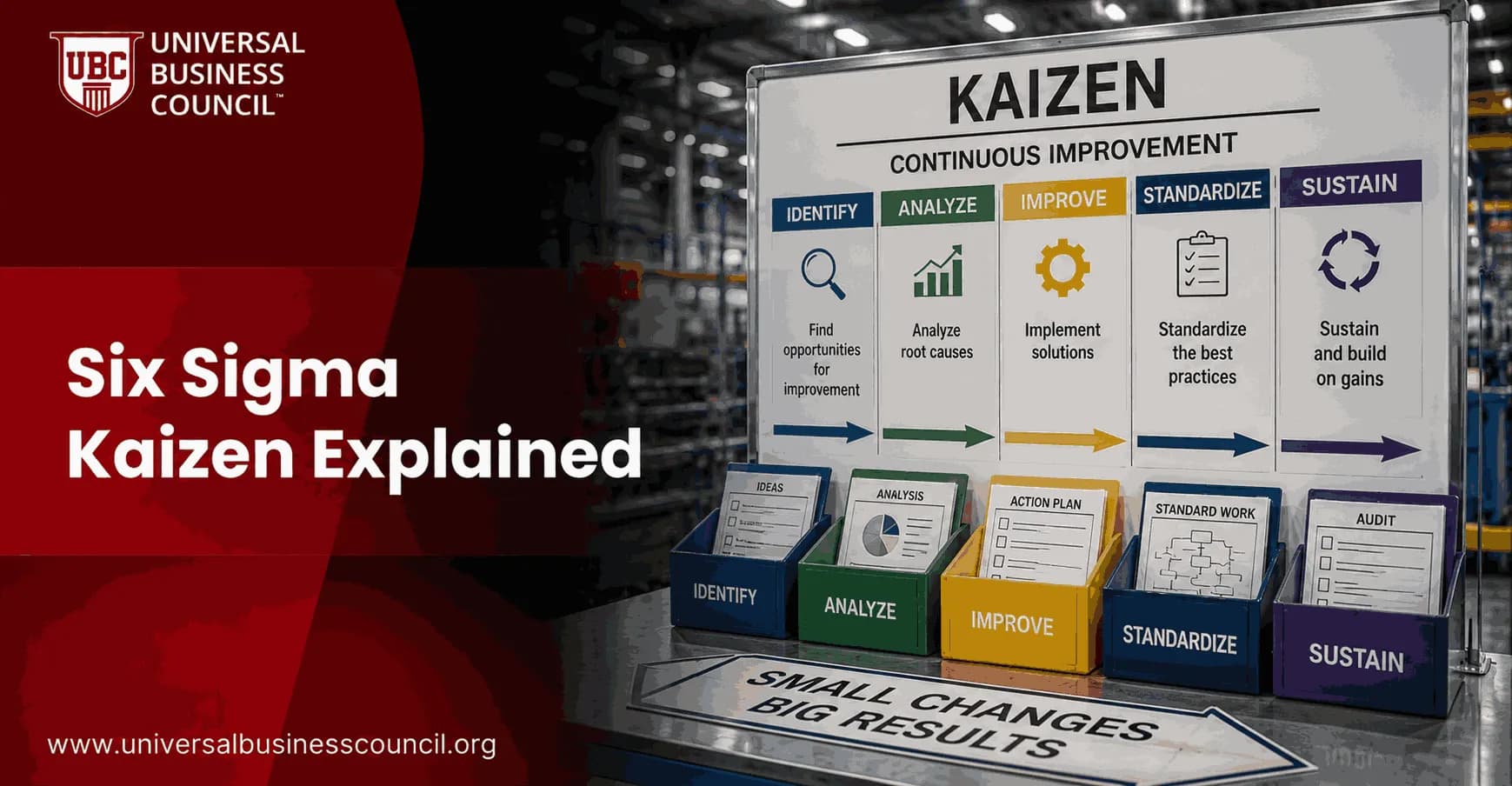
Six Sigma Kaizen is the practical marriage of two ideas that work best together. Six Sigma gives you the data discipline. Kaizen gives you the daily habit of small improvement. Used well, it reduces defects, cuts waste, and gets employees involved in fixing the work they actually do. Professionals who want to run this kind of program properly, rather than just hold occasional workshops, often start with the Certified Six Sigma Expert credential, which covers the DMAIC discipline this article is built around.
That last part matters. A spreadsheet can show you that cycle time is too high. The operator, analyst, nurse, developer, or service agent can usually tell you where the delay really happens.

What Six Sigma Kaizen Means
Six Sigma is a structured improvement method focused on reducing variation and defects. It commonly uses the DMAIC cycle: Define, Measure, Analyze, Improve, Control. The point is not to guess. You define the problem, measure current performance, analyze root causes, improve the process, then control the new standard so the gains do not fade.
Kaizen is a Japanese term often translated as "good change" or continuous improvement. Masaaki Imai helped popularize the concept in modern management practice, especially the idea that improvement should involve everyone, not only managers or specialists. Because sustaining that culture across a whole organization touches leadership, training, and daily operations together, program sponsors often pair Six Sigma training with broader Management Certifications, since embedding continuous improvement as a habit is as much a leadership skill as a statistical one.
Put them together and you get Six Sigma Kaizen: small, frequent improvements guided by data. It is common in Lean Six Sigma environments, where teams use Kaizen events, PDCA cycles, 5S, value stream thinking, root cause analysis, and basic statistics to solve tightly scoped problems.
How Small Improvements Produce Big Results
Big operational gains rarely come from one heroic fix. They come from removing friction, one step at a time.
A claims team may reduce rework by changing one field in an intake form. A warehouse may cut walking distance by moving fast-moving SKUs closer to packing benches. A software support team may reduce ticket aging by standardizing escalation criteria. None of these sounds dramatic. But if the change affects hundreds or thousands of transactions, the result can be substantial.
Six Sigma Kaizen works because it attacks three common sources of poor performance:
Waste: waiting, motion, overprocessing, excess inventory, handoff delays, and duplicated effort.
Variation: inconsistent methods, unclear standards, unstable inputs, and avoidable errors.
Overburden: workarounds, poorly designed tools, unclear priorities, and stress on people or equipment.
To be blunt, many improvement programs fail because leaders chase large transformation projects while ignoring the daily annoyances that create defects. Kaizen reverses that habit.
Six Sigma Kaizen Events: The 3 to 5 Day Model
A Kaizen event is a short, focused improvement activity. In Six Sigma settings, it often brings 5 to 8 people together for 3 to 5 days to solve a specific process problem. The team should include people who do the work, not just people who manage it.
Typical Kaizen Event Structure
Prepare: Select the problem, define the process boundary, gather baseline data, and choose the team.
Map the current state: Use process maps, SIPOC, spaghetti diagrams, or value stream maps to see the real workflow.
Analyze causes: Apply tools such as 5 Whys, fishbone diagrams, Pareto charts, and control charts where useful.
Test improvements: Change layout, remove steps, clarify standards, rebalance work, or redesign forms and handoffs.
Control the gain: Update standard operating procedures, assign owners, set review dates, and track metrics.
The best events are narrow. Do not run a Kaizen event to fix the entire order-to-cash process. Pick one pain point, such as invoice rework caused by missing purchase order data. Scope is the difference between action and theater.
Metrics That Matter in Six Sigma Kaizen
If you cannot measure the improvement, you cannot defend it. Six Sigma brings the measurement discipline that Kaizen needs.
Useful metrics include:
Defect rate: errors per unit, transaction, form, ticket, or production batch.
First pass yield: the percentage of work completed correctly without rework.
Cycle time: how long work takes from start to finish.
Lead time: total elapsed time from request to delivery.
Cost of poor quality: scrap, rework, refunds, penalties, warranty claims, and lost capacity.
Customer measures: complaints, SLA performance, customer satisfaction, or Net Promoter Score where appropriate.
One certification exam topic that catches candidates off guard is the difference between common cause and special cause variation. Common cause variation is built into the process. Special cause variation comes from a specific event or abnormal condition. Treating common cause noise as if it were a special cause leads to tampering, and tampering often makes the process worse.
Where Six Sigma Kaizen Works Best
Six Sigma Kaizen is not only for factories. It fits any repeatable process with visible waste, defects, or delay.
Manufacturing
Teams use Kaizen to improve setup time, material flow, safety, defect detection, and equipment availability. Six Sigma tools help confirm whether a change has reduced variation rather than only shifting work somewhere else.
Healthcare and Services
Hospitals, insurers, banks, and shared service centers use Kaizen to shorten queues, reduce documentation errors, and improve handoffs. The most useful projects usually start with a complaint employees already know well: too many approvals, unclear forms, repeated data entry, or slow exception handling.
IT and Digital Operations
In IT, Kaizen can improve incident management, release workflows, access requests, and support ticket triage. Pair it with DMAIC when the issue is measurable and recurring. As more of this tracking moves onto ticketing platforms, automated dashboards, and connected monitoring tools, some Kaizen teams also build that footing with a Deep Tech Certification, since it covers the emerging-technology fundamentals now sitting behind these digital operations systems.
Six Sigma vs Kaizen: Which Should You Use?
Use Six Sigma when the problem is complex, data-heavy, and tied to variation or defects. Use Kaizen when the improvement opportunity is visible, practical, and close to the work. Use Six Sigma Kaizen when you need both: disciplined analysis and quick participation.
Here is the trade-off. A full DMAIC project can be too slow for obvious waste. A pure Kaizen workshop can be too light for deep variation problems. The combined approach keeps teams from overanalyzing simple fixes or oversimplifying hard problems.
Skills Professionals Need Next
If you want to lead Six Sigma Kaizen work, build skill in process mapping, data collection, root cause analysis, facilitation, and control planning. You also need enough confidence to ask basic questions without embarrassing the team. Why is this step here? Who uses this report? What happens if we stop doing it for one week?
For internal development, consider linking this topic to Universal Business Council programmes in Six Sigma, Lean Six Sigma, operations management, project management, and business management. Professionals who understand both the statistical side and the people side of improvement are better prepared to run projects that last.
Next Step: Run a Small Kaizen Test
Pick one process this week. Measure one baseline metric, such as cycle time or defect rate. Ask the people doing the work to identify one irritating step. Test one change. Then check the data.
That is Six Sigma Kaizen in practice: no drama, no grand speech, just a better process made visible, measured, and standardized. If your role also touches the ticketing, dashboard, or monitoring systems behind that data, a general Tech Certification can help round out that technical side of the work.
FAQs
1. What is Kaizen in Six Sigma?
Kaizen is a continuous improvement approach centered on making frequent, practical improvements to processes. It originated in Japanese management practices and is closely associated with Lean. Within Lean Six Sigma, Kaizen complements data-driven problem solving by encouraging employees to identify waste, remove obstacles, standardize better methods, and continually improve everyday work.
2. What does Kaizen mean?
Kaizen is commonly translated from Japanese as “change for the better” or continuous improvement. Rather than waiting for a massive transformation program, organizations encourage ongoing improvements to quality, flow, safety, productivity, and customer value.
Small changes may look unimpressive individually. Fortunately, processes do not care whether an improvement was dramatic enough for a keynote presentation.
3. How does Kaizen relate to Six Sigma?
Kaizen and Six Sigma share the goal of better process performance but approach improvement somewhat differently.
Kaizen emphasizes frequent, incremental improvements involving the people closest to the work.
Six Sigma emphasizes structured, data-driven analysis to reduce defects and variation.
Lean Six Sigma combines these approaches so simple problems can be improved quickly while complex problems receive deeper statistical analysis.
4. What is the difference between Kaizen and DMAIC?
Kaizen is often appropriate for localized problems where causes and solutions can be understood relatively quickly. DMAIC is more appropriate for complex problems requiring detailed measurement and root-cause validation.
A team might use Kaizen to reorganize a workstation, while DMAIC could be used to investigate a persistent defect involving several interacting process variables.
Not every crooked shelf requires regression analysis.
5. What is a Kaizen event?
A Kaizen event is a focused improvement workshop typically conducted over a short period, often several days. A cross-functional team analyzes a defined process, identifies waste, develops improvements, tests changes, and establishes a better standard.
Kaizen events are sometimes called rapid improvement events or Kaizen blitzes.
6. What happens during a Kaizen event?
A typical Kaizen event includes:
Define the problem and objectives.
Observe the current process.
Collect relevant performance data.
Map the workflow.
Identify waste and root causes.
Generate improvement ideas.
Test practical changes.
Measure results.
Standardize successful improvements.
Assign follow-up actions.
The emphasis is on implementing improvements, not merely producing a particularly attractive list of recommendations.
7. What is the role of PDCA in Kaizen?
Kaizen commonly uses the Plan-Do-Check-Act (PDCA) cycle:
Plan: Identify the problem and develop an improvement.
Do: Test the proposed change.
Check: Evaluate the results.
Act: Standardize the successful change or revise the approach.
The cycle then repeats, creating an ongoing process of learning and improvement.
8. What types of waste does Kaizen target?
Kaizen commonly addresses the eight Lean wastes:
Defects
Overproduction
Waiting
Non-utilized talent
Transportation
Inventory
Motion
Extra-processing
Employees performing the work often notice these wastes first because they experience the awkward procedures, unnecessary walking, repeated data entry, and mysterious approvals every day.
9. How does Kaizen improve quality?
Kaizen improves quality by encouraging employees to identify recurring problems and correct them close to their source. Improvements may include standardized work, better visual controls, Poka-Yoke, clearer procedures, improved layouts, and simpler workflows.
Repeated small improvements can gradually reduce defects and process variation.
10. How does Kaizen reduce costs?
Kaizen can reduce costs by eliminating activities that consume resources without creating customer value.
Examples include reducing:
Scrap
Rework
Excess inventory
Waiting
Unnecessary transportation
Equipment downtime
Excess motion
Duplicate processing
Because many improvements require limited capital investment, Kaizen can produce attractive returns from relatively modest changes.
11. How does Kaizen improve productivity?
Kaizen improves productivity by simplifying work, reducing interruptions, improving layouts, balancing workloads, and removing unnecessary process steps.
For example, moving frequently used tools closer to an operator may save only a few seconds per cycle. Across thousands of cycles, those seconds become meaningful capacity.
12. What is the role of employees in Kaizen?
Employee participation is central to Kaizen. Workers closest to a process often understand its practical problems better than people reviewing it from several organizational levels away.
Employees can identify improvement opportunities, test solutions, and help establish standardized work. Management's role includes providing time, resources, support, and authority for appropriate improvements.
13. What is Gemba in Kaizen?
Gemba refers to the actual place where value-creating work occurs. In manufacturing, this might be the production floor. In healthcare, it could be a clinical area; in customer service, the service operation.
A Gemba walk involves observing the process directly, asking questions, and understanding actual conditions rather than relying entirely on reports.
Processes occasionally behave differently from their PowerPoint diagrams. Shocking, admittedly.
14. How does 5S support Kaizen?
5S provides a structured method for organizing and maintaining workplaces:
Sort → Set in Order → Shine → Standardize → Sustain
Kaizen teams frequently use 5S to reduce searching, unnecessary movement, clutter, safety problems, and inconsistency. Improvements should then be standardized so the workplace does not gradually return to its previous condition.
15. How does Poka-Yoke support Kaizen?
Poka-Yoke, or mistake-proofing, helps Kaizen teams prevent recurring errors through simple process or design changes.
Examples include fixtures that prevent incorrect assembly, sensors detecting missing parts, barcode verification, required digital fields, and visual indicators.
Simple preventive controls are often excellent Kaizen improvements because they solve recurring problems without depending on perfect human attention.
16. Can Kaizen be used outside manufacturing?
Yes. Kaizen can be applied to healthcare, banking, insurance, logistics, software, government, education, customer service, and administrative operations.
Examples include simplifying approval workflows, reducing patient waiting times, improving invoice processing, shortening customer onboarding, and eliminating duplicate data entry.
Kaizen concerns how work is performed, not whether someone happens to be standing beside a machine.
17. What metrics should be used to measure Kaizen results?
Useful measures include:
Cycle time
Lead time
Defect rate
First Pass Yield
WIP
Throughput
Scrap and rework
Changeover time
Productivity
Safety incidents
Cost savings
Customer satisfaction
Metrics should be recorded before and after improvements whenever practical so results can be demonstrated rather than enthusiastically estimated.
18. Why do Kaizen programs fail?
Common reasons include weak management support, limited employee involvement, poor follow-up, lack of measurement, excessive bureaucracy, and failure to standardize successful changes.
Another failure mode is turning Kaizen into a suggestion box where employees submit ideas and then watch them disappear into an administrative dimension from which nothing returns.
19. How can organizations sustain Kaizen?
Organizations can sustain Kaizen by incorporating improvement into normal work rather than treating it as an occasional event.
Useful practices include regular Gemba walks, improvement boards, daily management meetings, employee training, standardized work, recognition systems, performance tracking, and clear ownership of improvement actions.
Leaders should also remove barriers preventing employees from implementing sensible low-risk changes.
20. What is the best way to implement Kaizen with Six Sigma?
A practical roadmap is:
Identify customer value → observe work at the Gemba → measure current performance → identify waste → select manageable improvement opportunities → use PDCA to test changes → apply Lean tools such as 5S and Poka-Yoke → measure results → standardize successful changes → monitor performance → repeat continuously.
Use Kaizen for frequent, practical improvements and bring in DMAIC and deeper Six Sigma analysis when problems are complex, causes are uncertain, or variation requires statistical investigation.
The central principle is wonderfully resistant to management fashion: improve the process a little, verify that it actually got better, make the better method standard, and then improve it again.
Related Articles
View All
Six Sigma
Six Sigma Change Management: Getting Stakeholder Buy-In for Improvements
Learn how Six Sigma change management improves stakeholder buy-in, reduces resistance, and helps DMAIC projects sustain measurable gains.
Six Sigma
Six Sigma vs Kaizen: Continuous Improvement Approaches Compared
Compare Six Sigma vs Kaizen by focus, tools, cost, metrics, and use cases. Learn when to use each approach and how they work together.
Six Sigma
Six Sigma Minitab Explained: Statistical Software for DMAIC Projects
Learn how Six Sigma Minitab supports DMAIC projects with capability analysis, control charts, DOE, regression, Minitab Engage, and real project results.
Trending Articles
The Role of Blockchain in Ethical AI Development
How blockchain technology is being used to promote transparency and accountability in artificial intelligence systems.
AWS Career Roadmap
A step-by-step guide to building a successful career in Amazon Web Services cloud computing.
Top 5 DeFi Platforms
Explore the leading decentralized finance platforms and what makes each one unique in the evolving DeFi landscape.