

AI Benchmarking: Limitations, Bias and Responsible Interpretation
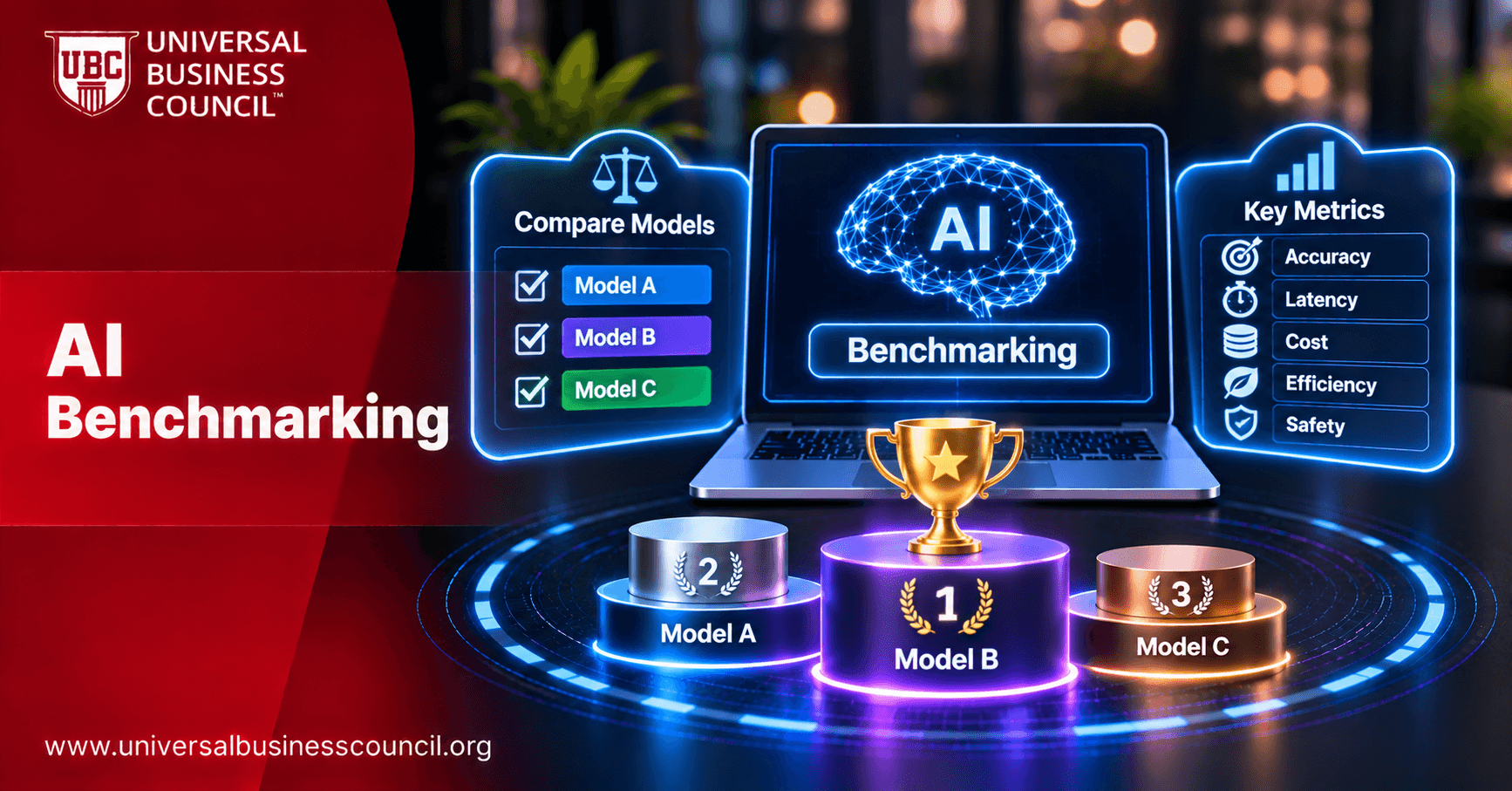
A leaderboard score answers a question that someone else chose. That is the first thing to remember when a vendor, a research paper or an internal team presents benchmark results as proof that an AI system is ready. Benchmarks are useful tools, but they measure narrow tasks under controlled conditions, and they can mislead when read as general statements about quality, safety or fairness. This guide explains what AI benchmarks do, where they fall short, how bias enters them and how to interpret results responsibly. For structured professional learning in the field, see the certified responsible AI expert certification. This is general information, not legal advice.
What is AI benchmarking?
AI benchmarking is the practice of comparing models on standard tasks, datasets and metrics so that results can be compared across systems and over time. Benchmarks exist for language understanding, reasoning, coding, image recognition, safety behavior, fairness and many other areas.

They give the field a shared yardstick. They also create incentives, because models and teams are often tuned to do well on the tests that get attention.
Why benchmark results can mislead
Understanding the weak points helps you ask better questions.
Narrow coverage
A benchmark covers a slice of behavior. A high score on a question-answering test does not show that a model will handle your customers' questions, your documents or your regulatory context. Real use includes messy inputs, ambiguity and combinations of tasks that tests rarely capture.
Contamination and overfitting
If benchmark questions or close variants appear in a model's training data, the score reflects memory rather than ability. Teams may also tune models specifically to the test. Either way, results overstate how well the model will perform on new problems.
Saturation and shelf life
As models improve, older benchmarks stop separating strong systems from weak ones. Scores bunch near the top, and small differences become noise. Meanwhile, new risks appear that existing tests do not cover.
Metric and format effects
Results can change with prompt wording, answer format, scoring rules and the number of attempts allowed. Two reports on the same benchmark may not be comparable if the setups differ.
Tests cover narrow tasks, not your real use
Training data may overlap with test content
Strong models saturate older benchmarks
Setup details change scores and comparisons
Bias in benchmarks
Benchmarks are built by people, from data collected in particular contexts, so they carry assumptions.
Whose data and whose language?
Many benchmarks lean heavily toward certain languages, regions, cultures and writing styles. A model that scores well may perform much worse for speakers of under-represented languages or dialects, or for contexts the test authors did not think about.
Whose idea of correct?
Labels and "gold" answers reflect annotator judgment, instructions and cultural norms. Disagreement among annotators, and the decision to treat one answer as right, can embed bias, especially for subjective tasks such as toxicity or sentiment.
Fairness benchmarks have limits too
Tests designed to detect bias usually check specific, predefined patterns. Passing them does not prove a model is fair. It shows only that it avoided the particular behaviors tested.
Who benefits from the design?
Tests are often written in settings with different priorities from yours. A benchmark built for research may ignore the costs of errors that matter most in healthcare, lending or employment.
Responsible interpretation
Use benchmarks as one input, with clear eyes about what they can and cannot tell you.
Ask what was measured and how
Request the benchmark name, version, setup, prompts, scoring method and date. Ask whether results were produced independently or by the developer, and whether contamination checks were performed. Treat missing details as a warning sign.
Match the test to your use
Prefer evidence from tasks and data similar to yours. Build internal evaluation sets from realistic samples, including edge cases and the groups you serve. Technical teams who design such tests benefit from strong engineering skills, which many develop through tech certifications.
Look at more than the average
Review results by subgroup, error type and difficulty. Ask about worst-case behavior, not only typical performance. For safety, check failure modes and refusal behavior in context.
Combine methods
Pair benchmarks with human evaluation, red teaming, pilots and monitoring after launch. No single measure can establish that a system is safe or fair.
Compare like with like
Only compare scores produced under the same conditions, and beware of small differences that fall within normal variation.
Governance and communication
Benchmark claims have compliance consequences.
Procurement and due diligence
When vendors cite benchmarks, treat the numbers as claims to be checked. Ask for supporting methodology and for performance evidence in your context, and write expectations into contracts.
Honest marketing
Overstating benchmark results can attract regulatory attention under advertising and consumer protection rules. Avoid phrases such as "best in class" or "bias-free" unless you can substantiate them. Teams that publish performance claims can improve accuracy and credibility with a digital marketing course.
Records and people
Keep a record of the benchmarks used, versions, results and the reasoning behind decisions, in secure, tamper-evident form. Related integrity techniques appear in deep tech certifications. Confirm that the people who design evaluations and sign off on claims have the qualifications they state, with checks through services such as HireValid.
Conclusion
AI benchmarks give useful comparisons but have real limits: narrow coverage, contamination, saturation and sensitivity to setup. They also carry bias in the data, language and labels they use. Interpret results responsibly by asking how they were produced, matching tests to your use, examining subgroups and worst cases and combining benchmarks with human review, red teaming and monitoring. Report claims honestly, and keep records of how decisions were made.
Frequently asked questions
These are the questions teams ask most about AI benchmarks.
1. What is an AI benchmark?
A standard test used to compare models on a defined task.
2. Why do benchmarks matter?
They give a shared yardstick for progress and comparison.
3. Do high scores mean a model is safe?
No. Scores reflect specific tests, not overall safety.
4. What is benchmark contamination?
When test content appears in a model's training data.
5. Why does contamination matter?
It inflates scores by rewarding memory over ability.
6. What is benchmark saturation?
When strong models cluster near the top, so the test no longer separates them.
7. Can prompts change benchmark results?
Yes. Wording, format and scoring rules can shift scores.
8. How can benchmarks be biased?
Through skewed data, languages, labels and annotator judgments.
9. Can a fairness benchmark prove fairness?
No. It checks only the patterns it was designed to test.
10. What details should vendors provide?
Benchmark name, version, setup, prompts, scoring and who ran it.
11. Should we trust developer-run results?
Treat them as claims, and seek independent or internal verification.
12. How do we build our own tests?
Use realistic samples from your use case, including edge cases and key groups.
13. Why look at subgroup results?
Averages can hide poor performance for some groups.
14. What other methods should we use?
Human evaluation, red teaming, pilots and ongoing monitoring.
15. Are small score differences meaningful?
Often not, especially within normal variation.
16. How do benchmarks affect procurement?
They should inform questions to vendors, not replace your own evidence.
17. Can benchmark claims create legal risk?
Yes, if they are overstated or misleading in marketing.
18. How often should we refresh evaluations?
Regularly, since models, risks and test relevance change.
19. What records should we keep?
Benchmarks used, versions, setups, results and decisions.
20. Who should interpret benchmark results?
Qualified technical staff with input from risk, legal and domain experts.
Related Articles
View All
Artificial Intelligence
Federated Learning and Responsible AI: Benefits, Risks and Limitations
Explore how federated learning supports responsible AI by allowing machine learning models to train across decentralized data sources without directly sharing raw data. Learn about its benefits for privacy and collaboration, along with risks, technical limitations, security concerns, and practical applications.

Artificial Intelligence
Responsible Prompt Engineering: Privacy, Bias and Security Best Practices
Learn how to practice responsible prompt engineering while protecting privacy, reducing bias, and maintaining AI security. Explore best practices for writing safe and effective prompts, handling sensitive information, preventing harmful outputs, and using generative AI responsibly across personal and business applications.
Artificial Intelligence
Model Drift vs Data Drift: Implications for Responsible AI
Understand the difference between model drift and data drift and how both affect AI system performance over time. Explore their causes, key indicators, detection methods, and implications for responsible AI, including accuracy, fairness, reliability, and the need for continuous model monitoring.
Trending Articles
The Role of Blockchain in Ethical AI Development
How blockchain technology is being used to promote transparency and accountability in artificial intelligence systems.
AWS Career Roadmap
A step-by-step guide to building a successful career in Amazon Web Services cloud computing.
Top 5 DeFi Platforms
Explore the leading decentralized finance platforms and what makes each one unique in the evolving DeFi landscape.