

Responsible AI Monitoring After Deployment: What to Track
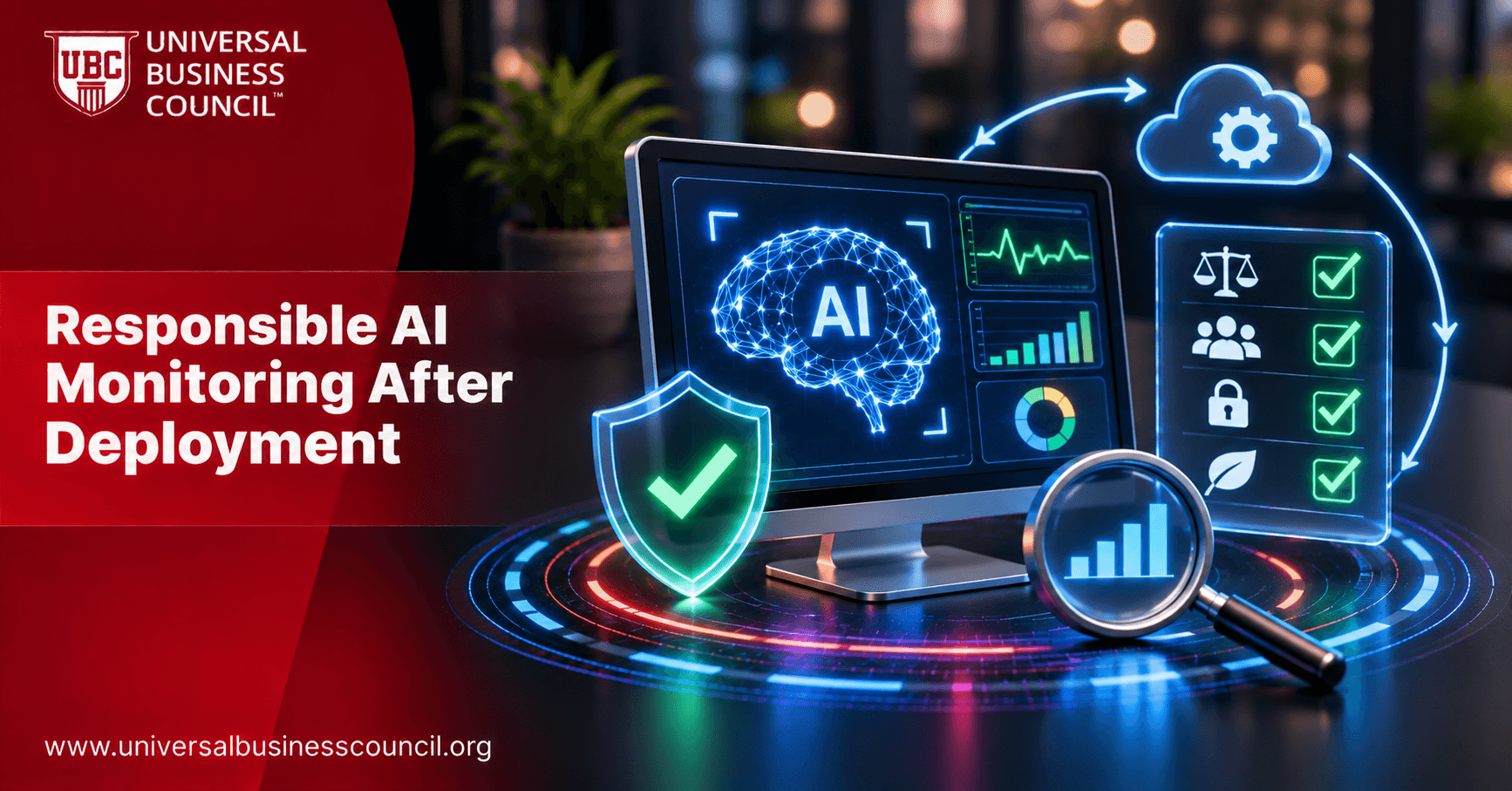
Launch is the starting line for responsible AI, not the finish. Models face new data, new users and new misuse after release, and the testing that justified approval cannot cover everything that happens in production. Monitoring after deployment is how organizations notice when a system stops behaving as intended, and it is increasingly expected by regulators and standards. This guide explains what to track, how to set thresholds, who should respond and how to keep the evidence. For professional training in this area, see the certified responsible AI expert certification. This is general information, not legal advice.
What is responsible AI monitoring after deployment?
It is the ongoing observation of live AI systems to confirm that they remain accurate, fair, safe, secure, lawful and used as intended. It combines automated measurement, human review and feedback from users and staff, and it feeds into decisions to adjust, retrain, restrict or retire a system.

Monitoring is not the same as logging. Logs are raw records. Monitoring means someone has decided what to watch, what counts as a problem and what happens when a signal appears.
Why monitoring matters
Production conditions change in ways that testing cannot fully predict.
Data and user behavior shift over time, which can degrade performance
Edge cases and unusual inputs appear at scale
Attackers probe systems and try to manipulate them
Upstream vendors may update models without warning
Laws, policies and business uses evolve
Without monitoring, organizations find out about problems from customers, journalists or regulators, usually after harm has occurred.
What to track
Group your measures into a few categories, and select the ones that fit each system's risk.
Performance and reliability
Track accuracy or the relevant quality measure, error types, response quality for generative systems, latency and availability. Compare against baselines from testing and set alert thresholds. Where ground truth arrives late, use proxy measures and periodic sampled review.
Drift and data quality
Watch for changes in input data and in the relationship between inputs and outcomes. Monitor missing values, unusual ranges and new categories. Drift is often the earliest warning that performance will decline.
Fairness and impact
Monitor outcomes and error rates across relevant groups where lawful and feasible. Look at complaint patterns, appeals and overturned decisions, since they can reveal harms that aggregate metrics hide.
Safety and content
For generative systems, track harmful or policy-violating outputs, refusal patterns, filter triggers, hallucination rates in sampled outputs and user reports. Review a regular sample of conversations, within privacy limits.
Security and misuse
Watch for prompt injection attempts, unusual query patterns that might signal data extraction, unauthorized access and abuse of connected tools. Engineers who build these detection pipelines benefit from strong technical foundations, and many develop them through tech certifications.
Privacy and data handling
Check for leakage of personal data in outputs and logs, adherence to retention rules and unauthorized data access. Monitoring itself should respect privacy, with limited access and clear purposes.
Human oversight and use
Track review rates, override rates, reviewer workload and how users actually use the system. Uses that drift beyond the approved purpose are a compliance risk.
Business and compliance indicators
Include measures tied to obligations, such as time to resolve complaints, completion of required reviews and incident counts, so that leadership sees compliance status alongside technical health.
Setting thresholds and responses
A metric without a response plan is decoration.
Define thresholds and owners
For each key measure, set a normal range, a warning level and a critical level, and name who responds at each. Base thresholds on testing results, risk and legal requirements, and review them when conditions change.
Decide the actions
Agree in advance what happens at each level: investigate, add human review, restrict features, roll back, retrain or pause the system. Link serious signals to your incident process.
Reduce alert fatigue
Too many alerts teach people to ignore them. Focus on measures tied to real risk, tune thresholds and combine related signals.
Governance, people and records
Monitoring needs structure around it.
Ownership and cadence
Assign a system owner responsible for monitoring, schedule regular reviews with risk, privacy, security and compliance teams and report summaries to leadership. Confirm that the people running monitoring and approving changes hold the qualifications they claim, with verification services such as HireValid available for hiring and contractor checks.
Evidence and integrity
Keep monitoring reports, alerts, decisions and changes in a secure, traceable form. Records that cannot be quietly altered are more credible in audits, and related techniques are explored in deep tech certifications.
Vendor systems
You still need visibility into third-party AI. Request metrics, logs and change notices from vendors, and run your own sampling and testing where risk is high.
Honest communication
Describe your monitoring accurately. Avoid claiming "continuous assurance" if reviews are periodic. A digital marketing course can help teams explain safeguards clearly and without exaggeration.
Conclusion
Responsible AI monitoring after deployment keeps systems accurate, fair, safe and lawful as conditions change. Track performance, drift, fairness, safety, security, privacy and human oversight, with a few business and compliance indicators. Set thresholds, name owners and predefine actions, and keep records that stand up to scrutiny. Extend monitoring to vendor systems and review the whole approach on a schedule.
Frequently asked questions
These are the questions teams ask most about post-deployment monitoring.
1. What is post-deployment AI monitoring?
Ongoing observation of live AI systems to confirm they stay accurate, fair, safe and lawful.
2. Why is testing before launch not enough?
Real-world data, users and attackers differ from test conditions.
3. How is monitoring different from logging?
Monitoring decides what to watch and how to respond, while logs are raw records.
4. What performance measures should we track?
Accuracy or quality measures, error types, latency and availability.
5. What is drift?
A change in data or in input-output relationships that can degrade performance.
6. How do we monitor fairness?
Compare outcomes and errors across relevant groups where lawful and feasible.
7. What about generative AI?
Track harmful output, filter triggers, hallucination rates and user reports.
8. How do we monitor security?
Watch for injection attempts, unusual queries and unauthorized access.
9. Should we review conversations?
Sample them within privacy limits and with clear purposes.
10. What are override rates?
How often human reviewers change AI outputs.
11. Why track complaints and appeals?
They reveal harms that aggregate metrics can hide.
12. How do we set thresholds?
Use testing results, risk and legal needs to define normal, warning and critical levels.
13. What actions can a threshold trigger?
Investigation, extra review, restrictions, rollback, retraining or pause.
14. How do we avoid alert fatigue?
Focus on risk-linked measures and tune thresholds.
15. Who owns monitoring?
The system owner, with support from risk, security, privacy and compliance.
16. How often should we review results?
On a regular schedule set by risk, with immediate review for serious alerts.
17. Do we monitor vendor AI?
Yes, through vendor metrics, change notices and your own sampling.
18. What records should we keep?
Reports, alerts, decisions, changes and incidents.
19. Does monitoring raise privacy issues?
Yes, so limit access, collect only what you need and set retention rules.
20. When should monitoring plans be updated?
When systems, uses, risks or laws change.
Related Articles
View All
Artificial Intelligence
Responsible AI Lifecycle: From Data Collection to AI Deployment
Explore the responsible AI lifecycle, from data collection and preparation to model development, testing, deployment, and monitoring. Learn how organizations apply fairness, transparency, accountability, privacy, and human oversight at every stage to build reliable and ethical AI systems.
Artificial Intelligence
AI Benchmarking: Limitations, Bias and Responsible Interpretation
Explore how AI benchmarking measures model performance and where its limitations can affect results. Learn how biased datasets, incomplete evaluation criteria, and misleading comparisons can influence benchmark scores, along with best practices for interpreting results responsibly and evaluating AI systems more fairly.
Artificial Intelligence
AI Model Monitoring: Performance, Fairness and Safety Metrics
Learn how AI model monitoring helps organizations maintain reliable, fair, and safe AI systems after deployment. Explore key metrics for tracking model performance, accuracy, bias, fairness, security, and safety, along with monitoring practices that help identify issues and support responsible AI management.
Trending Articles
The Role of Blockchain in Ethical AI Development
How blockchain technology is being used to promote transparency and accountability in artificial intelligence systems.
AWS Career Roadmap
A step-by-step guide to building a successful career in Amazon Web Services cloud computing.
Top 5 DeFi Platforms
Explore the leading decentralized finance platforms and what makes each one unique in the evolving DeFi landscape.