

AI Evaluation Frameworks: How to Test Reliability and Safety
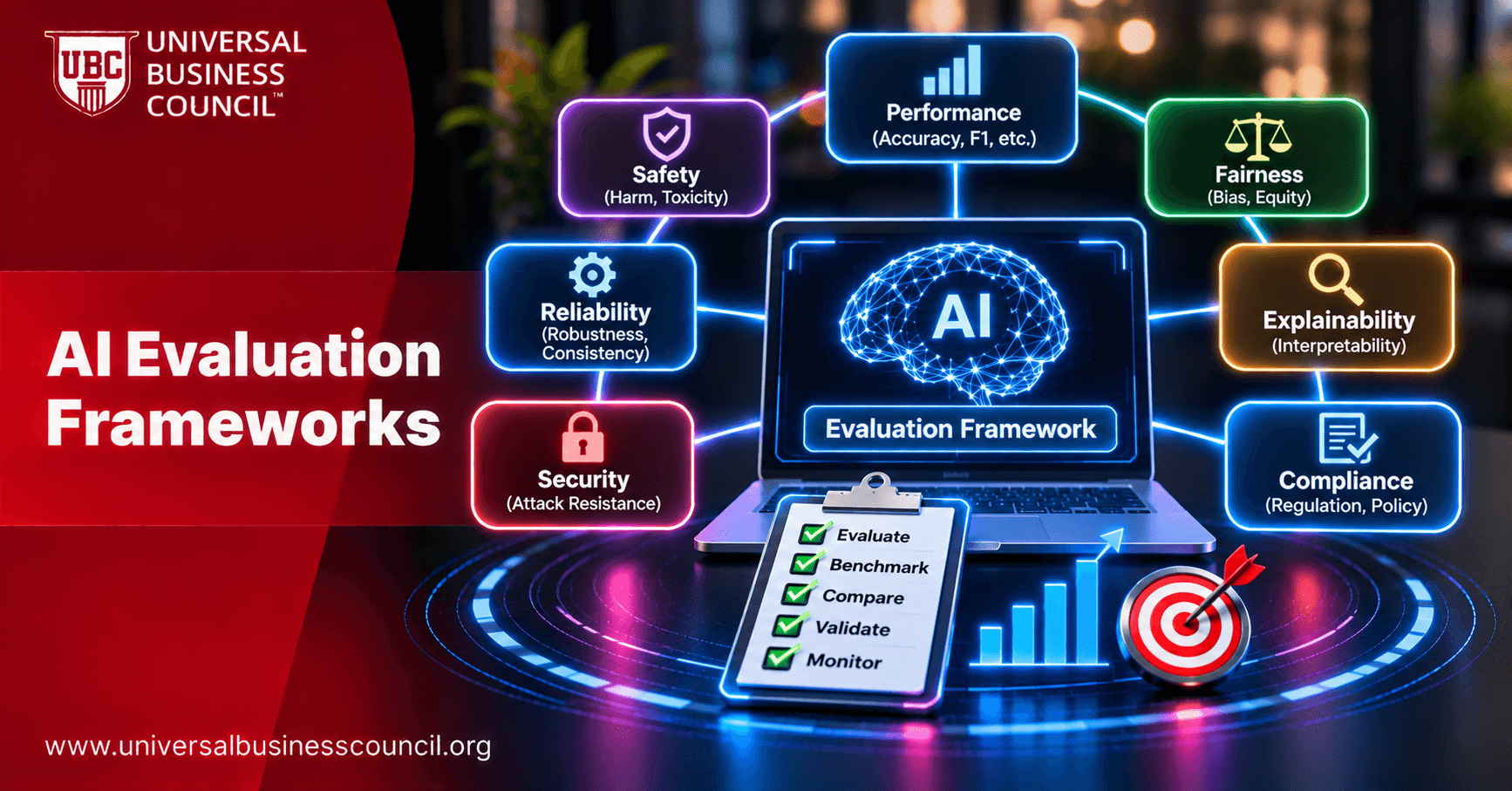
Testing an AI system is not the same as testing ordinary software. Traditional code does what it is told, so a passing test suite means something definite. AI systems produce probabilistic outputs, behave differently across inputs and can fail in ways nobody wrote a test for. An AI evaluation framework gives teams a structured way to judge whether a system is reliable and safe enough to release and to keep using. This guide explains what such a framework contains, how to design tests, which dimensions to cover and how to keep the evidence audit-ready. For professional grounding in the field, see the certified responsible AI expert certification. This is general information, not legal advice.
What is an AI evaluation framework?
An AI evaluation framework is a documented approach for deciding what to test, how to test it, what counts as passing and who decides. It covers the evaluation goals, test datasets and scenarios, metrics, methods, thresholds, roles and records. It applies before launch, after major changes and, in a lighter form, throughout the system's life.

A good framework is tied to the intended use. A model that screens job applicants and a chatbot that answers product questions need different tests, even if the underlying technology is similar.
Core elements of a framework
Most strong frameworks share the same building blocks.
Clear objectives and risk context
Start with the purpose, the people affected, the possible harms and the legal requirements. These define what "reliable" and "safe" mean for this system, and they determine how rigorous testing must be.
Representative test data and scenarios
Test data should reflect real conditions, including edge cases, rare events and the groups the system will serve. Keep test sets separate from training data, and refresh them so they do not go stale. For generative systems, build scenario libraries covering normal use, ambiguous requests, sensitive topics and misuse attempts.
Metrics, thresholds and decision rules
Choose metrics for each dimension and set pass, conditional and fail criteria before you see the results. Deciding in advance prevents the temptation to move the goalposts. Define who can approve a release with known limitations and what mitigation is required.
Independence and review
Where risk is high, have evaluation done or reviewed by people independent of the builders. Independence reduces blind spots and strengthens credibility.
Dimensions to evaluate
Cover several dimensions, and weigh them by risk.
Reliability and accuracy
Test task performance, consistency across repeated runs, behavior on unusual inputs and calibration. For generative AI, assess factual grounding, instruction following and the rate of fabricated content. Check how performance holds up as conditions change.
Robustness
Evaluate behavior under noise, typos, formatting changes and adversarial manipulation. Robust systems degrade gracefully and fail in predictable, safe ways.
Safety and harm prevention
Test for harmful, biased or unlawful outputs, unsafe advice and failure to refuse inappropriate requests. For systems that act, test whether permissions, limits and approvals work as designed. Engineers who build evaluation harnesses benefit from strong technical foundations, which many develop through tech certifications.
Fairness
Compare performance and outcomes across relevant groups, and investigate gaps. Document the chosen fairness measures and the reasoning behind them.
Security and privacy
Include red teaming and tests for prompt injection, data extraction, leakage of personal or confidential information and abuse of connected tools. Review how data is handled during testing itself.
Transparency and usability
Check that explanations are accurate and understandable, that users are told what they need to know and that human reviewers can interpret and override outputs in practice.
Reliability and accuracy
Robustness to noise and attack
Safety and harm prevention
Fairness across groups
Security and privacy
Transparency and human oversight
Methods and good practice
Use a mix of methods, because each has strengths and gaps.
Automated benchmarks and test suites
Automated tests run quickly and catch regressions after every change. Public benchmarks give rough comparisons, but they may not reflect your use case, and models can be tuned to them. Build custom tests from your own scenarios.
Human evaluation
Trained reviewers assess qualities that metrics miss, such as tone, helpfulness and subtle harm. Give them clear rubrics, check agreement between reviewers and protect them from distressing content with proper support.
Red teaming
Deliberate attacks reveal weaknesses that routine tests overlook. Combine internal and, for higher-risk systems, external testers.
Using models to judge models
Some teams use one model to score another's outputs. This scales well but can inherit bias and error, so validate it against human judgment before relying on it.
Continuous evaluation
Re-run core tests after any change to the model, data, prompts or vendor version, and on a schedule. Link results to monitoring so that production findings feed back into the test library.
Governance, people and evidence
Evaluation results matter only if they drive decisions and survive scrutiny.
Roles and sign-off
Name who designs tests, runs them, reviews results and approves release. Align the level of sign-off to risk. Confirm that those responsible for evaluation and approval hold the qualifications they claim, with services like HireValid supporting verification.
Documentation and records
Record objectives, test sets, versions, methods, results, limitations and decisions, and keep them with the model's documentation. Tamper-evident storage supports audits, and related ideas are explored in deep tech certifications.
Honest claims
Describe evaluation results accurately, including limits. "Tested for safety" is not the same as "safe." A digital marketing course can help teams communicate evidence-based claims clearly and without exaggeration.
Conclusion
An AI evaluation framework gives structure to testing reliability and safety. Define objectives in context, build representative test data and scenarios, set metrics and decision rules in advance and use independent review where risk is high. Cover reliability, robustness, safety, fairness, security, privacy and transparency, combine automated, human and red team methods and re-run evaluations as systems change. Keep clear records and report results honestly.
Frequently asked questions
These are the questions teams ask most about evaluating AI systems.
1. What is an AI evaluation framework?
A documented approach to what is tested, how, against what criteria and who decides.
2. How is AI testing different from software testing?
AI outputs are probabilistic and can fail in unexpected ways.
3. When should we evaluate?
Before launch, after major changes and on a regular schedule.
4. What should evaluation cover?
Reliability, robustness, safety, fairness, security, privacy and transparency.
5. Why set pass criteria in advance?
It prevents moving the goalposts after seeing results.
6. What makes a good test set?
It reflects real conditions, includes edge cases and stays separate from training data.
7. Are public benchmarks enough?
No. They may not match your use case, so add custom tests.
8. What is human evaluation?
Review of outputs by trained people using clear rubrics.
9. What is red teaming?
Deliberate attacks on a system to find weaknesses.
10. Can one model judge another?
It can help at scale, but validate it against human judgment.
11. How do we test robustness?
Use noisy, altered and adversarial inputs.
12. How do we test generative AI for safety?
Use scenario libraries covering normal use, sensitive topics and misuse attempts.
13. How do we evaluate fairness?
Compare performance and outcomes across relevant groups.
14. What about security testing?
Test for injection, data extraction, leakage and tool abuse.
15. Who should run evaluations?
Qualified testers, with independent review for high-risk systems.
16. Who approves release?
A named approver whose level matches the system's risk.
17. Can we release with known limitations?
Yes, if approved, documented and mitigated.
18. How do we keep evaluations current?
Refresh test sets and re-run after changes and on a schedule.
19. What records should we keep?
Objectives, test sets, versions, methods, results and decisions.
20. How does evaluation link to monitoring?
Production findings should feed back into the test library.
Related Articles
View All
Artificial Intelligence
AI Model Monitoring: Performance, Fairness and Safety Metrics
Learn how AI model monitoring helps organizations maintain reliable, fair, and safe AI systems after deployment. Explore key metrics for tracking model performance, accuracy, bias, fairness, security, and safety, along with monitoring practices that help identify issues and support responsible AI management.

Artificial Intelligence
AI Security vs AI Safety: Key Differences and Best Practices
Understand the difference between AI security and AI safety, why both matter, and how they contribute to responsible AI development. Explore common threats, safety risks, practical safeguards, and best practices organizations can use to protect AI systems and ensure reliable outcomes.

Artificial Intelligence
Responsible AI Tools and Frameworks Every AI Professional Should Know
Explore the tools and frameworks that help organizations put responsible AI principles into practice. Learn how AI governance platforms, risk assessment methods, auditing tools, and industry frameworks support fairness, transparency, accountability, and safer AI adoption.
Trending Articles
The Role of Blockchain in Ethical AI Development
How blockchain technology is being used to promote transparency and accountability in artificial intelligence systems.
AWS Career Roadmap
A step-by-step guide to building a successful career in Amazon Web Services cloud computing.
Top 5 DeFi Platforms
Explore the leading decentralized finance platforms and what makes each one unique in the evolving DeFi landscape.