

Responsible AI Tools and Frameworks Every AI Professional Should Know
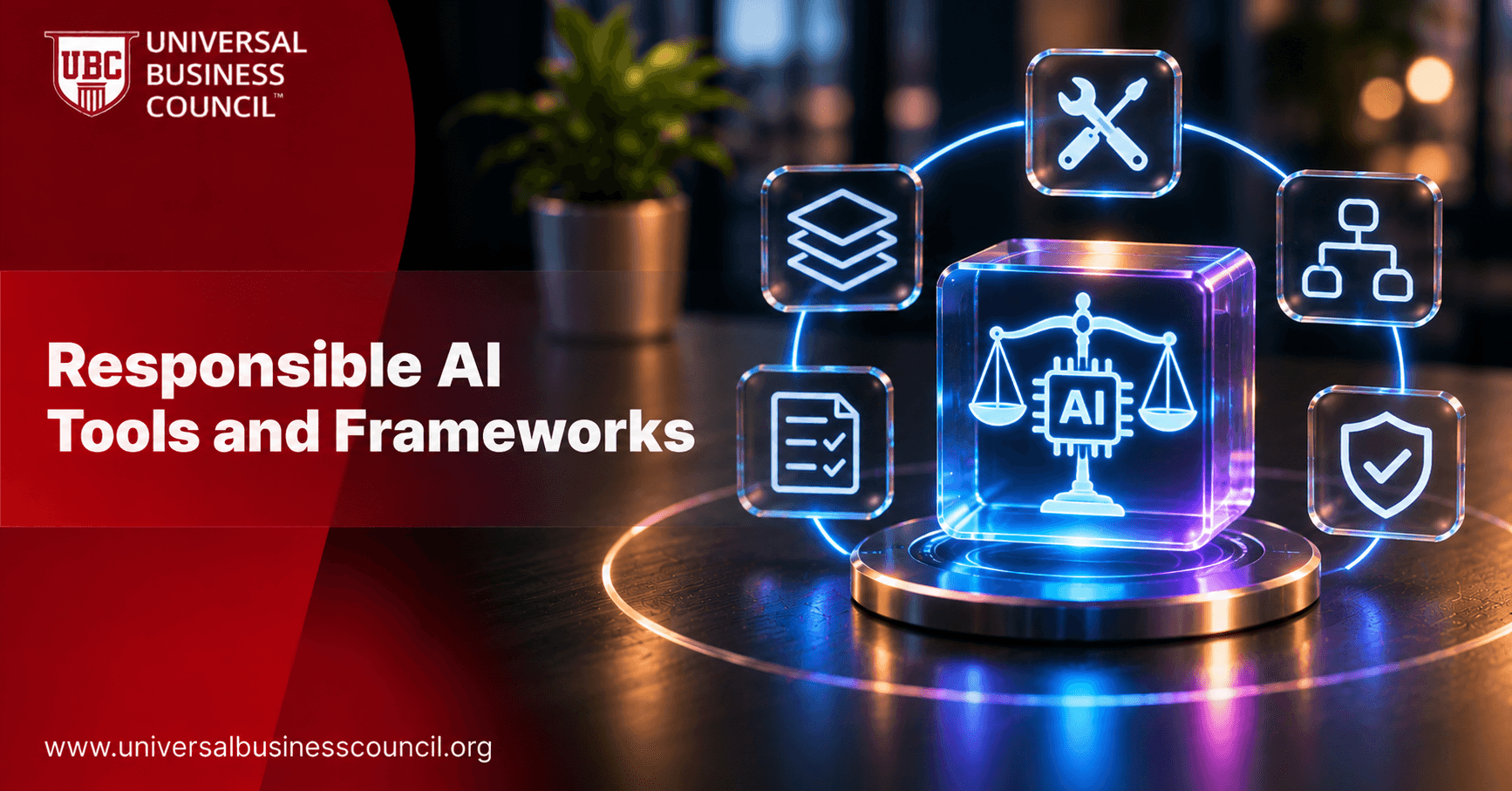
Which responsible AI tools and frameworks are worth learning, and which are just noise? The landscape is crowded, with risk frameworks, management standards, open-source toolkits and vendor platforms all claiming to make AI safer. This guide sorts them into categories, explains what each category does and shows how to choose and combine them. The point is not to memorize names. It is to know which type of tool answers which compliance or engineering question. For structured professional training, see the certified responsible AI expert certification.
What are responsible AI tools and frameworks?
Frameworks are structured guidance: principles, processes and controls that tell you what to do. Tools are the software, templates and techniques that help you do it, such as testing for bias, explaining a model or tracking an incident. A framework without tools stays theoretical. Tools without a framework produce data nobody knows how to use.

Professionals need both, and they need to know where each fits in the AI lifecycle.
Governance and risk frameworks
These set the structure for how an organization manages AI.
Risk management frameworks
Widely used risk frameworks, such as the NIST AI Risk Management Framework and ISO/IEC 23894 guidance, describe how to identify, assess, treat and monitor AI risk. They are voluntary, flexible and suit organizations that want a repeatable process.
Management system standards
Standards such as ISO/IEC 42001 set requirements for an AI management system, covering policy, roles, risk, controls and continual improvement. Organizations use them to build and demonstrate disciplined governance.
Principles and regulatory frameworks
International principles, such as those from the OECD and UNESCO, set shared values. Laws like the EU AI Act turn requirements into legal duties for certain systems. Know which apply to your sector and regions, and check current texts.
Risk frameworks tell you how to assess and treat risk
Management standards tell you how to run a program
Principles tell you what to value
Regulations tell you what you must do
Technical tools for building responsibly
Engineers and data scientists use several categories of tools during development and testing.
Fairness and bias testing toolkits
Open-source and commercial toolkits calculate group-level metrics, compare outcomes and suggest mitigation techniques. They help you spot disparities, though choosing the right metric and interpreting results still requires human judgment and legal input.
Explainability tools
Explainability libraries show which inputs influenced a prediction, using techniques such as feature attribution and example-based explanations. They support debugging, review and customer-facing explanations, with the caveat that explanations are approximations and should be validated.
Robustness and security testing tools
These tools test how models respond to adversarial inputs, noisy data and prompt-based attacks. Teams building them benefit from strong programming skills, which many develop through tech certifications.
Privacy-enhancing technologies
Techniques such as differential privacy, federated learning and secure computation reduce exposure of personal data in training and analysis. They suit use cases where data is sensitive or cannot be centralized.
Documentation and governance tools
Documentation turns practice into evidence.
Model cards and datasheets
Standard templates describe what a model or dataset is for, how it was built, how it performs and its known limits. They help reviewers, buyers and regulators understand a system without reading code.
AI inventories and registers
A central register tracks each system's owner, purpose, data, risk tier and review dates. Many organizations start with a spreadsheet and move to a governance platform as volume grows.
Impact assessment templates
Standard templates guide teams through purpose, harms, legal requirements and mitigations before launch. Consistency makes assessments comparable and auditable.
Audit trails and records
Secure, tamper-evident logs of tests, approvals and changes support audits. Integrity techniques, including those explored in deep tech certifications, can be relevant here.
Monitoring and incident tools
After launch, tools track performance, drift, fairness metrics, security events and user feedback. Incident tracking systems log problems, assign owners and record fixes. Choose tools that integrate with your existing observability and ticketing systems so that responsible AI work fits normal operations.
How to choose and combine them
A sensible selection process saves time and money.
Start from your risks
List your AI uses and highest risks, then pick tools that address them. A company using third-party generative tools needs vendor assessment and usage policy more than a model-debugging toolkit.
Check fit and evidence
Ask what a tool measures, what it does not and how results are validated. No tool delivers "fairness" or "safety" on its own. For commercial platforms, review data handling, security and vendor claims. Confirm that team members have the skills they claim, and consider verification through HireValid when hiring specialists.
Keep humans in charge
Tools generate metrics and alerts. People decide what they mean and what to do. Build review steps and clear ownership around every tool.
Describe capabilities honestly
If you sell or promote AI products, describe what your tooling does without overstating. A digital marketing course can help teams communicate safeguards accurately.
Conclusion
Every AI professional should know the main categories of responsible AI tools and frameworks: risk and management frameworks, principles and regulations, fairness, explainability, robustness and privacy tools, documentation such as model cards and registers, and monitoring and incident systems. Choose based on your risks, check what each tool really measures and keep people responsible for decisions. Knowing which tool answers which question is more valuable than knowing every product name.
Frequently asked questions
These are the questions professionals ask most about responsible AI tooling.
1. What is a responsible AI framework?
Structured guidance on principles, processes and controls for AI.
2. How is a tool different from a framework?
A framework says what to do, and a tool helps you do it.
3. Which frameworks are most used?
Risk frameworks, management standards and international principles, such as NIST, ISO and OECD materials.
4. Are these frameworks mandatory?
Many are voluntary, but laws and regulators may expect similar practice.
5. What does a fairness toolkit do?
It measures outcome differences across groups and suggests mitigations.
6. Can a fairness tool prove a model is fair?
No. It provides metrics that need human and legal interpretation.
7. What are explainability tools?
Tools that show which inputs influenced a model's output.
8. Are explanations always accurate?
They are approximations, so validate them.
9. What are privacy-enhancing technologies?
Techniques that reduce exposure of personal data in AI work.
10. What is a model card?
A document describing a model's purpose, performance and limits.
11. What is an AI inventory?
A register of AI systems with owners, risk tiers and review dates.
12. Do we need a governance platform?
Not at first. Many start with a simple register and scale up.
13. What do robustness tools test?
Behavior under noise, adversarial inputs and attacks.
14. What should monitoring tools track?
Performance, drift, fairness, security events and feedback.
15. How do we choose a tool?
Start from your risks and check what the tool measures.
16. Should we build or buy?
It depends on needs, skills and risk. Review vendor claims carefully.
17. Can tools replace human review?
No. People must interpret results and decide.
18. How do tools support audits?
By producing records of tests, approvals and changes.
19. What skills help professionals use these tools?
Data and programming skills, risk thinking and legal awareness.
20. How often should we review our toolset?
Regularly, since both tools and rules change quickly.
Related Articles
View All
Artificial Intelligence
Certified Responsible AI Expert™: Course Overview, Learning Outcomes and Who Should Enrol
Explore the Certified Responsible AI Expert™ course, including its curriculum, key learning outcomes, and intended audience. Discover the skills and knowledge learners can gain in AI ethics, governance, risk management, compliance, and responsible AI implementation.

Artificial Intelligence
Federated Learning and Responsible AI: Benefits, Risks and Limitations
Explore how federated learning supports responsible AI by allowing machine learning models to train across decentralized data sources without directly sharing raw data. Learn about its benefits for privacy and collaboration, along with risks, technical limitations, security concerns, and practical applications.
Artificial Intelligence
Responsible AI Data Governance: Quality, Consent and Provenance
Explore how responsible AI data governance supports reliable and ethical AI systems through data quality, informed consent, and data provenance. Learn how organizations can manage training data, protect individual privacy, track data origins, reduce bias, and maintain accountability throughout the AI lifecycle.
Trending Articles
The Role of Blockchain in Ethical AI Development
How blockchain technology is being used to promote transparency and accountability in artificial intelligence systems.
AWS Career Roadmap
A step-by-step guide to building a successful career in Amazon Web Services cloud computing.
Top 5 DeFi Platforms
Explore the leading decentralized finance platforms and what makes each one unique in the evolving DeFi landscape.