

Product Management Fundamentals: A Complete Guide to Building Successful Products
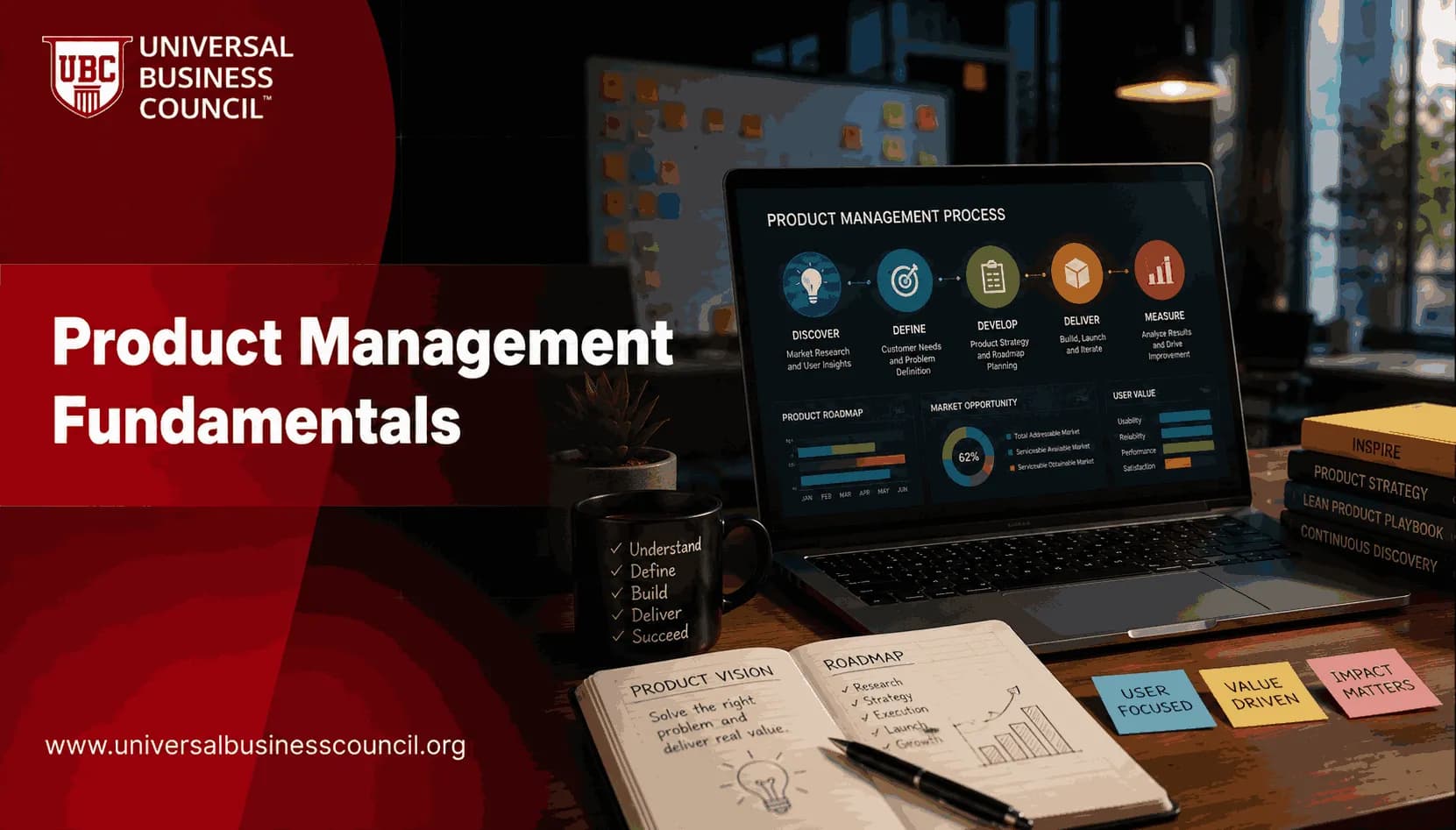
Product management fundamentals help you decide what to build, why it matters, how to launch it, and when to change direction. That sounds simple until a roadmap is full, sales wants a custom feature, engineering is warning about technical debt, and the dashboard shows new users leaving after the first session.
This is why fundamentals still matter. MIT Professional Education has referenced Clayton Christensen's estimate that about 95 percent of new products fail to achieve success. Other analyses are less severe but still sobering. Scanner-data work associated with Nielsen and Catalina has placed many consumer product failure rates in the 80 to 90 percent range, and broader launch research often finds meaningful failure within the first two years. The exact percentage changes by category. The lesson does not. Most product failures begin before delivery, in weak discovery, unclear strategy, or poor validation.

What Product Management Really Means
Product management is the discipline of maximizing product value for customers and the organization. It is not the same as project management. Project management asks whether work is on time, within scope, and properly resourced. Product management asks whether the work should exist at all.
A product manager connects customer insight, business goals, technology constraints, and market timing. You are expected to influence without formal authority, which is a polite way of saying you must get engineering, design, marketing, sales, support, and executives to make hard trade-offs together.
The role has expanded. Modern product managers are often accountable for activation, retention, revenue, churn, lifetime value, and adoption. Specialized roles are also growing, including growth product manager, platform product manager, technical product manager, and AI product manager.
As the role continues to expand across industries, becoming a Product Management Professional can help build stronger capabilities in product strategy, customer discovery, prioritization, stakeholder management, and delivering measurable business outcomes.
Why Product Management Fundamentals Matter Now
Product work has become more measurable and less forgiving. Subscription models, product-led growth, and AI-augmented workflows mean a product manager can no longer hide behind output metrics such as number of features shipped.
Leadership tracks outcomes. In software, that often means:
Activation rate: the percentage of users who reach a meaningful first value moment.
Retention: whether customers come back after day 7, day 30, or month 12.
Churn: how many customers or accounts leave.
LTV and CAC: customer lifetime value compared with acquisition cost.
Expansion revenue: upgrades, seat growth, or usage growth inside existing accounts.
NPS and customer satisfaction: useful signals, but weak substitutes for actual behavior.
To be blunt, a beautiful roadmap is not strategy. If your team cannot explain which customer problem it is solving and which metric should move, the roadmap is probably a feature queue.
The Product Lifecycle
Most products move through five broad stages. The labels vary by company, but the work is familiar.
Discovery and problem definition: identify the customer problem, context, market, and constraints.
Solution exploration: test possible ways to solve the problem before committing major resources.
Delivery and launch: build, release, communicate, and support the product.
Growth and optimization: improve activation, engagement, retention, monetization, and operational performance.
Maturity, evolution, or sunset: decide whether to maintain, reposition, rebuild, or retire the product.
Good teams do not treat this as a straight line. They cycle back. A mature product still needs discovery. A new product still needs a sunset discussion if the evidence turns against it.
Discovery: Build the Right Product First
Discovery is the part many teams rush, usually because someone powerful already has a solution in mind. That is risky. CB Insights has reported that 42 percent of startup failures are tied to building products with no real market need. That is not an engineering problem. It is a discovery problem.
Start with the problem, not the feature
Write the problem in plain language. Who has the problem? When does it happen? What are they doing now? What makes the current workaround painful or expensive?
A common mistake in first-time product teams is treating a feature request as evidence. It is not. A customer asking for a dashboard might really need faster reporting for a Monday leadership meeting. The product answer could be a dashboard, an export, a scheduled email, or a better integration with Salesforce. You will not know until you ask.
Use mixed research methods
Strong discovery combines qualitative and quantitative inputs:
Customer interviews to understand motivations and language.
Contextual inquiry to see what users actually do.
Surveys to quantify patterns, if the questions are clean.
Product analytics from tools such as Google Analytics 4, Amplitude, Mixpanel, or product data warehouses.
Support tickets, sales call notes, and churn reasons.
One practical warning: do not define activation as 'user logged in' unless login itself creates value. It usually does not. Activation should mark the first meaningful outcome, such as creating the first project, inviting a teammate, completing a transaction, or publishing the first campaign. This small definition error can make a product look healthier than it is.
Apply Jobs-to-be-Done
Jobs-to-be-Done helps you move beyond demographics. Instead of asking only who the customer is, ask what progress the customer is trying to make. A finance manager buying reporting software may be trying to reduce month-end stress, avoid manual spreadsheet errors, and answer the CFO before Friday. Those are sharper inputs than 'mid-market finance user.'
Product Strategy and Vision
A product vision describes the long-term customer and business outcome. Strategy defines the choices that will get you there. Good strategy is selective. It says yes to a target segment and no to distractions.
Useful strategy work covers:
Target customers: which segment you will serve first.
Value proposition: why customers should choose this product over alternatives.
Business model: subscription, usage-based pricing, transaction fees, services, licensing, or another model.
Positioning: how the market should understand the product.
Capabilities: what the organization must be good at to win.
Frameworks such as Porter's Five Forces, the 4Ps of marketing, SWOT analysis, and OKRs can help, but only if you use them to make decisions. Filling slides is not strategy.
Roadmapping and Prioritization
A roadmap should communicate outcomes, not just delivery dates. A weak roadmap says, 'launch referral feature in Q2.' A stronger roadmap says, 'increase qualified user invitations by 20 percent among activated accounts.' The second version gives the team room to solve the problem.
Prioritization frameworks are useful when stakeholders disagree. RICE is common:
Reach: how many users or accounts will be affected.
Impact: how much the initiative could improve the outcome.
Confidence: how strong the evidence is.
Effort: how much work is required.
RICE is not perfect. It can create false precision if people invent numbers to win an argument. Use it as a conversation structure, not a courtroom verdict.
Delivery and Cross-functional Leadership
Delivery is where product managers can accidentally become ticket writers. Resist that. Your job is to clarify the problem, define success, set constraints, and help the team make trade-offs. Engineering and design should have room to shape the solution.
Good delivery habits include:
Maintaining a backlog tied to strategic outcomes.
Writing clear problem statements and acceptance criteria.
Separating discovery work from committed delivery work.
Using iterative releases, pilots, and staged rollouts.
Documenting decisions for remote and hybrid teams.
Influence matters here. Product managers rarely control everyone needed to ship and grow a product. Clear evidence, steady communication, and honest trade-off discussions beat persuasion theater.
Data, Experimentation, and Product-led Growth
Data literacy is now a core product management fundamental. You do not need to be a data scientist, but you should understand funnels, cohorts, segmentation, statistical noise, and experiment design.
A/B tests are valuable when traffic volume is high enough and the decision is measurable. They are the wrong tool for every question. For early B2B products with low sample sizes, structured customer interviews, concierge tests, prototype testing, and sales-assisted pilots may produce better evidence.
Product-led growth adds another layer. In PLG, the product experience drives adoption, expansion, and retention. That makes onboarding, time-to-value, in-product education, pricing signals, and usage limits product strategy issues, not just UX details.
AI in Product Management
AI is changing product work, especially research synthesis, competitive scanning, feedback clustering, experiment drafting, and roadmap analysis. Use it. But do not outsource judgment.
AI tools can summarize 500 support tickets quickly. They cannot sit with a frustrated operations manager who is juggling three browser tabs, a spreadsheet, and a handwritten note because your workflow missed one approval step. That detail is where product insight often lives.
AI product managers also face harder questions around bias, privacy, explainability, and responsible design. If the product uses customer data or automated decisions, ethics and regulation belong in the roadmap discussion from the start.
As AI and other emerging technologies become central to product strategy, a Deep Tech Certification can help professionals build a broader understanding of advanced innovations such as artificial intelligence, automation, blockchain, and data-driven product development.
Skills Professionals Should Build Next
If you want to improve your product capability, focus on skills that reduce product risk and improve decision quality:
Customer discovery and interview technique.
Market analysis and competitive positioning.
Analytics, cohort analysis, and experiment design.
Business metrics such as CAC, LTV, churn, margin, and payback period.
Technical fluency, especially APIs, data flows, AI systems, and software delivery constraints.
Stakeholder communication and decision documentation.
For structured learning, connect this topic with relevant Universal Business Council certification pages and courses in business, management, marketing, analytics, and artificial intelligence. Product management sits across all of those disciplines.
How to Apply Product Management Fundamentals This Week
Do not start by rewriting the whole roadmap. Start smaller.
Pick one active initiative.
Write the customer problem in one sentence.
Name the metric that should change if the work succeeds.
List the riskiest assumption behind the initiative.
Choose one test that could validate or weaken that assumption within two weeks.
Share the decision logic with engineering, design, and one commercial stakeholder.
That exercise will expose gaps quickly. Maybe the customer problem is vague. Maybe the metric is not instrumented. Maybe the riskiest assumption rests on one loud customer. Good. You found the weak point before spending another sprint on it.
Your next step: strengthen discovery, metrics, and cross-functional decision making before adding more features. If you are building a formal career path, pair product practice with Universal Business Council learning in management, marketing analytics, business strategy, and AI so you can connect customer value to business outcomes with confidence.
A Tech Certification can further strengthen this learning journey by expanding your understanding of digital technologies, software ecosystems, cloud platforms, and innovation frameworks that increasingly shape modern product management and business growth.
FAQs
1. What Is Product Management?
Product management is the process of planning, developing, launching, and improving products that solve customer problems while achieving business goals. Product managers coordinate teams, define strategy, and guide products throughout their lifecycle.
2. Why Is Product Management Important?
Product management ensures products meet customer needs, align with business objectives, prioritize valuable features, and remain competitive. It helps organizations build products that deliver long-term value and sustainable growth.
3. What Does a Product Manager Do?
A product manager defines product vision, conducts market research, gathers customer feedback, prioritizes features, manages product roadmaps, collaborates with cross-functional teams, and measures product success.
4. What Are the Main Responsibilities of a Product Manager?
Key responsibilities include product strategy, customer research, roadmap planning, feature prioritization, stakeholder communication, product launches, performance analysis, and continuous product improvement.
5. What Is the Product Development Lifecycle?
The product development lifecycle includes idea generation, market research, product planning, design, development, testing, launch, growth, optimization, and retirement when the product is no longer viable.
6. What Is Product Strategy?
Product strategy is a long-term plan that defines a product's vision, target audience, market positioning, business objectives, competitive advantage, and roadmap for future development.
7. What Is a Product Roadmap?
A product roadmap is a strategic document that outlines planned product features, development priorities, timelines, and business goals, helping teams stay aligned throughout the product lifecycle.
8. How Does Market Research Help Product Management?
Market research helps product managers understand customer needs, industry trends, competitor offerings, pricing strategies, and market opportunities before building or improving a product.
9. Why Is Customer Feedback Important in Product Management?
Customer feedback provides insights into user needs, pain points, and feature requests, enabling product teams to improve products based on real user experiences rather than assumptions.
10. What Is Feature Prioritization?
Feature prioritization is the process of deciding which product improvements should be developed first based on customer value, business impact, technical feasibility, and available resources.
11. How Does Agile Support Product Management?
Agile enables product teams to deliver improvements through iterative development, frequent feedback, continuous testing, and flexible planning, allowing products to evolve based on changing customer needs.
12. What Metrics Should Product Managers Track?
Important product metrics include user growth, customer retention, customer satisfaction (CSAT), Net Promoter Score (NPS), feature adoption, churn rate, conversion rate, revenue, and customer lifetime value (CLV).
13. What Skills Are Required to Become a Product Manager?
Successful product managers need communication, leadership, problem-solving, strategic thinking, market research, data analysis, stakeholder management, customer empathy, and project management skills.
14. Which Tools Do Product Managers Commonly Use?
Popular tools include Jira, Confluence, Notion, Trello, Asana, Figma, Miro, Productboard, Aha!, Google Analytics, Mixpanel, Microsoft Power BI, and Tableau.
15. How Does Artificial Intelligence Support Product Management?
AI helps product managers analyze customer behavior, automate research, prioritize features, forecast demand, generate insights, improve personalization, and support faster, data-driven decision-making.
16. What Challenges Do Product Managers Commonly Face?
Common challenges include balancing customer needs with business goals, managing competing priorities, limited resources, stakeholder alignment, changing market conditions, and making decisions with incomplete information.
17. How Can Someone Start a Career in Product Management?
Aspiring product managers should learn product management frameworks, build business and analytical skills, understand Agile methodologies, create product case studies, gain practical experience, and earn relevant certifications.
18. What Certifications Can Help Product Managers?
Popular certifications include Certified Scrum Product Owner (CSPO), PMI certifications, Pragmatic Institute certifications, Product School programs, Google Project Management Certificate, and Agile certifications.
19. What Common Mistakes Should New Product Managers Avoid?
Avoid building products without customer validation, prioritizing features based on assumptions, ignoring product metrics, failing to communicate with stakeholders, and focusing only on product launches instead of continuous improvement. Successful product management depends on customer feedback, measurable outcomes, and iterative learning.
20. What Is the Future of Product Management?
Product management is evolving with AI, automation, advanced analytics, and customer-centric innovation. Future product managers will increasingly use data-driven insights, AI-powered tools, and cross-functional collaboration to build intelligent products that adapt to changing user needs and market demands while delivering measurable business value.
Related Articles
View All
Management
Supply Chain Management Certification Guide: Best Credentials for Career Growth
Compare the best supply chain management certification options for planning, logistics, procurement, analytics, and leadership career growth.

Management
Sustainable Supply Chain Management: How Businesses Can Reduce Environmental Impact
Sustainable supply chain management helps firms cut Scope 3 emissions, waste, and freight impact through better data, supplier engagement, circular design, and traceability.

Management
AI in Supply Chain Management: Use Cases, Benefits, and Future Trends
AI in supply chain management is changing planning, logistics, inventory, sourcing, and risk. Learn key use cases, measurable benefits, and future trends.
Trending Articles
The Role of Blockchain in Ethical AI Development
How blockchain technology is being used to promote transparency and accountability in artificial intelligence systems.
AWS Career Roadmap
A step-by-step guide to building a successful career in Amazon Web Services cloud computing.
Top 5 DeFi Platforms
Explore the leading decentralized finance platforms and what makes each one unique in the evolving DeFi landscape.