

Responsible AI in Autonomous Vehicles: Safety, Testing and Accountability
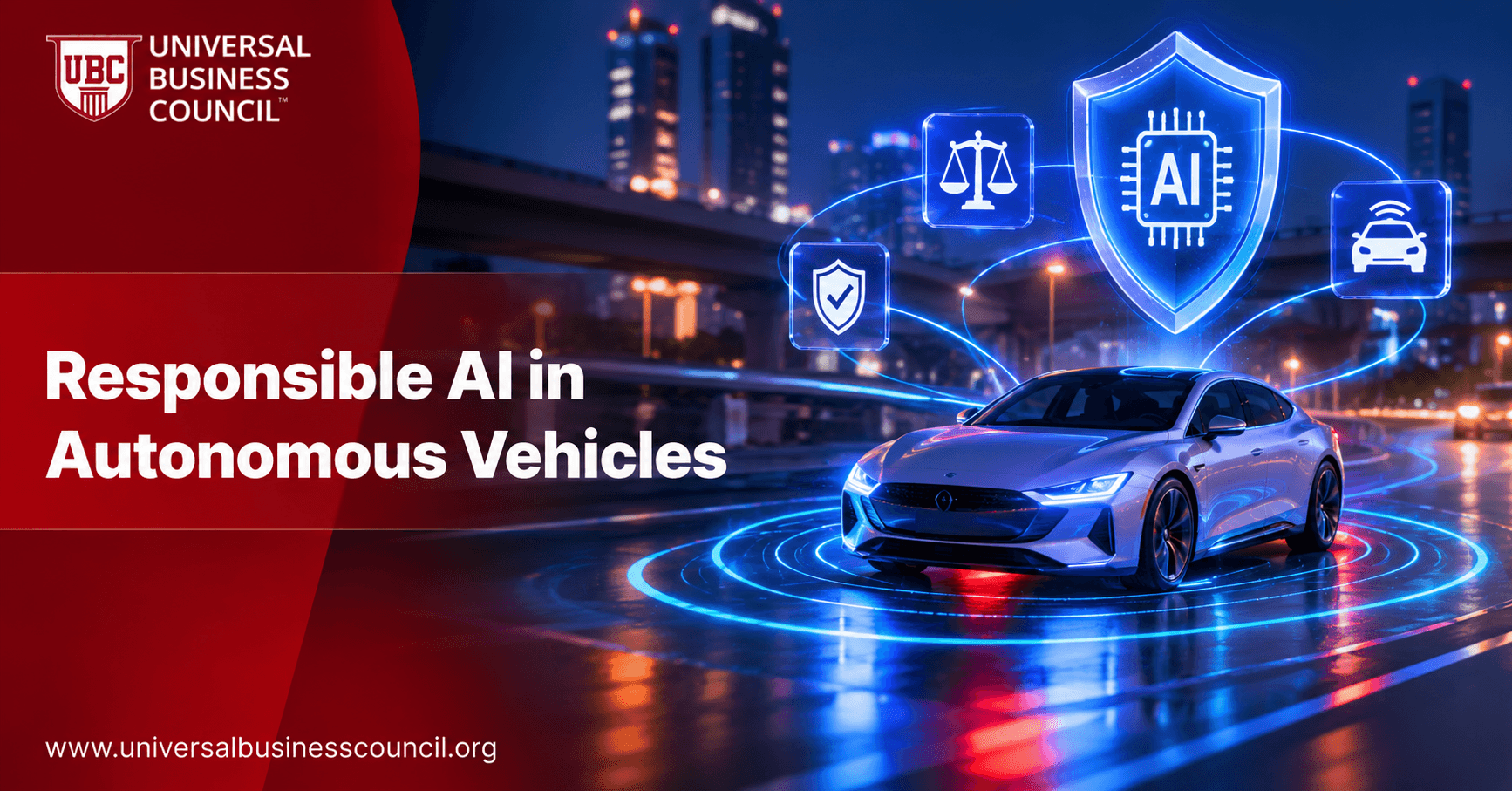
An autonomous vehicle makes thousands of decisions every minute, at speed, around people who never agreed to be part of an experiment. That makes it one of the most demanding settings for responsible AI. The software has to perceive, predict and act reliably across weather, road conditions and human behavior that no test set fully covers, and when it fails, the consequences are physical. This guide explains the main safety challenges, how testing and validation should work, how accountability is allocated and what governance manufacturers and operators need. For professional learning in the field, see the certified responsible AI expert certification. This is general information, not legal advice, and rules differ widely across regions.
What is responsible AI in autonomous vehicles?
Responsible AI in autonomous vehicles is the practice of developing, testing, deploying and operating self-driving and driver-assistance systems in ways that protect road users, comply with vehicle safety and traffic laws, respect privacy and keep clear lines of accountability. It combines functional safety engineering, AI assurance, cybersecurity and ethics.

Levels of automation matter. Driver-assistance features that need a human to supervise raise different issues from systems that drive without a human fallback, and responsibilities shift accordingly.
Core safety challenges
Several features make this domain hard.
The long tail of rare events
Most driving is routine, but safety depends on unusual situations: odd road layouts, unexpected objects, unusual behavior by other road users, rare weather or sensor faults. Models can handle common cases well and still fail at the edges.
Perception and prediction limits
Systems must detect and classify objects and predict what others will do. Performance can degrade in darkness, glare, rain or snow, and may vary across different populations of pedestrians or environments if training data is uneven.
Human-machine interaction
With partial automation, drivers may over-trust the system, lose attention or misunderstand its limits. Clear communication, driver monitoring and sensible handover design are essential.
Cybersecurity
Connected vehicles can be attacked through software, communications or sensors. Spoofed signals or manipulated inputs can mislead perception, so security is part of safety.
Rare and unusual scenarios
Degraded sensing in poor conditions
Over-reliance by human drivers
Attacks on software and sensors
Uneven performance across environments and groups of road users
Testing and validation
No single method proves safety, so developers combine several.
Simulation at scale
Virtual testing can run vast numbers of scenarios, including dangerous ones that are unsafe to stage. Its value depends on how realistic the simulation is and how well scenarios reflect real conditions, so validate the simulator against real-world data. Engineers who build these tools benefit from strong technical foundations, which many develop through tech certifications.
Closed-course and controlled testing
Test tracks allow repeatable tests of specific maneuvers and failures with real hardware, including emergency braking, obstacle avoidance and sensor degradation.
On-road testing
Public road testing exposes the system to real conditions, but it carries risk to others. Use safety drivers or remote supervision where appropriate, set clear operational limits, monitor closely and follow local permit and reporting rules.
Define the operating domain
Specify where and when the system is meant to work, such as road types, speeds, weather and times of day, and test thoroughly within it. Make sure the vehicle recognizes when it is outside its domain and responds safely.
Metrics and safety cases
Build a structured safety case that argues, with evidence, why the system is acceptably safe for its intended use. Track meaningful measures such as disengagements, near misses, incidents and performance across scenarios, and be cautious about simple mileage statistics that hide differences in conditions.
Accountability and ethics
Responsibility is shared across a chain of actors.
Who is accountable?
Manufacturers, software developers, suppliers, fleet operators, regulators and human drivers can each carry duties, depending on the level of automation and local law. Liability rules are evolving, so seek specialist legal advice. Within organizations, name accountable executives and document decision rights for safety approvals.
Transparency and incident reporting
Maintain data recorders and logs that capture what the system perceived and did before incidents, within privacy limits. Report incidents as required, cooperate with investigators and share lessons that improve safety across the industry.
Ethical choices and fairness
Dilemma scenarios attract attention, but most ethical work lies in everyday choices: how cautiously to drive, how to treat vulnerable road users, how to behave around cyclists and children and whether performance holds up across diverse environments. Document these design decisions and test for equitable performance.
Privacy
Vehicles collect location, video and behavior data. Minimize collection, protect it, limit sharing and be clear with users and the public about what is recorded.
Governance, supply chain and communication
Strong governance runs through the lifecycle.
Lifecycle controls
Apply safety management processes from design through updates and decommissioning. Control over-the-air updates with testing, staged release, approval and rollback, and keep traceable records linking software versions to vehicles and test results. Integrity techniques for such records are explored in deep tech certifications.
Suppliers and people
Vehicles depend on many suppliers for sensors, chips, models and maps. Assess their safety and security practices and contract for transparency and incident cooperation. Confirm that safety engineers, test drivers and contractors hold the qualifications they claim, with verification services such as HireValid supporting those checks.
Honest marketing
Names and marketing for driver-assistance features must not suggest more autonomy than exists. Misleading claims contribute to misuse and attract regulatory action. A digital marketing course can help teams describe capabilities accurately.
Conclusion
Responsible AI in autonomous vehicles depends on rigorous safety engineering, layered testing, honest communication and clear accountability. Address rare events, perception limits, human over-reliance and cybersecurity. Combine simulation, closed-course and on-road testing within a defined operating domain, support them with a structured safety case and keep data and records that allow incidents to be investigated. Govern updates and suppliers tightly, and never promise more autonomy than the system can deliver.
Frequently asked questions
These are the questions people ask most about autonomous vehicle AI.
1. What is an autonomous vehicle?
A vehicle that can perform some or all driving tasks using sensors and AI.
2. Why is this a high-risk AI use?
Errors can cause physical harm to many people.
3. What is the long tail problem?
Rare situations that are hard to anticipate and test.
4. What is an operating domain?
The conditions in which a system is designed to work safely.
5. Why is human over-reliance a risk?
Drivers may trust partial automation more than they should.
6. How is safety tested?
Through simulation, closed-course testing and controlled on-road trials.
7. Can simulation replace road testing?
No. It complements it, and the simulator must be validated.
8. What is a safety case?
A structured argument with evidence that a system is acceptably safe.
9. Are mileage statistics enough?
No. They can hide differences in conditions and difficulty.
10. Who is liable in a crash?
It depends on the automation level and local law, so seek legal advice.
11. Do vehicles record data?
Many do, which helps investigations but raises privacy concerns.
12. How should incidents be handled?
Report as required, cooperate and learn from root causes.
13. How is cybersecurity part of safety?
Attacks can alter perception or control and cause harm.
14. How should updates be managed?
With testing, staged release, approval and rollback ability.
15. Do suppliers matter?
Yes. Sensors, chips and models all affect safety and risk.
16. Is fairness relevant here?
Yes. Systems should perform well across environments and road users.
17. What about ethical dilemmas?
Document design choices, but focus on everyday cautious behavior.
18. How should features be marketed?
Accurately, without implying more autonomy than exists.
19. What records are needed?
Test results, safety cases, versions, approvals and incident logs.
20. How often should safety be reviewed?
Continuously, and after incidents, updates and domain changes.
Related Articles
View All
Artificial Intelligence
Responsible AI in Healthcare: Safety, Privacy, Fairness and Accountability
Discover how responsible AI is transforming healthcare through safer, fairer, and more transparent applications. Explore its benefits, challenges, ethical considerations, and the importance of protecting patient data while improving clinical decision-making.

Artificial Intelligence
Responsible AI in Manufacturing: Quality, Safety and Workforce Impacts
Discover how manufacturers can apply responsible AI to improve product quality, workplace safety, and operational efficiency. Learn how to manage AI risks, protect workers, reduce bias, maintain human oversight, and address the impact of automation on the workforce.
Artificial Intelligence
AI Safety Testing: Test Cases for High-Risk Applications
Learn how to test AI safety in high-risk applications using structured test cases and evaluation methods. Explore how organizations can assess harmful outputs, bias, reliability, security vulnerabilities, and unexpected model behaviour to identify risks and support safer AI deployment in critical environments.
Trending Articles
The Role of Blockchain in Ethical AI Development
How blockchain technology is being used to promote transparency and accountability in artificial intelligence systems.
AWS Career Roadmap
A step-by-step guide to building a successful career in Amazon Web Services cloud computing.
Top 5 DeFi Platforms
Explore the leading decentralized finance platforms and what makes each one unique in the evolving DeFi landscape.