

What Is Genie 4 and How Does It Work?
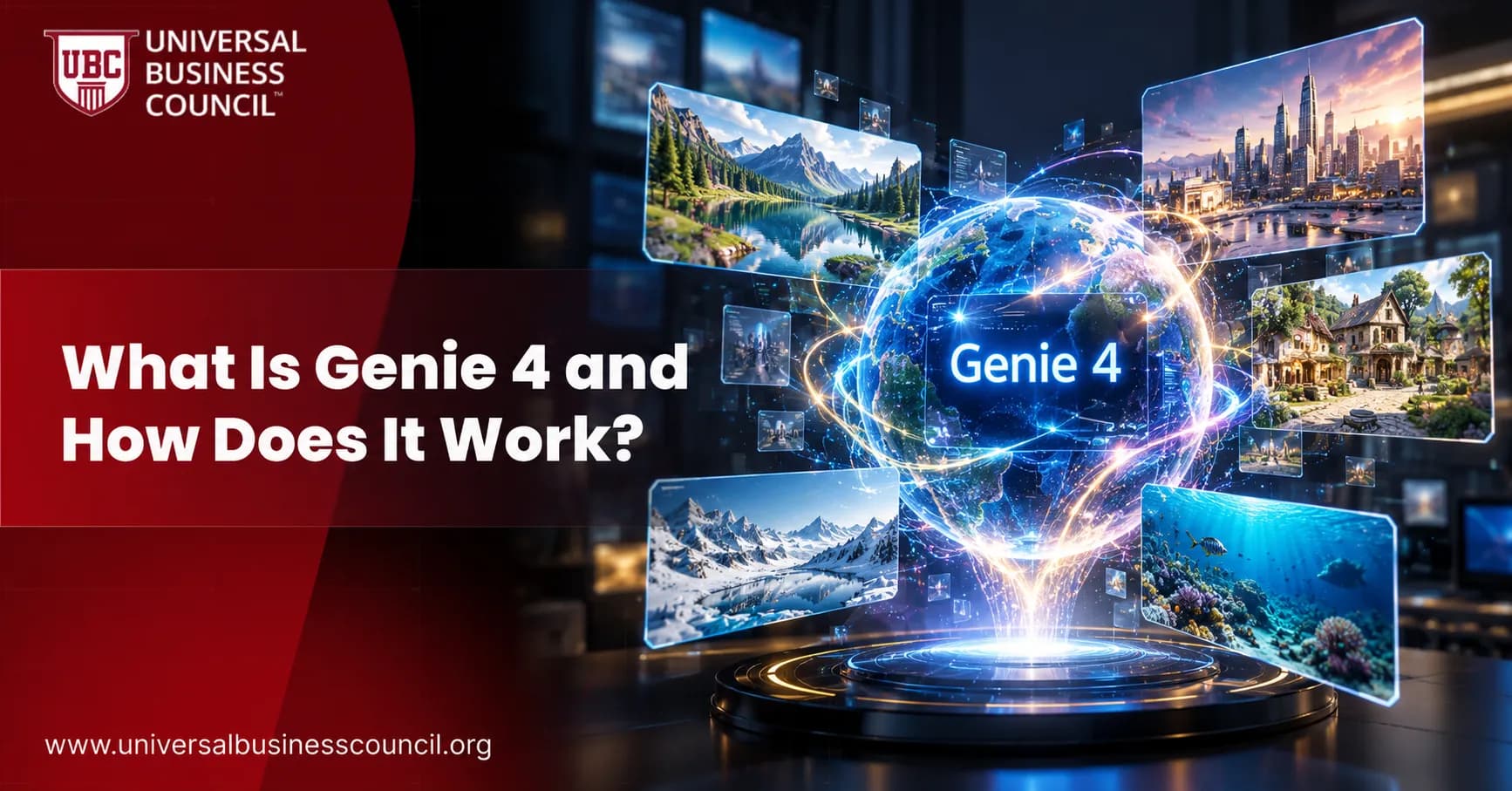
Genie 4 is Google DeepMind's newest AI world model. It turns a short description into a 3D scene that you can explore, change, and hear, all in real time. Google announced it on October 27, 2026, as an early research preview. Many people want to know how such a thing is even possible. This guide explains the Genie 4 Google release step by step, in everyday language. It covers the technology, the features, the safety measures, and the limits. Marketers, creators, and students who follow AI trends, including those who pair their skills with a Marketing Certification, will find useful ideas here.
What Is Genie 4 in Simple Words?
Think of a flipbook. Each page shows a slightly different picture, and flipping fast makes the drawing seem to move. Genie 4 works a bit like a magical flipbook that draws each new page while you flip it. You move, and the next page appears to match your move. You type a new idea, and later pages reflect it.

Google calls Genie 4 a world model for real-time interactive simulation. A world model is an AI that has learned how places look, sound, and behave. It uses that knowledge to create a scene on demand. You are not watching a finished video. You are stepping into a world that the AI builds moment by moment.
Google says Genie 4 is its most realistic and interactive world model so far. It is also the first from Google to generate audio natively in real time, according to the company. That means the sound of wind, music, or speech comes from the model itself.
How Does Genie 4 Work Step by Step?
The full engineering is complex, but the basic flow is easy to follow. Google has not shared every technical detail, so this section explains the idea using its public descriptions. Learners who want to go deeper into the concepts often explore Artificial Intelligence Certifications, which cover how modern models learn and make predictions.
Step 1: You Give a Starting Point
You begin with a text prompt or an image. A prompt might describe a foggy lake, a busy station, or a sunlit meadow. Google's examples include very detailed instructions about place, lighting, mood, and camera view. A reference image can also set the first frame.
Step 2: The Model Builds the First Scene
Genie 4 draws the opening view. It uses what it learned from huge amounts of training data to decide how objects, light, and people should look. Google says Gemini Omni helps anchor the scene in real-world appearance and behavior.
Step 3: You Move and Steer
Next, you use standard keyboard controls to walk and move the camera. You can also type new prompts. Google's examples include changing the weather, shifting the camera, or adding a new person or object.
Step 4: The Model Predicts What Comes Next
For every action, Genie 4 predicts the next moment and draws it. It repeats this cycle again and again, so the scene feels continuous. This loop is the heart of any world model. It keeps the new picture consistent with what came before and with what you just did.
Step 5: Gemini Guides the Story
While the world runs, Gemini watches the scene. Google says it breaks goals into steps, checks the new frames, and verifies progress. If you change something, Gemini adapts its plan. This guidance helps events follow logical cause and effect.
Step 6: Sound and Speech Appear Together
Genie 4 creates audio at the same time as the visuals. Ambient noise, music, and character dialogue come from the same model. Characters can also react to you in real time.
Step 7: The Output Gets a Watermark
Google says all video and audio made by Genie 4 will carry SynthID, a hidden watermark that helps identify AI-generated content.
What Technology Powers Genie 4?
Genie 4 sits on top of the Gemini family. Google says the model builds on capabilities from Gemini. Gemini Omni supports realism, and other Gemini models provide reasoning. In one robotics setup, Gemini 3.8 Flash serves as a guiding agent, while Gemini 4 Argon helps break tasks into steps.
Several technologies come together here. Multimodal models handle images, sound, and language together. Fast chips and cloud systems deliver frames quickly enough to feel live. Safety tools check outputs and add watermarks. Anyone curious about these building blocks can look at a Deep Tech Certification path, which introduces advanced technologies that power modern AI platforms.
Why Real Time Is So Hard
Making one beautiful picture is one thing. Making many connected pictures every second, while reacting to a person, is another. The model must stay fast, remember what it drew a moment ago, and avoid sudden glitches. That is why Google treats the real-time part as a major achievement.
What Can Genie 4 Do Today?
Google highlights four main strengths.
Real-time steering: Change weather, camera angles, characters, and events while the simulation runs.
Realistic physics and people: Simulate effects such as aerodynamics and collisions, with characters that move more naturally.
Native audio: Generate ambient sound, music, and live dialogue.
Gemini-powered reasoning: Keep multi-step events coherent by letting Gemini plan and check progress.
TechCrunch adds that Genie 4 can hold a consistent scene for up to two minutes, double the limit of Genie 3. That time may sound short, yet it is meaningful for a first-generation, real-time system.
How Is a World Model Different From Other AI Tools?
People often mix up AI categories. This table clears up the differences.
Tool type | What it does | Can you step inside? |
|---|---|---|
Chatbot | Answers questions in text | No |
Video generator | Creates a fixed clip from a prompt | No, you only watch |
Game engine | Runs a world that developers built by hand | Yes, but humans design everything |
World model like Genie 4 | Generates the world live from a prompt | Yes, and the AI builds it as you go |
The key point is that a game engine needs designers to build every object and rule. A world model learns patterns and creates the scene itself. That difference explains why game and film companies are watching this field closely.
Where Is Genie 4 Being Tested?
Google says it worked with trusted testers in creative industries, journalism, education, gaming, and engineering. Their early experiments point to four directions.
Pre-visualization: Filmmakers can walk through a live scene, run several takes, and adjust lighting, dialogue, and action.
Immersive history: Photojournalists can turn an archival photo into a simulated environment, or visualize how a flood or wildfire might unfold.
Prototype design: Game developers can test visual styles and mechanics from a simple prompt before they write any engine code.
Scenario testing: Enterprise partners are exploring fast "zero-to-one" simulations and noting where the model needs to improve.
How Does Genie 4 Support Robotics Research?
Google paired Genie 4 with Gemini Robotics research. A Gemini model splits a user's task into small steps. Genie 4 receives those steps as captions and changes the simulation to match.
Google showed a Universal Robots arm dispensing liquid with a pipette and Apptronik's Apollo humanoid playing checkers. The goal is to test how AI systems handle different environments before they enter the real world.
This kind of simulation could save money and reduce risk. A robot can fail safely in a virtual world and learn from the mistake without breaking anything.
What Are the Limits and Safeguards?
Google calls Genie 4 an early, experimental model. It lists several open challenges. Visual details and objects can drift over time, especially in long sessions or after many edits. Complex physics, audio accuracy, readable text, spatial accuracy, and long-term consistency all need more work.
On safety, Google says Genie 4 follows strict guardrails consistent with its other models. The company ran internal safety evaluations before launch, and it released the model first to trusted testers. SynthID watermarks add another layer of transparency.
Readers should also separate Google's claims from independent proof. Descriptions such as "first real-time world model with native audio" come from the company. Outside experts have not yet verified them.
What These Limits Mean in Practice
For now, Genie 4 suits sketching, testing, and exploring rather than final production. A filmmaker might use it to explore camera angles, but not to deliver a finished scene. A teacher might use it to spark discussion, but would still check facts. A robotics team might use it to try ideas, then confirm results in real tests. Treat the output as a helpful draft that a person must review.
How Is Genie 4 Different From Genie 3?
Genie 3, announced on August 5, 2025, was Google's first world model with real-time interaction. Genie 4 keeps that core idea and adds several layers. The biggest changes are native audio, live dialogue, tighter Gemini guidance, and more lifelike people and physics. Reports also say scenes can stay consistent twice as long.
Genie 3 already proved useful beyond demos. Waymo used it as a base for a world model that simulates rare driving situations. Google also linked it to Street View imagery for real-place simulations. Genie 4 now takes the same foundation toward richer, more believable worlds.
Why Should Everyday Users Care About Genie 4?
You may never build a robot or direct a film, yet this technology can still reach you. Education apps could place students inside a historical street or a science experiment. Game studios could release new styles of interactive stories faster. News teams could explain events with immersive visuals. Brands could test ideas for virtual experiences before spending a large budget.
At the same time, realistic simulations raise new questions about trust. People will need to know what is real, what is generated, and who made it. That is why watermarking and clear labels matter so much.
Tips for First-Time Users
Start with one clear scene rather than a long story.
Describe place, light, mood, and camera view in one or two sentences.
Add the sounds you want to hear, since audio is a key feature.
Change one thing at a time while the simulation runs.
Expect small glitches, and treat the result as a draft.
Who Can Try Genie 4, and When?
Today, only trusted testers have access. Google says the model is coming soon to Google AI Ultra subscribers through Project Genie. Early access partners in the Gemini API and Google AI Studio will also receive it. A waitlist is open for Project Genie. Since earlier Genie access was limited in some regions, check whether your country is included.
Until then, you can prepare. Read Google's prompt guide, practice writing clear scene descriptions, and plan how you will label AI-generated media.
Where Can You Find the Official Google Launch Source?
Google published the full announcement on two pages:
Google blog: We're announcing Genie 4, our new world model for real-time interactive simulation
Google DeepMind blog: Genie 4: A new generation of world simulation
These pages show demo videos, safety details, and current availability.
Why Skills and Smart Hiring Matter in the AI Era
Every breakthrough needs people who can use it well. As artificial intelligence becomes part of everyday business operations, employers increasingly need people who can apply AI knowledge responsibly and effectively. Evaluating candidates on relevant skills, reasoning, and practical understanding can support stronger hiring decisions. HireValid can be explored by organisations seeking structured candidate assessments.
Conclusion
Genie 4 answers a simple question with a bold technology: what if an AI could build a world while you explore it? It predicts each moment, draws it, adds sound and speech, and lets Gemini guide the story. It is still an early preview, with drift, audio gaps, and short sessions among its limits. Yet the direction is clear, and fields from film to robotics may feel its impact.
The wise move is steady curiosity. Read the official posts, follow updates on the Genie 4 Google rollout, and test ideas once access opens. Keep human judgment in charge of what is true, safe, and appropriate.
A solid base of technical knowledge helps you read every new AI release with confidence. A respected Tech Certification can help professionals understand how modern systems work and how to apply them responsibly in their careers.
FAQs
1. What is Genie 4?
Genie 4 is described as an AI world model designed to generate interactive virtual environments. Rather than producing only a static image or video, an AI world model aims to simulate how an environment changes in response to actions and events.
2. How does Genie 4 work?
An AI world model such as Genie is designed to interpret information about an environment and generate possible next states based on user actions or other inputs. The general process involves generating a scene, processing interactions, and predicting how the simulated environment evolves.
3. What is an AI world model?
An AI world model is a system that learns patterns about how environments behave and change. It can generate or simulate possible outcomes, helping AI systems explore scenarios, understand interactions, and potentially plan actions.
4. How is Genie 4 different from a traditional AI chatbot?
A traditional AI chatbot primarily responds through text or other conversational outputs. An interactive world model focuses on generating or simulating an environment that can change as users interact with it. The two technologies may be combined, but they serve different purposes.
5. What are the main features of Genie 4?
Features associated with interactive world models include environment generation, dynamic scene changes, action-responsive simulations, and the potential to support virtual experimentation. Specific capabilities and availability should be verified against official Genie 4 documentation.
6. Can Genie 4 create virtual worlds from text prompts?
AI world-generation systems can use natural-language descriptions to guide the creation of virtual environments. The extent to which Genie 4 supports text-only world creation, live editing, and other interactive controls depends on its confirmed implementation and access version.
7. How does Genie 4 simulate movement and physical interactions?
World models learn patterns from data and use those patterns to generate changes over time. This can create the appearance of movement and interactions between objects. However, generated simulations may not follow real-world physics precisely.
8. What role do AI models play in Genie 4?
AI models can help interpret inputs, recognize patterns, and generate plausible environmental changes. Depending on the architecture, different components may handle visual generation, action conditioning, scene understanding, or other tasks.
9. Is Genie 4 related to Google DeepMind's earlier Genie research?
Google DeepMind has developed research into generative interactive environments, including the original Genie model and subsequent work. To establish the exact relationship between a product or announcement called Genie 4 and earlier research, its official technical documentation should be consulted.
10. How is Genie 4 different from AI video generators?
AI video generators typically produce sequences of frames from prompts or other inputs. A world model aims to represent how an environment changes in response to actions, making interactive simulation a central distinction. Actual capabilities vary by system.
11. Can Genie 4 be used in video games?
Interactive world models could help game developers explore environments, prototype ideas, and experiment with character interactions. Whether a particular Genie version can support a production game depends on its control mechanisms, consistency, performance, and integration options.
12. How could Genie 4 help robotics research?
Simulated environments can allow researchers to test how robots or AI agents respond to different situations before conducting physical experiments. However, simulation-to-reality differences mean that successful virtual tests do not automatically establish real-world safety or performance.
13. Can Genie 4 support AI agent training?
Potentially, world models can provide simulated settings in which AI agents practice navigation, planning, and responding to changing conditions. The usefulness of a specific system depends on the accuracy of its simulation, available action controls, and compatibility with training workflows.
14. Does Genie 4 support real-time interaction?
Real-time interaction is an important goal for interactive world models, allowing an environment to change as users act. The available interaction speed, controls, and supported features must be confirmed for the specific version being used.
15. What industries could benefit from Genie 4?
Potential applications for interactive world models include gaming, animation, virtual production, robotics research, education, and simulation-based experimentation. Practical value depends on how well the generated environment meets each industry's accuracy and control requirements.
16. What are the limitations of AI world models such as Genie 4?
Potential limitations include inconsistent object behavior, imperfect physical simulation, changes in scene details, limited control over generated events, and high computational demands. These systems may also struggle to maintain consistency during long or complicated interactions.
17. Is Genie 4 publicly available?
Availability depends on the specific product or research release. Before relying on claims about public access, subscriptions, API support, or a rollout schedule, check the official announcement for the exact version and eligibility requirements.
18. How does Genie 4 compare with traditional simulation software?
Traditional simulation software often provides explicit rules and carefully controlled environments. AI world models generate environment behavior from learned patterns, potentially enabling more flexible scene creation. Traditional simulators may still offer greater precision and repeatability for engineering and safety-critical tasks.
19. What safety considerations matter when using AI world models?
Users should consider generated-content labeling, privacy, intellectual property, simulation accuracy, and the risk of treating synthetic results as real-world evidence. For research and training, teams should validate important findings using appropriate independent tests.
20. Why is Genie 4 important for the future of AI?
AI world models represent a potential step toward systems that can reason about changing environments, simulate possible outcomes, and support interactive experiences. Their long-term impact will depend on improvements in reliability, physical consistency, controllability, computational efficiency, and safe deployment.
Related Articles
View All
Artificial Intelligence
What Is Gemini 4 Carbon and How Does It Work?
Gemini 4 Carbon is Google’s strongest AI model, built to find, check and fix software flaws and to handle long engineering tasks. Learn how it works, what its scores mean, and when you can use it.

Artificial Intelligence
How Does Responsible AI Work? A Beginner's Guide
Learn how responsible AI works and how organizations apply ethical principles throughout the AI lifecycle. Explore key practices such as data governance, fairness testing, transparency, accountability, human oversight, and continuous monitoring to understand how responsible AI systems are developed and managed.

Artificial Intelligence
What Is Nanbeige 4.3 and How Does It Work?
Nanbeige 4.3 is an open-weight 33B AI model that reads text, thinks before answering, and calls tools to finish multi-step jobs. See how it works step by step, how it was built to teach smaller models, and what its limits are.
Trending Articles
The Role of Blockchain in Ethical AI Development
How blockchain technology is being used to promote transparency and accountability in artificial intelligence systems.
AWS Career Roadmap
A step-by-step guide to building a successful career in Amazon Web Services cloud computing.
Top 5 DeFi Platforms
Explore the leading decentralized finance platforms and what makes each one unique in the evolving DeFi landscape.