

Upselling vs Cross-Selling in Customer Success
Sooner or later, every customer success team gets asked the same question by leadership: how much more can we grow the customers we already have? Growth from existing accounts is some of the most efficient revenue a business can win, but it's also easy to get wrong. A badly timed offer can undo months of goodwill, while a well-timed one can feel like help.
This guide compares upselling and cross-selling in customer success: what each one means, how they differ, when to use them, how to approach the conversation without damaging trust and how to measure the results. If you want to build these skills in a structured way, the Certified Customer Success Professional program from Universal Business Council covers renewals and expansion alongside onboarding and adoption.

What are upselling and cross-selling?
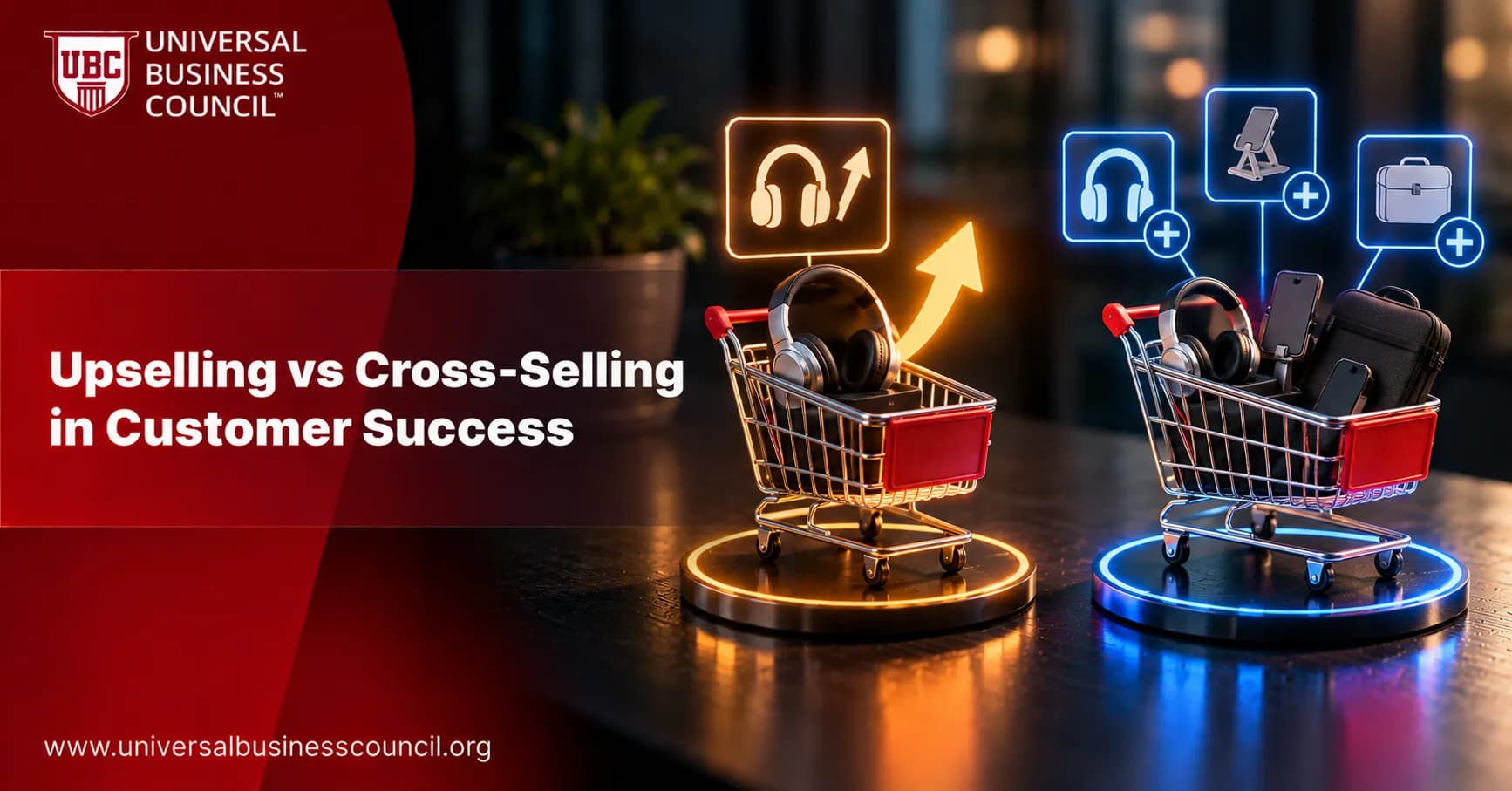
Upselling means encouraging a customer to move to a higher tier, a bigger plan or a larger quantity of what they already buy. A team that has outgrown a starter plan and moves to one with more seats, higher limits or advanced features is a typical example. Cross-selling means offering a different product or service that complements what the customer already uses, such as adding a reporting module, a training package or an integration to an existing subscription.
Both are forms of expansion revenue, which is the extra recurring revenue a company earns from existing customers. Expansion is what lifts net revenue retention above 100%, so it matters to any business with subscriptions. The difference between the two is mostly about direction: upselling goes deeper into the same product, while cross-selling goes wider across the range.
How they differ at a glance
Upselling | Cross-selling | |
|---|---|---|
What it is | A higher tier or larger volume of the same product | A different, complementary product or service |
Typical example | Moving from 10 seats to 50 seats | Adding an analytics module to a core subscription |
Usual trigger | Hitting limits or needing advanced features | A new use case or a related problem |
Main benefit to customer | More capacity or capability | A more complete solution |
Why customer success is involved in expansion
Customer success managers know the customer's goals, usage and relationships better than anyone else in the company. That puts them in a good position to see when an account has outgrown its plan or has a problem the company's other products could solve. Customers also tend to trust the person who has helped them reach their goals, so suggestions from that person carry weight.
Companies split the work in different ways. In some, customer success owns expansion conversations and carries a related target. In others, success identifies opportunities and hands them to an account manager or sales team who handle the commercial discussion. Neither model is right for every business. What matters is that the customer experiences a single, coherent relationship and that incentives don't push the team to sell things that don't help.
When to upsell and when to cross-sell
The best expansion offers come from customer needs, not from internal targets. A few signals can help you tell which direction fits.
Signals that point to an upsell
The customer is regularly hitting usage or seat limits
Team members keep asking for features that exist only on a higher tier
Usage is growing across departments or locations
The customer's goals have grown beyond what the current plan supports
Signals that point to a cross-sell
Look for a new use case the customer has mentioned, a new department with different needs, a manual process that another product could automate or a request that sits just outside the current product. Cross-selling works best when the new product connects to something the customer already values, so the additional purchase feels like a natural next step.
How to approach expansion without damaging trust
Customers can tell the difference between help and pressure. A few habits keep conversations on the right side of that line.
First, show value before you ask for more money. A customer who has reached a first result and understands the product is far more open to an offer than one who is still struggling with setup. Second, tie the offer to goals the customer has already stated, and use their own data to explain why it fits. Third, time it well. Avoid raising expansion during an escalation or in the middle of a difficult renewal. Fourth, be willing to say that an offer isn't a fit, which builds credibility for the times you say it is.
A simple conversation structure
Start by recalling the customer's goal and the progress made. Describe the new need or limit you've noticed, using their own usage as evidence. Explain how the upgrade or added product addresses it, and agree on what a good result would look like. Then let the customer decide at their own pace. If a commercial discussion is needed, bring in the account manager with a short handoff so the customer doesn't have to repeat themselves.
The way an offer is written and sent matters too. Clear, relevant messages timed to real usage perform better than generic promotions, and people who want to sharpen those skills can build them in a Digital Marketing Course.
How to measure upselling and cross-selling
Expansion needs measures that show both revenue and customer health. Useful ones include:
Expansion revenue: the extra recurring revenue from existing customers
Net revenue retention: revenue kept and grown from existing customers, which can exceed 100%
Upsell and cross-sell rates: the share of accounts that expand in a period
Attach rate: the share of customers who buy an additional product
Satisfaction after expansion: whether customers who expand stay happy and keep renewing
That last measure is easy to overlook. If expanded accounts churn faster or give lower satisfaction scores, the offers may be pushing customers into products they don't need. Compare results by segment and review them regularly with sales and finance.
Finding the right accounts at the right time depends on data from product usage, billing and the CRM. The Tech Certifications from Global Tech Council cover the programming and analytics skills behind that kind of work. AI tools can help flag accounts that look ready for expansion, but a person who knows the customer should decide whether and how to approach them.
Common mistakes to avoid
Most expansion problems come from a few familiar habits:
Offering an upgrade before the customer has seen value from the current plan
Treating every account as ready to buy, regardless of usage or health
Mixing a difficult renewal with an upsell in the same conversation
Letting targets drive offers that don't match the customer's goals
Making customers repeat their story when sales or account management joins
Expansion also looks different in newer fields such as blockchain and fintech, where customers often need to learn unfamiliar concepts before they can see why an added product matters. The Deep Tech Certifications from Blockchain Council are a helpful way to build that background if you work with customers in those areas.
Conclusion
Upselling vs cross-selling comes down to direction. Upselling takes a customer deeper into what they already use, while cross-selling adds a complementary product or service. Customer success is well placed to spot both, because it knows the customer's goals and usage. The approach matters more than the label: lead with value, tie offers to stated goals, choose the right moment and measure customer health alongside revenue. Teams that do this grow accounts steadily, protect trust and see expansion as part of helping customers succeed.
Frequently asked questions
What is upselling?
It's encouraging a customer to move to a higher tier or larger volume of what they already buy.
What is cross-selling?
It's offering a different, complementary product or service alongside what the customer already uses.
What is the main difference between upselling and cross-selling?
Upselling goes deeper into the same product, while cross-selling goes wider across the product range.
What is expansion revenue?
It's the extra recurring revenue a company earns from existing customers.
Why do upselling and cross-selling matter?
They lift net revenue retention and grow accounts without the cost of winning new customers.
Should customer success own upselling?
It depends on the company. Some success teams own it, while others identify opportunities and hand them off.
When is a customer ready for an upsell?
Often when they hit limits, need advanced features or have grown beyond their current plan.
When is a customer ready for a cross-sell?
When a new use case, department or related problem appears that another product could solve.
How do I upsell without being pushy?
Show value first, tie the offer to stated goals and let the customer decide at their own pace.
When should I avoid an expansion conversation?
During escalations, difficult renewals or when the customer hasn't yet seen value.
What is net revenue retention?
It's revenue kept and grown from existing customers, and it can exceed 100% when expansion is strong.
What is attach rate?
It's the share of customers who buy an additional product alongside their core purchase.
How do I measure upselling success?
Track expansion revenue, net revenue retention, expansion rates and satisfaction after the purchase.
Can expansion hurt customer satisfaction?
Yes, if offers don't match needs, so watch satisfaction and churn among expanded accounts.
How do I know which accounts are ready?
Use usage, health and goal data, and then check with the customer before approaching them.
How should customer success hand off to sales?
Share the customer's goals and context, so they don't have to repeat themselves.
Can AI help with expansion?
It can flag accounts that look ready, but a person who knows the customer should decide the approach.
What role does communication play?
Clear, relevant messages timed to real usage work better than generic promotions.
How often should I review expansion results?
Review them regularly by segment, together with sales and finance.
Where can I learn more about customer success?
A structured program such as the Certified Customer Success Professional covers renewals, expansion and the rest of the lifecycle.
Related Articles
View All
Business
The Future of Customer Success: AI, Automation and Predictive Analytics
Discover how customer success is evolving and what businesses can expect in the years ahead. Explore emerging trends such as AI-powered engagement, predictive analytics, automation, personalized experiences, and data-driven retention strategies.

Business
Best Customer Success Tools and CRM Platforms
Discover the best customer success tools and CRM platforms for managing customer relationships, tracking engagement, improving onboarding, and reducing churn. Compare key features and learn how to choose the right software for your team's needs.

Business
Customer Success Automation: What Can You Automate?
Discover how customer success automation helps teams save time, improve customer engagement, and deliver consistent experiences. Explore tasks you can automate, tools to consider, and areas where human interaction still matters.
Trending Articles
The Role of Blockchain in Ethical AI Development
How blockchain technology is being used to promote transparency and accountability in artificial intelligence systems.
AWS Career Roadmap
A step-by-step guide to building a successful career in Amazon Web Services cloud computing.
Top 5 DeFi Platforms
Explore the leading decentralized finance platforms and what makes each one unique in the evolving DeFi landscape.