

Claude Fable 5 Marketing Automation: Transforming Customer Engagement
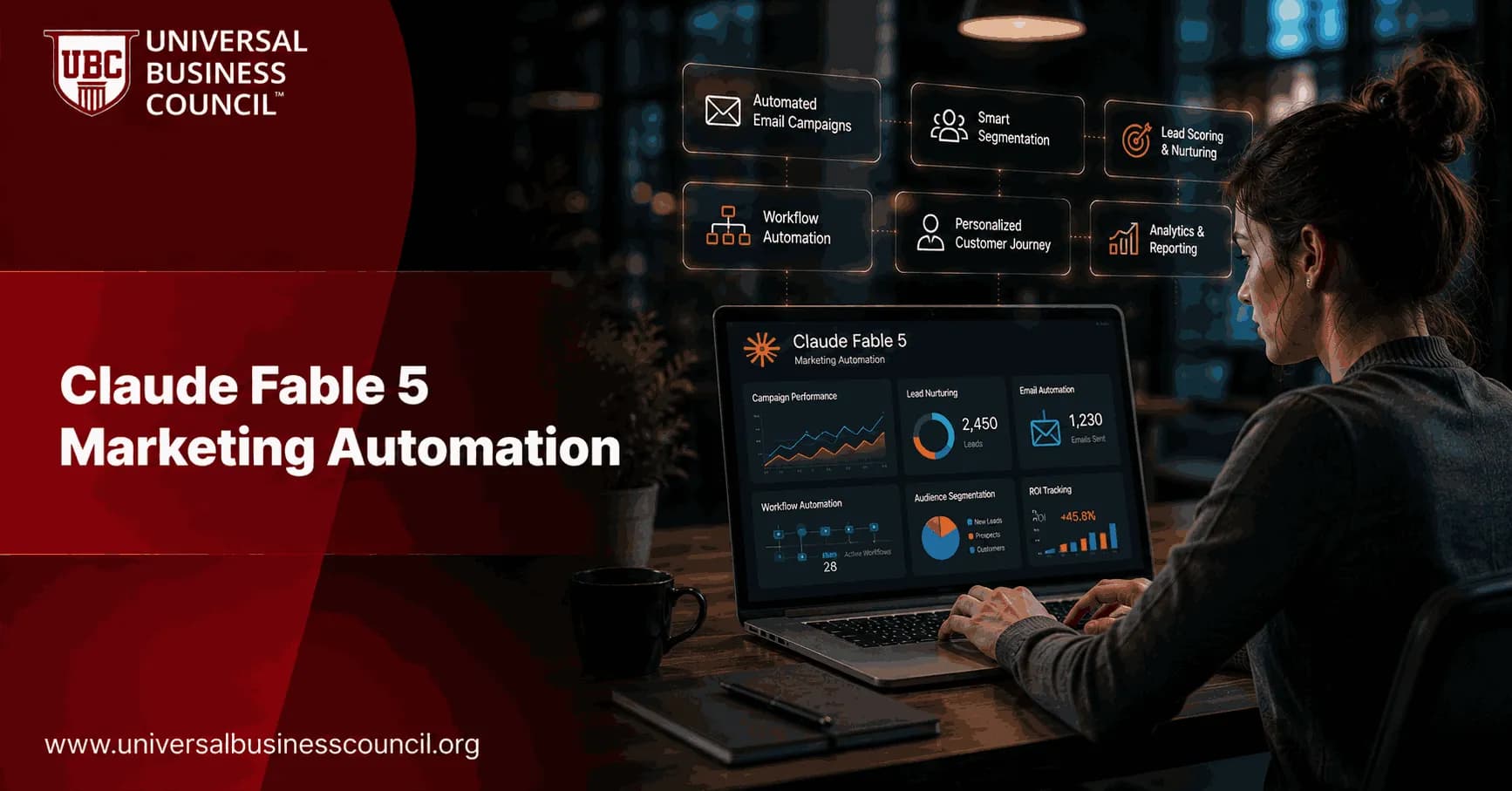
Claude Fable 5 marketing automation represents a shift from static campaign workflows to agentic, data-driven lifecycle operations. With long-horizon planning, strong tool use, and the ability to manage complex knowledge work, Claude Fable 5 can help marketing teams plan, execute, analyze, and optimize customer engagement across channels with less manual intervention.
For enterprises, the significance is not simply better content generation. The larger opportunity is building AI-powered marketing systems that can interpret strategy, coordinate tools, personalize journeys, debug workflows, and support governance. This article examines how Claude Fable 5 can transform marketing automation and customer engagement, while also outlining the risks, cost considerations, and skills professionals need to manage it responsibly.

As AI-powered marketing platforms become more sophisticated, a Claude AI Expert Certification can help professionals develop practical expertise in AI workflows, automation strategies, governance frameworks, and the responsible deployment of Claude-based solutions across marketing and business operations.
What Is Claude Fable 5?
Claude Fable 5 is a next-generation large language model designed for complex knowledge work, coding, long-running tasks, and ambiguous workflows. Vendor documentation describes the model as capable of sustained operation across multi-day tasks, including planning across stages, delegating to sub-agents, and self-verifying its work.
According to available model documentation, Claude Fable 5 supports a large maximum output of up to 128K tokens, adaptive reasoning, and configurable effort levels for deeper analysis. Some platform providers position it as a quality leader for autonomous knowledge work and provide access through governed access layers that span cloud environments.
For marketing leaders, these capabilities matter because advanced marketing automation often requires more than writing emails. It involves interpreting customer data, mapping journeys, coordinating systems, applying brand and compliance rules, running experiments, and producing insights over time.
Why Claude Fable 5 Fits Marketing Automation
From Static Rules to Agentic Lifecycle Marketing
Traditional marketing automation platforms often depend on manually configured rules: if a customer signs up, send an email; if they abandon a cart, trigger a reminder. These workflows can be effective, but they are difficult to maintain as customer behavior, channels, and business priorities change.
Claude Fable 5 can act as an autonomous operating layer for lifecycle marketing. Instead of relying only on pre-built rules, teams can define goals, constraints, brand guidelines, customer segments, and compliance rules. The model can then help design multi-step customer journeys, generate assets, check logic, analyze performance, and recommend updates.
Lifecycle marketing guidance for AI coding agents shows how these agents can support strategy definition, journey building, template design, quality assurance, auditing, debugging, and reporting through APIs and command-line workflows. Claude Fable 5 is well suited to this pattern because it is designed for long-running, multi-stage work.
As AI-driven automation becomes more deeply integrated into marketing operations, a Tech Certification can help professionals strengthen their understanding of APIs, workflow orchestration, cloud platforms, and the technical systems that support scalable AI-powered customer engagement.
Cross-Channel Customer Engagement
Modern customer engagement spans email, SMS, push notifications, in-app messaging, chat, web personalization, and customer support. Coordinating these channels manually can create inconsistent timing, duplicated messages, and fragmented customer experiences.
Claude Fable 5 can help unify cross-channel engagement by reading documented channel strategies, brand voice guidelines, journey inventories, customer histories, and performance data. It can then recommend which channel to use, what message to send, when to send it, and how to adapt based on user behavior.
Email: Longer educational content, onboarding sequences, reactivation campaigns, and account updates.
Push notifications: Time-sensitive prompts, reminders, and behavioral nudges.
In-app messages: Contextual guidance, feature adoption prompts, and product education.
Customer support: Personalized responses based on policy documents, product manuals, and transaction history.
This creates a path toward more coherent customer engagement, where every channel is part of a coordinated lifecycle strategy rather than an isolated campaign.
Data-Driven Personalization at Scale
Claude Fable 5 marketing automation can support personalization beyond basic merge fields or broad audience segments. With the right governance, integrations, and data architecture, it can help create micro-journeys that reflect individual customer behavior, preferences, lifecycle stage, and intent.
Reported benchmark results suggest Claude Fable 5 performs well on hard document question answering with tool use, file search, web search, code execution, and multimodal document understanding. This type of capability is relevant for marketers who need AI systems to query campaign archives, interpret analytics documentation, compare policies, and work across structured and unstructured information.
In practical terms, Claude Fable 5 can support personalization by helping teams:
Analyze customer cohorts and identify behavior patterns.
Generate segment-specific messaging aligned with brand guidelines.
Recommend next-best actions based on lifecycle stage.
Adapt onboarding, retention, and upsell journeys over time.
Explain why certain campaigns underperform and propose tests.
For professionals seeking to build these capabilities, Universal Business Council certifications in digital marketing, business analytics, AI strategy, and marketing management offer structured learning pathways. They can help marketers combine technical fluency with campaign strategy, customer insight, and ethical governance.
Marketing Analytics and Decision Support
One of the most valuable applications of Claude Fable 5 is not content production, but decision support. Marketing teams often struggle to interpret dashboards, attribution models, CRM data, product usage metrics, and customer feedback at the same time.
Claude Fable 5 can serve as a natural language analytics partner when connected to approved tools and governed data sources. It can generate SQL queries, summarize campaign performance, compare cohorts, draft experiment plans, and explain likely causes of changes in conversion or retention.
For example, a marketing operations team could ask the model to analyze why trial-to-paid conversion fell for a specific segment. Claude Fable 5 could inspect journey logic, review email engagement, examine product usage, identify changes in audience composition, and propose controlled tests. Its reported ability to complete complex analysis with fewer tool calls than earlier models can make advanced workflows more efficient.
Martech Integration and Technical Enablement
Marketing automation increasingly depends on technical infrastructure: CRMs, customer data platforms, analytics tools, event pipelines, messaging APIs, consent systems, and experimentation platforms. The strong coding and complex reasoning capabilities attributed to Claude Fable 5 make it relevant for marketing operations and martech engineering.
Industry analysis suggests Claude Fable 5 is meaningfully more capable on long, complex, autonomous tasks than earlier models, and that it is best used where multi-stage work justifies the cost. In marketing, that includes:
Writing integration code between CRM, CDP, analytics, and messaging systems.
Debugging event tracking and attribution problems.
Creating infrastructure-as-code for campaign triggers and data flows.
Auditing notification logic and identifying broken journeys.
Generating documentation for marketing operations teams.
This can reduce the gap between marketing strategy and technical implementation. It does not, however, remove the need for human review, security oversight, and quality assurance.
Risks, Governance, and Cost Considerations
Cost and Model Routing
Reported pricing places Claude Fable 5 at a premium relative to lighter models, with higher per-token costs for both input and output. It is also reported to run with somewhat higher latency while producing more output tokens.
For this reason, organizations should avoid using Claude Fable 5 for every marketing task. A practical routing strategy is to reserve it for complex journey planning, large audits, advanced analytics, customer engagement agents, and technical martech projects. Simpler work, such as one-off copy variations or routine classifications, can often be handled by lower-cost models.
Data Retention and Customer Privacy
Model providers may apply data retention policies, including limited retention of traffic for safety and security purposes. Even where data is not used for training, marketers handling personal data must still evaluate regulatory and contractual obligations before deployment.
Responsible deployment should include:
Data minimization, sending only the attributes needed for the task.
Pseudonymization or tokenization of sensitive identifiers.
Access controls and approval workflows for high-impact changes.
Audit trails through governed access platforms.
Clear policies for human review of customer-facing outputs.
Marketing teams in regulated industries should involve legal, compliance, data protection, and information security leaders before deploying AI agents that interact with customer data.
How Marketing Roles Will Change
Claude Fable 5 marketing automation will not eliminate the need for marketing expertise. It will change where expertise is applied. Professionals will spend less time manually assembling workflows and more time defining objectives, constraints, measurement plans, brand standards, and ethical boundaries.
The marketer of the future will need to understand campaign strategy, analytics, AI governance, prompt design, experimentation, and customer experience. Universal Business Council courses and certifications in marketing, management, business analytics, and AI-enabled strategy can support this transition by helping professionals develop both business judgment and technical literacy.
Conclusion
Claude Fable 5 can transform marketing automation and customer engagement by moving teams from static, rule-based workflows toward agentic lifecycle operations. Its long-horizon planning, tool use, large output capacity, and strong performance on complex knowledge tasks make it well suited for cross-channel orchestration, analytics-driven personalization, customer engagement agents, and martech integration.
At the same time, the model introduces important trade-offs around cost, latency, data retention, compliance, and human oversight. The best approach is not to use Claude Fable 5 everywhere, but to apply it where autonomy, reasoning depth, and complex coordination create clear value.
For marketing professionals and enterprises, the strategic priority is clear: build the skills, governance frameworks, and data foundations needed to use advanced AI responsibly. Organizations that combine Claude Fable 5 with disciplined marketing strategy and well-trained teams will be better positioned to deliver intelligent, personalized, and compliant customer engagement at scale.
FAQs
1. What Is Claude Fable 5 Marketing Automation?
Claude Fable 5 Marketing Automation refers to the use of advanced AI capabilities to automate marketing tasks, personalize customer interactions, and optimize engagement across multiple channels.
2. How Can Claude Fable 5 Transform Customer Engagement?
It can analyze customer behavior, generate personalized content, automate responses, and deliver relevant experiences that improve engagement and satisfaction.
3. Why Is AI-Powered Marketing Automation Important?
AI helps businesses scale personalization, reduce manual effort, improve campaign performance, and respond to customers more effectively.
4. What Marketing Functions Can Claude Fable 5 Automate?
It can assist with email campaigns, content creation, customer segmentation, lead nurturing, chatbot interactions, reporting, and workflow management.
5. How Does Claude Fable 5 Improve Personalization?
The platform can analyze customer preferences, behaviors, and interactions to deliver tailored messages, recommendations, and offers.
6. How Can Claude Fable 5 Enhance Email Marketing Campaigns?
It can generate email content, personalize messaging, optimize subject lines, recommend send times, and automate customer journeys.
7. What Role Does Claude Fable 5 Play in Customer Segmentation?
It can identify patterns in customer data and automatically group audiences based on demographics, behavior, interests, and purchase intent.
8. How Can Businesses Use Claude Fable 5 for Lead Nurturing?
The AI can automate follow-up communications, provide personalized content, score leads, and guide prospects through the sales funnel.
9. Can Claude Fable 5 Support Omnichannel Marketing?
Yes, it can help coordinate messaging across email, websites, social media, chatbots, mobile apps, and other customer touchpoints.
10. How Does Claude Fable 5 Improve Content Marketing?
It can assist with content ideation, article drafting, social media content creation, campaign messaging, and content optimization.
11. How Can Claude Fable 5 Improve Customer Journey Mapping?
It can analyze customer interactions and identify opportunities to improve engagement at different stages of the customer journey.
12. What Benefits Does Claude Fable 5 Offer for Customer Support?
It can support automated responses, case summaries, knowledge retrieval, and personalized assistance that improve customer experiences.
13. How Does Claude Fable 5 Help with Marketing Analytics?
The AI can process large datasets, identify trends, generate reports, and provide actionable insights to improve campaign performance.
14. Can Claude Fable 5 Improve Campaign Performance?
Yes, it can help optimize targeting, messaging, timing, and customer engagement strategies based on data-driven recommendations.
15. How Does Claude Fable 5 Support Sales and Marketing Alignment?
It can provide shared customer insights, improve lead qualification, automate communication workflows, and help both teams work from consistent data.
16. What Industries Can Benefit from Claude Fable 5 Marketing Automation?
Industries such as retail, e-commerce, finance, healthcare, education, technology, travel, and professional services can benefit from AI-powered engagement strategies.
17. What Challenges Should Businesses Consider Before Implementation?
Organizations should consider data quality, integration complexity, employee training, privacy requirements, governance policies, and content review processes.
18. How Can Businesses Measure Success with Claude Fable 5 Marketing Automation?
Key metrics include engagement rates, lead generation, conversion rates, customer retention, campaign ROI, customer lifetime value, and revenue growth.
19. What Are Common Mistakes When Using AI for Marketing Automation?
Common mistakes include over-automation, poor data management, neglecting human oversight, inconsistent brand messaging, and relying entirely on AI-generated outputs. Customers generally appreciate personalization, but they are less enthusiastic when it feels like they are corresponding exclusively with a machine that learned empathy from a spreadsheet.
20. What Is the Future of Claude Fable 5 Marketing Automation?
The future will likely involve deeper personalization, predictive customer journeys, autonomous campaign optimization, real-time decision-making, and more intelligent customer engagement across every stage of the marketing funnel.
Related Articles
View All
Claude Ai
How Can You Access and Use Claude Fable 5.1 for Free?
Want to access Claude Fable 5.1 for free? Explore its current availability, supported Claude plans, access options, and what users should know before getting started.

Claude Ai
Claude Fable 5 Returns Worldwide: Safer, Stricter, and Ready for Enterprise Again
Claude Fable 5 has reportedly returned for global availability with stronger safety controls, stricter governance, and enterprise-focused capabilities. This article explores the reported updates, potential business impact, and what organizations should know before adopting the model.
Claude Ai
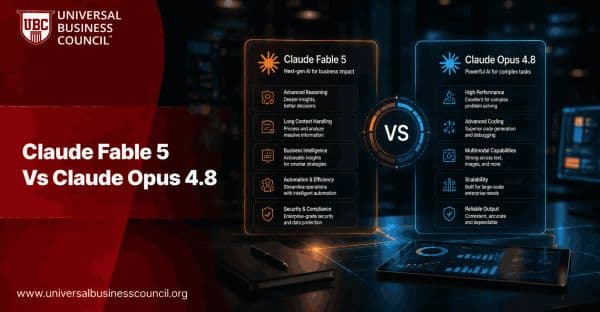
Claude Fable 5 vs Claude Opus 4.8
Claude Fable 5 and Claude Opus 4.8 represent different approaches to advanced AI performance. This comparison explores their reasoning abilities, speed, agentic capabilities, and enterprise use cases in 2026. Humans do enjoy lining models up and making them compete like intellectual racehorses.
Trending Articles
The Role of Blockchain in Ethical AI Development
How blockchain technology is being used to promote transparency and accountability in artificial intelligence systems.
AWS Career Roadmap
A step-by-step guide to building a successful career in Amazon Web Services cloud computing.
Top 5 DeFi Platforms
Explore the leading decentralized finance platforms and what makes each one unique in the evolving DeFi landscape.