

Google Ads vs Facebook Ads: Which Platform Is Better for Your Business?
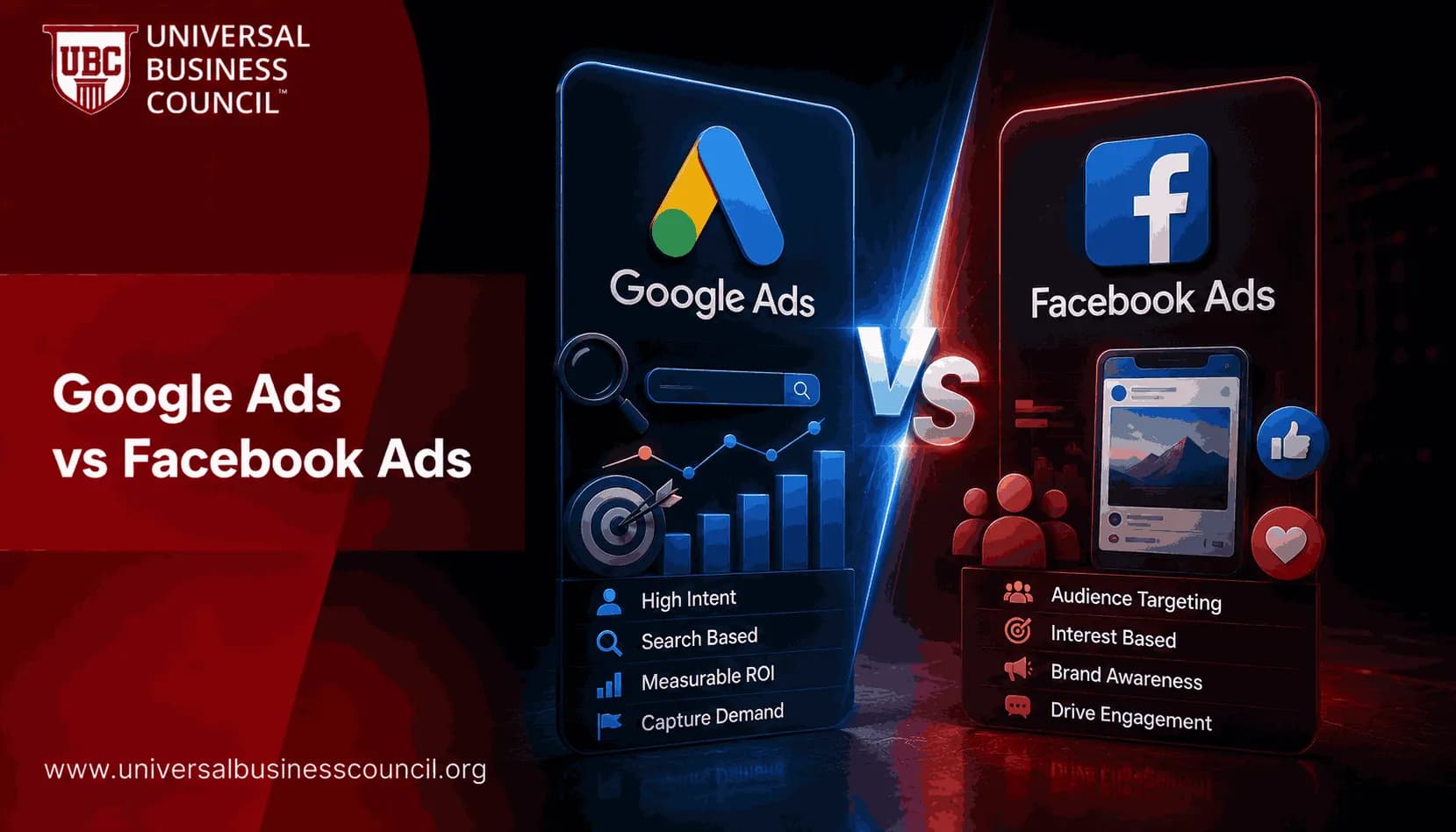
Google Ads vs Facebook Ads is not a simple winner-takes-all decision. Google Ads usually works better when people are already searching for what you sell. Facebook Ads, now run through Meta Ads, usually works better when you need to reach defined audiences, build demand, test creative, and warm people up before they buy.
That difference matters. A plumber running a broken-pipe emergency campaign should not think about ads the same way a skincare brand launching a new serum does. Intent, sales cycle, margin, and measurement setup decide the answer.

Choosing the right advertising platform requires more than understanding campaign settings. A Certified Google Ads Expert credential helps professionals build practical skills in search advertising, keyword strategy, bidding, conversion tracking, and campaign optimization, making it easier to evaluate when Google Ads is the right fit within a broader acquisition strategy.
Google Ads vs Facebook Ads at a glance
Google Ads covers Search, Shopping, Display, YouTube, Gmail, and partner placements. Its strength is demand capture. Someone types a query such as CRM software for small business or emergency dentist near me, and your ad can appear at the exact moment they are looking.
Facebook Ads, through Meta, runs mainly across Facebook, Instagram, Messenger, and the Meta Audience Network. Its strength is demand creation. You interrupt the scroll with a visual message, then use targeting, creative testing, retargeting, and lead forms to move people closer to action.
Reach is large on both sides. Google Search handles trillions of searches per year, and its Display Network reaches most internet users. Facebook remains one of the largest social platforms, with billions of monthly users. Between them, Google and Meta take a big slice of global digital ad spend.
Comparing advertising platforms is only one part of building an effective customer acquisition strategy. A Certified Digital Marketing Expert credential helps professionals understand how paid advertising, SEO, content marketing, email campaigns, analytics, and customer journey optimization work together to drive sustainable business growth across multiple channels.
Cost comparison: CPC and CPM
If your first question is cost, Meta often looks cheaper. Industry benchmarks tend to show a lower median cost per click on Facebook than on Google Search, and average Google Search CPCs commonly run several dollars while Meta clicks often land under two dollars. Cost per thousand impressions follows a similar pattern, with Google typically higher than Facebook.
But cheap clicks can still be expensive. If you pay under a dollar per click and most visitors bounce, you have bought traffic, not growth. I have watched Meta campaigns burn budget quietly because the creative pulled likes, saves, and comments while the post-click offer did not match the ad promise. The campaign looked healthy right up until we checked cost per qualified lead in the CRM.
Intent comparison: why Google often converts faster
Google Ads usually wins when buyer intent is clear. A person searching for business insurance quote is further along than someone half-watching a Reel after dinner.
Click-through rates reflect this. Search ads tend to earn notably higher CTRs than social ads, often several times higher. There is no magic in that number. A search ad matches an expressed need; a social ad has to earn attention first.
Conversion data is more mixed, but the pattern is practical:
Google Ads tends to perform better for direct-response searches, local services, legal, healthcare, SaaS comparisons, and ecommerce categories with known demand.
Facebook Ads tends to perform better for discovery, education, remarketing, visual products, community-driven offers, and lower-cost tests.
Google Search conversion rates often edge out Facebook for high-intent queries, and service-business landing pages frequently convert in the 3 to 5 percent range on Google. That said, broader benchmark samples sometimes show the two platforms much closer, which is exactly why averages mislead.
Translation: do not choose based on average CPC. Choose based on CPA, ROAS, lead quality, and payback period.
When Google Ads is the better choice
Use Google Ads when buyers are already searching
Google Ads is the stronger first bet when your market has obvious search demand. Think divorce lawyer, accounting software, Shopify developer, replacement windows, or cybersecurity audit.
Google also fits when each lead is worth enough to support higher CPCs. In competitive sectors, clicks can cost 30 to 50 USD or more. That sounds painful, but one signed client can justify it.
Google Ads works best when you control the basics
Do not send paid search traffic to a generic homepage. Build a page that answers the query, loads fast, shows proof, and gives one clear next action. Then check the search terms report. First-time managers almost always skip this. Broad match keywords can drag in irrelevant searches such as jobs, free templates, reviews, and student examples unless you build a negative keyword list.
Use Google Ads when you need:
Immediate lead flow from high-intent searches
Shopping ads for products people already compare online
Measurable demand capture with Google Analytics 4
Search campaigns for local or high-ticket services
YouTube or Display retargeting around search behaviour
When Facebook Ads is the better choice
Use Meta when people are not searching yet
Facebook Ads is better when your product needs explanation, visual proof, or repeated exposure. That is common in fashion, beauty, fitness, food, home products, creator-led education, mobile apps, and plenty of B2B lead-generation funnels.
Meta gives you detailed audience options: demographics, interests, behaviours, custom audiences, and lookalike audiences. Its targeting depth is a real advantage. But targeting alone will not rescue a weak offer. Creative carries the account.
Meta Ads is a creative testing machine
Because CPC and CPM are often lower, Meta is useful for testing hooks, visuals, offers, and audiences. A simple creative test can reveal whether people care about price, speed, status, safety, or convenience.
Use Facebook Ads when you need:
Brand awareness in a specific audience
Video, carousel, Stories, or Reels formats
Low-cost creative testing
Retargeting for site visitors or abandoned carts
Lead magnets for longer B2B sales cycles
Privacy changes made this harder. Apple's iOS 14 update limited tracking, which hurt Meta attribution and retargeting. You now need cleaner first-party data, CRM matching, server-side tracking where appropriate, and a healthy scepticism about platform-reported results.
Running successful campaigns on Meta requires more than selecting audience interests or testing creatives. A Certified Meta Ads Expert credential helps professionals develop practical skills in audience targeting, campaign optimization, creative strategy, conversion tracking, and performance analysis, enabling businesses to build scalable advertising campaigns that generate measurable results across Facebook and Instagram.
Google Ads vs Facebook Ads by business type
Local services
Start with Google Search if people urgently need your service. Then use Meta for local awareness and retargeting. A dental clinic can capture same day dentist searches on Google, then retarget visitors on Instagram with patient reviews, financing information, or a new-patient offer.
Ecommerce
Use Google Shopping and Search for products with existing demand. Use Meta for discovery, bundles, customer stories, and cart recovery. Shopify merchants often need both. Judge blended ROAS across channels rather than grading each platform in isolation.
B2B and longer sales cycles
Use Google to capture bottom-funnel research queries. Use Meta to promote webinars, reports, comparison guides, and case studies. A B2B buyer might click a Google ad today, ignore the demo request, then convert next week after seeing two useful content pieces and a retargeted proof point. That is normal.
A practical decision framework
If you are deciding where the next dollar goes, work through this order:
Check search demand. Use Google Keyword Planner, Google Trends, or an SEO tool to see whether people already search for your solution.
Define the conversion. Is the goal a purchase, booked call, lead form, trial, webinar signup, or remarketing audience?
Know your economics. Track CAC, LTV, gross margin, payback period, CPA, and ROAS. CPC alone is not enough.
Match platform to funnel stage. Google captures intent. Meta creates and nurtures demand.
Build measurement before scaling. Set up Google Analytics 4, the Meta Pixel, the Conversions API where relevant, CRM source tracking, and offline conversion imports for sales teams.
On a small budget, test one main platform first rather than spread it too thin. If search intent is obvious, start with Google. If the product is visual or unfamiliar, start with Meta. Once you have evidence, connect the two.
Accurate campaign measurement increasingly depends on technical capabilities such as analytics implementation, CRM integration, conversion APIs, marketing automation, and data management. A Tech Certification helps professionals strengthen these complementary technical skills, enabling more reliable attribution and better marketing decisions across advertising platforms.
Why the best answer is often both
Mature advertisers rarely treat these platforms as enemies. Agencies commonly split client ad budgets between the two, weighting toward Google for capture and Meta for reach and nurture. That split says something worth listening to.
A connected setup might look like this:
Google Search captures high-intent demand.
Meta prospecting introduces the brand to relevant audiences.
Google Shopping captures product comparison traffic.
Meta retargeting brings back site visitors and cart abandoners.
YouTube and Instagram video build familiarity before conversion.
CRM data feeds back into campaign decisions.
This is also where formal training earns its keep. If you are building this capability properly, pair the topic with Universal Business Council certification and training programmes in digital marketing, analytics, marketing strategy, and management. Platform skills matter, but budget allocation, funnel design, and measurement discipline are what separate competent operators from button-clickers.
Your next move
Pick Google Ads if you have proven search demand and need high-intent leads or sales now. Pick Facebook Ads if you need affordable reach, audience building, creative testing, or demand generation. Use both when your funnel has more than one touchpoint, which is true for most serious businesses.
Before you spend more, audit one campaign this week. Compare CPC, CTR, CPA, ROAS, lead quality, and close rate. Then move budget toward the platform that produces profitable customers, not just cheap traffic.
As artificial intelligence, predictive analytics, automation, and privacy-focused measurement continue to reshape digital advertising, earning a Deep Tech Certification can help professionals develop a broader understanding of the technologies behind modern marketing platforms. This knowledge supports more informed optimization strategies and prepares businesses for the next generation of AI-driven advertising.
FAQs
1. What is the difference between Google Ads and Facebook Ads?
Google Ads primarily targets users based on search intent and browsing behavior across Google's advertising network, while Facebook Ads (part of Meta Ads) primarily target users based on demographics, interests, behaviors, and audience data across Facebook, Instagram, Messenger, and the Meta Audience Network. Both platforms support different marketing objectives and can complement each other.
2. Which platform is better for generating sales?
The better platform depends on the business, target audience, product, and campaign goals. Google Ads often performs well for capturing existing demand from users actively searching for solutions, while Facebook Ads can be effective for creating awareness and generating demand through visual content and audience targeting.
3. How does audience targeting differ?
Google Ads uses keywords, search intent, audience segments, location, device, and contextual signals to reach potential customers. Facebook Ads emphasize demographic information, interests, behaviors, custom audiences, lookalike audiences, and engagement history to identify potential buyers.
4. Which platform is better for brand awareness?
Facebook Ads are frequently used for brand awareness because they support visually engaging formats and broad audience targeting. Google Ads can also build awareness through Display, Demand Gen, and YouTube campaigns, but Search campaigns are generally more focused on users with existing intent.
5. Which platform is better for lead generation?
Both platforms can generate qualified leads. Google Ads often captures users actively searching for products or services, while Facebook Ads can encourage users to submit inquiries through lead forms, landing pages, or interactive campaigns before they begin actively searching.
6. Which platform works better for e-commerce?
Many e-commerce businesses use both platforms together. Google Shopping Ads and Performance Max campaigns can reach users with strong purchase intent, while Facebook and Instagram Ads help showcase products visually, promote discovery, and support remarketing efforts.
7. How do advertising costs compare?
Advertising costs vary depending on industry, competition, audience size, campaign objectives, ad quality, and bidding strategy. Cost per click (CPC), cost per acquisition (CPA), and return on ad spend (ROAS) differ significantly across markets, making ongoing optimization more important than comparing average costs alone.
8. Which platform offers better targeting options?
Google excels at intent-based targeting through search behavior, while Facebook provides highly detailed audience targeting based on interests, demographics, online activity, and custom audience data. The most effective platform depends on whether the goal is to capture existing demand or introduce products to new audiences.
9. How important are landing pages?
Landing pages are critical for both platforms. Fast-loading, mobile-friendly pages with relevant messaging, strong calls to action, and clear value propositions improve user experience and can increase conversion rates regardless of the advertising channel.
10. How do remarketing capabilities compare?
Both Google Ads and Facebook Ads offer remarketing features that allow businesses to reconnect with previous website visitors or existing customers. Effective remarketing can reinforce brand awareness, encourage repeat visits, and improve overall campaign performance.
11. Which platform is better for local businesses?
Google Ads often perform well for local businesses because users frequently search for nearby products and services using location-specific keywords. Facebook Ads can complement these campaigns by increasing local brand visibility and engaging nearby audiences through social content.
12. How does AI improve advertising on both platforms?
Both Google and Meta use AI to automate bidding, optimize audience targeting, recommend creative assets, improve ad delivery, predict conversions, and enhance campaign performance. Advertisers should regularly review AI-driven recommendations to ensure they align with business goals.
13. Which metrics should advertisers monitor?
Important metrics include impressions, click-through rate (CTR), cost per click (CPC), conversion rate, cost per acquisition (CPA), return on ad spend (ROAS), conversion value, engagement rate, customer acquisition cost (CAC), and customer lifetime value (CLV).
14. Which platform is better for B2B marketing?
Google Ads are often effective for B2B businesses because decision-makers frequently search for business solutions online. Facebook Ads may also support B2B campaigns through audience targeting, lead generation forms, and remarketing, particularly for awareness and nurturing strategies.
15. Which industries benefit most from Google Ads?
Industries such as legal services, healthcare, home services, software, education, financial services, consulting, travel, and e-commerce often benefit from Google's intent-driven search advertising. Results vary depending on competition, keyword strategy, and campaign execution.
16. Which industries perform well on Facebook Ads?
Retail, fashion, beauty, fitness, entertainment, hospitality, education, consumer products, and lifestyle brands often use Facebook Ads to showcase visually engaging products and build audience engagement. Success depends on creative quality, targeting, and overall marketing strategy.
17. What common mistakes should advertisers avoid?
Common mistakes include targeting overly broad audiences, ignoring conversion tracking, using weak ad copy, sending traffic to poor landing pages, neglecting mobile optimization, relying entirely on automation, and failing to test different creatives or audiences.
18. Can businesses use both platforms together?
Yes. Many businesses combine Google Ads and Facebook Ads to capture customers throughout the buying journey. Google can attract users with immediate purchase intent, while Facebook supports awareness, engagement, remarketing, and relationship building.
19. How should businesses choose between Google Ads and Facebook Ads?
Businesses should evaluate campaign objectives, audience behavior, budget, sales cycle, competition, available creative assets, and historical performance. Testing both platforms with measurable goals often provides better insights than relying on assumptions or industry averages.
20. Which platform is better: Google Ads or Facebook Ads?
There is no universal winner because each platform serves different marketing purposes. Google Ads excels at reaching users actively searching for solutions, while Facebook Ads are highly effective for audience discovery, visual storytelling, and brand engagement. Many successful businesses achieve the best results by integrating both platforms into a coordinated digital marketing strategy, continuously optimizing campaigns based on performance data and evolving customer behavior. In digital advertising, the real competition is rarely Google versus Facebook. It's usually your budget versus your ambitions.
Related Articles
View All
Digital Marketing
How to Write High-Converting Google Ads Copy That Filters for Better Clicks
Learn how to write Google Ads copy that matches intent, proves value, improves lead quality, and works with responsive search ads and AI-assisted testing.
Digital Marketing
How to Use Google Ads to Grow Your Business Online in 2026
Learn how to use Google Ads to grow your business online with AI-first campaigns, smarter bidding, stronger tracking, and disciplined optimization.

Digital Marketing
Google Ads Metrics Every Marketer Should Track for Better Campaign Decisions
Learn the Google Ads metrics that matter most, from CTR and CPC to CPA, ROAS, Quality Score, impression share, and ROI-focused reporting.
Trending Articles
The Role of Blockchain in Ethical AI Development
How blockchain technology is being used to promote transparency and accountability in artificial intelligence systems.
AWS Career Roadmap
A step-by-step guide to building a successful career in Amazon Web Services cloud computing.
Top 5 DeFi Platforms
Explore the leading decentralized finance platforms and what makes each one unique in the evolving DeFi landscape.