

Search Ads vs Display Ads: Key Differences and When to Use Each
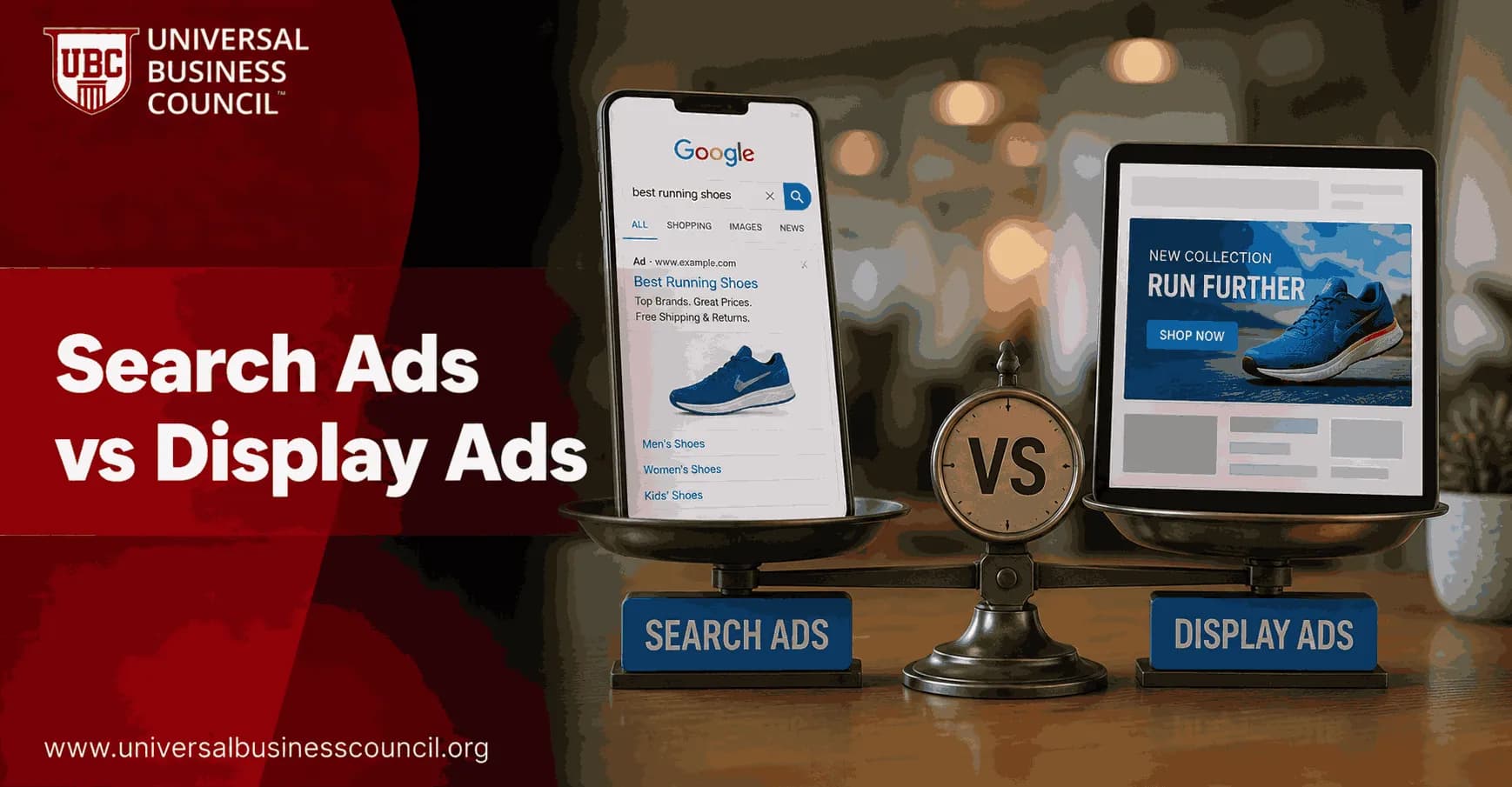
Search ads vs display ads is really a question about intent. Search ads meet people when they are actively looking. Display ads interrupt, remind, and introduce your brand while people browse websites, apps, and videos. Both can work. They just solve different problems.
Run them the same way and you will waste budget. I have watched teams judge display by last-click sales, then kill a campaign that was quietly feeding branded search. I have also seen search campaigns burn money on broad, vague terms like "business software" because nobody opened the search terms report for two weeks. Different channels. Different jobs.

Choosing the right advertising strategy requires understanding not only where ads appear but also how user intent influences campaign performance. A Certified Google Ads Expert credential helps professionals build practical skills in search and display advertising, audience targeting, bidding strategies, campaign optimization, and conversion tracking, making it easier to allocate budgets across the right channels.
What are search ads?
Search ads are paid text ads that appear on search engine results pages, such as Google or Microsoft Bing, when someone types a query. They usually include a headline, description, display URL, and an ad label.
Search advertising is often called pull advertising because the user has already expressed demand. They typed "emergency plumber near me," "CRM for small business," or "digital marketing certification." That query is the signal.
Search ads are usually best for:
Lead generation
Ecommerce sales
Demo requests
Bookings and consultations
Course or certification enrollments
High-intent B2B and local service queries
Most search campaigns use a pay-per-click model, so you pay when someone clicks. Targeting runs mainly on keywords, match types, location, device, audience lists, and negative keywords. The quiet money-saver is often the negative keyword list. Miss it, and you may pay for students, job seekers, free templates, or unrelated product categories.
What are display ads?
Display ads are visual ads shown across websites, mobile apps, and ad networks such as the Google Display Network. They can be static banners, responsive display ads, rich media, or video placements.
Display advertising is usually push advertising. The person reading a news article or checking a recipe is not necessarily shopping right now. Your job is to earn attention, build memory, or bring them back after a previous visit.
Search and display advertising are most effective when they support a wider digital marketing strategy rather than operating in isolation. A Certified Digital Marketing Expert credential helps professionals understand how paid media works alongside SEO, content marketing, analytics, email marketing, and conversion optimization to create a more consistent customer journey.
Display ads are usually best for:
Brand awareness
Remarketing and retargeting
Visual products such as fashion, travel, interiors, and consumer electronics
Long-cycle B2B sales
Audience expansion
Low-cost reach and frequency
Display can be bought on CPM, meaning cost per thousand impressions, or on CPC. It often looks cheap in the platform. Be careful. A $0.59 click is not cheap if the visitor bounces in four seconds and never comes back.
Search ads vs display ads: side-by-side comparison
Dimension | Search ads | Display ads |
|---|---|---|
Primary placement | Search engine results pages | Websites, apps, and ad networks |
User intent | High intent, active search | Lower intent, passive browsing |
Format | Mainly text | Images, banners, video, rich media |
Targeting | Keywords, queries, match types, audience filters | Audiences, interests, topics, placements, remarketing |
Typical pricing | Mostly PPC | Often CPM, sometimes CPC |
Main objective | Conversions and direct response | Awareness, reach, remarketing, consideration |
Performance benchmarks: what the numbers say
Across recent industry analyses, search ads still hold a clear conversion-rate advantage. Commonly cited Google Ads benchmarks put average search conversion rates in the region of 3 to 4 percent, against roughly 0.5 to 0.6 percent for display. Treat these as directional. Your own account data beats any published average, because vertical, offer, and landing page do most of the work.
Cost moves the other way. Average CPC on the search network tends to land around $2 to $3, compared with well under a dollar on the display network. Search clicks cost more but usually convert better. Display clicks cost less, but many of those users sit earlier in the buying process.
Scale is where display wins. Google reports that its Display Network reaches the vast majority of internet users across millions of websites and apps. That kind of reach is impossible to match with search alone.
Here is the practical read. If your board is asking for pipeline this quarter, start with search. If nobody knows your brand exists, the search volume may not be there yet. Use display to build recognition, then watch what happens to branded search, direct traffic, assisted conversions, and remarketing performance.
When to use search ads
Use search ads when demand already exists and you need to capture it efficiently.
Prioritise search ads when:
You need leads or sales now. Search is stronger for bottom-of-funnel action.
Your offer solves an urgent problem. Locksmiths, plumbers, clinics, repair services, and support providers fit this pattern.
Your sales cycle is short. If people compare, click, and buy within a few hours or days, search usually fits.
Your budget is limited. You cannot afford to educate the whole market first.
Your keywords show buying intent. Words like "buy," "pricing," "near me," "demo," "best," and "certification" often signal serious interest.
Take a professional education provider bidding on "project management certification online." That advertiser reaches someone much closer to enrollment than a person reading a general productivity article. It does not guarantee a sale. It does mean the conversation starts later in the funnel.
One warning: do not treat all keywords equally. "Digital marketing" is broad. "Digital marketing certification cost" is sharper. "Best digital marketing certification for managers" may be better still for a professional audience. In Google Ads, let the search terms report and conversion data in Google Analytics 4 or your CRM decide what stays.
When to use display ads
Use display ads when you need reach, visual messaging, or repeated exposure before the buyer is ready to search.
Prioritise display ads when:
You are building awareness. New brands often cannot rely on search because nobody knows what to type yet.
Your product benefits from visuals. A banner can show a room design, a travel destination, or a product in use faster than text can explain it.
Your sales cycle is long. B2B software, enterprise training, consulting, and high-value services often need multiple touches.
You want remarketing. Bring back people who visited a pricing page, abandoned a cart, or downloaded a guide.
You need audience-based targeting. Display can reach people by interests, placements, custom segments, or remarketing lists.
Remarketing is where display often earns its keep. A visitor who viewed a course page but did not enroll may simply not be ready today. A measured display sequence can remind them about the topic, show proof points, and bring them back when they are comparing options.
Even so, display gets messy fast. Watch your placement reports. Exclude mobile apps or low-quality placements that produce accidental clicks. Check frequency too. If someone sees the same banner 38 times in a week, you are not building trust. You are becoming wallpaper.
How to combine search and display without wasting budget
The best answer is rarely search or display. For most teams, the stronger structure is search plus display, with each channel given a clear role.
Use display for awareness. Target relevant audiences, industries, interests, or placements. Keep creative simple. One idea per ad.
Use display remarketing for consideration. Segment audiences by behaviour, such as product page visitors, cart abandoners, or webinar attendees.
Use search for conversion. Bid on high-intent non-branded terms, competitor comparison queries where appropriate, and branded terms if rivals are bidding on your name.
Measure across the funnel. Track CAC, ROAS, conversion rate, assisted conversions, branded search lift, lead quality, and CRM-stage movement.
Cut by evidence, not instinct. A display campaign may look weak on last-click CPA but strong on view-through assisted revenue or returning-user conversion rate.
Running integrated advertising campaigns also depends on technical capabilities such as analytics implementation, CRM integration, marketing automation, audience measurement, and data management. A Tech Certification helps professionals strengthen these complementary technical skills, enabling more accurate attribution and better optimization across multiple advertising channels.
A useful B2B setup is simple. Run display to reach your target segment. Retarget engaged visitors with a practical asset such as a checklist or webinar. Then capture late-stage demand with search ads on terms such as "marketing management certification" or "business management training." For Universal Business Council readers, that structure also opens natural internal linking to relevant digital marketing, marketing management, and business management certification pages.
Which channel should you choose first?
If you have to pick one, pick based on the business problem.
Choose search first if you need measurable leads, sales, bookings, or enrollments from people already searching.
Choose display first if you need awareness, visual reach, remarketing, or demand creation before search volume exists.
Use both if you have enough budget to cover the full journey from first exposure to final conversion.
To be blunt, display is overhyped when teams expect it to behave like search. Search is overrated when teams expect it to create demand from nothing. The disciplined marketer treats search ads vs display ads as a planning framework, not a turf war.
What to do next
Open your Google Ads account and label every active campaign by job: awareness, remarketing, or conversion. If a campaign has no clear job, fix that before you touch bids or creative. Then compare conversion rate, CPC, CAC, ROAS, and lead quality by channel.
If you are building formal capability in paid media, pair hands-on platform practice with structured study through Universal Business Council courses in digital marketing and related business disciplines. Start with search intent, measurement, and funnel design. The channel tactics will make more sense once that base is in place.
As artificial intelligence, machine learning, automation, and privacy-focused advertising technologies continue to reshape digital marketing, earning a Deep Tech Certification can help professionals develop a broader understanding of the technologies behind modern advertising platforms. This knowledge supports smarter campaign planning, stronger cross-channel optimization, and better long-term marketing performance.
FAQs
1. What is the difference between Search Ads and Display Ads?
Search Ads appear on Google Search results pages when users enter relevant queries, while Display Ads appear across websites, apps, videos, and other properties within the Google Display Network. Search Ads focus on capturing existing demand, whereas Display Ads are commonly used to build awareness, engage audiences, and support remarketing efforts.
2. How do Search Ads work?
Search Ads are triggered by keywords and user search intent. When someone searches for terms related to your products or services, Google determines whether your ad is eligible to appear based on factors such as bidding strategy, ad relevance, Quality Score, and other auction signals.
3. How do Display Ads work?
Display Ads use visual formats such as images, responsive display creatives, and banners to reach users while they browse websites, watch videos, or use mobile apps. Targeting can be based on audiences, interests, demographics, placements, contextual signals, and remarketing lists.
4. Which campaign type is better for lead generation?
Search Ads are often preferred for lead generation because they target users actively looking for products or services. Display Ads can complement lead generation by increasing brand awareness, nurturing prospects, and encouraging previous visitors to return and convert.
5. Which campaign type is better for brand awareness?
Display Ads are commonly used for brand awareness because they reach users across a broad network of websites and apps using visually engaging creative formats. Search Ads contribute to brand visibility when users actively search for relevant terms but are generally more intent-driven.
6. Which campaign type is better for e-commerce?
Many e-commerce businesses benefit from using both campaign types. Search Ads capture shoppers with strong purchase intent, while Display Ads promote products visually, support remarketing, and encourage repeat engagement throughout the buying journey.
7. How does audience targeting differ?
Search Ads primarily target users through keywords and search intent, with additional audience signals available. Display Ads rely more heavily on audience segments, interests, demographics, placements, contextual targeting, and behavioral data to reach potential customers.
8. What role does keyword targeting play?
Keyword targeting is central to Search Ads because it determines when ads are eligible to appear for specific searches. Display campaigns generally rely less on keywords and more on audience targeting, although contextual targeting may still consider page content.
9. Which campaign type usually has higher click-through rates?
Search Ads often achieve higher click-through rates because they appear when users are actively searching for information or solutions. Display Ads typically generate lower CTRs but can deliver broad reach and repeated brand exposure across the web.
10. How do Search Ads and Display Ads compare in cost?
Advertising costs vary depending on industry, competition, targeting options, bidding strategy, and campaign objectives. Search Ads often have higher average cost per click for competitive keywords, while Display Ads may offer lower click costs but different engagement and conversion patterns.
11. Can Display Ads improve remarketing campaigns?
Yes. Display Ads are widely used for remarketing by showing ads to users who have previously visited a website or interacted with a business. Personalized remarketing campaigns can help re-engage potential customers and encourage future conversions.
12. How does AI improve both campaign types?
Google's AI can optimize bidding, audience targeting, asset selection, budget allocation, and ad delivery for both Search and Display campaigns. Advertisers should review AI-driven recommendations regularly to ensure campaign performance aligns with business goals.
13. Which metrics should advertisers monitor?
Key metrics include impressions, click-through rate (CTR), cost per click (CPC), conversion rate, cost per acquisition (CPA), return on ad spend (ROAS), conversion value, impression share, view-through conversions where applicable, and customer acquisition cost (CAC).
14. Which industries benefit most from Search Ads?
Industries such as legal services, healthcare, software, home services, financial services, education, consulting, and professional services often perform well with Search Ads because customers frequently begin their buying journey through search engines.
15. Which industries commonly benefit from Display Ads?
Retail, travel, hospitality, entertainment, consumer products, education, real estate, and lifestyle brands frequently use Display Ads to increase visibility, promote new offerings, and strengthen brand recognition across multiple online channels.
16. Should businesses use Search Ads and Display Ads together?
In many cases, yes. Search Ads can capture high-intent users ready to take action, while Display Ads build awareness, support remarketing, and keep brands visible throughout longer customer decision-making processes.
17. What common mistakes should advertisers avoid?
Common mistakes include using overly broad targeting, neglecting negative keywords for Search campaigns, failing to optimize creative assets for Display campaigns, ignoring conversion tracking, sending users to weak landing pages, and relying entirely on automation without strategic oversight.
18. How should businesses choose between Search Ads and Display Ads?
The decision should be based on campaign objectives, customer behavior, available budget, sales cycle, creative resources, and target audience. Businesses focused on immediate demand may prioritize Search Ads, while those seeking broader visibility often incorporate Display Ads into a larger marketing strategy.
19. How are Search Ads and Display Ads evolving in 2026?
Google continues to expand AI-powered automation, audience modeling, asset optimization, privacy-focused measurement, and cross-channel campaign capabilities. Advertisers who monitor official Google Ads updates and adapt their strategies accordingly can better respond to evolving advertising opportunities.
20. Which is better: Search Ads or Display Ads?
Neither campaign type is universally better because each serves different stages of the customer journey. Search Ads excel at reaching users with immediate intent, while Display Ads strengthen awareness, engagement, and remarketing across Google's extensive network. A balanced strategy that combines both campaign types, supported by accurate measurement and ongoing optimization, often provides the greatest long-term value. Digital marketing rarely rewards choosing one tool forever. It usually rewards knowing when each tool deserves to leave the toolbox.
Related Articles
View AllDigital Marketing
Digital Marketing vs Programmatic Advertising: Key Differences and How They Work Together
Digital marketing sets the online strategy. Programmatic advertising automates paid media buying. Learn the differences, trade-offs, and how to combine both.
Digital Marketing
How to Use Google Ads to Grow Your Business Online in 2026
Learn how to use Google Ads to grow your business online with AI-first campaigns, smarter bidding, stronger tracking, and disciplined optimization.

Digital Marketing
How to Use Negative Keywords in Google Ads to Stop Wasted Spend
Learn how negative keywords in Google Ads reduce wasted spend, improve traffic quality, and help you build a cleaner PPC optimization process.
Trending Articles
The Role of Blockchain in Ethical AI Development
How blockchain technology is being used to promote transparency and accountability in artificial intelligence systems.
AWS Career Roadmap
A step-by-step guide to building a successful career in Amazon Web Services cloud computing.
Top 5 DeFi Platforms
Explore the leading decentralized finance platforms and what makes each one unique in the evolving DeFi landscape.