

Meta Advantage+ Explained: Automated Targeting, Placements, and Creative Tools
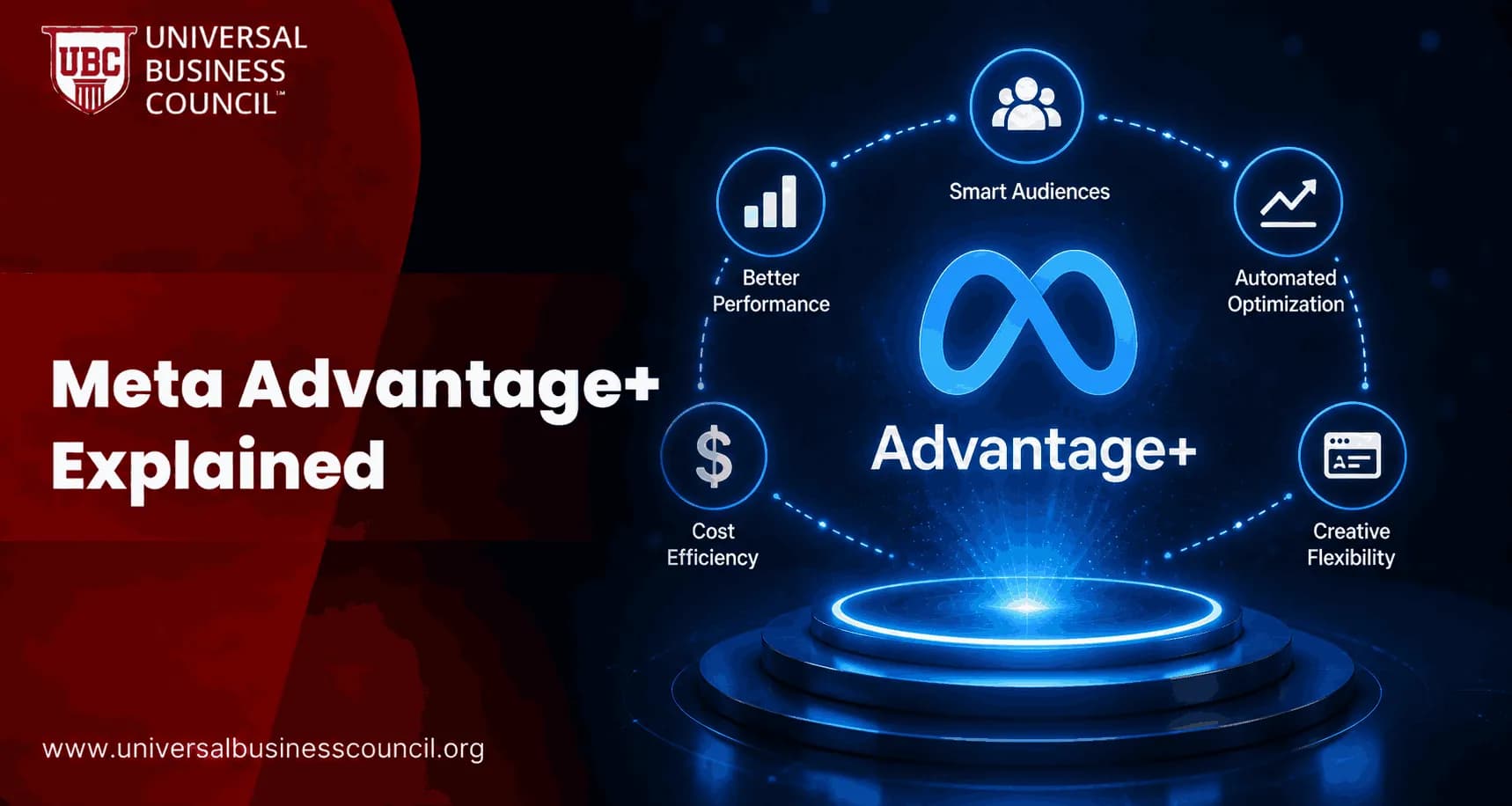
Meta Advantage+ is now the automation layer behind much of Meta Ads Manager. It is not one campaign type. It is Meta's AI-driven system for automated targeting, placements, budget pacing, bidding, and creative testing across Facebook, Instagram, Audience Network, and other Meta surfaces.
If you manage paid social, the practical message is simple: you do less manual steering, but your inputs matter more. Bad tracking, weak creative, or a confused offer will still lose money. Automation does not fix a poor campaign brief.

As Meta's advertising platform becomes increasingly AI-driven, professionals need to understand not only campaign setup but also how automation, attribution, and creative optimization work together. A Certified Meta Ads Expert credential helps build these practical skills, enabling marketers to create, manage, and optimize high-performing Meta advertising campaigns with greater confidence.
What Is Meta Advantage+?
Meta Advantage+ is the umbrella name for Meta's advertising automation suite. It includes end-to-end automated campaign formats such as Advantage+ Sales, Advantage+ App, and Advantage+ Leads. It also includes modular tools that slot into broader campaign builds, including Advantage+ Audience, Advantage+ Placements, Advantage+ Creative, and budget automation features.
At a working level, Meta Advantage+ answers four questions:
Who should see the ad?
Where should the ad appear?
How much budget should go to an impression, placement, or campaign?
Which creative version should that person see?
You still provide the objective, assets, product feed, event setup, and business rules. Meta's machine learning system then makes delivery decisions in real time. Meta has described its Andromeda ad retrieval and ranking infrastructure as able to evaluate candidate ads at a scale roughly 10,000 times greater than its predecessor, which is why the platform can test far more ad-user combinations than a human media buyer could ever structure by hand.
Successfully using automated advertising tools also requires a broader understanding of digital marketing strategy, customer journeys, analytics, and campaign optimization. A Certified Digital Marketing Expert credential helps professionals develop these capabilities, making it easier to combine AI-powered automation with sound marketing decision-making.
Why Meta Advantage+ Became the Default
Advantage+ has shifted from a specialist option to the default buying surface across much of Meta Ads Manager. New campaign workflows increasingly start with Advantage+ features already active. If you want stricter control, you often have to switch specific options off rather than turn automation on.
This is not just an interface change. Meta has also pushed automation-first behaviour through campaign setup rules and API-level defaults. The direction is clear: Meta wants advertisers to set the goal and supply high-quality inputs, while the system handles more of the targeting, placement, and optimisation work.
That can feel uncomfortable if you grew up building twenty ad sets by interest, age band, and placement. To be blunt, much of that work is now low-value busywork unless you have a strong reason for control, such as regulated messaging, strict geography, or a hard budget split by business unit.
Advantage+ Audience: Automated Targeting Explained
Advantage+ Audience changes how targeting works. Instead of treating audience settings as fixed walls, Meta increasingly treats them as signals. You can still provide inputs such as custom audiences, conversion history, pixel events, broad demographic guidance, or interest hints. The system then expands delivery when it predicts a better chance of conversion outside the original audience.
What This Means in Practice
In older campaign structures, you might have separated prospecting, retargeting, lookalikes, and interest groups into different ad sets. Advantage+ tends to blend discovery and remarketing inside a broader optimisation pool. That gives the algorithm more data. It also gives you less clean separation.
Here is a mistake I see often in account reviews. A team keeps adding interest hints because the campaign feels too broad, then ignores the real bottleneck, which is usually the landing page event setup or the first three seconds of the video. If Meta does not receive clean purchase, lead, or app event data, Advantage+ Audience has weak signals to learn from.
Use audience inputs when they reflect real business knowledge. Do not treat them as precision targeting in the old sense.
Advantage+ Placements: Where the Ads Run
Advantage+ Placements distributes ads automatically across available Meta placements, including Facebook Feed, Instagram Feed, Stories, Reels, in-stream video, and Audience Network. The system predicts which surface is most likely to produce the result you want for each impression.
This is where advertisers often feel a loss of control. A placement report may show cheap clicks from one surface and expensive conversions from another. The trick is not to panic over click cost. Compare placement performance against the actual business event: purchase, qualified lead, subscription, booked demo, or downstream CRM status.
When to Keep Placements Broad
Broad placements usually make sense when:
You are optimising for a clear conversion event.
You have enough weekly conversion volume for learning.
Your creative can adapt to square, vertical, and feed formats.
You care more about CPA or ROAS than channel-level control.
When to Restrict Placements
Restrict placements when you have a defensible reason. Examples include brand safety concerns, creative that clearly fails in vertical formats, or campaigns tied to a specific content experience. Otherwise, placement exclusions often cut learning and raise costs.
Advantage+ Creative: The Main Human Lever Left
Advantage+ Creative tests and adapts ad assets. It can vary images, videos, text combinations, backgrounds, crops, aspect ratios, and other presentation elements. Meta's newer generative AI tools can also help produce background variations and adjust creative for different surfaces.
This is where your work still matters. Targeting is more automated. Placements are more automated. Bidding is more automated. Creative strategy is where skilled marketers can still build a clear edge.
Strong Advantage+ creative inputs usually include:
Several distinct angles, not five near-identical versions of the same ad.
Vertical video built for Reels and Stories, not a cropped desktop ad.
Clear product proof, such as reviews, demonstrations, or before-and-after context where compliant.
Copy tied to buying intent, objections, price, delivery, trust, or urgency.
Catalog assets with clean titles, product images, prices, and availability.
Do not hand your judgment to generative tools. AI can make variants faster. It cannot tell you whether the offer is credible, whether the claim is legal, or whether the creative matches the buyer's stage.
Performance Benchmarks: What the Data Suggests
Meta has reported that Sales campaigns using Advantage+ produce, on average, roughly 9 percent lower cost per action than manual setups. Meta has also reported around 10 percent cheaper qualified leads for Advantage+ Lead campaigns.
Some agency and industry tests have shown larger gains, with head-to-head comparisons citing 17 to 22 percent lower CPA for Advantage+ campaigns against previous manual structures, and a handful of cases reporting reductions above 30 percent after consolidating into fewer campaigns. Treat the higher figures as ceilings, not expectations.
Read those numbers properly. They are not a guarantee. Advantage+ usually performs best when the account has enough conversion volume, clean events, strong creative variety, and a clear optimisation goal. A new advertiser with ten purchases per month should expect more volatility than an ecommerce brand sending hundreds of weekly purchase events back to Meta.
Use Cases for Meta Advantage+
Ecommerce and Retail
Advantage+ Sales, which grew out of the earlier Advantage+ Shopping workflows, is a natural fit for ecommerce. It works best with a healthy product catalog, purchase event tracking, and enough creative variation to cover different buyer motivations.
For retail teams, the practical build is usually simple. Consolidate campaigns, optimise for purchase or value, feed Meta clean catalog data, and refresh creative before fatigue damages performance. Watch ROAS, CPA, new customer share, and margin, not just platform-reported revenue.
Lead Generation
Advantage+ Leads can work well when you connect lead quality back into measurement. Form fills alone are not enough. If sales rejects half the leads, you need to inspect form questions, qualification signals, and CRM feedback.
A common certification exam trap, and a real account-management trap too, is assuming cheaper leads mean better leads. They might. They might not. Track cost per qualified lead and cost per accepted opportunity where you can.
Mobile Apps
Advantage+ App campaigns are built for app installs and in-app events such as purchases, subscriptions, or level completions. Advanced teams often optimise toward value or retention rather than install volume, because install campaigns can attract users who never open the app again.
How to Manage Meta Advantage+ Without Losing Control
You cannot manage Advantage+ like a 2018 media plan. Use fewer, cleaner structures and put your effort into inputs and measurement.
Check conversion tracking first. Confirm the pixel, Conversions API, event deduplication, purchase values, and lead events before you scale spend.
Consolidate where sensible. Too many small ad sets starve the model. Give the system enough data to learn.
Separate only for business reasons. Split campaigns by market, margin, budget owner, funnel stage, or compliance need, not personal preference.
Feed creative variety. Test different hooks, formats, proof points, and offers.
Use soft steering. Where available, Value Rules can help Meta bid more for higher-value segments without a full return to manual control.
Read reports sceptically. Compare Meta-reported performance with GA4, Shopify, HubSpot, Salesforce, or your CRM.
As marketing technology stacks become more sophisticated, professionals also benefit from strengthening their technical knowledge of analytics platforms, cloud-based tools, automation, and data integration. A Tech Certification helps build these complementary skills, enabling marketers to manage complex digital ecosystems more effectively while supporting data-driven campaign optimization.
Skills Professionals Need Now
Meta Advantage+ changes what paid social expertise looks like. The best practitioners are less like button-pushers and more like campaign architects. You need to understand creative testing, conversion data, attribution limits, offer economics, CAC, LTV, ROAS, churn, and lead quality.
If you are building a professional development path, connect this topic with Universal Business Council learning in digital marketing strategy, marketing analytics, business management, and performance measurement. Those areas support the real work behind Advantage+: setting the right objective, reading the data, and making disciplined decisions when the platform hides much of the mechanics.
The Practical Bottom Line
Meta Advantage+ is not magic. It is a powerful automation system that rewards clear signals and punishes messy inputs. Use it when you can define the conversion, supply enough data, and keep creative fresh. Avoid blind reliance when you lack tracking, have strict audience requirements, or cannot verify lead or revenue quality outside Meta Ads Manager.
Your next step: audit one campaign this week. Check whether Advantage+ Audience, Placements, and Creative are active, then review the conversion event, creative mix, and post-click quality. Fix those before you touch another interest target.
The continued evolution of AI-powered advertising highlights the growing value of advanced technical expertise alongside marketing knowledge. A Deep Tech Certification helps professionals strengthen their understanding of emerging technologies, artificial intelligence, data-driven systems, and digital innovation, supporting more effective adoption of next-generation advertising and business technologies.
FAQs
1. What is Meta Advantage+?
Meta Advantage+ is a suite of AI-powered automation features within Meta Ads Manager that helps optimize campaign targeting, placements, budgeting, bidding, and creative delivery across Facebook, Instagram, Messenger, and the Meta Audience Network. Its goal is to improve campaign performance while reducing manual setup and optimization.
2. Why is Meta Advantage+ important?
Advantage+ helps advertisers automate many campaign decisions using Meta's machine learning systems. By analyzing large volumes of signals in real time, it can identify opportunities to improve conversions, reach, and return on ad spend (ROAS), particularly for campaigns with sufficient data.
3. How does Meta Advantage+ work?
Meta's AI continuously analyzes user behavior, conversion signals, campaign objectives, historical performance, and contextual data to determine who is most likely to achieve the selected campaign goal. The system automatically adjusts targeting, placements, bidding, and creative combinations where applicable.
4. What is Advantage+ Audience?
Advantage+ Audience is an AI-assisted audience targeting option that allows advertisers to provide audience suggestions, such as interests or customer lists, while Meta's system expands beyond those suggestions when it predicts better campaign performance. It is designed to optimize delivery based on the chosen objective rather than strict manual targeting.
5. What are Advantage+ Placements?
Advantage+ Placements automatically deliver ads across eligible Meta platforms and placements, including Facebook Feed, Instagram Feed, Stories, Reels, Messenger, and the Meta Audience Network. The system allocates impressions to placements that are expected to produce the best results for the campaign objective.
6. What is Advantage+ Creative?
Advantage+ Creative includes automated features that adapt ad assets to different users and placements. Depending on available features, Meta may optimize image cropping, aspect ratios, text presentation, brightness, templates, music, or other creative elements to improve engagement while preserving the advertiser's core message.
7. What is an Advantage+ Shopping Campaign?
Advantage+ Shopping Campaigns are designed primarily for eCommerce advertisers. They automate audience selection, creative optimization, and budget allocation to help maximize online purchases and conversions using Meta's machine learning models.
8. What campaign objectives work with Advantage+?
Advantage+ supports multiple campaign objectives, including sales, leads, app promotion, engagement, traffic, and awareness. Available automation features may vary depending on the selected objective and current Meta Ads platform capabilities.
9. Does Advantage+ replace manual targeting?
Not entirely. Advertisers can still provide audience suggestions, exclusions, geographic targeting, and other campaign settings where supported. Advantage+ expands automation by allowing Meta's AI to optimize beyond manually defined audiences when appropriate.
10. What are the benefits of using Advantage+?
Benefits may include simplified campaign management, broader audience discovery, automated optimization, efficient budget allocation, improved scalability, reduced manual adjustments, faster testing, and potentially stronger performance for campaigns with sufficient conversion data.
11. What are the limitations of Advantage+?
Advantage+ offers less granular manual control than traditional campaign configurations. Some advertisers may have limited visibility into exactly how audience expansion or creative optimization occurs, and results can vary depending on campaign goals, available data, creative quality, and market conditions.
12. Which businesses benefit most from Advantage+?
Advantage+ is commonly used by eCommerce brands, direct-to-consumer businesses, retailers, mobile app developers, subscription services, lead generation companies, and advertisers managing campaigns with significant conversion volume and diverse audiences.
13. How does Advantage+ compare with traditional Meta campaigns?
Traditional campaigns provide greater manual control over targeting, placements, and optimization settings. Advantage+ shifts more decision-making to Meta's AI, aiming to improve efficiency while reducing the need for ongoing manual optimization. The most suitable approach depends on campaign objectives, available data, and business requirements.
14. What metrics should advertisers monitor?
Key performance indicators include Return on Ad Spend (ROAS), Cost Per Acquisition (CPA), Cost Per Click (CPC), Click-Through Rate (CTR), conversion rate, impressions, reach, frequency, average order value, revenue, and overall return on investment (ROI).
15. Which tools integrate with Advantage+?
Advantage+ works with Meta Ads Manager, the Meta Pixel, Conversions API (CAPI), Commerce Manager, product catalogs, Meta Business Suite, and various third-party analytics, eCommerce, and customer relationship management (CRM) platforms.
16. What common mistakes should advertisers avoid?
Common mistakes include providing insufficient conversion data, using low-quality creative assets, failing to implement accurate conversion tracking, making frequent campaign edits during the learning phase, relying on a single creative variation, and evaluating performance before the algorithm has accumulated enough optimization data.
17. What are best practices for using Advantage+?
Best practices include installing the Meta Pixel and Conversions API, supplying high-quality creative assets, defining clear conversion goals, allowing adequate learning time, monitoring business outcomes rather than vanity metrics, testing creative variations, and making data-driven optimizations instead of frequent manual changes.
18. How does Advantage+ fit into a digital marketing strategy?
Advantage+ complements broader digital marketing efforts by automating campaign optimization while working alongside SEO, content marketing, email marketing, Google Ads, influencer campaigns, customer retention strategies, and analytics platforms to support full-funnel marketing objectives.
19. What trends are shaping Meta Advantage+ in 2025-2026?
Key trends include AI-generated creative optimization, predictive audience modeling, privacy-focused measurement, deeper Conversions API integration, generative AI for ad assets, multimodal creative testing, automated budget allocation, and increasing reliance on first-party data as third-party tracking continues to decline.
20. What is the future of Meta Advantage+?
Meta Advantage+ is expected to become increasingly automated as artificial intelligence assumes greater responsibility for campaign optimization, creative adaptation, audience discovery, and bidding decisions. While advertisers will continue to define business goals, budgets, and brand guidelines, AI is likely to handle more day-to-day optimization, enabling marketers to focus on strategy, creative direction, and customer experience. The algorithm may become remarkably good at finding potential customers, but it still cannot rescue an ad that says absolutely nothing worth clicking.
Related Articles
View AllMeta Ads
How Meta Ads Work: Targeting, Auctions, Budgets, and Delivery Explained
Learn how Meta Ads work across targeting, auctions, budgets, bidding strategies, and delivery so you can diagnose performance with evidence, not guesswork.
Meta Ads
AI for Meta Ads: Improve Targeting, Creative Testing, and Conversions
Learn how AI for Meta Ads improves targeting, creative testing, and conversions with Advantage+, Conversions API, better signals, and smarter workflows.

Meta Ads
Meta Campaign Objectives Explained: How to Choose the Right Goal for Your Ads
Learn how Meta campaign objectives work, when to use Awareness, Traffic, Engagement, Leads, App Promotion, and Sales, and how to match each to your KPI.
Trending Articles
The Role of Blockchain in Ethical AI Development
How blockchain technology is being used to promote transparency and accountability in artificial intelligence systems.
AWS Career Roadmap
A step-by-step guide to building a successful career in Amazon Web Services cloud computing.
Top 5 DeFi Platforms
Explore the leading decentralized finance platforms and what makes each one unique in the evolving DeFi landscape.