

How Meta Ads Work: Targeting, Auctions, Budgets, and Delivery Explained
How Meta Ads work is simpler than the Ads Manager interface makes it look: Meta predicts which person is most likely to take your chosen action, scores each eligible ad in a real-time auction, then spends your budget where it expects the best result for the lowest practical cost. Facebook, Instagram, Messenger, and Audience Network all sit inside this auction-led delivery system.
That does not mean you should hand everything to the algorithm and hope. You still control the objective, conversion event, creative, budget, bid strategy, and data quality. Get those wrong and Meta will optimize very efficiently toward the wrong outcome. I have seen that happen with lead campaigns where the platform found cheap form fills, but sales rejected most of them because the qualifying question was buried after the submit button.

How Meta Ads Work From Objective to Impression
Meta Ads are objective-led. When you choose sales, leads, traffic, engagement, or app promotion, you are telling Meta which prediction model to use. A sales campaign optimized for purchases is not hunting for the same people as a traffic campaign optimized for link clicks.
Meta describes its ad auction as a system built to balance advertiser value and user experience. In each eligible impression, Meta evaluates:
- Bid: what you are willing to pay for the optimized result.
- Estimated action rate: Meta's prediction that a specific person will complete the action, such as click, lead, add to cart, or purchase.
- Ad quality: signals from creative quality, engagement, landing page experience, and negative feedback such as hides or reports.
A common way to express the auction logic is: Total Value = Bid x Estimated Action Rate + Ad Quality. Meta Business Help Center materials and Meta Blueprint education explain the same principle: the highest total value wins, not always the highest bid.
Meta Ads Targeting: Less Manual Control, More Prediction
Meta Ads targeting used to feel like building a neat audience box: age, gender, location, interests, behaviors, and maybe a few exclusions. Those controls still matter, especially for regulated categories and local campaigns. But modern delivery is far more prediction-driven.
Core, custom, lookalike, and broad audiences
You generally work with four targeting patterns:
- Core audiences: location, age, gender, interests, and behavior-based filters.
- Custom audiences: website visitors, app users, customer lists, video viewers, or people who engaged with your Meta presence.
- Lookalike audiences: people who resemble a source audience, such as purchasers or qualified leads.
- Broad targeting: minimal restrictions, allowing Meta's delivery system to find likely responders.
Here is the trade-off. Narrow targeting gives you control, but it can starve the system. Broad targeting gives Meta more room, but weak creative will attract the wrong people. For many ecommerce and lead generation accounts, broad or lightly constrained targeting now beats heavily sliced interest stacks, provided the pixel or Conversions API is sending clean events.
Creative acts like targeting
To be blunt, your ad often targets more powerfully than your interest settings. A founder-led video about cash-flow problems will pull a different audience from a polished brand montage, even if both use the same campaign settings. Meta sees who stops, clicks, saves, comments, hides, and converts. Those signals change estimated action rate.
This is why three hooks in the same ad set can produce very different costs. One speaks to bargain hunters. One speaks to enterprise buyers. One speaks to students. The auction notices.
How the Meta Ads Auction Decides Winners
Every time a person opens an eligible placement, such as Instagram Feed or Facebook Reels, Meta gathers ads that could be shown to that person. Then it scores them.
- Eligibility: the ad must pass policy review and match the person's location, audience settings, placement rules, and optimization event.
- Prediction: Meta estimates the chance that person will perform your chosen action.
- Quality scoring: Meta weighs relevance, engagement, and negative experience signals.
- Total value ranking: the ad with the strongest combined score wins the impression.
- Charging: Meta uses a second-price-style approach, so you usually pay just enough to beat the next strongest competing ad, not your full maximum willingness to pay.
This matters. A low-quality ad with a high bid can lose to a lower bid if the competing ad has a much higher estimated action rate and better quality. Meta has a business reason to do that. Bad ads may create short-term revenue, but they train users to ignore or resent the feed.
Bidding Strategies: Lowest Cost, Cost Cap, and Bid Cap
Your bid strategy tells Meta how aggressive it should be in auctions. Pick this carefully. Many performance problems are not targeting problems. They are bid strategy mismatches.
Lowest Cost
Lowest Cost lets Meta bid dynamically to get the most results within your budget. It is usually the best default when you are testing, learning a new account, or trying to scale with enough conversion volume.
Use it when your main question is: where can Meta find volume efficiently?
Cost Cap
Cost Cap sets a target average cost per result. Meta can bid above your cap in some auctions if it expects the average to stay near your target. This suits advertisers with a clear allowable CPA, such as a lead generation team that knows a qualified lead can cost up to a certain amount before sales economics break.
Do not set the cap too low. If your true market CPA is 65 and you set a cost cap at 25, delivery may crawl or stop.
Bid Cap
Bid Cap is stricter. It sets a hard maximum bid per auction. Advanced advertisers use it when margins are tight or when they are testing auction pressure. It is the wrong choice for most beginners because it can suppress delivery before the system has enough data.
A common certification exam trap is confusing Cost Cap with Bid Cap. Cost Cap controls average cost. Bid Cap limits each auction bid. Small wording difference. Big operational difference.
Meta Ads Budget and Pacing
Meta does not spend your daily budget evenly by the hour. A 100 daily budget does not mean 4.17 every hour. The platform paces spend based on predicted opportunity, audience activity, competition, and expected conversion value.
Daily budgets and lifetime budgets
- Daily budget: Meta aims to average your spend around that amount over time, with some day-to-day flexibility when it sees stronger opportunities.
- Lifetime budget: Meta distributes spend across a defined schedule and can shift more money into high-opportunity days or hours.
You may see uneven spend in the first few days. That is not always a problem. Check performance over a meaningful window, not at 10 a.m. after two conversions. For conversion campaigns, Meta's learning phase has historically needed around 50 optimization events in a week to stabilize, according to Meta guidance. Many small accounts never reach that threshold, which is why their results swing.
Standard vs accelerated delivery
Standard delivery is the normal choice. It tries to spend in a controlled way across the campaign period. Accelerated delivery spends faster and is mainly useful for short, urgent campaigns where speed matters more than cost efficiency. For most professional accounts, accelerated delivery is overused. It can buy expensive impressions just because they are available now.
Delivery Is Where Everything Meets
Delivery is not a separate magic layer. It is the combined result of objective, audience, bid strategy, budget, creative, placement, and conversion data.
Here is a practical delivery flow:
- You choose an objective and conversion event.
- You define an audience, or give Meta broad permission to find one.
- You upload creative and set budget controls.
- Meta identifies eligible people and placements.
- The auction ranks your ad by bid, estimated action rate, and ad quality.
- Budget pacing decides how much to spend now versus later.
- Results feed back into the model, improving or weakening future delivery.
If a campaign is stuck in Learning limited, do not immediately rebuild the whole account. First check three things: is the optimization event too rare, is the budget too small for the audience, and is the creative earning poor engagement? Those are the problems I would check before touching advanced bid controls.
What Professionals Should Measure
Ads Manager gives you many numbers. Leadership usually cares about fewer: CAC, LTV, ROAS, cost per qualified lead, conversion rate, pipeline value, churn, and payback period. A cheap lead is not cheap if it never becomes revenue.
For cleaner optimization, make sure your Meta Pixel and Conversions API events match the business outcome you want. Purchase, lead, complete registration, and add payment info mean different things to the model. If you optimize for link clicks, do not be surprised when Meta finds clickers instead of buyers.
For Universal Business Council learners, this topic connects naturally with study paths on digital marketing strategy, marketing analytics, campaign management, and customer acquisition. If you are preparing for a marketing certification, practice reading campaign settings and explaining why a delivery issue is caused by objective, budget, bidding, or creative quality.
Practical Next Step
Open one live or sample Meta Ads campaign and map it against four questions: what action is Meta optimizing for, who is eligible to see the ad, which bid strategy controls auction entry, and whether the creative raises or lowers estimated action rate. If you cannot answer those in five minutes, study the campaign structure before changing the budget.
Related Articles
View All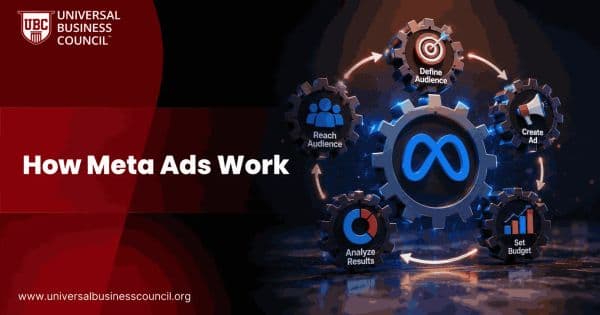
Meta Ads
How Meta Ads Work
Meta Ads use advanced targeting, machine learning, and real-time auctions to deliver ads across Facebook, Instagram, Messenger, and the Meta Audience Network. Learn how Meta Ads work, from campaign creation and audience selection to bidding, optimization, and performance tracking.

Meta Ads
Meta Advantage+ Explained: Automated Targeting, Placements, and Creative Tools
Meta Advantage+ explained for professionals: how automated targeting, placements, creative tools, and campaign controls affect CPA, ROAS, and strategy.

Meta Ads
Meta Campaign Objectives Explained: How to Choose the Right Goal for Your Ads
Learn how Meta campaign objectives work, when to use Awareness, Traffic, Engagement, Leads, App Promotion, and Sales, and how to match each to your KPI.
Trending Articles
The Role of Blockchain in Ethical AI Development
How blockchain technology is being used to promote transparency and accountability in artificial intelligence systems.
AWS Career Roadmap
A step-by-step guide to building a successful career in Amazon Web Services cloud computing.
Top 5 DeFi Platforms
Explore the leading decentralized finance platforms and what makes each one unique in the evolving DeFi landscape.