

How Meta Ads Work
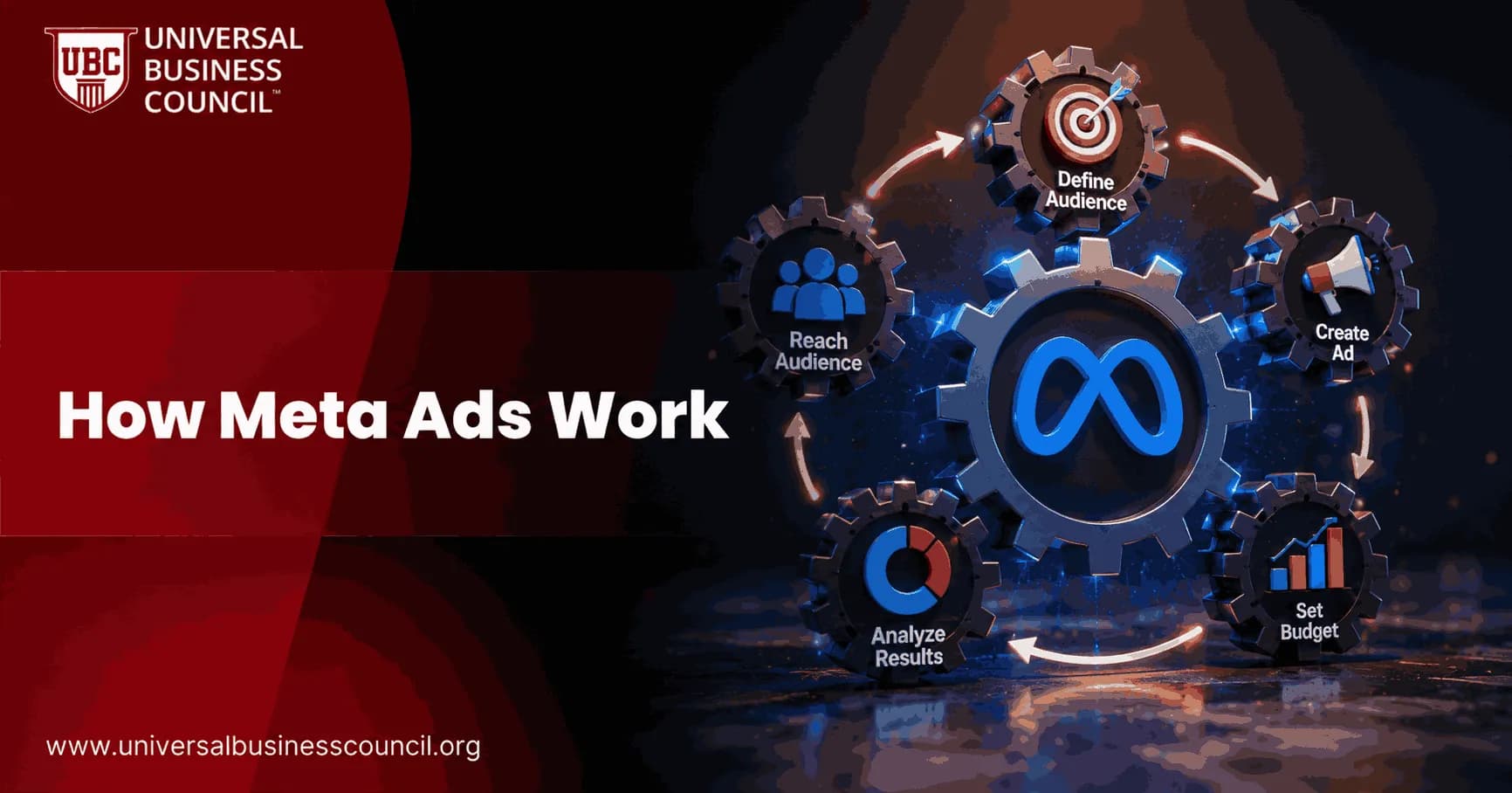
Most people have seen a Meta Ad appear perfectly timed, for a product they were just thinking about, from a brand they barely knew existed. It feels almost personal. That precision is not accidental. It is the result of a sophisticated machine learning system processing millions of signals every second to decide which ad to show which person, at what moment, on which platform, at what price.
Understanding how Meta Ads actually work, not just how to set them up but why they behave the way they do, is what separates advertisers who spend confidently from those who burn budget without knowing why. This guide walks through every mechanical layer of the Meta advertising system: the auction, the algorithm, the tracking infrastructure, the delivery process, and the optimization cycle that determines whether your campaigns improve over time or stall.

For professionals who want to go beyond understanding and develop genuine platform mastery, a Certified Meta Ads Expert credential provides the structured, expert-level training that turns theoretical knowledge into campaigns that consistently perform. Whether you are running your first campaign or your thousandth, understanding the mechanics below will immediately change how you make every decision inside Meta Ads Manager.
The Big Picture: What Meta Ads Is Actually Doing
At its core, the Meta advertising system is a two-sided marketplace. On one side, billions of users spend time across Facebook, Instagram, Messenger, WhatsApp, Threads, and the Meta Audience Network. On the other side, more than ten million active advertisers compete to reach those users. Meta sits in the middle, running billions of auctions every day to match advertisers with the users most valuable to them.
When you create a Meta campaign, you are not buying guaranteed placements. You are entering an ongoing auction for the attention of specific people. Meta's algorithm decides, in real time, which ad to show each user, when to show it, and at what cost. That decision happens in milliseconds, before the page finishes loading, for every single ad impression across every surface Meta owns.
Understanding this auction-based system is the foundation of everything that follows.
Step 1: The Campaign Structure How You Tell Meta What You Want
Before Meta can do anything, you need to give it a goal. Every Meta Ads campaign is organized into three levels, and each level communicates something specific to the algorithm.
The Campaign Level: Your Objective
The campaign objective is the single most important input you give Meta. It does not just define what you want, it tells Meta's algorithm which users to prioritize and which behaviors to optimize for across the entire campaign.
Meta uses the ODAX (Outcome-Driven Ad Experiences) framework, which offers six objectives: Awareness, Traffic, Engagement, Leads, App Promotion, and Sales. When you choose Sales, for example, Meta's algorithm immediately begins favoring users who have a demonstrated history of making purchases online. When you choose Traffic, it favors users who frequently click links. This difference is why choosing the wrong objective can waste your entire budget even with perfect targeting and creative.
The Ad Set Level: Your Audience, Placement, and Budget
The ad set level is where you define who should see your ad, where it should appear, how much to spend, and what bidding strategy to use. Each campaign can contain multiple ad sets, each targeting a different audience segment or testing a different placement configuration.
The Ad Level: Your Creative
The ad level is where users actually encounter your brand. This is where you upload your image or video, write your headline and body text, and choose your call-to-action button. Each ad set can contain multiple ads, which Meta uses to test and compare creative performance.
This three-level hierarchy is not administrative. It is the data architecture that Meta's algorithm uses to learn, optimize, and improve delivery over time. The cleaner and more intentional your structure, the faster the algorithm can identify what works.
Step 2: The Auction How Meta Decides Which Ad Wins
When a user opens Instagram, scrolls through Facebook, or checks Messenger, Meta runs an auction to determine which ad they see in each available placement. This happens in real time, before the app finishes loading the screen.
Who Participates in the Auction?
Every advertiser whose targeting settings include this specific user is eligible to participate. If your ad set targets women aged 25 to 34 interested in fitness in Chicago, every advertiser with overlapping targeting criteria is competing in the same auction for this user's attention at this moment.
How the Winner Is Determined: Total Value Score
Meta does not simply award the auction to the highest bidder. The winner is the advertiser with the highest Total Value Score, which Meta calculates from three components:
Advertiser Bid: The maximum amount you are willing to pay for the action you want (a click, an impression, a conversion). If you use automatic bidding, Meta sets this dynamically based on your budget and objective.
Estimated Action Rate: Meta's prediction of how likely this specific user is to take the specific action your campaign is optimized for. If you are running a Sales campaign and Meta predicts this user has a 5% probability of purchasing versus another user's 1%, it will strongly favor showing your ad to the higher-probability user.
Ad Quality Score: Meta's assessment of how relevant, useful, and non-disruptive your ad is, based on engagement signals from users who have seen it. Ads with high engagement rates, positive reactions, and low rates of users choosing "hide ad" score higher. Ads that generate reports of being misleading or irrelevant score lower.
Total Value = Bid × Estimated Action Rate + Ad Quality
The advertiser with the highest Total Value Score wins the placement. Critically, you do not pay your maximum bid. You pay the minimum amount required to beat the next-best bidder, the second-price auction model which means competing aggressively on quality and relevance can win auctions while paying less than a higher-bidding but lower-quality competitor.
Step 3: The Tracking System How Meta Learns Who Converts
The auction determines who sees your ad. The tracking system determines whether Meta's algorithm can learn from what happens afterward. Without conversion tracking, Meta can deliver impressions and count clicks, but it cannot learn who actually converts. That means it cannot improve.
The Meta Pixel
The Meta Pixel is a small JavaScript snippet placed in the header of your website. It fires tracking events whenever users take specific actions: page views, product views, add-to-cart events, form submissions, purchases, and custom events you define. Each event sends data back to Meta, telling the algorithm: "this type of user, with these characteristics, took this action after seeing your ad."
Over time, this data teaches Meta's algorithm which users are most likely to convert. The more conversion events the algorithm sees, the more precisely it can identify users likely to convert in future campaigns.
Conversions API
The Conversions API (CAPI) is a server-side tracking method that sends conversion data directly from your server to Meta, independent of the user's browser. Because it does not rely on browser cookies, it is not affected by ad blockers, iOS privacy settings (App Tracking Transparency), or browser-level privacy restrictions.
In 2026, using both the Pixel and CAPI simultaneously is the standard for any serious advertiser. Dual tracking recovers between 15% and 30% of conversion data that Pixel-only setups lose to browser privacy restrictions, giving the algorithm significantly more data to learn from.
The Learning Phase
When a new ad set launches, or when significant changes are made to an existing one, Meta enters the learning phase. During this period, the algorithm is actively exploring different users, placements, and times of day to identify which combinations produce results for your specific campaign. Delivery is less stable and efficient during the learning phase than after it exits.
The learning phase exits when an ad set generates 50 qualifying conversion events in a seven-day period. Until that threshold is reached, the algorithm has not yet gathered enough data to deliver with consistent efficiency. This is why underfunding ad sets, spreading a small budget across too many ad sets, is one of the most common and most expensive mistakes in Meta advertising.
Step 4: Targeting and Delivery Who Actually Sees Your Ad
Once the auction system and tracking infrastructure are in place, the delivery system determines the specific users who see your ads. Meta matches your targeting settings against its user data to identify eligible users, then the auction process determines which of those users actually receive your ad.
Core Audiences: Demographic and Interest Targeting
Core Audiences are built using Meta's native targeting options. You select parameters including age, gender, geographic location, language, education level, relationship status, interests (based on pages liked and content engaged with), and behaviors (purchasing patterns, device usage, travel activity).
Core Audiences are the primary tool for reaching cold audiences who have never interacted with your brand. They are most effective when targeting is specific enough to reach genuinely relevant users but not so narrow that the audience is too small for the algorithm to optimize within.
Custom Audiences: Targeting People You Already Know
Custom Audiences allow you to target people who have already interacted with your business in some way. They can be built from website visitors tracked by the Pixel (segmented by specific pages visited or actions taken), customer email lists and phone numbers uploaded to Meta, app users, people who have engaged with your Instagram or Facebook content, or people who have opened or filled out your lead forms.
Custom Audiences are the foundation of retargeting. Because these users are already familiar with your brand, they convert at significantly higher rates and lower cost than cold audiences. A visitor who added a product to their cart but did not complete a purchase is the clearest example of a Custom Audience segment that consistently delivers strong retargeting ROAS.
Lookalike Audiences: Finding New People Like Your Best Customers
Lookalike Audiences take a source Custom Audience and instruct Meta's algorithm to find new users who share the same statistical characteristics. The algorithm compares the source audience across hundreds of signals, demographic patterns, interest clusters, behavioral signatures and identifies similar users in a geographic market you specify.
At a 1% Lookalike (the closest match to the source), the resulting audience is your highest-quality cold audience. Lookalike Audiences built from paying customers consistently deliver double the return on ad spend compared to interest-based Core Audiences targeting the same product category.
Advantage+ Audience: AI-Expanded Targeting
In 2026, Advantage+ Audience (formerly Advantage Detailed Targeting Expansion) is the default targeting mode for most campaign types. Rather than requiring advertisers to specify every targeting parameter, Advantage+ Audience uses Meta's AI to automatically identify additional users beyond the defined audience who are likely to convert. The algorithm ignores defined boundaries when it identifies a high-probability user outside those parameters.
For many campaigns, Advantage+ Audience outperforms manually restricted targeting because Meta's dataset of billions of users is too large and too complex for human-defined interest categories to capture every relevant signal.
Step 5: Creative Delivery How Meta Serves Your Ad Content
Once a user is identified and the auction is won, Meta determines exactly how to serve the ad creative. Several systems operate at this layer.
Placement Optimization
Meta automatically distributes your ads across all eligible placements Facebook Feed, Instagram Feed, Stories, Reels, Audience Network, Messenger unless you manually restrict specific placements. Automatic Placements allows Meta's algorithm to direct budget toward the placements delivering the best results for your objective at any given moment.
Manual placement selection is sometimes appropriate for campaigns with specific creative requirements (vertical video for Reels, for example) or for campaigns where you have data showing specific placements dramatically outperform others. For most campaigns, particularly early-stage ones, Automatic Placements gives the algorithm more flexibility and generally produces better cost-efficiency.
Advantage+ Creative Optimization
Meta's Advantage+ Creative system automatically tests multiple creative variations and dynamically serves the version most likely to resonate with each specific user. It evaluates different combinations of headlines, descriptions, images, videos, and call-to-action buttons and personalizes delivery based on what individual users have historically responded to.
This system means that two users seeing "the same ad" may actually see different creative combinations if Advantage+ Creative is enabled, with the algorithm selecting the version most likely to produce the desired action for each specific person.
Ad Frequency Management
Meta's delivery system monitors how often each user sees your ad. High frequency, seeing the same ad many times without taking action, is a negative signal that reduces ad quality scores and increases costs. The algorithm naturally manages frequency at the campaign level, but advertisers managing retargeting campaigns or small audiences should monitor frequency metrics closely and refresh creative regularly to prevent audience fatigue.
Step 6: The Optimization Cycle How Meta Ads Improve Over Time
The most important thing to understand about Meta Ads is that they are not static. Every campaign that runs is an ongoing machine learning experiment. The algorithm continuously refines its understanding of which users, placements, times, and creative combinations produce results for your specific campaign goal.
How the Algorithm Learns
Each conversion event that fires gives the algorithm a new data point: this type of user, in this context, with these behavioral characteristics, converted after seeing this ad. Over thousands of conversion events, the algorithm builds an increasingly precise model of what a converting user looks like for your specific campaign.
This is why campaign performance often improves over the first several weeks after launch and why making frequent changes during that period is counterproductive. Every significant change to targeting, budget, or bidding resets the learning phase and requires the algorithm to start rebuilding its optimization model from scratch.
Signals Meta Uses to Optimize Delivery
Meta's Andromeda algorithm processes an enormous range of signals to optimize delivery including: historical purchase behavior across Meta's platform, app usage patterns, content consumption habits, search behavior shared through Meta's data partnerships, real-time contextual factors (time of day, device type, connection speed), and past interactions with your specific brand (pixel events, page visits, ad engagement).
The richness of this signal set is why Meta's targeting outperforms most alternatives and why campaigns with more conversion data consistently outperform campaigns with less. Every purchase, every lead, every conversion event makes the algorithm more precise.
Step 7: Budget and Bidding How Costs Are Controlled
Budget and bidding settings determine how aggressively Meta participates in auctions on your behalf and how costs are managed over time.
Campaign Budget Optimization (CBO) vs. Ad Set Budget Optimization (ABO)
With Campaign Budget Optimization, you set a single budget at the campaign level and Meta dynamically allocates it across ad sets based on where it identifies the best real-time opportunities. CBO is the recommended approach for most campaigns because it gives the algorithm more flexibility to find efficiency.
With Ad Set Budget Optimization, you control the budget for each individual ad set independently. ABO is useful when you need guaranteed spend allocation across specific audiences, such as when testing audiences and requiring equal budget exposure for reliable comparison.
Bidding Strategies
Meta offers several bidding options ranging from fully automated to manually controlled:
Highest Volume (default): Meta spends your full budget to generate as many results as possible at the lowest available cost. Appropriate for most campaigns, particularly those in the learning phase.
Cost Per Result Goal: You set a target cost per conversion. Meta tries to deliver results at or near that target while spending your full budget. Requires sufficient historical data to work well.
Minimum ROAS: You define a minimum return on ad spend. Meta only enters auctions it believes will achieve or exceed that threshold. Effective for established e-commerce campaigns with strong conversion data.
Bid Cap: A hard ceiling on what Meta bids per auction. Provides the most cost control but can limit delivery and scale if set too conservatively.
The Role of AI in Modern Meta Ads
The 2026 Meta advertising system is deeply AI-powered in ways that extend well beyond standard machine learning. Meta's Andromeda system processes billions of auction decisions per second, incorporating real-time context signals that static targeting rules cannot capture.
Advantage+ tools represent Meta's most significant AI investment from an advertiser perspective: Advantage+ Shopping Campaigns automate creative, targeting, and budget allocation end-to-end for e-commerce brands. Advantage+ Creative personalizes ad content at the individual user level. Advantage+ Audience expands targeting dynamically based on predicted conversion probability.
For professionals who want to build genuine fluency in digital marketing strategy across all channels, not just Meta, a Certified Digital Marketing Expert credential provides the comprehensive cross-channel framework needed to understand how Meta Ads fits into a complete marketing ecosystem alongside search, email, content, and analytics, and how to architect strategies that maximize performance across all of them together.
What Goes Wrong: Why Meta Ads Fail
Understanding how Meta Ads work also means understanding the specific failure modes that cause campaigns to underdeliver.
Wrong objective: The most expensive mistake. Choosing Traffic when you need conversions means Meta optimizes for clicks from people who browse but rarely buy. The algorithm faithfully delivers what you asked for the wrong thing.
Learning phase starvation: Too many ad sets, too little budget per ad set, means none of them ever exit the learning phase. The algorithm never accumulates enough data to optimize efficiently, and costs remain high and inconsistent.
Tracking gaps: Without dual Pixel-plus-CAPI tracking, Meta's algorithm is making optimization decisions with incomplete data. Campaigns that would perform well with full tracking data may appear unprofitable because conversions are going uncounted.
Creative fatigue: When users see the same ad repeatedly without responding, Meta's algorithm interprets it as a quality signal. Frequency rises, costs increase, and the algorithm begins reducing delivery to protect user experience. Regular creative refresh prevents this cycle.
Making changes too often: Every significant change resets the learning phase. Advertisers who make daily adjustments prevent the algorithm from ever reaching stable, efficient delivery.
Technical Infrastructure: The Systems Behind Meta Ads
Running Meta Ads at a high level requires understanding the technical systems that underpin the platform: server-side tracking implementation, data clean rooms for privacy-compliant measurement, the API infrastructure for programmatic campaign management, and the data pipeline from campaign events to reporting dashboards. For practitioners who want to develop genuine technical competence across AI-powered advertising infrastructure, a Tech Certification covering digital advertising systems, data infrastructure, and AI-driven marketing technology provides the technical grounding to work with these systems from an architectural perspective rather than just a practitioner one.
Advanced Understanding: The AI Systems Powering Meta's Optimization
The machine learning systems running Meta's advertising platform represent some of the most advanced AI deployed at commercial scale in the world. Meta's recommendation systems, ranking algorithms, and auction optimization engines are built on deep learning architectures processing petabytes of behavioral data in real time. For practitioners who want to build foundational understanding of how large-scale AI systems like Meta's Andromeda algorithm actually work at a technical level, a Deep Tech Certification covering machine learning principles, neural network architectures, and the computational foundations of modern AI systems provides the technical depth that separates informed AI-era practitioners from those relying on surface-level intuition.
Conclusion
Meta Ads work through a layered system of interconnected mechanisms: the three-level campaign structure that defines your goal, the real-time auction that determines which ad wins each placement, the Pixel and Conversions API tracking infrastructure that teaches the algorithm who converts, the targeting systems that identify the right users, the creative delivery systems that optimize how your ad is served, and the ongoing optimization cycle that improves performance over time as conversion data accumulates.
Every decision you make inside Meta Ads Manager objective selection, audience definition, bid strategy, creative format, budget allocation is an input into this machine learning system. Understanding how the system uses those inputs to make decisions is what allows you to make each one deliberately rather than reactively.
For practitioners who want to operate at expert level, building on that mechanical understanding with structured credentials makes the difference between campaigns that struggle and campaigns that compound. A Certified Meta Ads Expert credential for platform-specific mastery, a Certified Digital Marketing Expert certification for cross-channel strategic depth, a Tech Certification for technical infrastructure literacy, and a Deep Tech Certification for AI systems understanding together form the complete professional foundation for mastering how Meta Ads work at every level of depth.
Frequently Asked Questions
1. How do Meta Ads work in simple terms?
Meta Ads work by letting you pay to show your message to specific people across Facebook, Instagram, and other Meta platforms. You define your goal and audience, Meta runs real-time auctions to place your ad in front of the right people, and the system learns from the results to improve delivery over time.
2. What is the Meta Ads auction and how does it work?
The Meta Ads auction is a real-time competition between advertisers every time a user's attention is available. The winner is not the highest bidder but the advertiser with the highest Total Value Score, calculated from bid amount, estimated action rate, and ad quality.
3. How does Meta decide who sees my ad?
Meta combines your targeting settings with its own behavioral data, running an auction against other advertisers targeting the same user. The algorithm also considers how likely that specific user is to take the action you want, weighing this probability heavily in its delivery decisions.
4. What is the Meta Pixel and how does it work?
The Meta Pixel is a JavaScript snippet on your website that fires tracking events when users take actions, page views, add-to-cart, purchases after clicking your ad. This data trains Meta's algorithm to identify and target users most likely to convert.
5. What is Conversions API and why does it matter?
Conversions API sends conversion data directly from your server to Meta, bypassing browser-level privacy restrictions. Using it alongside the Meta Pixel recovers 15% to 30% of conversion data lost to ad blockers and iOS privacy settings.
6. What is the learning phase?
The learning phase is the period when a new or significantly changed ad set is gathering data. The algorithm explores different users and placements to find what works. It exits after 50 conversion events in seven days, after which delivery becomes more stable and efficient.
7. How does the Total Value Score work in Meta's auction?
Total Value Score combines your bid, Meta's estimate of how likely the user is to take your desired action, and your ad quality score. The highest Total Value wins the placement, not necessarily the highest bid.
8. What is the difference between CBO and ABO?
Campaign Budget Optimization (CBO) sets one budget at the campaign level and lets Meta allocate it dynamically across ad sets. Ad Set Budget Optimization (ABO) gives you fixed control over each ad set's budget. CBO generally delivers better efficiency; ABO gives more control over testing.
9. What is Advantage+ Audience?
Advantage+ Audience is Meta's AI-powered targeting mode that automatically identifies users likely to convert beyond your manually defined audience. It uses Meta's full behavioral dataset to find conversion opportunities that static interest targeting would miss.
10. Why do Meta Ads improve over time?
Each conversion event gives Meta's algorithm a new data point about what a converting user looks like. Over hundreds and thousands of events, the algorithm builds an increasingly precise model of your converting audience, improving targeting accuracy and cost efficiency progressively.
11. What is ad frequency and why does it matter?
Ad frequency is the average number of times each user sees your ad. High frequency without action signals irrelevance, reducing ad quality scores and increasing costs. Meta manages frequency automatically, but advertisers should monitor it in retargeting campaigns and refresh creative regularly.
12. How does Advantage+ Creative work?
Advantage+ Creative tests multiple creative combinations automatically and serves the version most likely to resonate with each individual user based on their historical engagement patterns. Different users may see different creative variations from the same ad.
13. What is the Andromeda algorithm?
Andromeda is Meta's core ad ranking and optimization system, powered by deep learning, that processes billions of auction decisions per second. It incorporates real-time contextual signals, behavioral history, and conversion probability predictions to determine ad delivery across all Meta platforms.
14. How does Campaign Budget Optimization allocate budget?
CBO monitors real-time performance across all ad sets in a campaign and dynamically shifts budget toward ad sets finding the best opportunities at any given moment. It can favor one ad set heavily if it is significantly outperforming others, which is important to account for when designing testing structures.
15. What is a Lookalike Audience and how is it built?
A Lookalike Audience finds new users who share statistical characteristics with a source Custom Audience. Meta's algorithm compares the source audience across hundreds of behavioral and demographic signals to identify similar users in your target market.
16. How does ad quality affect Meta auction results?
Ad quality is scored based on user engagement signals: positive reactions, comments, shares, and low rates of "hide ad" or negative feedback. Higher quality scores improve Total Value in the auction, allowing you to win placements at lower effective cost than a higher-bidding but lower-quality competitor.
17. Why does changing an ad set reset the learning phase?
The learning phase builds a specific optimization model for a specific ad set configuration. When you change targeting, budget, bidding, or creative significantly, the model no longer applies to the new configuration, so the algorithm must restart data collection and rebuild from scratch.
18. What happens when Meta's algorithm exits the learning phase?
After the learning phase, the algorithm has gathered sufficient data to deliver ads efficiently and consistently. Costs typically stabilize, delivery becomes more predictable, and campaign performance generally improves compared to the exploratory learning phase.
19. How does Meta's second-price auction model affect what I actually pay?
In a second-price auction, you pay the minimum required to beat the next-best bidder, not your maximum bid. This means you can set aggressive maximum bids without automatically paying the maximum you only pay slightly above what was needed to win each specific auction.
20. What is the most important thing to understand about how Meta Ads work?
The most important principle is that Meta Ads are not a static media buy they are a dynamic machine learning system that optimizes based on the data it receives. The quality of your inputs (objective, tracking, creative, audience structure) determines the quality of the algorithm's optimization. Better inputs produce better results over time; poor inputs cannot be overcome by budget alone.
Related Articles
View AllMeta Ads
How Meta Ads Work: Targeting, Auctions, Budgets, and Delivery Explained
Learn how Meta Ads work across targeting, auctions, budgets, bidding strategies, and delivery so you can diagnose performance with evidence, not guesswork.

Meta Ads
Meta Ads Major Updates: What Brand Owners Must Know
Meta has launched Ads Super Burst, started testing First Impression Ads, and expanded Reels Trending Ads. Learn what each update does, what is still a test, and how brand owners can plan smarter campaigns.
Meta Ads
How to Set Up Meta Ads Manager
Meta Ads Manager is the primary platform for creating, managing, and optimizing advertising campaigns across Facebook, Instagram, Messenger, and the Meta Audience Network. This guide explains how to set up Ads Manager and prepare your account for effective campaign management.
Trending Articles
The Role of Blockchain in Ethical AI Development
How blockchain technology is being used to promote transparency and accountability in artificial intelligence systems.
AWS Career Roadmap
A step-by-step guide to building a successful career in Amazon Web Services cloud computing.
Top 5 DeFi Platforms
Explore the leading decentralized finance platforms and what makes each one unique in the evolving DeFi landscape.