

Local SEO for Multi-Location Businesses: Google Business Profile, Reviews, and Location Pages
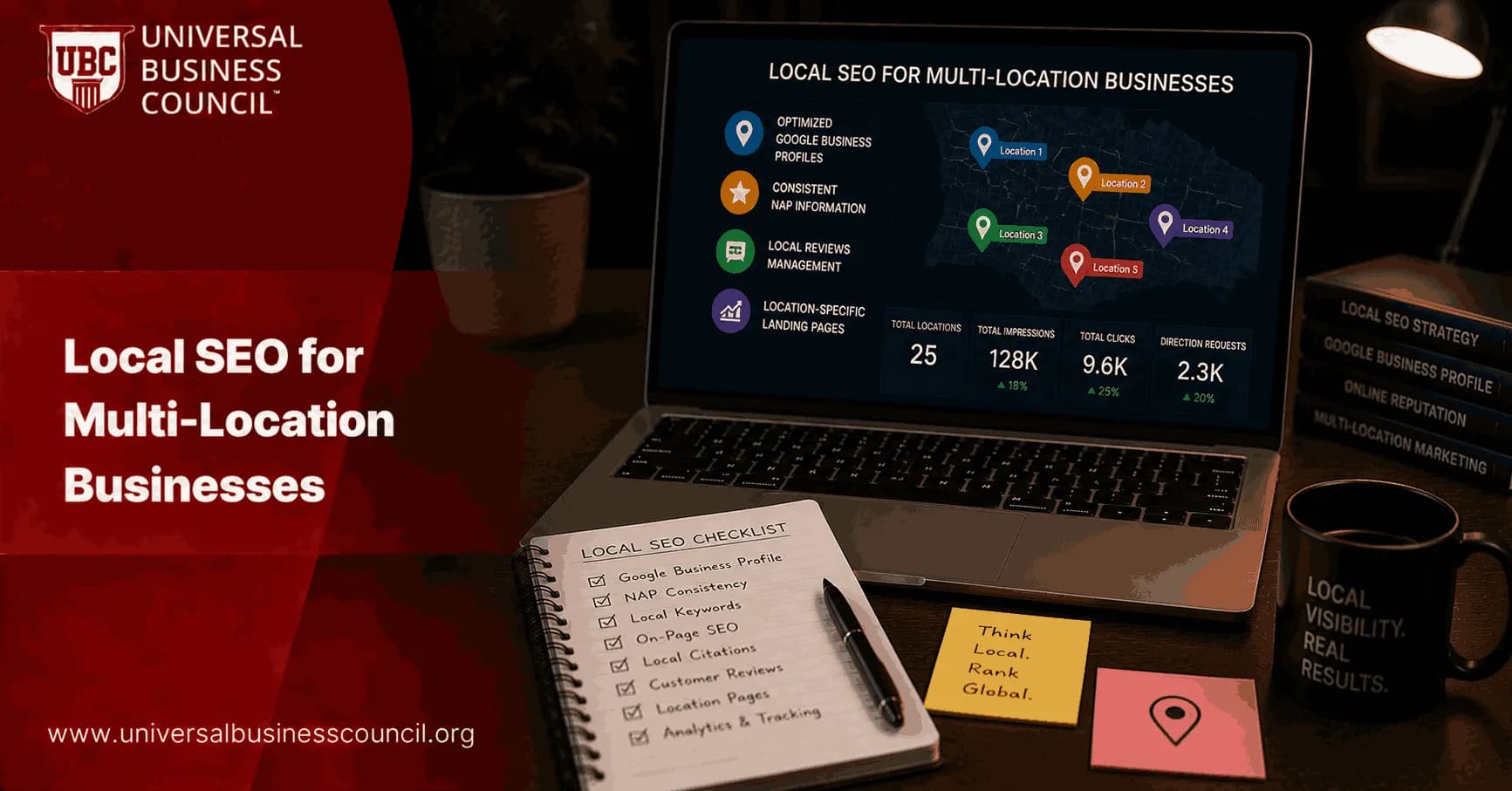
Local SEO for multi-location businesses is not a single campaign you run once a year. It is an operating system repeated for every branch so each location can earn visibility in Google Search, Google Maps, and the Local Pack. Industry guidance is consistent on what matters most: well-optimized Google Business Profiles, systematic review management, and unique, useful location pages that avoid duplicate or doorway-style content.
For an SEO Expert, multi-location optimization is less about ranking a single website and more about creating repeatable systems that help every branch earn visibility, maintain data accuracy, and compete effectively in its local market.

This article breaks down those three pillars, along with the supporting elements (schema, citations, and scalable workflows) that help multi-location brands execute consistently.
Why local SEO changes when you have multiple locations
Multi-location brands compete in many local markets simultaneously. That creates three core challenges:
Visibility is location-specific: one branch can rank well while another struggles, even under the same brand.
Data consistency is harder: hours, phone numbers, categories, and services change frequently and not always centrally.
Reputation becomes distributed: customer experience varies by branch, and reviews reflect that reality.
BrightLocal and other local search practitioners frame the goal of multi-location SEO as winning exposure in the Local Pack for each branch. Google also emphasizes that verified locations are more likely to appear across Google products such as Search and Maps, which makes verification and ongoing profile hygiene a foundational requirement.
Pillar 1: Google Business Profile optimization at scale
For most multi-location businesses, Google Business Profile (GBP) is the primary local visibility layer. A strong website helps, but GBP is frequently the deciding surface for discovery, directions, calls, and first impressions.
1) Claim and verify every location
Each physical location should have its own claimed and verified profile. Google's guidance highlights verification as a factor that increases the likelihood of appearing in local results across Google products.
2) Standardize and complete your core fields
For multi-location organizations, consistency prevents ranking and trust issues. Ensure the following match your website and other listings:
Name, address, phone number (NAP)
Primary and secondary categories
Hours, including holiday hours
Services and service areas (when applicable)
Attributes (accessibility, payments, amenities)
Website link that points to the correct location page, not a generic homepage
3) Use location-specific photos and ongoing updates
Multi-location SEO playbooks consistently recommend keeping profiles active with fresh photos and Google Posts (updates, offers, events). The key is localization. Branch photos, staff shots where appropriate, storefront images, and real on-site visuals can outperform generic brand imagery because they reduce uncertainty for searchers.
4) Monitor GBP Insights by location
GBP provides insights that can be compared across branches. Treat reporting as a diagnostic tool:
Which locations receive the most discovery searches?
Which locations get direction requests but fewer calls?
Which locations underperform relative to nearby competition?
This supports location-level decisions rather than relying only on brand-wide averages.
5) Use bulk management and APIs for chains and franchises
When you operate dozens or hundreds of locations, manual updates become a risk. Multi-location best practice commonly involves:
Bulk uploads for profile data
API-based workflows to sync updates and reduce errors
Central dashboards to manage categories, hours, and links across locations
The operational objective is straightforward: keep every branch accurate and complete, all the time.
Pillar 2: Reviews and reputation management as a ranking and conversion lever
Industry consensus holds that reviews influence local visibility and customer choice. BrightLocal describes online reviews, including Google reviews, as one of the key forces behind strong local performance. For multi-location brands, review strategy must be both centralized (governance and reporting) and local (service delivery and branch accountability).
1) Build a repeatable review acquisition process
Relying on ad hoc review requests creates uneven performance across branches. Instead, define a process each location can follow consistently:
Identify trigger points (purchase, appointment completion, successful support resolution).
Request feedback promptly while the experience is fresh.
Route customers to the correct location profile.
Document what is and is not allowed under platform policies.
2) Respond to all reviews, positive and negative
Multi-location SEO guidance consistently recommends prompt responses. Response quality also matters. Use a consistent brand voice, but localize the substance:
Positive reviews: thank the customer, reference the specific service, and invite them back.
Negative reviews: acknowledge concerns, avoid defensiveness, offer a clear next step, and move sensitive details offline.
3) Train branch teams because reviews reflect branch reality
Central marketing can guide policy, but branch-level training often determines results. If one location regularly earns lower ratings, investigate staffing, service quality, wait times, or fulfillment issues. Reputation management is not only messaging - it is operational improvement.
4) Monitor reviews across platforms, not only Google
Google reviews are critical, but multi-location brands often benefit from a broader footprint that includes Yelp and industry-specific platforms. A multi-platform approach also reduces dependency on one ecosystem and can strengthen overall brand credibility.
5) Use centralized monitoring to spot patterns by location
For leadership teams, the most valuable insight is trend analysis by branch:
Which locations have declining sentiment?
Which service lines drive complaints?
Which managers or processes correlate with higher ratings?
Review management software or unified inbox workflows can deliver significant value at this level, particularly for larger organizations.
Pillar 3: Location pages that are truly unique and useful
Dedicated location pages remain foundational for local SEO for multi-location businesses. The standard is clear: create one page per physical location and make it genuinely helpful. Google's quality guidance and industry commentary warn against thin or duplicated pages that exist only to capture keyword variations, commonly described as doorway pages.
What every location page should include
NAP details that exactly match GBP and primary citations
Hours, plus holiday or seasonal updates
Location-specific services and differentiators (not a generic list)
Directions, parking details, and accessibility notes
Nearby landmarks that help users confirm they are choosing the right branch
Photos of the actual location
Embedded map and clear calls to action (call, book, get directions)
Local testimonials or review excerpts where permissible
Avoid duplicate templates that only swap the city name
Templates are fine for structure, but content should be localized. Add details that demonstrate the page exists to help users, not only to rank. For example:
Retail: store layout notes, fitting rooms, curbside pickup procedures, nearby parking structures.
Restaurants: dine-in versus takeout options, delivery zones, Wi-Fi availability, dietary options, booking policies.
Professional services: practitioner bios at that office, local focus areas, relevant local memberships.
Use clean URL structures and strong internal linking
Make it easy for users and search engines to understand your location footprint. Common URL patterns include:
/locations/city/branch-name/
/locations/state/city/
Support discoverability with internal links from a central Locations hub page, and link from each branch page to related services. This also creates natural opportunities to connect users with relevant training resources, such as a SEO Certification, Digital Marketing Certification, or Reputation Management programme for branch teams.
Supporting elements: schema, citations, and local links
While the three pillars do most of the work, supporting signals help search engines confirm each location as a distinct entity.
Implement structured data for entity clarity
Multi-location SEO best practice recommends:
LocalBusiness schema on each location page (address, phone, hours, geo coordinates where relevant)
Organization schema to define the parent brand and connect locations under one entity
This aligns with Google's entity-based understanding of local businesses.
Strengthen citations and local authority
Consistent citations reinforce NAP accuracy. Go beyond generic directories where relevant:
Industry directories for your vertical
Local chambers of commerce
Community sponsorship pages
Local news and event listings
Community involvement and local sponsorships can also earn local press coverage and backlinks that support branch-level authority.
Managing local SEO at scale requires an understanding of structured data, analytics platforms, location management tools, and digital infrastructure. A Tech Certification can help professionals strengthen the technical skills needed to support consistent local search performance across multiple locations.
Operationalizing multi-location local SEO: a practical system
The most useful framing across industry sources is that multi-location SEO is a repeatable system per location. A practical operating cadence looks like this:
Monthly: audit GBP accuracy, add photos, publish updates, review insights.
Weekly: monitor and respond to reviews; escalate recurring issues.
Quarterly: refresh location page content (services, FAQs, local proof), validate schema and links.
Ongoing: run citation checks, maintain hours, and standardize processes for new locations.
As AI continues to influence local search and customer discovery, an AI Certification can help professionals better understand automation, search intelligence, and data-driven optimization strategies.
Conclusion: treat each branch as its own local SEO asset
Local SEO for multi-location businesses succeeds when every location is managed as a distinct digital entity with consistent data, strong reputation signals, and a location page that genuinely helps customers. Start with verified, complete Google Business Profiles. Build a disciplined review workflow that blends centralized oversight with branch accountability. Publish unique location pages that avoid duplication and doorway-page patterns, and support them with structured data, citations, and local links.
Performance should be measured at the location level. Multi-location growth rarely comes from one large change - it comes from running the same high-quality process across every branch, then iterating where the data shows opportunity.
FAQs
1. What Is Local SEO for Multi-Location Businesses?
Local SEO for multi-location businesses is the process of optimizing online visibility so that each business location can rank in local search results and attract customers from its specific geographic area.
2. Why Is Local SEO Important for Multi-Location Businesses?
Local SEO helps individual locations appear in local searches, Google Maps results, and location-based queries, driving more traffic, leads, and sales.
3. How Does Local SEO Differ for Multi-Location Businesses?
Unlike single-location businesses, multi-location companies must optimize each location separately while maintaining consistent brand identity across all locations.
4. What Is a Google Business Profile and Why Is It Important?
A Google Business Profile is a free business listing that helps locations appear in Google Search and Google Maps, making it a critical component of local SEO.
5. Should Each Location Have Its Own Google Business Profile?
Yes, each physical business location should have its own verified and optimized Google Business Profile to maximize local search visibility.
6. What Information Should Be Included in Each Business Listing?
Listings should include accurate business names, addresses, phone numbers, website links, business categories, operating hours, services, and photos.
7. What Is NAP Consistency in Local SEO?
NAP stands for Name, Address, and Phone Number. Consistency across directories and platforms helps search engines trust business information.
8. Why Is NAP Consistency Important for Multi-Location Businesses?
Inconsistent information can confuse search engines and customers, potentially reducing local search rankings and credibility.
9. Should Each Location Have a Dedicated Landing Page?
Yes, dedicated location pages help search engines understand each branch's geographic relevance and provide users with location-specific information.
10. What Should Be Included on Location Landing Pages?
Location pages should include contact details, operating hours, directions, services offered, customer reviews, FAQs, and locally relevant content.
11. How Can Businesses Optimize Location Pages for Search?
Businesses can use location-specific keywords, structured data, local content, internal links, and optimized metadata to improve visibility.
12. What Role Do Customer Reviews Play in Local SEO?
Reviews influence local rankings, build trust, improve credibility, and help potential customers evaluate individual business locations.
13. How Can Businesses Encourage More Local Reviews?
Businesses can request reviews after positive customer interactions, simplify the review process, and respond professionally to feedback.
14. What Is Local Link Building?
Local link building involves acquiring backlinks from local organizations, directories, community websites, media outlets, and business partners.
15. How Does Structured Data Help Multi-Location SEO?
Structured data helps search engines better understand business details such as locations, operating hours, services, and contact information.
16. What Are Local Citations?
Local citations are online mentions of a business's name, address, and phone number across directories, review sites, and local business listings.
17. How Can Multi-Location Businesses Track Local SEO Performance?
Performance can be tracked through local rankings, Google Business Profile insights, website traffic, phone calls, direction requests, reviews, and conversions.
18. What Common Mistakes Should Multi-Location Businesses Avoid?
Common mistakes include duplicate location pages, inconsistent NAP information, neglected business listings, generic location content, and poor review management. Search engines are surprisingly unimpressed when twenty locations all claim to be "your trusted local provider" using the exact same paragraph.
19. How Can AI Improve Local SEO for Multi-Location Businesses?
AI can help analyze local search trends, optimize content, manage listings, monitor reviews, identify ranking opportunities, and automate reporting.
20. What Is the Best Long-Term Strategy for Multi-Location Local SEO?
The best strategy combines optimized Google Business Profiles, location-specific content, consistent business information, strong review management, local link building, technical SEO, and continuous performance monitoring to strengthen visibility across all locations.
Related Articles
View All
Seo
Google Removing Search Bar: What Happens to SEO?
The search experience is changing. Learn what marketers and businesses should expect if AI-powered experiences replace traditional search bars.

Seo
Is SEO Dead Without Google Search?
As AI assistants and answer engines gain popularity, many marketers are questioning the future of SEO. Learn why SEO is evolving rather than disappearing and how brands can adapt.

Seo
E-E-A-T for SEO: How to Demonstrate Expertise and Trust with Author Pages, Citations, and Content Standards
Learn how to implement E-E-A-T for SEO using author pages, credible citations, and editorial standards that build expertise, authority, and trust in 2026.
Trending Articles
The Role of Blockchain in Ethical AI Development
How blockchain technology is being used to promote transparency and accountability in artificial intelligence systems.
AWS Career Roadmap
A step-by-step guide to building a successful career in Amazon Web Services cloud computing.
Top 5 DeFi Platforms
Explore the leading decentralized finance platforms and what makes each one unique in the evolving DeFi landscape.