

How to Choose a Six Sigma DMAIC Project That Delivers ROI
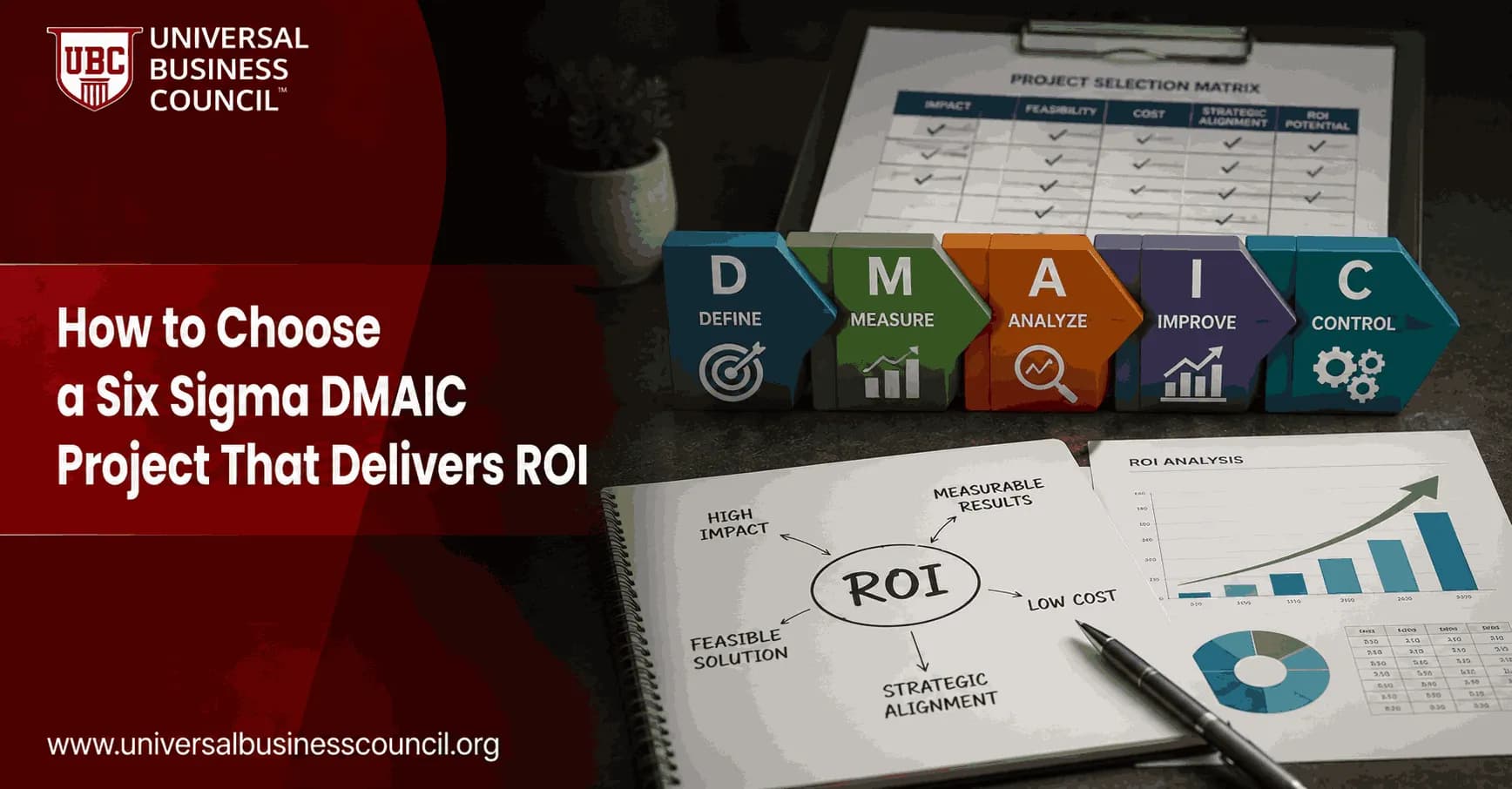
A Six Sigma DMAIC project delivers ROI when it is chosen like an investment, not like a workshop exercise. Start with money, strategy, data, sponsorship, and feasibility. If any one of those is weak, the project may still improve a process, but it is unlikely to survive finance review. For professionals looking to strengthen their project selection and process improvement skills, a Certified Six Sigma Expert pathway can provide a structured foundation for applying DMAIC in real business settings.
Here is the blunt rule I use with project charters: if the team cannot explain the financial benefit in two sentences, the project is not ready. A vague goal such as "improve order processing" is not enough. "Reduce invoice rework from 9 percent to 4 percent, saving 1,200 analyst hours per year" is closer.

Set an ROI Threshold Before You Pick the Project
The standard Six Sigma ROI formula is simple:
ROI = (Financial Benefits - Project Costs) / Project Costs x 100
Project costs should include belt time, team member hours, software, data work, training, and any capital spend. Benefits should be split into hard savings, soft savings, revenue protection, and risk reduction. Finance teams care about that split.
For professionals who want to connect improvement projects with broader organizational leadership and business management skills, Management Certifications can complement Six Sigma learning by strengthening capabilities around project governance, decision-making, and organizational performance.
Many Lean Six Sigma programs use a minimum benefit-to-cost ratio of 3:1. Conservative organizations often ask for 4:1 or 5:1, especially when the savings estimate is uncertain. For example, if a DMAIC project will consume 20,000 dollars in time and resources, a 5:1 target means you should be looking for about 100,000 dollars in measurable benefit.
Use these financial checks:
ROI percentage: Net return compared with total cost.
Payback period: How fast the project earns back the investment.
Net present value: Useful when benefits occur over several years.
Cost-benefit ratio: A quick screen for leadership review.
Use a DMAIC Project Selection Matrix
Good DMAIC project selection is not a popularity contest. Build a scoring matrix and force trade-offs. One practical weighting model is:
Strategic alignment: 30 percent
Financial effect: 25 percent
Process performance gap: 25 percent
Implementation feasibility: 20 percent
You can add customer impact, sponsor strength, data quality, and risk as sub-scores. Keep it simple enough that managers will actually use it. A 14-tab spreadsheet usually dies in the first steering meeting.
Score Strategic Alignment First
A project tied to a board-level goal gets resources. A side project gets polite nods. Choose problems linked to margin, churn, customer complaints, regulatory risk, capacity, or growth constraints.
If your organization is focused on reducing customer wait time, a DMAIC project on call center transfer errors may deserve priority over a small back-office defect issue, even if both have similar savings estimates.
Check Whether DMAIC Is the Right Method
DMAIC fits problems where the root cause is not yet known. If the solution is obvious, do not wrap it in a five-phase project. Just fix it.
A classic mistake is choosing a technology implementation and calling it DMAIC. If leadership has already decided to replace the system, the process is not stable enough for proper Measure and Analyze work. Use project management instead.
Choose Processes With Clean Data and Clear Defects
Data availability can make or break a Six Sigma DMAIC project. You need a baseline, a defect definition, and a way to measure change without heroic manual effort.
Strong candidates usually have:
High transaction volume
Repeated process cycles
Known cost per defect, delay, or rework event
Accessible data from systems such as ERP, CRM, ticketing, or Google Analytics 4
A process owner who agrees with the measurement method
Weak candidates sound like this: "Everyone knows it is a problem, but we do not track it." That may become a measurement project first, not a full DMAIC project.
One service team I worked with wanted to reduce "bad handoffs" between sales and implementation. The first charter failed because nobody could define a bad handoff. Once the team narrowed it to missing contract fields in Salesforce, the defect rate was measurable. The project finally had teeth.
Favor Projects That Can Finish in About Six Months
Most strong Green Belt and Black Belt projects should reach Control in roughly six months. Shorter is fine. Much longer raises risk.
Long projects suffer from sponsor changes, shifting priorities, bad benefit attribution, and team fatigue. If a project needs a two-year capital program, split out a smaller DMAIC scope. Reduce scrap on one production line first. Improve one claims workflow before redesigning the whole operating model.
Separate Hard Savings From Soft Savings
Practitioner surveys on Six Sigma programs have often reported six-figure median hard savings per Black Belt project, with soft savings tracked separately. The key point is not the exact benchmark. It is the discipline.
Hard savings usually affect the budget or profit and loss statement, such as reduced overtime, lower warranty cost, less scrap, or avoided hiring. Soft savings may include time saved, fewer complaints, better employee experience, or improved first-pass yield. Soft savings matter, but do not pretend they are cash unless finance agrees.
Ask finance to validate the benefits during Define, not after Control. Late arguments over savings can damage an otherwise excellent project.
Technology can also influence project selection when a process depends on automation, software, data systems, or digital infrastructure. Understanding those technical dependencies helps teams distinguish a genuine process improvement opportunity from a project whose outcome depends mainly on technology implementation. A Deep Tech Certification can provide complementary technology-focused learning for professionals working across process and technical teams.
A Practical 8-Step Selection Process
Scan business priorities: Look at cost, quality, customer, compliance, and capacity problems.
List candidate projects: Capture the problem, process owner, affected metric, and estimated value.
Screen out poor fits: Remove projects with known solutions, unstable processes, or no sponsor.
Confirm the data: Check baseline measures, defect definitions, and data access.
Estimate costs and benefits: Include labor, training, tools, and implementation costs.
Apply the scoring matrix: Rank projects by alignment, financial effect, gap, and feasibility.
Review with sponsors: Test assumptions and confirm authority to implement changes.
Define benefit controls: Decide who tracks savings, how often, and for how long.
What to Avoid
Projects chosen because a senior leader is irritated by a one-off issue.
Projects with no measurable baseline.
Projects dependent on another initiative you do not control.
Projects where the sponsor cannot assign people or approve changes.
Projects that improve a metric nobody in leadership tracks.
For certification candidates, this is a common exam and workplace trap. Teams jump into fishbone diagrams before proving the business case. Do not do that. Define the value first.
Build the Skills to Select Better DMAIC Projects
If you are preparing to lead improvement work, pair this topic with Universal Business Council resources on Six Sigma, Lean Six Sigma, project management, and business analytics. Related certification pathways help learners move from theory to project governance, financial modeling, and Control phase benefit audits.
Your next step is practical: take three candidate projects from your workplace and score them using the matrix above. Pick the one with the strongest financial case, cleanest data, committed sponsor, and shortest path to verified savings. That is the Six Sigma DMAIC project most likely to deliver ROI.
As DMAIC projects increasingly depend on analytics platforms, automation, enterprise systems, and digital workflows, broader technical knowledge can also help professionals evaluate technology-related constraints and opportunities. A Tech Certification pathway can complement Six Sigma expertise with additional technology-focused learning.
FAQs
1. What makes a good Six Sigma DMAIC project?
A good Six Sigma DMAIC project addresses a meaningful, measurable problem that is hurting customer satisfaction, cost, quality, delivery, productivity, or revenue.
Strong projects generally have:
A measurable performance gap
Significant business or customer impact
A process that already exists
An unknown or unverified root cause
Accessible data
A manageable scope
Leadership support
Quantifiable financial benefits
DMAIC works best when the problem is known but the causes and best solution are not. If everyone already knows the exact problem and solution, five phases of statistical ceremony may be unnecessary.
2. What does ROI mean in a Six Sigma project?
ROI stands for Return on Investment. It compares the financial benefit generated by a Six Sigma project with the cost required to execute it.
A common formula is:
ROI (%) = [(Financial Benefits − Project Costs) ÷ Project Costs] × 100
For example:
Annual verified savings = $300,000
Project cost = $75,000
ROI = [($300,000 − $75,000) ÷ $75,000] × 100 = 300%
ROI helps organizations compare improvement opportunities using financial impact rather than enthusiasm alone.
3. Why is project selection important in Six Sigma?
Project selection determines whether Six Sigma resources are directed toward problems that actually matter.
Poorly selected projects often have:
Minimal financial impact
Vague objectives
Excessive scope
Weak customer relevance
No reliable baseline
Little management support
Solutions already predetermined
A technically excellent DMAIC project can still be a poor business investment if solving the problem produces little measurable value.
Project selection therefore connects process improvement with business strategy.
4. How do you identify potential DMAIC projects?
Potential projects can come from many sources, including:
Customer: Complaints, returns, dissatisfaction, warranty claims.
Quality: Defects, scrap, rework, yield losses.
Delivery: Delays, long lead times, missed service levels.
Cost: Excess labor, inventory, overtime, waste.
Productivity: Low throughput, bottlenecks, poor utilization.
Business: Lost revenue, margin erosion, capacity constraints.
Risk: Compliance failures or operational weaknesses.
The initial objective is to build a project pipeline before prioritizing the opportunities with consistent criteria.
5. How does Voice of the Customer help select DMAIC projects?
Voice of the Customer (VOC) helps identify process problems that materially affect customers.
Suppose customers repeatedly report:
“Orders arrive late.”
The team can translate this into:
VOC → Reliable delivery
↓
CTQ → On-time delivery
↓
Current Performance → 84%
↓
Requirement → ≥ 98%
↓
Performance Gap → 14 percentage points
That measurable gap can become a potential DMAIC project.
VOC helps prevent teams from spending six months improving an internal metric customers never knew existed.
6. How should a DMAIC project align with business strategy?
High-value projects should support strategic priorities such as:
Revenue growth
Margin improvement
Customer retention
Cost reduction
Capacity expansion
Faster delivery
Quality improvement
Working-capital reduction
Risk reduction
For example, if the business strategy requires increasing production without purchasing additional equipment, a project reducing bottleneck cycle time may have significant strategic value.
Strategic alignment also improves the likelihood of leadership support and sustained implementation.
7. How do you estimate the financial benefits of a Six Sigma project?
Financial benefits should be estimated from measurable changes in business performance.
Potential benefits include:
Scrap reduction
Rework reduction
Labor productivity
Reduced overtime
Inventory reduction
Warranty reduction
Avoided capital expenditure
Increased throughput
Recovered capacity
Revenue retention or growth
For example:
Current annual scrap = $800,000
Expected reduction = 30%
Potential annual benefit = $240,000
Finance should ideally validate assumptions so the savings survive contact with accounting.
8. What are hard savings and soft savings in Six Sigma?
Hard savings usually create a directly measurable financial impact on budgets, spending, or profit.
Examples:
Reduced material consumption
Lower overtime
Eliminated external processing costs
Reduced scrap expense
Soft savings create operational benefits that may not immediately appear as direct accounting reductions.
Examples:
Time saved
Increased capacity
Reduced risk
Faster response
Improved employee productivity
Both can matter, but they should be reported separately. Calling every hour saved “cash savings” can produce financial benefits impressive enough to alarm the finance department.
9. What is Cost of Poor Quality when selecting DMAIC projects?
Cost of Poor Quality (COPQ) represents the financial impact of failures and inefficient quality performance.
COPQ may include:
Scrap
Rework
Returns
Warranty claims
Inspection
Customer complaints
Expediting
Downtime
Lost productivity
Failure-related transportation
Processes with high COPQ often contain strong DMAIC opportunities.
For example, reducing annual rework cost from $1 million to $400,000 can create substantial measurable value.
10. How can Pareto analysis help select Six Sigma projects?
A Pareto chart can identify which problem categories account for the largest share of defects, cost, complaints, or delays.
Suppose annual quality losses are:
Problem | Annual Cost |
|---|---|
Dimensional defects | $450,000 |
Surface defects | $220,000 |
Packaging defects | $90,000 |
Label errors | $60,000 |
Other | $40,000 |
Dimensional defects clearly deserve investigation before lower-impact categories, assuming feasibility and risk are reasonable.
Pareto analysis helps direct DMAIC resources toward the vital few opportunities.
11. What project selection criteria should Six Sigma teams use?
A project-selection scorecard can evaluate candidates using criteria such as:
Criterion | Typical Question |
|---|---|
Financial Impact | How much measurable value could be created? |
Customer Impact | Does the problem affect important CTQs? |
Strategic Alignment | Does it support business priorities? |
Problem Magnitude | How large is the performance gap? |
Feasibility | Can the process realistically be improved? |
Data Availability | Can performance be measured reliably? |
Scope | Can the project be completed in reasonable time? |
Leadership Support | Is there an accountable sponsor? |
Using common criteria makes portfolio decisions more defensible.
12. How can a weighted project selection matrix be used?
A weighted selection matrix assigns importance weights to project criteria and scores each candidate.
For example:
Criterion | Weight | Project Score |
|---|---|---|
Financial impact | 30% | 5 |
Customer impact | 20% | 4 |
Strategic alignment | 20% | 5 |
Feasibility | 15% | 3 |
Data availability | 10% | 4 |
Risk | 5% | 4 |
Each score is multiplied by its weight, and the weighted values are totaled.
This creates a structured comparison across projects.
The matrix does not eliminate management judgment. It merely makes management explain its judgment using numbers, which is already progress.
13. How large should a DMAIC project scope be?
A DMAIC project should be large enough to create meaningful value but narrow enough to complete within a reasonable period.
Weak scope:
“Improve global customer service.”
Better:
“Reduce average order-resolution lead time for North American B2B customers from 4.8 days to below 3 days.”
Clear boundaries should identify:
Process
Product or service
Customer group
Location
Start and end points
Relevant performance metric
Large problems can often be divided into several linked DMAIC projects.
14. What problems are not suitable for DMAIC?
DMAIC is not ideal for every improvement opportunity.
It may be inappropriate when:
The solution is already known: Implement it using appropriate change management.
No existing process exists: DMADV or another design methodology may be more suitable.
The problem is purely a one-time incident: Traditional corrective action may suffice.
The scope is enormous: Break it into smaller projects.
The project has no measurable outcome: Define a meaningful metric first.
DMAIC is a problem-solving methodology, not mandatory paperwork for every organizational inconvenience.
15. How do you determine whether enough data exists for a DMAIC project?
Before launching a project, determine whether the key output Y can be measured reliably.
Ask:
Is the metric clearly defined?
Can historical data be accessed?
Is the data representative?
Can additional data be collected?
Is the measurement system reliable?
For physical measurements, Measurement System Analysis or Gauge R&R may be necessary.
For transactional processes, teams should validate definitions, timestamps, system records, and classifications.
Bad data can turn an excellent project opportunity into an extremely sophisticated misunderstanding.
16. What role does the project sponsor or Champion play in project selection?
A Champion or executive sponsor helps ensure that the DMAIC project has organizational support, resources, and strategic relevance.
Typical responsibilities include:
Confirming business importance
Approving project scope
Removing organizational barriers
Securing resources
Supporting cross-functional cooperation
Reviewing progress
Validating business benefits
A project without an engaged sponsor can stall when improvements require decisions outside the Black Belt's authority.
Statistical significance is powerful, but it has limited ability to approve budgets.
17. How should project risk be considered when selecting DMAIC opportunities?
ROI should not be considered in isolation.
Teams should evaluate risks such as:
Implementation complexity
Technology dependency
Regulatory requirements
Safety implications
Customer disruption
Data limitations
Resource availability
Resistance to change
A high-return project with an extremely low probability of successful implementation may be less attractive than a moderate-return project with strong feasibility.
A useful portfolio considers both value and probability of realization.
18. How do you calculate the payback period for a Six Sigma project?
The payback period estimates how long it takes for financial benefits to recover the initial project investment.
A simplified formula is:
Payback Period = Project Investment ÷ Periodic Financial Benefit
Suppose:
Project cost = $120,000
Annual verified benefit = $360,000
Then:
Payback = $120,000 ÷ $360,000 = 0.33 years
That is approximately 4 months.
Payback is useful alongside ROI when organizations need to prioritize projects based on how quickly investments generate value.
19. What are common mistakes when choosing DMAIC projects?
Common project-selection mistakes include:
Selecting projects because data is conveniently available.
Choosing problems with little customer or financial impact.
Starting with a predetermined solution.
Using excessively broad scope.
Overestimating savings.
Ignoring implementation costs.
Counting soft savings as hard savings.
Ignoring project dependencies.
Launching too many projects simultaneously.
Selecting projects without process-owner support.
Failing to establish a measurable baseline.
A pipeline containing 40 “high-priority” projects contains, by definition, a rather creative interpretation of priority.
20. How should organizations choose DMAIC projects that deliver strong ROI?
A disciplined project-selection process can follow this sequence:
Identify Strategic Priorities
↓
Collect VOC and Business Performance Data
↓
Identify CTQ Performance Gaps
↓
Analyze COPQ, Defects, Delays and Capacity Losses
↓
Create Candidate Project List
↓
Define Preliminary Scope
↓
Estimate Financial Opportunity
↓
Assess Data Availability
↓
Assess Technical and Organizational Feasibility
↓
Evaluate Risk
↓
Score Projects Using Common Criteria
↓
Validate Benefits with Finance
↓
Assign Champion and Process Owner
↓
Create Project Charter
↓
Launch DMAIC
↓
Track Verified Benefits
A practical project-selection model might weight candidates as follows:
Financial Impact: 30%
Customer/CTQ Impact: 20%
Strategic Alignment: 20%
Feasibility: 15%
Data Availability: 10%
Risk/Complexity: 5%
The highest-scoring project is not automatically the winner, but this framework makes tradeoffs visible.
The strongest DMAIC opportunities generally sit where four conditions overlap:
Important Problem + Measurable Gap + Solvable Process + Significant Financial/Customer Value
The project should also begin with a problem, not a predetermined solution.
“Reduce customer onboarding time from 12 days to 7 days” is a legitimate DMAIC objective.
“Implement new onboarding software” is already a solution.
That distinction matters. DMAIC exists to discover and validate what drives poor performance before deciding how to fix it. Otherwise, an organization can spend several months performing rigorous analysis merely to justify the software someone had already decided to buy.
A profitable DMAIC portfolio therefore does not ask only:
“What processes could we improve?”
It asks:
“Which measurable process problems are costing us the most, matter to customers or strategy, can realistically be solved, and will generate verified value if we solve them?”
That is how Six Sigma becomes an investment discipline rather than an unusually elaborate collection of green belts and PowerPoint templates.
Related Articles
View All
Six Sigma
How to Build a Six Sigma Project Charter Aligned with Business Goals
Learn how to build a Six Sigma project charter that connects scope, metrics, financial impact, and DMAIC goals to real business priorities.
Six Sigma
Six Sigma vs Project Management: Methods, Tools, and Career Paths
Compare Six Sigma vs Project Management across methods, tools, salaries, and career paths. Learn when to use DMAIC, Agile, Waterfall, or both.

Six Sigma
Six Sigma Certification vs MBA: Cost, ROI, and Career Value
Compare Six Sigma certification vs MBA by cost, ROI, time commitment, salary impact, and career outcomes so you can choose the right path.
Trending Articles
The Role of Blockchain in Ethical AI Development
How blockchain technology is being used to promote transparency and accountability in artificial intelligence systems.
AWS Career Roadmap
A step-by-step guide to building a successful career in Amazon Web Services cloud computing.
Top 5 DeFi Platforms
Explore the leading decentralized finance platforms and what makes each one unique in the evolving DeFi landscape.