

Six Sigma Brainstorming Techniques for Better Improvement Ideas
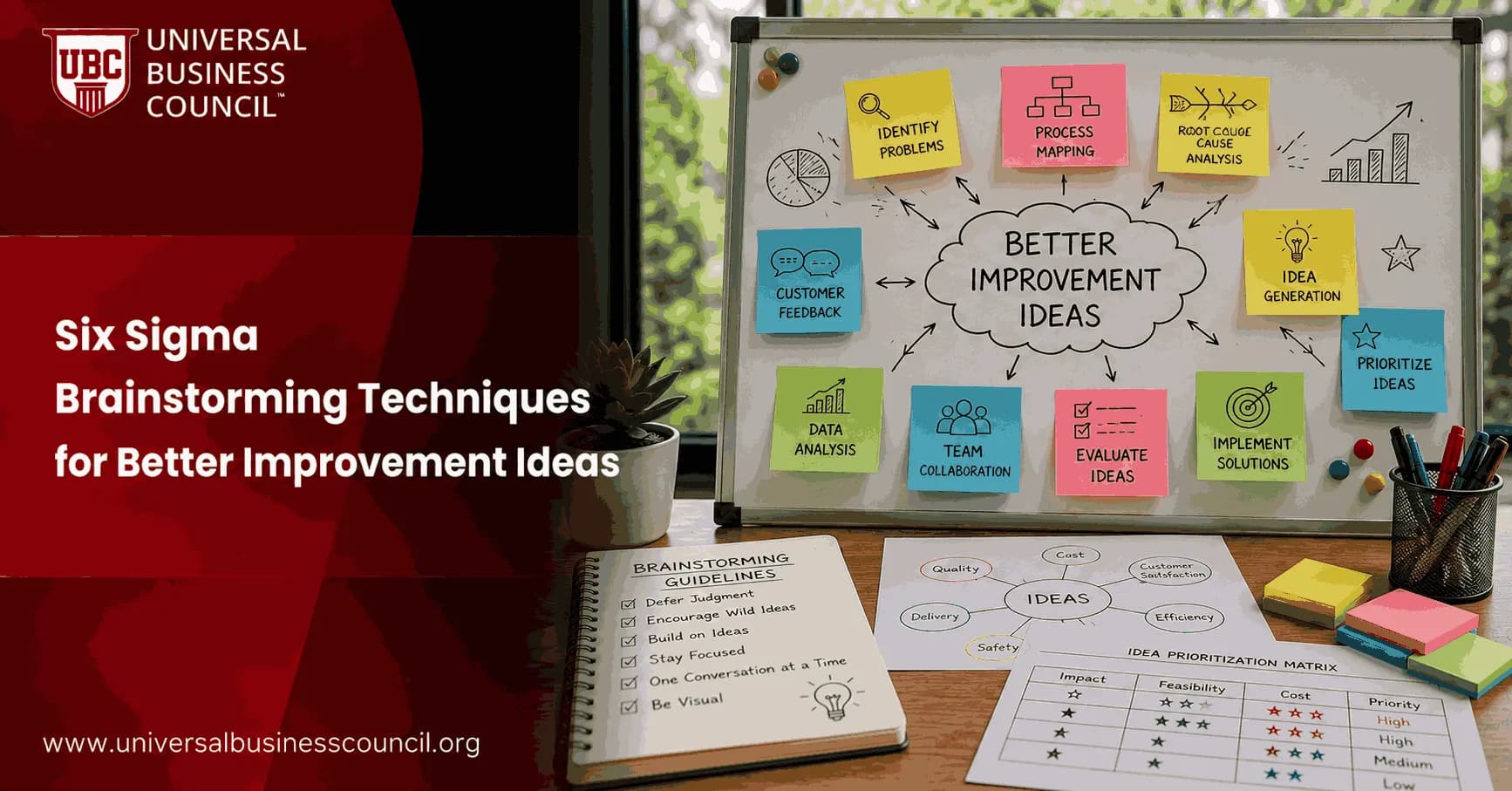
Six Sigma brainstorming techniques turn a room full of opinions into a disciplined list of possible causes, solutions, and experiments. In DMAIC, they earn their keep in the Analyze and Improve phases, where you need more than the first obvious answer. You need ideas that can be grouped, tested, and tied back to data. For professionals developing practical process improvement skills, a Certified Six Sigma Expert pathway can provide a structured foundation for applying these techniques within DMAIC projects.
The common mistake is treating brainstorming as casual discussion. It is not. A good session has a clear question, a neutral facilitator, rules that protect participation, and a separate step for evaluation. Skip any one of those and the loudest person wins.

Why Six Sigma Teams Need Structured Brainstorming
Six Sigma work is data driven, but data does not always tell you where to look first. A Pareto chart may show that 62 percent of complaints come from late shipments, yet the team still has to ask why. Is the problem order entry, carrier pickup, warehouse staging, credit holds, or master data?
For professionals who want to combine process improvement with broader leadership and organizational capabilities, Management Certifications can complement Six Sigma learning by strengthening the management skills needed to facilitate teams, evaluate ideas, and implement improvements.
That is where structured brainstorming pays off. It helps you build a broad set of hypotheses before you test them. In one call center exercise, the useful detail was not the vague idea of staffing. It was the timestamp gap between IVR exit and first agent touch in the ACD report. That is the kind of specific clue you want on the wall.
Core Six Sigma Brainstorming Techniques
1. Classic Brainstorming
Classic brainstorming still works when the problem is simple and the group trusts each other enough to speak freely. The facilitator states a focused question, such as: What could cause a 15 percent final inspection defect rate?
Defer judgment during idea generation.
Capture every idea in the participant's own words.
Use one idea per sticky note or digital card.
Push for quantity first, quality later.
Do not evaluate while generating. That small rule matters. The first criticism usually cuts the idea count in half.
2. Round Robin and Nominal Group Technique
Round robin brainstorming gives each person one turn at a time. People may pass, but everyone gets the same chance to contribute. It works well with mixed seniority groups, especially when operators, analysts, supervisors, and managers sit in the same room.
Nominal group technique goes a step further. Participants write ideas alone first, then share them, discuss for clarity, and vote or rank. Use it when you need broad participation and a decision in the same session.
3. Brainwriting and the 6-3-5 Method
Brainwriting is often better than talking it out. To be blunt, it stops the meeting from becoming a performance.
In the 6-3-5 method, six participants each write three ideas in five minutes. They then pass the sheet to the next person, who builds on what is already there. After several rounds, the team has a large idea pool without waiting for the most confident speaker to finish.
Use brainwriting when you have introverted specialists, remote participants, or a politically sensitive problem. It also sets up a fishbone diagram nicely, because the notes are already written and ready to sort.
4. Reverse Brainstorming
Reverse brainstorming asks: How could we make this problem worse? Then the team flips those answers into controls or improvement ideas.
For late shipments, the reverse list might include:
Hide order exceptions until the end of the day.
Let sales promise nonstandard lead times without review.
Schedule carrier pickup before orders are fully staged.
Each item points to a practical control: exception alerts, promise-date rules, or a staging readiness check. This technique is strong for risk, service failures, and hidden process weaknesses.
5. Affinity Diagrams and Mind Mapping
After idea generation, you need order. Affinity diagrams group related notes into natural categories. Do not force the categories too early. Let the notes cluster first, then label the groups.
Common Six Sigma clusters include People, Process, Technology, Materials, Measurement, and Environment. Mind maps help when relationships matter more than categories, such as exploring how rework, overtime, training gaps, and inspection delays connect.
6. Fishbone Diagrams and Cause-and-Effect Matrices
A fishbone diagram, also called an Ishikawa or cause-and-effect diagram, gives brainstorming a structure for root cause analysis. Teams place the problem at the head of the fish, then brainstorm causes under major categories.
Do not stop at the fishbone. A diagram is not proof. Use a cause-and-effect matrix, a Pareto chart, process data, or Gemba observation to test which causes actually matter. Six Sigma improvement ideas should survive contact with evidence.
7. SCAMPER and Role Storming
SCAMPER stands for Substitute, Combine, Adapt, Modify, Put to another use, Eliminate, and Reverse. It helps when a team keeps suggesting the same small fixes.
Role storming asks people to brainstorm as a customer, regulator, competitor, supplier, or frontline employee. It can reduce hesitation and expose blind spots. It is not right for every meeting, but it works when the current process is protected by habit.
A Practical Facilitation Sequence
Use this sequence for a 60 to 90 minute Six Sigma brainstorming session:
Define the problem. Use a measurable statement, such as defect rate, cycle time, first-call resolution, or complaints per 1,000 orders.
Frame one question. Ask for causes or solutions, not both at the same time.
Start in silence. Give people five minutes to write alone.
Share with structure. Use round robin or brainwriting rather than open discussion.
Cluster ideas. Build an affinity diagram or fishbone.
Prioritize objectively. Use impact-effort scoring, N/3 multi-voting, customer impact, risk, or data availability.
Convert ideas into tests. Assign owners, data sources, and next actions.
Which Technique Should You Use?
Use classic brainstorming for quick, low-risk exploration.
Use brainwriting when equal participation matters.
Use reverse brainstorming for failure modes, service breakdowns, and risk controls.
Use affinity diagrams when you have too many ideas to interpret.
Use fishbone diagrams when the goal is root cause analysis.
Use SCAMPER when the team is stuck in incremental thinking.
The wrong choice? Open-ended verbal brainstorming with senior leaders in the room and no facilitator. You may get fast answers, but they are usually recycled assumptions.
Build the Skill, Then Apply It
If you are preparing for a Universal Business Council Six Sigma course or certification, practice these tools with real process data, not just classroom examples. Take one current problem, write a clear DMAIC problem statement, run a 6-3-5 brainwriting round, then build an affinity diagram and select the top ideas with impact-effort scoring.
Your next step is simple. Choose one measurable process problem this week and run a structured session. Keep the raw notes. The best Six Sigma brainstorming techniques leave a visible trail from problem, to idea, to tested improvement.
For professionals applying brainstorming and process improvement within technology-driven environments, Deep Tech Certification can provide complementary exposure to emerging technologies and help broaden the technical perspective behind modern improvement initiatives.
As organizations increasingly use digital collaboration tools, analytics, and technology-enabled workflows to support improvement projects, broader technical knowledge can also be valuable. A Tech Certification pathway can complement Six Sigma expertise with additional technology-focused learning.
FAQs
1. What is brainstorming in Six Sigma?
Six Sigma brainstorming is a structured technique for generating ideas about process problems, potential root causes, risks, and possible improvements. It encourages team members to contribute multiple ideas before evaluating which ones deserve further investigation.
In a Six Sigma project, brainstorming commonly supports tools such as Fishbone diagrams, 5 Whys, FMEA, affinity diagrams, and solution-selection matrices.
The basic sequence is:
Define the problem → Generate ideas → Organize ideas → Evaluate with evidence → Select actions
The important part is that brainstorming generates possibilities. It does not magically convert opinions into root causes, despite what some meetings appear to believe.
2. Why is brainstorming important in Six Sigma?
Brainstorming helps teams use the combined knowledge of people who understand different parts of a process. Operators, engineers, managers, customers, analysts, and support teams may each see causes or solutions others overlook.
Effective brainstorming can help:
Identify potential root causes
Generate improvement ideas
Discover process risks
Challenge assumptions
Encourage cross-functional thinking
Explore alternatives
Build team involvement
Six Sigma then adds the necessary discipline: promising ideas should be validated with data before major decisions are made.
3. When is brainstorming used in DMAIC?
Brainstorming can be used throughout DMAIC:
Define: Identify customer problems and project opportunities.
Measure: Identify possible data sources and measurement issues.
Analyze: Generate potential root causes.
Improve: Develop potential solutions.
Control: Identify risks, controls, and response actions.
It is particularly common during Analyze and Improve, where teams need broad thinking followed by structured evaluation.
4. How do you conduct a Six Sigma brainstorming session?
A practical brainstorming process includes:
Step 1: Define one clear problem or question.
Step 2: Select relevant participants.
Step 3: Establish simple session rules.
Step 4: Generate ideas without immediate criticism.
Step 5: Record every relevant idea visibly.
Step 6: Clarify ideas without debating them.
Step 7: Group similar ideas.
Step 8: Remove genuine duplicates.
Step 9: Prioritize promising ideas.
Step 10: Validate important assumptions with data.
Keeping generation and evaluation separate usually produces more ideas and reduces premature rejection.
5. What are the basic rules of effective brainstorming?
Useful brainstorming rules include:
Focus on a clearly defined question.
Encourage quantity during idea generation.
Avoid criticizing ideas too early.
Allow participants to build on others' ideas.
Give quieter participants space to contribute.
Record ideas accurately.
Keep discussion relevant.
Evaluate ideas after generation.
The facilitator should also prevent seniority from determining which ideas survive. A manager's idea does not acquire a lower p-value merely because it arrived wearing a nicer job title.
6. What is structured brainstorming in Six Sigma?
Structured brainstorming uses an organized method to ensure each participant has an opportunity to contribute.
One common approach is round-robin brainstorming. Participants take turns contributing one idea at a time until the group has exhausted its suggestions.
This method can reduce domination by highly vocal participants and increase contributions from quieter team members.
Structured brainstorming is particularly useful when hierarchy, personality differences, or group size could distort participation.
7. What is unstructured brainstorming?
Unstructured brainstorming allows participants to contribute ideas whenever they think of them.
It can be fast and energetic, particularly with small teams that already work comfortably together.
However, it also has weaknesses:
Dominant participants may control discussion.
People may interrupt each other.
Quieter members may contribute less.
Early ideas may influence later thinking.
Discussion may drift.
For complex Six Sigma problems, some structure usually improves the quality of the resulting idea set.
8. What is brainwriting in Six Sigma?
Brainwriting asks participants to write ideas individually before sharing them with the group.
A simple approach is:
Problem presented → Individuals write ideas → Ideas collected → Group reviews and expands them
Brainwriting can reduce social pressure and prevent early speakers from anchoring everyone else's thinking.
It is particularly useful when teams contain different levels of seniority or when some participants prefer time to formulate ideas before speaking.
Apparently, not every useful thought needs to be shouted across a conference table. A breakthrough for civilization.
9. What is the 6-3-5 brainwriting technique?
6-3-5 brainwriting is a structured idea-generation technique traditionally involving:
6 participants
3 ideas per participant
5 minutes per round
Participants write ideas and then pass them to others, who build on or add new ideas.
The method encourages rapid generation while reducing the tendency for one person's opinion to dominate the session.
The exact format can be adapted for different team sizes and time constraints while preserving the principle of written, iterative idea development.
10. What is round-robin brainstorming?
Round-robin brainstorming gives each participant a turn to contribute an idea.
For example:
Person A → Idea 1
Person B → Idea 2
Person C → Idea 3
Person D → Idea 4
↓
Repeat
Participants may be allowed to pass when they have nothing new to contribute.
This technique promotes more balanced participation and can reveal ideas that might never emerge in a free-form discussion dominated by two people who have mistaken meeting airtime for process expertise.
11. How is brainstorming used with a Fishbone diagram?
A Fishbone diagram, or Ishikawa diagram, provides categories for organizing brainstormed potential causes.
A manufacturing team might use the 6Ms:
Manpower/People
Machine
Method
Material
Measurement
Mother Nature/Environment
The team brainstorms possible causes within each category.
For example:
Problem: High Defect Rate
↓
Machine: Worn tooling
Method: Incorrect setup procedure
Material: Supplier variation
Measurement: Inaccurate gauge
The Fishbone diagram structures the ideas, but the suspected causes still require validation.
12. How can brainstorming support the 5 Whys technique?
Brainstorming can identify possible causes, while the 5 Whys helps explore individual causal paths more deeply.
For example:
Problem: Orders are shipped late.
Brainstormed cause:
Picking starts late.
Then:
Why? Orders are released late.
Why? Approval is delayed.
Why? Managers receive approval requests in batches.
Why? The system sends them only twice daily.
The combination can work as:
Brainstorm broadly → Select plausible causes → Use 5 Whys to investigate deeper
Evidence should still be used to confirm the resulting causal chain.
13. What is reverse brainstorming?
Reverse brainstorming changes the question from:
“How can we solve this problem?”
to:
“How could we make this problem worse?”
For example, to reduce customer waiting time, the team might ask:
How could we deliberately increase waiting time?
Ideas could include:
Add more approvals.
Batch requests.
Reduce staffing during peaks.
Require duplicate data entry.
Create unnecessary handoffs.
The team then reverses these ideas into improvement opportunities.
This technique can expose process weaknesses that ordinary solution brainstorming overlooks.
14. What is SCAMPER and how can Six Sigma teams use it?
SCAMPER is a creative-thinking framework for generating alternatives:
S - Substitute
C - Combine
A - Adapt
M - Modify
P - Put to another use
E - Eliminate
R - Reverse or Rearrange
For a slow approval process, a team might ask:
Eliminate: Which approvals can be removed?
Combine: Can two reviews occur simultaneously?
Substitute: Can manual verification be automated?
Rearrange: Can validation happen earlier?
SCAMPER is particularly useful during the Improve phase when teams need alternatives beyond obvious fixes.
15. What is an affinity diagram in Six Sigma brainstorming?
An affinity diagram organizes a large number of brainstormed ideas into related groups.
Suppose a team generates 70 possible causes of delivery delays.
The ideas might naturally cluster into:
People
Systems
Scheduling
Suppliers
Transportation
Order Quality
This reduces a chaotic list into meaningful themes.
Affinity grouping is especially useful after large brainstorming sessions because 70 sticky notes are not, by themselves, an improvement strategy.
16. How should Six Sigma teams prioritize brainstorming ideas?
After generating ideas, teams can prioritize them using structured criteria such as:
Expected impact
Implementation effort
Cost
Risk
Customer benefit
Time required
Technical feasibility
Data support
An impact-effort matrix is a simple option:
High Impact + Low Effort → Strong candidates
High Impact + High Effort → Strategic projects
Low Impact + Low Effort → Optional quick wins
Low Impact + High Effort → Usually low priority
More complex decisions may use weighted decision matrices or risk analysis.
17. How do you prevent groupthink during brainstorming?
Groupthink occurs when participants conform to dominant opinions rather than independently exploring alternatives.
Six Sigma teams can reduce it by:
Using brainwriting before discussion
Collecting anonymous ideas
Inviting cross-functional participants
Asking participants to challenge assumptions
Separating idea generation from evaluation
Rotating facilitators
Encouraging alternative explanations
Preventing senior leaders from speaking first
Independent thinking is particularly important during root cause analysis because early consensus can make an incorrect explanation feel increasingly factual.
18. What are common brainstorming mistakes in Six Sigma?
Common mistakes include:
Starting with a vague problem: Ideas become equally vague.
Criticizing ideas immediately: Participants stop contributing.
Allowing one person to dominate: Team knowledge is underused.
Inviting only managers: Frontline process knowledge disappears.
Generating too few alternatives: The first plausible idea becomes the solution.
Failing to record ideas: Useful suggestions vanish.
Skipping prioritization: Everything becomes equally urgent.
Treating brainstormed causes as proven causes: Opinions become conclusions without evidence.
That final mistake is especially dangerous. A Fishbone diagram full of sticky notes is a hypothesis generator, not a confession from the process.
19. What is an example of Six Sigma brainstorming for process improvement?
Suppose a warehouse has excessive order-picking errors.
The team defines the problem:
“Why are incorrect items being picked?”
Brainstorming produces:
People: Inadequate training, fatigue, temporary staff.
Methods: Similar item codes, unclear picking instructions.
Machines/Technology: Scanner failures, slow system response.
Materials: Similar packaging.
Environment: Poor lighting, crowded locations.
Measurement: Error categories inconsistently recorded.
The team then collects data and discovers that errors are concentrated among products with similar packaging stored in adjacent locations.
Possible improvements include:
Separate similar products → Improve location labels → Add barcode verification → Test results
Brainstorming generated the possibilities. Data narrowed them. Testing determined what actually worked.
20. How can Six Sigma teams turn brainstorming ideas into real improvements?
Effective brainstorming should end with a transition from creative thinking to evidence-based improvement.
A useful sequence is:
Define the Problem Clearly
↓
Generate Ideas Independently and Collectively
↓
Organize Similar Ideas
↓
Identify Potential Causes or Solutions
↓
Prioritize by Impact, Effort and Risk
↓
Collect Supporting Data
↓
Validate Root Causes
↓
Develop Alternative Solutions
↓
Pilot or Test Improvements
↓
Measure Results
↓
Standardize Successful Changes
↓
Monitor Through the Control Phase
The critical distinction is:
Brainstorming generates hypotheses.
Six Sigma validates them.
For root-cause analysis, a team should not conclude:
“We brainstormed that poor training causes defects, therefore poor training is the root cause.”
Instead:
Brainstorm potential cause → Define measurable evidence → Collect data → Analyze relationship → Confirm or reject → Act accordingly
For solution development, the same discipline applies:
Generate many alternatives → Evaluate objectively → Test promising solutions → Verify improvement
That combination of creative idea generation and statistical validation is what makes brainstorming useful within Six Sigma rather than merely another meeting in which humans produce colorful sticky notes and eventually order lunch.
Related Articles
View All
Six Sigma
Six Sigma Defect Reduction: Proven Techniques for Better Quality
Learn how Six Sigma defect reduction uses DMAIC, SPC, FMEA, CTQs, and error proofing to cut defects, reduce rework, and improve process quality.
Six Sigma
Six Sigma vs Process Improvement: Is Six Sigma the Same Thing?
Six Sigma is a structured process improvement method, not a synonym for process improvement. Learn when to use Six Sigma, Lean, Kaizen, or simpler workflow fixes.

Six Sigma
Six Sigma vs Scrum: Quality Improvement and Iterative Delivery Compared
Six Sigma vs Scrum explained for professionals comparing quality improvement, defect reduction, Agile delivery, certification paths, and hybrid use cases.
Trending Articles
The Role of Blockchain in Ethical AI Development
How blockchain technology is being used to promote transparency and accountability in artificial intelligence systems.
AWS Career Roadmap
A step-by-step guide to building a successful career in Amazon Web Services cloud computing.
Top 5 DeFi Platforms
Explore the leading decentralized finance platforms and what makes each one unique in the evolving DeFi landscape.