

Six Sigma DMAIC Project Guide for Beginners and Practitioners
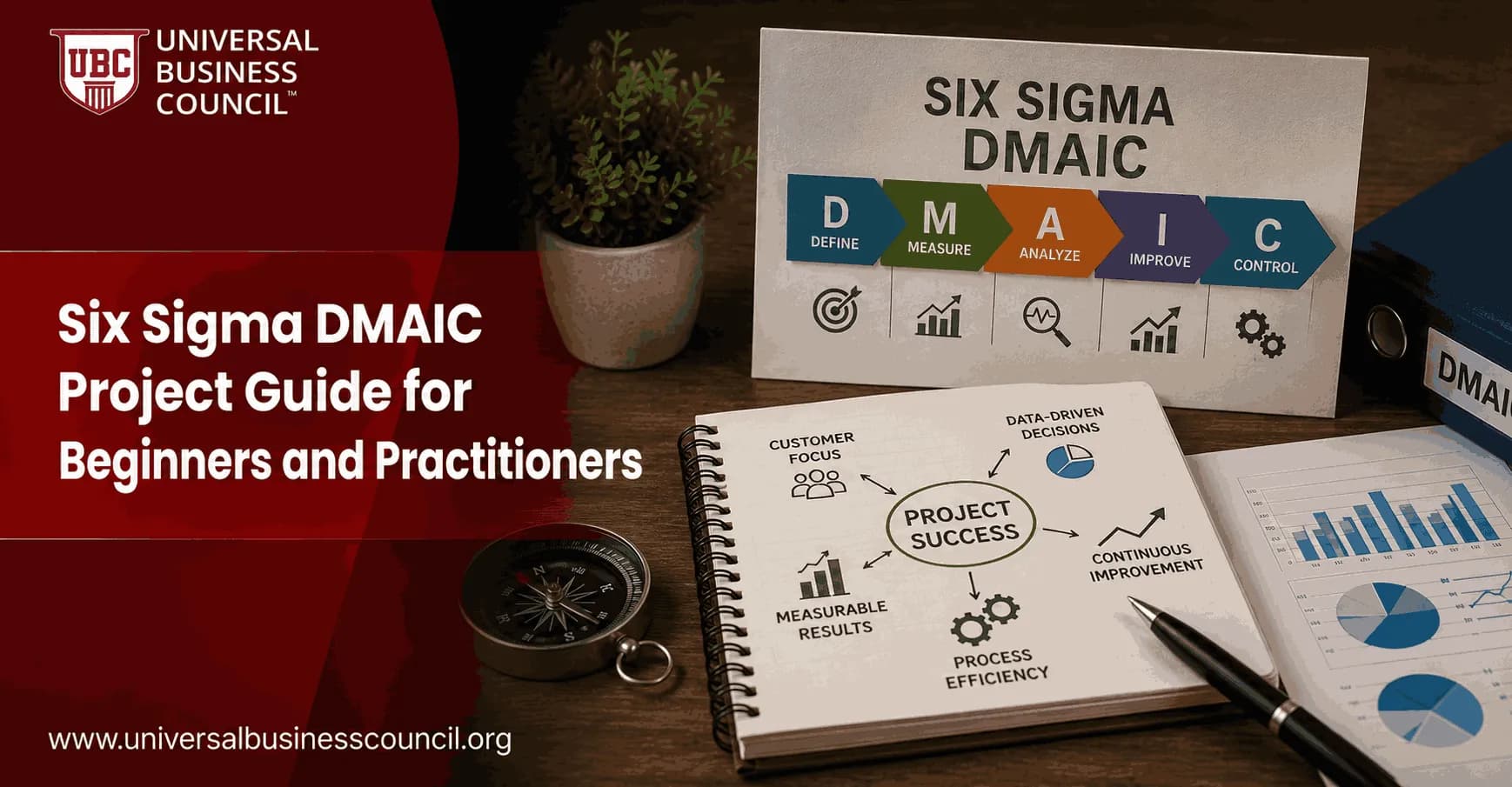
Six Sigma DMAIC is the project method you use when an existing process is underperforming and you need proof, not opinions. It works best when the process already runs, the problem can be measured, and leadership cares about the cost of defects, delays, rework, or customer complaints. For professionals building formal process improvement expertise, a Certified Six Sigma Expert pathway can provide a practical foundation for applying DMAIC concepts to real improvement projects.
Do not use DMAIC to design a brand-new process from scratch. That is where design-focused methods such as DFSS or DMADV fit better. DMAIC is for fixing what already exists.

What Six Sigma DMAIC Means
DMAIC stands for Define, Measure, Analyze, Improve, and Control. The sequence matters. Beginners often jump from Define straight to Improve because the solution feels obvious. That is how teams end up automating a bad process or standardizing the wrong step. For professionals who want to strengthen their broader organizational and leadership capabilities alongside process improvement, Management Certifications can complement their Six Sigma learning.
The discipline is simple: describe the problem, measure current performance, prove the root causes, test the fix, then protect the gain.
The Five DMAIC Phases and What You Produce
1. Define: Set the boundary before the work expands
Start with a narrow problem statement. A weak statement says the billing process is poor. A useful one says billing errors increased from 3 percent to 7.8 percent over two quarters, causing rework, delayed collections, and customer disputes.
Your key outputs are:
Project charter covering scope, business case, goal, timeline, roles, and exclusions
SIPOC map to define suppliers, inputs, process, outputs, and customers
Voice of the Customer notes and Critical to Quality requirements
High-level process map showing where work actually moves
Be ruthless on scope. If your first Green Belt project tries to fix order entry, credit approval, warehouse picking, invoicing, and complaints all at once, it will stall.
2. Measure: Build a baseline you can trust
The Measure phase tells you how the process performs before you touch anything. Use a data collection plan that specifies what you will measure, where the data comes from, who records it, and over what period.
For physical measurements, run Measurement System Analysis. In service work, audit the definitions instead. I have watched teams count a billing error three different ways: wrong price, missing tax code, and customer dispute. Those are not the same defect. Clean definitions save weeks.
Useful tools include run charts, descriptive statistics, process capability, check sheets, and sampling plans. If you cannot trust the measurement system, pause. Bad baseline data makes every later chart look more precise than it really is.
3. Analyze: Prove the real causes
Analyze is where Six Sigma DMAIC earns its reputation. You move from guesses to evidence.
Common tools include:
Fishbone diagrams for grouping possible causes
5 Whys for drilling into process logic
Pareto charts to find the few defect types causing most of the pain
Value stream mapping for delays, handoffs, and queues
Statistical tests such as t-tests, chi-square tests, regression, or ANOVA when the data calls for them
Do not let a fishbone diagram turn into a voting session. Voting is fine for prioritizing what to investigate, not for declaring root cause. If shift, supplier, machine setting, queue age, or agent training is suspected, test it.
4. Improve: Test before you standardize
In Improve, generate options and rank them by impact, effort, risk, and control. Then pilot. Small tests catch practical issues that meeting rooms miss.
A documented billing improvement project cut its error rate from 7.8 percent to 2.9 percent within three months, with customer disputes dropping by 40 percent. The gain came from mapping the process, finding error-prone steps, and adding targeted controls, not from a broad motivational push.
For technical processes, Design of Experiments helps when several variables interact. For service processes, pilots, mistake-proofing, revised forms, approval rules, scripts, and queue controls often do more than complex statistics.
5. Control: Stop the process from drifting back
Control is the phase beginners underbuild. The project is not done when the metric improves. It is done when the process owner can hold the gain without the project team hovering.
Create:
Control plan with metric, owner, frequency, threshold, and response action
Updated SOPs and work instructions
Training materials for staff who run the process
SPC charts or dashboards for ongoing monitoring
Escalation rules for when performance moves out of control
Leadership usually tracks cost, service level, cycle time, defect rate, complaints, and productivity. Tie your control metrics to those. A beautiful control chart no manager reviews will not protect the result.
Where DMAIC Works Best
Six Sigma DMAIC now shows up far beyond manufacturing. It is used in healthcare, finance, customer service, supply chain, and knowledge work. The common condition is measurability.
Manufacturing quality: Bearing press and rubber weather strip projects have used Pareto analysis, Ishikawa diagrams, capability analysis, standardized settings, tooling adjustments, and SPC to reduce rejection rates.
Healthcare operations: Hip replacement length-of-stay projects have used DMAIC to reduce variation, standardize care pathways, improve bed availability, and lower avoidable cost.
Finance and billing: Error reduction projects use process mapping, defect definitions, checks at known failure points, and control routines.
Supply chain: Inventory and stockout projects show DMAIC can improve availability when demand, replenishment, and control rules are visible.
Changeovers: Injection mould projects have addressed long setup windows and recovered meaningful annual productivity losses by cutting wasted setup activity.
For professionals working across operations and technology, Deep Tech Certification can also provide complementary technology-focused knowledge, particularly as modern DMAIC projects increasingly involve digital systems, automation, analytics, and connected workflows.
Beginner vs Practitioner Approach
If you are new to DMAIC
Pick a contained project. Use a charter, SIPOC, Pareto chart, fishbone, run chart, and control plan. You do not need advanced regression for every problem. You do need a clear definition of a defect and a baseline that others accept.
If you already run improvement projects
Go deeper on Measurement System Analysis, capability indices, regression, DOE, FMEA, and Statistical Process Control. Also sharpen governance. The best Black Belt-level work often fails for non-statistical reasons: weak sponsorship, unclear process ownership, or a control plan nobody funds.
How DMAIC Is Changing in 2026
The five phases stay stable, but the working environment has changed. Teams now manage charters, data collection, dashboards, and control plans in digital workflow systems. Google Analytics 4, Salesforce, HubSpot, ERP reports, manufacturing execution systems, and business intelligence tools make transactional DMAIC more practical than it was a decade ago.
The risk is dashboard overload. More data does not mean better analysis. You still need clean operational definitions, sampling discipline, and a clear link between process inputs and outputs.
Training Path for Universal Business Council Learners
If you are building capability, connect this topic with Universal Business Council learning paths in Six Sigma, quality management, operations management, business analysis, and project management. DMAIC sits at the intersection of process data, stakeholder management, and disciplined execution, so these paths reinforce each other.
Your next step: choose one underperforming process this week and write a one-paragraph DMAIC problem statement. Include the current level, target level, time period, impact, and scope exclusions. If you cannot write that cleanly, the project is not ready to start. As DMAIC practitioners expand their capabilities across digital operations and business transformation, Tech Certification can complement process improvement knowledge with broader technology-focused learning.
FAQs
1. What is a Six Sigma DMAIC project?
A Six Sigma DMAIC project is a structured improvement initiative used to solve problems in an existing process. DMAIC stands for Define, Measure, Analyze, Improve, and Control. Each phase answers a different question about the problem and guides the team from understanding the performance gap to implementing and sustaining improvements.
The basic roadmap is Define → Measure → Analyze → Improve → Control. DMAIC is particularly useful when a process already exists, its performance is unsatisfactory, and the underlying causes or best solutions are not yet fully known.
2. What does DMAIC stand for in Six Sigma?
DMAIC stands for Define, Measure, Analyze, Improve, and Control.
Define establishes the problem, customer requirements, project scope, business case, and objectives. Measure establishes reliable data and baseline process performance. Analyze identifies and validates the causes of poor performance. Improve develops and tests solutions that address those causes. Control establishes methods for sustaining the improved performance.
The five phases create a logical progression from problem identification to long-term process management rather than the traditional corporate method of jumping directly from complaint to favorite solution.
3. When should you use DMAIC?
DMAIC should generally be used when an existing process has a measurable performance problem and the causes or optimal solutions are not fully understood.
Typical examples include excessive defects, long cycle times, high rework, customer complaints, poor yield, excessive variation, high operating costs, late deliveries, and low productivity.
DMAIC is less appropriate when the solution is already known and simply needs implementation, or when an entirely new process must be designed. In the latter case, DMADV or another Design for Six Sigma methodology may be more appropriate.
4. What happens during the Define phase of DMAIC?
The Define phase establishes exactly what the project is trying to accomplish and why the problem matters.
The team identifies the customer, captures the Voice of the Customer (VOC), defines Critical-to-Quality requirements, establishes process boundaries, estimates business impact, identifies stakeholders, and creates the project charter.
For example, rather than defining the problem as “delivery performance is poor,” a stronger statement might be: “On-time delivery has averaged 82% during the past six months compared with the customer requirement of at least 97%.”
A precise problem statement gives the remaining DMAIC phases something measurable to investigate.
5. What is a DMAIC project charter?
A DMAIC project charter is the document that formally defines the improvement project.
It normally describes the business case, problem statement, goal statement, project scope, key metrics, expected benefits, project team, Champion, process owner, milestones, and major constraints.
A good charter prevents the project from quietly expanding from “reduce invoice errors” into “redesign the company's entire financial operating model,” which tends to happen when scope is treated as a decorative concept.
6. What happens during the Measure phase of DMAIC?
The Measure phase establishes how the process currently performs.
The team defines the key metrics, creates operational definitions, develops a data collection plan, validates the measurement system, maps the current process, collects baseline data, and evaluates process performance.
The purpose is to answer: “How bad is the problem, and can we trust the data describing it?”
For manufacturing measurements, tools such as Gauge R&R may be used. Transactional processes may require validation of system timestamps, classifications, database fields, and other data sources.
7. Why is Measurement System Analysis important in DMAIC?
Measurement System Analysis (MSA) determines whether the measurement process is sufficiently reliable for decision-making.
Observed variation can come from the actual process and from the measurement system itself. If measurement error is excessive, the team may incorrectly conclude that process performance has changed when the measuring method is responsible.
For physical measurements, Gauge R&R can assess repeatability and reproducibility. For service and transactional processes, teams may evaluate definitions, classification consistency, data completeness, and system accuracy.
DMAIC built on unreliable measurements is essentially sophisticated analysis of questionable numbers, which is rarely the bargain it appears to be.
8. How do you establish baseline performance in DMAIC?
Baseline performance describes how the process performs before improvements are implemented.
Depending on the project, baseline measures might include defect rate, yield, DPMO, sigma level, cycle time, cost, customer complaints, process capability, throughput, or on-time delivery.
Suppose an order process currently achieves 84% on-time delivery, while the customer requirement is 98%. The 84% value provides the baseline against which future improvement can be evaluated.
Baseline measurements should use representative data and clearly defined calculation methods so that before-and-after comparisons remain meaningful.
9. What happens during the Analyze phase of DMAIC?
The Analyze phase determines why the measured performance problem occurs.
Teams explore potential causes and then validate which causes actually influence the key output. Common techniques include process analysis, Pareto charts, Fishbone diagrams, 5 Whys, scatter diagrams, hypothesis testing, ANOVA, regression, and other statistical methods.
A useful progression is Potential Causes → Data Collection → Statistical or Process Analysis → Verified Root Causes.
The distinction between suspected and verified causes is crucial. A cause written confidently on a Fishbone diagram remains a hypothesis until evidence supports it.
10. How are root causes identified in a DMAIC project?
Root cause identification normally combines process knowledge with evidence.
The team may begin with process mapping, brainstorming, Fishbone analysis, Pareto charts, and 5 Whys to generate possible causes. Important causes are then converted into measurable hypotheses and tested using appropriate data.
For example, if the team suspects that machine temperature affects defect rate, it can collect temperature and defect data and evaluate the relationship statistically.
The objective is not merely to produce a plausible explanation. It is to establish enough evidence that changing the identified cause should improve the outcome.
11. What is Y = f(X) in DMAIC?
The expression Y = f(X) is commonly used in Six Sigma to represent the relationship between process outputs and process inputs.
Y represents the output or result the team wants to improve. The Xs represent factors that may influence that result.
For example, if Y = delivery lead time, possible X variables could include order volume, staffing, approval time, inventory availability, picking time, and transportation delays.
DMAIC gradually narrows a large collection of possible Xs into the critical few inputs that materially influence Y. Humans call this root cause analysis because “stop changing random things and measure what actually drives the outcome” apparently needed a professional name.
12. What happens during the Improve phase of DMAIC?
The Improve phase develops, evaluates, tests, and implements solutions addressing the verified root causes.
Teams may use brainstorming, Kaizen, error-proofing, Lean techniques, Design of Experiments, optimization, automation, workflow redesign, and pilot testing.
Suppose analysis confirms that duplicate manual approvals create most of a process delay. The improvement might involve removing unnecessary approval levels, redesigning decision rules, or automating low-risk approvals.
The solution should have a traceable relationship to the validated cause rather than simply being the most fashionable technology available.
13. Why should DMAIC solutions be piloted before full implementation?
A pilot tests a proposed improvement on a limited scale before broader implementation.
Piloting allows the team to determine whether the solution produces the expected benefit and whether it creates unintended consequences.
Suppose a redesigned workflow is expected to reduce processing time by 30%. The team can implement it in one location or customer segment, measure performance, compare results with baseline data, and identify implementation problems.
A successful pilot reduces implementation risk. An unsuccessful pilot is also useful because discovering a bad idea cheaply is considerably preferable to discovering it after an enterprise-wide rollout.
14. How do you verify that a DMAIC improvement worked?
The team should compare post-improvement performance against the baseline and project goal.
Suppose baseline defect rate was 6.2%, the project goal was below 2%, and post-improvement performance is 1.4%. That provides initial evidence of improvement.
Depending on the project, teams may also use confidence intervals, hypothesis tests, control charts, capability analysis, or other statistical techniques to determine whether the observed change is meaningful and sustainable.
Verification should also consider customer outcomes and financial results rather than relying only on technical process measures.
15. What happens during the Control phase of DMAIC?
The Control phase ensures that improvements continue after the project team finishes its work.
The team establishes process ownership, monitoring methods, standard procedures, training, documentation, reaction plans, and ongoing performance measures.
Control charts may be used when appropriate to detect changes in process stability. A Control Plan can specify what will be measured, how often measurements will occur, who owns the measure, and what action should be taken when performance deteriorates.
Without Control, a successful improvement can gradually drift back toward the original condition, allowing the organization to solve exactly the same problem again next year with admirable consistency.
16. What is a Six Sigma Control Plan?
A Control Plan documents how important process characteristics will be monitored and managed after improvements are implemented.
For example, a Control Plan for fill weight might specify a target of 500 grams, acceptable requirements, the measurement instrument, sampling frequency, responsible operator, SPC method, and reaction procedure.
The Control Plan converts project improvements into routine operating discipline.
It is particularly important for CTQs and critical process inputs where deterioration could significantly affect quality, customer requirements, safety, or financial performance.
17. How long should a DMAIC project take?
There is no universal duration, because project complexity varies significantly. Many well-scoped DMAIC projects are designed to be completed within several months rather than continuing indefinitely.
A project that repeatedly misses milestones may suffer from excessive scope, weak sponsorship, poor data availability, insufficient resources, or an unclear problem statement.
Complex business problems sometimes require longer projects, but duration alone should not become a measure of sophistication. A DMAIC project is supposed to solve a problem, not become a permanent department.
18. What roles are involved in a DMAIC project?
A DMAIC project commonly involves a Champion or Sponsor, Process Owner, Black Belt or Green Belt, subject-matter experts, frontline employees, and other stakeholders.
The Champion provides organizational support and helps remove barriers. The project leader manages the DMAIC work and analytical approach. Subject-matter experts provide process knowledge. Frontline employees contribute practical insight into how the process actually operates. The Process Owner ultimately assumes responsibility for sustaining the improved process.
Effective DMAIC projects combine analytical capability with operational knowledge. Statistics without process understanding can mislead, while process opinions without evidence can do the same thing considerably faster.
19. What are the most common DMAIC project mistakes?
One common mistake is beginning with a predetermined solution rather than a measurable problem. Another is defining a scope so broad that the project cannot reasonably be completed.
Teams also struggle when they skip measurement-system validation, collect insufficient data, treat brainstormed causes as proven root causes, use statistical tools without understanding their assumptions, implement solutions without pilots, or fail to establish effective controls.
Another major mistake is rushing through Define and Measure because Analyze and Improve seem more interesting. Weak foundations usually return later disguised as confusing results.
DMAIC works because the phases build on one another. Skipping inconvenient steps rarely makes the problem disappear.
20. How should beginners and practitioners manage a DMAIC project from start to finish?
A successful DMAIC project should begin with a specific business or customer problem, not with a favorite solution.
During Define, the team establishes the problem, VOC, CTQs, scope, business case, goal, stakeholders, and project charter.
During Measure, the team maps the process, establishes operational definitions, validates the measurement system, collects representative data, and calculates baseline performance.
During Analyze, potential causes are identified and then tested using process knowledge and appropriate analytical methods until the critical drivers of poor performance are understood.
During Improve, the team develops solutions that address verified causes, evaluates risks, conducts pilots, measures results, and implements successful changes.
During Control, responsibility transfers into normal operations through standard work, monitoring, Control Plans, reaction procedures, training, and ongoing ownership.
The complete logic is:
Problem → Reliable Measurement → Verified Root Causes → Tested Solutions → Sustained Performance
For beginners, that sequence provides a disciplined roadmap that prevents premature solution jumping. For experienced practitioners, its value lies in maintaining analytical discipline when problems become politically messy, technically complicated, or inconveniently resistant to the solution management already announced.
DMAIC does not guarantee that every process problem will be easy. It does something more useful: it forces the organization to distinguish between what it assumes, what it measures, what the evidence supports, what actually improves performance, and what can be sustained.
That is the difference between running an improvement project and merely rearranging the process until the dashboard briefly turns green.
Related Articles
View All
Six Sigma
How to Build a Six Sigma Project Charter Aligned with Business Goals
Learn how to build a Six Sigma project charter that connects scope, metrics, financial impact, and DMAIC goals to real business priorities.
Six Sigma
Six Sigma vs Project Management: Methods, Tools, and Career Paths
Compare Six Sigma vs Project Management across methods, tools, salaries, and career paths. Learn when to use DMAIC, Agile, Waterfall, or both.
Six Sigma
Six Sigma in Project Management: Better Scope, Schedule, and Quality Control
Learn how Six Sigma in project management improves scope control, schedule reliability, and quality using DMAIC, CTQs, control charts, and change governance.
Trending Articles
The Role of Blockchain in Ethical AI Development
How blockchain technology is being used to promote transparency and accountability in artificial intelligence systems.
AWS Career Roadmap
A step-by-step guide to building a successful career in Amazon Web Services cloud computing.
Top 5 DeFi Platforms
Explore the leading decentralized finance platforms and what makes each one unique in the evolving DeFi landscape.