

Six Sigma Voice of Customer: Turning Customer Needs into Requirements
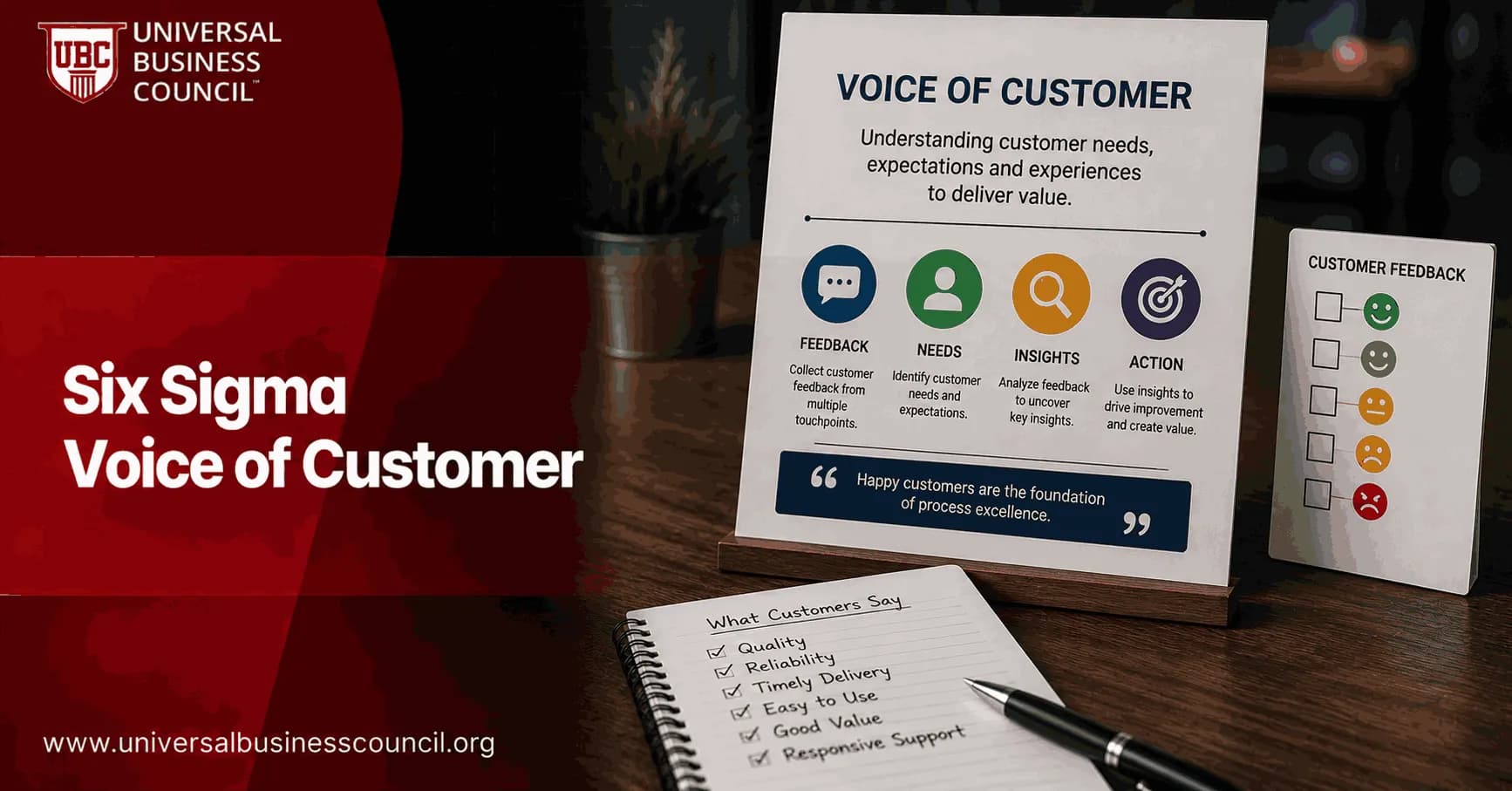
Six Sigma Voice of Customer is the discipline of taking messy customer feedback and turning it into measurable requirements your process can actually hit. Not slogans. Not vague goals like "better service." Real Critical-to-Quality metrics, such as first call resolution, order accuracy, defect rate, response time, or on-time delivery. For professionals developing structured process improvement skills, a Certified Six Sigma Expert pathway can provide a useful foundation for connecting customer requirements with DMAIC and measurable quality outcomes.
Done well, VOC keeps a Six Sigma project honest. It stops teams from optimizing what is easy to measure while ignoring what customers value. That mistake is common. A team can cut average handling time in a call center and still make customers angrier if agents rush calls and fail to solve the issue.

What Voice of Customer Means in Six Sigma
In Six Sigma, Voice of Customer is the structured collection and analysis of customer needs, expectations, preferences, and complaints. The goal is to translate those needs into Critical-to-Quality requirements, often called CTQs, and sometimes Critical-to-Satisfaction requirements, or CTS.
For professionals who want to combine customer-focused quality improvement with broader organizational capabilities, Management Certifications can complement this learning by developing skills useful for managing teams, processes, and improvement initiatives.
VOC usually sits at the front of the DMAIC cycle, especially in the Define phase. Before you measure defects or dig into root causes, you need to know what counts as a defect from the customer's point of view. ISO 9001:2015 reinforces this through clause 9.1.2, which requires organizations to monitor customer perceptions of whether their needs and expectations have been met.
A practical VOC effort answers four questions:
Who is the customer? End users, buyers, internal teams, regulators, channel partners, or patients may all matter.
What do they need? Capture spoken needs, repeated complaints, observed behavior, and hidden expectations.
How will you measure it? Convert comments into CTQs, CTS metrics, and specifications.
Which process variables control it? Link customer outcomes to KPOVs and KPIVs.
How to Capture VOC Without Bias
One survey is rarely enough. The loudest customers are not always the most representative, and the quiet ones may be leaving without warning. Use more than one channel.
Common VOC collection methods
Surveys and questionnaires: Good for quantifying satisfaction, importance, and performance. Keep them short. Response quality drops fast when a survey feels like homework.
Interviews and focus groups: Best for finding the language customers actually use. Listen for repeated phrases. Those often become the best CTQ labels.
Complaints and support tickets: Useful because they reflect real friction, not abstract opinions.
Usage analytics: Click paths, repeat contacts, abandoned carts, failed searches, and call logs show behavior customers may not mention.
Digital feedback: App reviews, chat transcripts, social comments, and post-interaction prompts can surface emerging problems quickly.
Here is a small but important field lesson. In service operations, average wait time hides the real pain. Look at abandonment by time band instead. If callers start dropping after 75 seconds, a two-minute average wait may look acceptable on a dashboard and still damage retention.
Turning Customer Comments into CTQ Requirements
The hard part of Six Sigma Voice of Customer is translation. Raw comments are not requirements yet. "Your delivery is slow" is a complaint. "95 percent of orders delivered within 48 hours of payment confirmation" is a requirement.
A simple VOC-to-CTQ process
Capture the raw voice: Keep verbatim comments from surveys, interviews, tickets, reviews, and observations.
Group related statements: Use affinity diagrams to cluster comments into themes such as speed, accuracy, ease of use, reliability, or staff responsiveness.
Define the need behind the words: Translate "I keep chasing updates" into "customer needs proactive status communication."
Create CTQs or CTS metrics: Choose measurable outputs, such as notification timeliness, first response time, defect rate, or repeat contact rate.
Set specifications: Define the target, tolerance, and measurement method.
Map to process variables: Connect the CTQ to KPOVs and KPIVs, so improvement work moves the outcome customers care about.
Take a telecom support team as an example. It may hear: "I wait too long and then explain the issue twice." The CTQs could be average speed of answer, abandonment rate, first call resolution, and transfer rate. The KPIVs might include staffing levels by interval, routing rules, agent skill matrix accuracy, and knowledge base quality.
VOC Tools Six Sigma Teams Use
A few simple tools do most of the work:
Affinity diagram: Groups large volumes of customer statements into natural themes.
CTQ tree: Breaks a broad need into drivers and measurable requirements.
Translation matrix: Connects customer needs to CTQs, process outputs, and process inputs.
Trend chart: Shows whether satisfaction, defects, or response time is improving, declining, or flat.
Pareto chart: Identifies the few complaint categories causing most of the dissatisfaction.
Do not overcomplicate the toolset. A clean CTQ tree and a well-maintained complaint Pareto chart often beat a complicated dashboard no one trusts.
Business Impact of Structured VOC
Structured VOC programs are not just customer-experience exercises. Industry research links formal VOC programs with higher satisfaction scores, better retention, and revenue growth when feedback is tied to operational change. Reported gains vary widely across studies and depend heavily on how the program is run, so treat any single benchmark with caution.
The key phrase is tied to operational change. Collecting feedback is cheap. Acting on it is where the return appears.
For customer-facing technology processes, VOC can also reveal requirements involving system reliability, data accuracy, digital usability, automation, and response performance. Understanding the technical systems behind those experiences can help teams translate customer feedback into more actionable process requirements. Deep Tech Certification can provide complementary technology-focused learning for professionals working in these environments.
Where VOC Fits with Lean Six Sigma Training
If you are building Six Sigma capability, learn VOC before jumping into statistical analysis. Weak CTQs lead to clean analysis of the wrong problem. Universal Business Council readers can pair this topic with related Six Sigma, Lean Six Sigma, quality management, and operations management certification courses in the UBC catalog. It is a natural next step for anyone who manages process improvement, customer experience, service delivery, or product operations.
Common VOC Mistakes to Avoid
Using only complaints: Complaints show pain, but not always priority or market importance.
Confusing solutions with needs: "Add live chat" may be a proposed fix. The real need may be faster issue resolution.
Writing CTQs without numbers: If it cannot be measured, it cannot guide Six Sigma control.
Ignoring internal customers: Finance, compliance, sales, and operations may set requirements that affect delivery quality.
Failing to refresh VOC: Customer expectations move. Review your CTQs rather than carving them in stone.
Your Next Step
Pick one process with visible customer friction. Pull 50 recent complaints or support tickets. Group them into themes, build a CTQ tree for the top issue, and define one measurable requirement with a target. Then connect that CTQ to the process inputs your team can control. That is where Six Sigma Voice of Customer stops being research and starts becoming improvement work.
As VOC programs increasingly rely on analytics platforms, digital feedback systems, automation, and customer-data workflows, broader technology knowledge can also help professionals work effectively across quality and technology teams. A Tech Certification pathway can complement process improvement expertise with additional technology-focused learning.
FAQs
1. What is Voice of the Customer in Six Sigma?
Voice of the Customer (VOC) in Six Sigma is the systematic process of collecting, analyzing, and translating customer needs, expectations, preferences, complaints, and requirements into measurable quality characteristics.
Customers may say:
“Delivery takes too long.”
Six Sigma translates this into something measurable:
Customer Need → Fast delivery → CTQ → Order-to-delivery time ≤ 2 business days
VOC ensures improvement projects focus on outcomes customers actually value rather than whatever internal metric happens to have the most attractive dashboard.
2. Why is Voice of the Customer important in Six Sigma?
VOC helps organizations understand what quality means from the customer's perspective.
It can help teams:
Identify customer expectations
Discover recurring problems
Prioritize improvement opportunities
Define Critical-to-Quality characteristics
Establish measurable requirements
Improve customer satisfaction
Reduce defects and complaints
Align processes with customer value
Without VOC, a process can become faster, cheaper, and statistically impressive while improving something customers barely notice.
3. What does VOC stand for in Six Sigma?
VOC stands for Voice of the Customer.
It represents information about what customers:
Need
Want
Expect
Value
Dislike
Complain about
Consider acceptable or unacceptable
VOC can include both stated needs and needs inferred from customer behavior, complaints, service interactions, or usage patterns.
The objective is not merely to collect comments. It is to convert customer information into actionable process requirements.
4. What are examples of Voice of the Customer?
Examples of raw VOC statements include:
“Your deliveries are always late.”
“The website is difficult to use.”
“I keep receiving incorrect invoices.”
“Customer support takes too long to respond.”
“The product should last longer.”
These statements describe customer experiences but are not yet precise Six Sigma measures.
The team must translate them into measurable requirements such as delivery time, transaction accuracy, response time, usability measures, or product reliability.
5. How is VOC collected in Six Sigma?
VOC can be collected from multiple direct and indirect sources, including:
Customer interviews
Surveys
Focus groups
Complaint records
Product reviews
Support tickets
Call-center conversations
Warranty claims
Product returns
Sales feedback
Customer observations
Social media feedback
Usage and behavioral data
Using several sources can provide a more complete picture than relying on a single survey, particularly because customers do not always express needs neatly enough for spreadsheet columns.
6. What is the difference between direct and indirect VOC?
Direct VOC comes from customers explicitly communicating their needs or experiences.
Examples include:
Interviews
Surveys
Focus groups
Complaints
Feedback forms
Indirect VOC is inferred from customer behavior or operational information.
Examples include:
Returns
Cancellations
Repeat purchases
Product usage
Abandoned transactions
Warranty claims
Direct VOC tells you what customers say. Indirect VOC can reveal what customers actually experience or do.
Both can be useful because those two things occasionally refuse to be identical.
7. How do you translate VOC into customer requirements?
A useful translation process is:
Raw VOC → Customer Need → Quality Driver → Measurable Requirement
For example:
VOC: “I hate waiting for support.”
↓
Need: Fast customer assistance
↓
Quality Driver: Response speed
↓
CTQ: First-response time
↓
Requirement: 90% of inquiries receive a response within 30 minutes
This translation converts subjective customer language into something that can be measured and improved.
8. What is the relationship between VOC and CTQ?
VOC identifies what customers care about.
CTQ (Critical to Quality) defines how those needs will be measured.
For example:
VOC: “I need accurate invoices.”
↓
Need: Billing accuracy
↓
CTQ: Percentage of invoices issued without errors
↓
Requirement: ≥ 99.8%
A CTQ should therefore have a clear connection to a meaningful customer requirement rather than existing simply because the organization already collects the data.
9. What is a CTQ Tree in Voice of the Customer analysis?
A CTQ Tree helps translate broad customer needs into specific measurable characteristics.
For example:
Customer Need: Reliable Delivery
↓
Quality Drivers:
Speed
Accuracy
Condition
↓
CTQs:
≥ 98% delivered by promised date
≥ 99.5% order accuracy
≤ 0.2% damage rate
The CTQ Tree creates a traceable connection between what customers say and what the process must deliver.
10. How is VOC used in the Define phase of DMAIC?
VOC is especially important during the Define phase:
Define → Measure → Analyze → Improve → Control
Teams use VOC to:
Understand customer problems
Identify important requirements
Define CTQs
Clarify project scope
Establish project goals
Develop problem statements
Determine what successful improvement means
A DMAIC project should ideally begin with a problem that matters to customers or the business, rather than beginning with an interesting dataset and searching afterward for a reason to analyze it.
11. Who is the customer in a Six Sigma VOC analysis?
The customer can be external or internal.
External customers purchase, use, or receive the organization's products and services.
Internal customers receive outputs from another department, team, or process.
For example:
Sales → Order Processing → Warehouse → Logistics → Customer
The warehouse may be an internal customer of order processing because it depends on accurate order information.
Teams should identify whose requirements matter at each process boundary.
12. What is the difference between Voice of the Customer and Voice of the Business?
Voice of the Customer (VOC) represents customer needs and expectations.
Voice of the Business (VOB) represents organizational needs such as:
Profitability
Cost
Productivity
Capacity
Risk
Compliance
Strategic objectives
For example:
VOC: Deliver orders faster.
VOB: Reduce fulfillment cost.
A strong Six Sigma solution should consider both. Delivering every order by private helicopter might delight customers, but finance may develop several reasonable objections.
13. What is the difference between VOC and Voice of the Process?
Voice of the Customer describes what performance is required.
Voice of the Process (VOP) describes what the process is currently capable of producing.
For example:
VOC Requirement: Delivery ≤ 2 days
VOP: Average delivery = 2.8 days with substantial variation
The gap between VOC and VOP reveals an improvement opportunity.
This relationship is fundamental to Six Sigma:
Customer Requirement vs Current Process Performance
If the process cannot reliably meet customer requirements, capability must be improved.
14. How can surveys be used to collect VOC?
Surveys can gather structured customer feedback across larger populations.
Useful survey practices include:
Ask clear questions
Avoid leading language
Keep scales consistent
Include relevant customer segments
Combine ratings with open-ended feedback
Avoid unnecessarily long surveys
Analyze response bias
Track results over time
Survey questions should connect to decisions the organization can actually make.
Asking 73 questions because the software permits 73 questions mainly measures the customer's willingness to abandon surveys.
15. How can customer complaints be used as VOC?
Customer complaints provide valuable information about unmet requirements.
Teams can categorize complaints by:
Problem type
Product
Location
Customer segment
Severity
Frequency
Cost
Process stage
A check sheet can structure complaint data, while a Pareto chart can identify major categories.
The team can then use Fishbone diagrams, 5 Whys, process mapping, and statistical methods to investigate root causes.
Complaints should therefore be treated as process data, not merely messages requiring polite replies.
16. How can Pareto analysis help prioritize VOC?
When customers identify many different problems, Pareto analysis can help determine which categories contribute most to dissatisfaction.
Suppose complaints are:
Complaint | Cases |
|---|---|
Late delivery | 420 |
Incorrect order | 230 |
Damaged product | 160 |
Billing problem | 110 |
Other | 80 |
The team can rank these categories and focus deeper analysis on the largest contributors.
However, frequency should be considered alongside severity, customer importance, regulatory risk, and financial impact.
A rare safety issue should not wait patiently behind 420 minor delivery complaints.
17. What is a Kano Model and how does it relate to VOC?
The Kano Model helps classify customer requirements according to how they influence satisfaction.
Common categories include:
Must-Be Requirements: Customers expect them automatically. Their absence creates dissatisfaction.
Performance Requirements: Better performance generally increases satisfaction.
Attractive Requirements: Unexpected features that can create delight.
For example, in a hotel:
Clean room → Must-Be
Fast Wi-Fi → Performance
Unexpected complimentary upgrade → Attractive
Kano analysis can help Six Sigma teams understand that not every customer requirement influences satisfaction in the same way.
18. What are common mistakes in Voice of the Customer analysis?
Common VOC mistakes include:
Collecting feedback from too few customers.
Listening only to the loudest customers.
Ignoring customer segmentation.
Treating vague comments as measurable requirements.
Confusing internal assumptions with customer needs.
Collecting feedback but never acting on it.
Defining too many CTQs.
Ignoring changing customer expectations.
Using only satisfaction scores without examining underlying drivers.
VOC should produce actionable requirements. Otherwise, the organization has merely created a sophisticated archive of things customers wish it would fix.
19. What is a practical Six Sigma VOC example?
Suppose an online retailer receives repeated feedback:
“Delivery is unreliable.”
The team collects surveys, complaints, and shipping data.
Analysis reveals three major needs:
Customer Need | CTQ | Requirement |
|---|---|---|
Fast delivery | Delivery lead time | ≤ 2 business days |
Reliable promise | On-time delivery | ≥ 98% |
Correct order | Order accuracy | ≥ 99.5% |
The team then compares current performance:
Lead time = 3.1 days
On-time delivery = 89%
Order accuracy = 99.6%
The largest VOC gaps involve delivery speed and reliability, giving the DMAIC project clear priorities.
20. How should Six Sigma teams turn Voice of the Customer into measurable requirements?
A disciplined VOC process connects customer language directly to process improvement:
Identify Customers
↓
Collect Direct and Indirect VOC
↓
Segment Customer Groups
↓
Organize Customer Statements
↓
Identify Underlying Needs
↓
Prioritize Important Requirements
↓
Identify Quality Drivers
↓
Build CTQ Trees
↓
Define Measurable CTQs
↓
Create Operational Definitions
↓
Establish Targets and Specifications
↓
Compare VOC with Process Performance
↓
Identify Performance Gaps
↓
Launch Improvement Actions
↓
Measure Results
↓
Continue Monitoring Customer Feedback
For example:
Customer says: “Your support is too slow.”
That becomes:
VOC → Faster support
↓
Need → Timely assistance
↓
CTQ → First-response time
↓
Requirement → 90% within 30 minutes
↓
Baseline → 62% within 30 minutes
↓
Gap → 28 percentage points
↓
DMAIC → Analyze and improve response process
The central idea is simple:
Customer Language → Measurable Requirement → Process Metric → Improvement Target
VOC gives Six Sigma its direction. Statistical tools can tell a team whether a process is stable, capable, correlated, or significantly different after an improvement. None of those calculations determines whether the measured outcome actually matters to customers.
That question has to come first.
Otherwise, an organization can achieve a beautifully controlled, highly capable process for producing something customers never particularly wanted. Statistically impressive, commercially awkward.
Related Articles
View All
Six Sigma
Six Sigma in Customer Service: Reducing Complaints and Response Times
Learn how Six Sigma in Customer Service reduces complaints, wait times, callbacks, and response delays using DMAIC, Lean tools, and measurable CTQ metrics.

Six Sigma
Six Sigma in Retail: Enhancing Store Operations and Customer Experience
Learn how Six Sigma in retail improves checkout speed, inventory accuracy, omnichannel fulfillment, and customer experience through DMAIC and Lean tools.

Six Sigma
Six Sigma and Data Analytics: Turning Process Data into Insights
Learn how Six Sigma and Data Analytics turn process data into practical insights that improve quality, speed, cost, and control across industries.
Trending Articles
The Role of Blockchain in Ethical AI Development
How blockchain technology is being used to promote transparency and accountability in artificial intelligence systems.
AWS Career Roadmap
A step-by-step guide to building a successful career in Amazon Web Services cloud computing.
Top 5 DeFi Platforms
Explore the leading decentralized finance platforms and what makes each one unique in the evolving DeFi landscape.