

Adversarial Machine Learning: Threats, Examples and Defenses
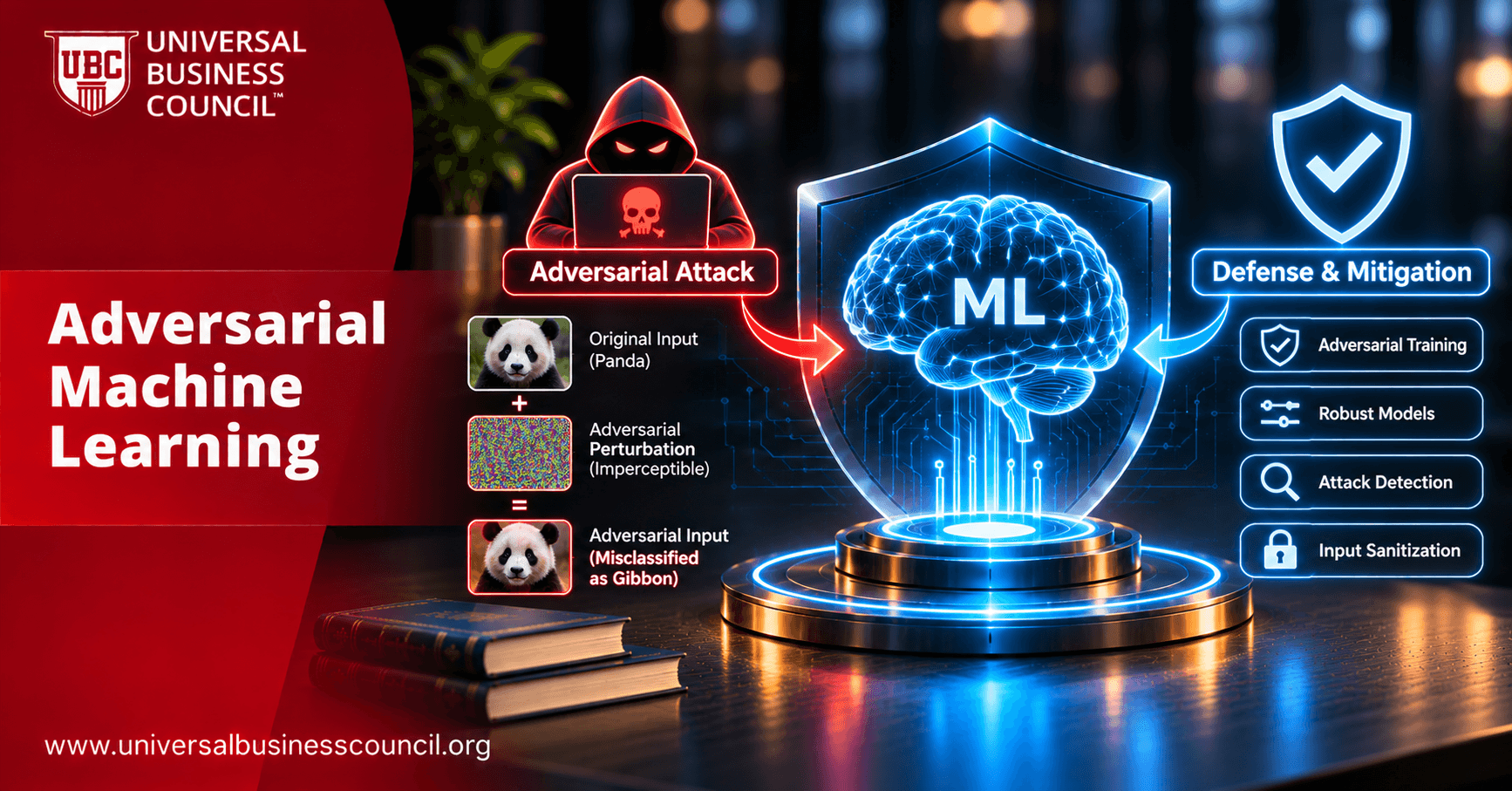
A stop sign with a few strategically placed stickers can look like a speed limit sign to a vision model, while looking perfectly normal to a person. That kind of gap between human perception and machine behavior is the heart of adversarial machine learning, a field that studies how AI systems can be fooled, manipulated or exploited, and how to defend them.
This guide explains what adversarial machine learning is, the major types of attacks, real examples and practical defenses. Professionals seeking wider training in responsible AI may also consider the Certified Responsible AI Expert certification from Universal Business Council.

What Is Adversarial Machine Learning?
Adversarial machine learning is the study of attacks on machine learning systems and the defenses against them. An adversary tries to cause a model to make mistakes, leak information, behave in unintended ways or become unavailable. Attacks can target any stage of the pipeline: training data, the model itself, the inputs at inference time or the surrounding infrastructure.
NIST has published a taxonomy of adversarial machine learning attacks and mitigations, and the MITRE ATLAS knowledge base catalogs real-world tactics. These resources help organizations speak a common language about threats and include them in risk assessments.
Main Categories of Attacks
Evasion Attacks
Evasion attacks occur at inference time. The attacker alters an input, often by tiny, carefully computed perturbations, so the model produces a wrong output. Examples include modified images that fool classifiers, tweaked audio that triggers voice assistants and malware changed just enough to slip past a detection model. Physical-world versions use stickers, patterns or printed patches.
Poisoning Attacks
Poisoning happens during training. The attacker inserts malicious or mislabeled data to degrade performance or implant a backdoor, a hidden trigger that causes specific misbehavior when present. Models trained on scraped or crowd-sourced data, or fine-tuned on third-party datasets, are especially exposed.
Privacy Attacks
Membership inference: determining whether a record was in the training data
Model inversion: reconstructing sensitive features or inputs from outputs
Training data extraction: prompting a model to reproduce memorized content
Model Extraction and Theft
By querying a model many times, an attacker can build a copy that mimics it, stealing intellectual property or enabling further attacks. Extracted copies can also be used to craft adversarial examples that transfer to the original.
Attacks on Language Models
Large language models face their own threats, including prompt injection, where malicious instructions hidden in inputs or documents hijack behavior, jailbreaks that bypass safety rules and attacks on connected tools and agents that cause unauthorized actions or data leaks.
Real-World Examples and Implications
Research has shown image classifiers misled by imperceptible noise, road-sign recognition fooled by stickers, face recognition evaded through patterned glasses and spam and fraud detectors bypassed by crafted inputs. Chatbots have been tricked into revealing system prompts or generating restricted content, and data poisoning has been demonstrated against web-scale training sets.
The consequences depend on the setting. In autonomous driving, an evasion attack is a safety risk. In fraud detection, it is a financial loss. In healthcare, a poisoned model could produce harmful recommendations. In customer-facing chatbots, manipulation can cause data leakage and reputational harm. For regulated or high-risk uses, resilience against such attacks is a legal expectation, since laws such as the EU AI Act call for robustness and cybersecurity.
Defenses and Mitigations
No single defense removes the threat, so organizations layer protections.
Strengthening Models
Adversarial training: include adversarial examples in training to build robustness
Input preprocessing: sanitize or transform inputs to remove perturbations
Ensembles and randomization: make attacks harder to craft reliably
Certified robustness methods: provide provable limits for some model types, usually at a performance cost
Protecting Data and the Supply Chain
Verify the source and integrity of datasets and pretrained models, scan for anomalies, use access controls and version control and track lineage. Treat third-party models like third-party code, with review and testing.
Securing Deployment
Limit query rates, monitor for extraction patterns, filter outputs, return minimal detail such as confidence scores where possible, and isolate model components. For language model applications, separate trusted instructions from untrusted content, validate tool calls, apply least privilege and require human approval for sensitive actions.
Testing and Monitoring
Red-team models before launch and regularly after, using established attack toolkits and threat catalogs. Monitor for drift, anomalies and suspicious usage, and have an AI-specific incident response plan.
These defenses require capable people. Organizations often verify the qualifications and experience of specialists before granting them access to sensitive models, and HireValid can help confirm credentials. Practitioners also strengthen their craft through programming and security study, and short tech certifications are one accessible route.
Building an Adversarial Resilience Program
Inventory AI systems and rank them by impact and exposure
Threat-model each important system, naming likely attackers and goals
Choose controls proportionate to risk, from basic input validation to adversarial training
Test with red teams and automated tools
Monitor and respond with logging, alerts and playbooks
Document findings and residual risk in model cards and risk registers
Review as attacks and models evolve
Customer messaging should stay honest about residual risk. A Digital Marketing Course can help teams describe AI protections clearly without exaggeration. As adversaries borrow ideas across technologies, learning about adjacent fields helps, and Deep Tech Certifications offer useful background on cryptography and distributed systems.
Conclusion
Adversarial machine learning shows that accurate models are not automatically secure models. Evasion, poisoning, privacy attacks, extraction and language-model manipulation are all real concerns, and defense requires layered controls, continuous testing and clear governance. The FAQs below answer common questions.
Frequently Asked Questions
What is adversarial machine learning?
The study of attacks on machine learning systems and defenses against them.
What is an adversarial example?
An input slightly altered to make a model produce a wrong output.
What is an evasion attack?
An attack at inference time that tricks a model with manipulated inputs.
What is data poisoning?
Inserting malicious data into training to degrade or manipulate a model.
What is a backdoor attack?
Poisoning that plants a hidden trigger causing specific misbehavior.
What is model extraction?
Copying a model's behavior through repeated queries.
What is membership inference?
Determining whether a record was in the training data.
What is model inversion?
Reconstructing sensitive inputs from model outputs.
What is prompt injection?
Malicious instructions that hijack a language model's behavior.
What is a jailbreak?
A technique that bypasses a model's safety restrictions.
Can attacks happen in the physical world?
Yes, for example stickers or patterns that fool vision systems.
What is adversarial training?
Training with adversarial examples to improve robustness.
Is there a complete defense?
No, layered defenses reduce risk but cannot eliminate it.
What is MITRE ATLAS?
A knowledge base of adversarial tactics against AI systems.
What is NIST's role?
NIST publishes a taxonomy of adversarial machine learning attacks and mitigations.
How can query-based theft be reduced?
With rate limits, monitoring and returning minimal output detail.
How do you secure the AI supply chain?
Verify datasets and models, scan dependencies and control changes.
Does the EU AI Act require resilience?
High-risk systems must meet accuracy, robustness and cybersecurity requirements.
What is AI red teaming?
Adversarial testing to find vulnerabilities before attackers do.
Where should organizations begin?
With an inventory and threat model of their most important AI systems.
Related Articles
View All
Artificial Intelligence
Privacy-Preserving Machine Learning: Techniques and Use Cases
Discover how privacy-preserving machine learning enables AI systems to learn from data while protecting sensitive information. Explore techniques such as federated learning, differential privacy, and homomorphic encryption, along with practical use cases across healthcare, finance, and other industries.

Artificial Intelligence
How to Detect and Reduce Bias in Machine Learning Models
Learn how to detect and reduce bias in machine learning models using practical techniques and evaluation methods. Explore data analysis, fairness metrics, bias testing, model auditing, and mitigation strategies to build more accurate, fair, and reliable AI systems.

Artificial Intelligence
Federated Learning and Responsible AI: Benefits, Risks and Limitations
Explore how federated learning supports responsible AI by allowing machine learning models to train across decentralized data sources without directly sharing raw data. Learn about its benefits for privacy and collaboration, along with risks, technical limitations, security concerns, and practical applications.
Trending Articles
The Role of Blockchain in Ethical AI Development
How blockchain technology is being used to promote transparency and accountability in artificial intelligence systems.
AWS Career Roadmap
A step-by-step guide to building a successful career in Amazon Web Services cloud computing.
Top 5 DeFi Platforms
Explore the leading decentralized finance platforms and what makes each one unique in the evolving DeFi landscape.